
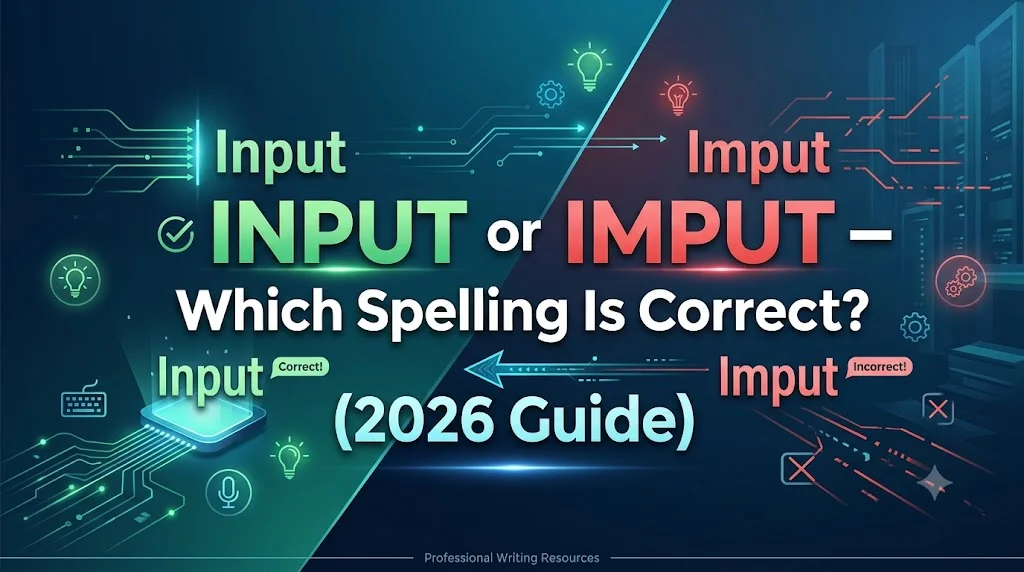
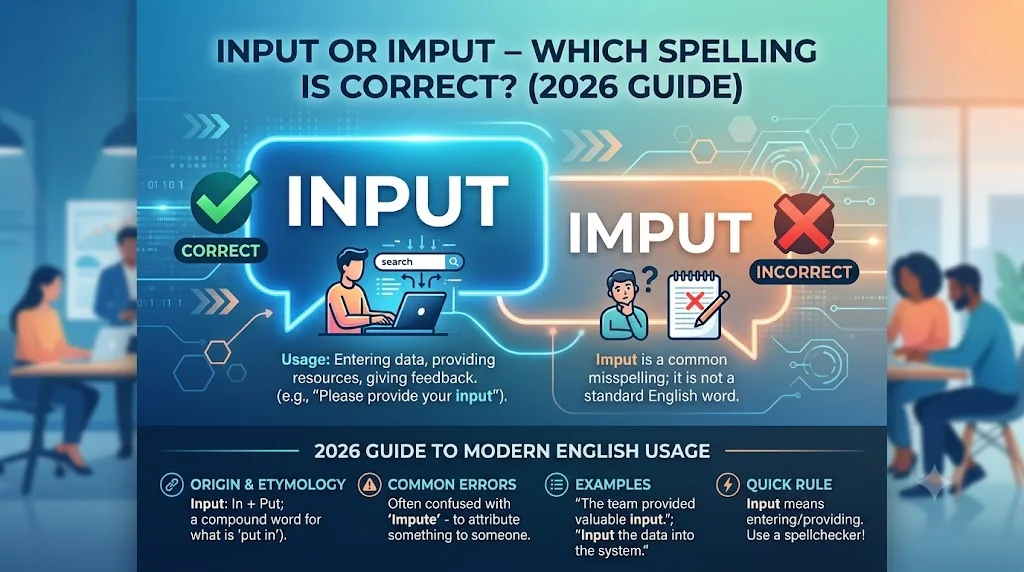
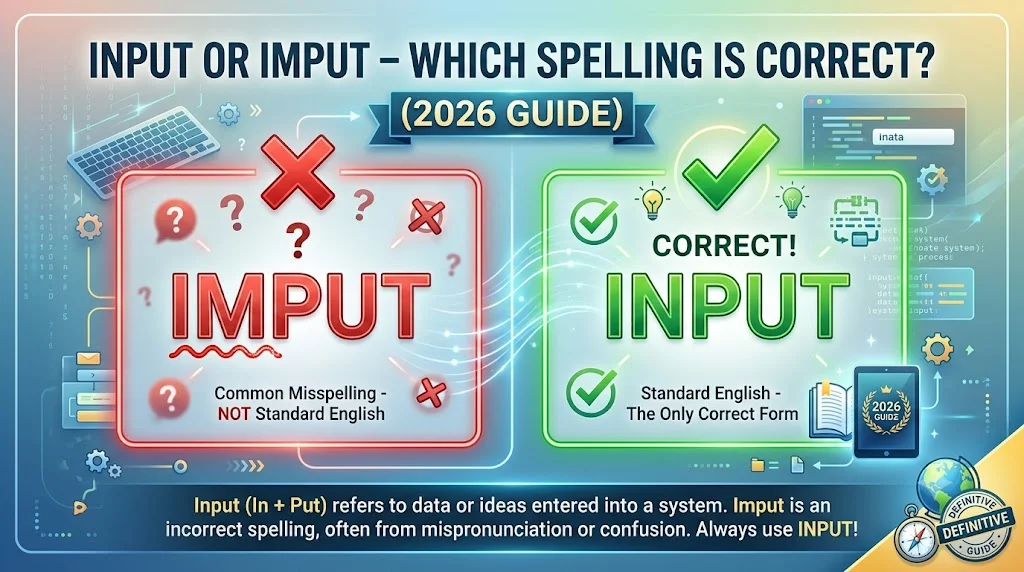
Have you ever typed “imput” and then paused, wondering if it’s actually a word? You’re not alone — this is one of the most searched spelling confusions in English. The truth is simple: “input” is correct, and “imput” is not a real word. It’s a common misspelling caused by how the word sounds when spoken quickly.
In this guide, you’ll learn exactly why this mistake happens, how to use “input” correctly as both a noun and a verb, its pronunciation, grammar rules, synonyms, and the most useful collocations. By the end, you’ll never confuse “input” and “imput” again.
Quick Answer: Input vs Imput
| Question | Answer |
| Correct spelling | Input |
| Is “imput” a word? | No, it’s a common misspelling |
| Part of speech | Noun and verb |
| Pronunciation | /ˈɪn.pʊt/ (IN-put) |
| Word origin | “in” + “put” (Old English roots) |
| Opposite word | Output |
Now let’s break this down the way a language teacher would — with meaning, grammar, examples, and memory tricks.
The Correct Spelling: “Input” (Not “Imput”)
Meaning: “Input” refers to something that is put into a system, process, discussion, or device. It can be information, energy, data, effort, or opinions.
Definition: According to standard English dictionaries, “input” means (1) something that is fed into a machine or system, or (2) advice, information, or a contribution given to help make a decision.
Spelling rule: The word is built from two smaller words — “in” and “put.” There is no “m” anywhere in this word. That single fact is the whole secret to spelling it correctly.
Example sentences:
- The teacher asked for the students’ input before finalizing the project topic.
- You need to input your password to access the account.
- Her input on the marketing plan was extremely valuable.
“Imput,” on the other hand, does not appear in any recognized English dictionary — not Merriam-Webster, not Oxford, not Cambridge. It is simply a spelling error, usually caused by mishearing or mistyping the word.
Why Do People Misspell “Input” as “Imput”?
This mistake isn’t random. There are real linguistic reasons behind it, and understanding them actually helps you avoid the error permanently.
1. Nasal Assimilation in Pronunciation
When we speak quickly, the “n” sound in “input” often shifts toward an “m” sound because your lips are already preparing for the “p” that follows. Try saying “input” fast — you might notice your mouth wants to blend the “n” and “p” into something closer to “m.” This is a natural sound change called nasal assimilation, and it happens in many English words (think of how “in the bank” can sound like “im the bank” in casual speech).
2. Confusion with Similar Words
Words like “impute,” “import,” and “impact” all start with “im-” and have similar sounds or meanings related to giving or bringing something in. Your brain may unconsciously borrow that “im-” pattern and misapply it to “input.”
3. Autocorrect and Typing Speed
Fast typing on phones and keyboards increases the chance of hitting “m” instead of “n,” especially since these letters sit close together on a QWERTY keyboard.
4. Lack of Awareness of the Word’s Structure
Many people don’t consciously recognize that “input” is a compound word made of “in” + “put.” Once you see that structure clearly, the correct spelling becomes almost automatic.
Quick Tip: Break the word apart mentally every time you write it: IN + PUT = INPUT. There’s no room for an “m” in either half.
Input vs Imput: Side-by-Side Comparison
| Feature | Input | Imput |
| Valid English word | ✅ Yes | ❌ No |
| Found in dictionaries | ✅ Merriam-Webster, Oxford, Cambridge | ❌ Not listed |
| Correct spelling | ✅ | ❌ |
| Part of speech | Noun, verb | None (not a word) |
| Usage in formal writing | ✅ Acceptable | ❌ Considered an error |
| Common cause | Standard English word | Spelling/pronunciation mistake |
There is genuinely nothing complicated about this comparison — one is a real, useful word, and the other is simply a typo that became common enough to confuse people.
How to Use “Input” Correctly
“Input” is flexible. It works as both a noun and a verb, and understanding each use will help you apply the word naturally and confidently.
Input as a Noun
Meaning: As a noun, “input” refers to information, ideas, energy, or data that is contributed to something.
Grammar explanation: “Input” is typically an uncountable (mass) noun when referring to general contribution or advice. It usually doesn’t take a plural form (“inputs” exists but is used mostly in technical or business contexts, such as economics or computing).
Pronunciation: /ˈɪn.pʊt/ — stress falls on the first syllable: IN-put.
Word origin: From Middle English “in” (inside) + “put” (to place), first used in the 16th century in a general sense, and later adopted in computing during the 20th century to describe data entered into a machine.
Common mistakes:
- ❌ “I need your imput.”
- ✅ “I need your input.”
- ❌ “She gave a good inputs.”
- ✅ “She gave good input.” (uncountable) or “She provided several inputs.” (technical/plural context)
Real-life examples:
- Formal: “The committee welcomes input from all stakeholders before the vote.”
- Informal: “Hey, can I get your input on this outfit?”
- Technical: “The sensor converts light input into an electrical signal.”
Formal vs informal usage:
- Formal settings (business reports, academic writing): “input” refers to structured feedback or data.
- Informal settings (casual conversation): “input” simply means an opinion or thought.
Similar words: feedback, contribution, opinion, suggestion, data, information
Opposite word: output (the result or product created after processing the input)
Related phrases: “provide input,” “give input,” “welcome input,” “user input,” “sensory input”
Common collocations: valuable input, direct input, creative input, technical input, parental input
Synonyms: contribution, feedback, opinion, suggestion, advice, data
Input as a Verb
Meaning: As a verb, “to input” means to enter data or information into a system, typically a computer or device.
Grammar explanation: “Input” is an irregular verb in many style guides, meaning the past tense and past participle can remain the same as the base form: input, input, input. However, “inputted” is also widely accepted, especially in everyday and American English usage.
| Form | Example |
| Base form | I input the data daily. |
| Past tense | Yesterday, I input (or inputted) the figures. |
| Past participle | The data has been input (or inputted) already. |
| -ing form | She is inputting the numbers now. |
Pronunciation: Same as the noun — /ˈɪn.pʊt/ — with stress on the first syllable.
Common mistakes:
- ❌ “He imputted the numbers wrong.”
- ✅ “He input (or inputted) the numbers wrong.”
- ❌ “Please imput your details.”
- ✅ “Please input your details.”
Real-life examples:
- “You must input your login credentials before proceeding.”
- “The technician inputted the wrong code, causing an error.”
- “Every transaction is input into the database automatically.”
Formal vs informal usage:
- Formal/technical writing: “Users must input the required fields.”
- Casual conversation: “Just input your name here and you’re good to go.”
Similar words: enter, key in, type in, feed in, submit
Opposite word: output, extract, retrieve
Related phrases: “input data,” “input a value,” “input information,” “manually input”
Common collocations: input a code, input details, input manually, input directly
Common Phrases and Collocations with “Input”
Learning collocations (words that naturally go together) helps you sound more fluent and native-like. Here are the most useful ones involving “input”:
| Collocation | Meaning | Example |
| user input | Data or actions entered by a person using a system | “The app responds instantly to user input.” |
| sensory input | Information received through the five senses | “Babies rely heavily on sensory input to learn.” |
| valuable input | Highly useful feedback or contribution | “Thank you for your valuable input on the report.” |
| creative input | Ideas contributed to an artistic or design project | “The director welcomed creative input from the whole team.” |
| technical input | Specialized or expert feedback | “We need technical input from the engineering team.” |
| input device | A hardware tool used to enter data (keyboard, mouse) | “A microphone is a common input device.” |
| input field | A box on a form where users type information | “Fill in the input field with your email address.” |
| positive input | Encouraging or constructive feedback | “Positive input from mentors builds confidence.” |
Quick Tip: If a phrase feels natural with “feedback,” “data,” or “contribution” instead, “input” will usually fit too — they share overlapping meanings in most contexts.
Similar Words Often Confused with “Input”
English learners sometimes mix “input” up with other words that look or sound similar. Here’s a quick breakdown:
| Word | Meaning | Example |
| Impute | To attribute something (often blame) to someone | “They imputed the failure to poor planning.” |
| Import | To bring goods or ideas from another country/source | “The company imports electronics from Asia.” |
| Impact | A strong effect or influence | “The policy had a major impact on sales.” |
| Output | The result produced from input or a process | “The machine’s output depends on its input.” |
Notice that “impute” is a real word — but it means something completely different from “input” (it relates to blame or attribution, not data or contribution). Confusing these two is another common source of the “imput” error, since people sometimes blend the spelling of “impute” into “input.”
Synonyms and Opposite Words for “Input”
Synonyms (noun): contribution, feedback, suggestion, opinion, advice, data, information, insight
Synonyms (verb): enter, key in, type, submit, feed in, log
Opposite words: output, result, outcome, product
Tip to remember: Think of “input” as what goes IN, and “output” as what comes OUT. The two words are natural partners, and remembering one helps you remember the correct spelling of the other.
Input vs Imput – Detailed Comparison
| Category | Input | Imput |
| Dictionary status | Standard English word | Not recognized |
| Spelling origin | “in” + “put” | Mistaken blend of “in” and “impute” |
| Grammatical roles | Noun, verb | None |
| Correct in academic writing | Yes | No |
| Correct in business writing | Yes | No |
| Correct in casual texting | Yes | No (still an error) |
| SEO/search behavior | High search volume, correct term | High search volume due to spelling confusion, not a valid term |
Even though many people search for “imput” online, search intent almost always points back to “input.” Google recognizes this and shows results for the correct word — which is exactly what you should do in your own writing too.
Quick Tips to Remember the Correct Spelling
- Break it down: IN + PUT = INPUT. No “m” involved.
- Pair it with “output”: If you remember “output” has no “m,” “input” shouldn’t either — they’re a matching set.
- Say it slowly: Pronouncing each syllable clearly (IN-put) reduces the chance of mishearing it as “imput.”
- Visualize the keyboard: Picture yourself literally putting information IN to a computer — the word literally describes the action.
- Proofread technical terms: Autocorrect doesn’t always catch this error since “imput” isn’t a recognized misspelling in every spellchecker. Read data-entry instructions twice.
Practice Examples
Try filling in the blank with the correct word (answers below):
- Please ______ your details in the form below.
- The teacher valued every student’s ______ during the discussion.
- This device converts sound ______ into digital signals.
- We need more ______ from the design team before launch.
- She ______ the numbers into the spreadsheet manually.
Answer key: 1. input, 2. input, 3. input, 4. input, 5. input (or inputted)
If you wrote “imput” for any of these, don’t worry — now you know the fix: always double-check for that missing “n.”
Final Thoughts
“Input” is the only correct spelling in English — “imput” is a common but incorrect variation that likely comes from pronunciation habits or confusion with words like “impute.” Whether you’re using it as a noun to mean feedback and contribution, or as a verb to describe entering data, remembering the simple structure “in + put” will keep your spelling accurate every time.
English constantly evolves, but this rule has stayed firmly the same. With the tips, examples, and comparisons in this guide, you now have everything you need to use “input” correctly and confidently in both formal and everyday writing.
FAQ
What is imput?
“Imput” is not a real English word. It’s a common misspelling of “input,” usually caused by how people pronounce the word quickly or by confusion with similar-sounding words like “impute.” Always use “input” instead in any type of writing.
What does your input mean?
“Your input” means your opinion, feedback, idea, or contribution to a discussion, project, or decision. For example, “We’d love your input on the new logo design” simply asks for your thoughts or suggestions.
Is input a real word?
Yes, “input” is a real and widely used English word. It functions as both a noun (meaning contribution or data) and a verb (meaning to enter information into a system). It appears in all major English dictionaries.
Is it correct to say input?
Yes, saying or writing “input” is completely correct in both formal and informal English. It’s commonly used in business, technology, education, and everyday conversation to describe contributions or data entry.
Is imput a word?
No, “imput” is not a recognized English word. It doesn’t appear in dictionaries and is considered a spelling error. The correct form is always “input,” regardless of the context or sentence.