
A common English idiom used to tell someone to stop harassing, criticizing, or pressuring you is “Get off my back.” When people use this expression, they are establishing a firm emotional or conversational boundary, demanding relief from unwanted oversight or persistent nagging. Choosing appropriate synonyms and alternative expressions for this phrase is essential because “get off my back” carries a blunt, highly informal tone that can sound defensive or aggressive in certain contexts. Selecting the right alternative allows speakers and writers to adjust their level of formality, preserve professional relationships, modulate emotional intensity, and ensure their message remains clear without causing unnecessary conflict. Understanding these variations equips language learners and communicators with the flexibility needed to navigate sensitive interpersonal dynamics smoothly.
What Does “Get Off My Back” Actually Mean?

“Get off my back” means to ask or demand that someone stop annoying, nagging, criticizing, or micromanaging you. People use “get off my back” in stressful or frustrating situations when they feel overwhelmed by persistent pressure or unwanted scrutiny from colleagues, supervisors, family members, or friends.
Where Did “Get Off My Back” Come From? Understanding Its Origin and Evolution
The expression “get off my back” emerged in American English during the mid-20th century, growing in popularity throughout the 1940s and 1950s. Linguists generally trace its physical imagery to the concept of carrying an unbearable physical load or burden. In this metaphor, a nagging or overbearing person is conceptualized as an unwanted weight resting directly on someone’s shoulders or back, making forward progress difficult and exhausting.
Over the decades, the phrase shifted from a literal visual metaphor to a ubiquitous idiom in spoken English. Pop culture, literature, and film in the post-WWII era popularized the phrase across global English-speaking regions. Today, while the core meaning of demanding space from persistent pressure remains unchanged, modern speakers use it across various media, digital conversations, and informal settings to signal boundary enforcement against unwanted pressure.
Alternative Expressions Explained With Meanings and Examples
Give Me Some Space to Handle This
Meaning: A neutral request asking someone to step back and allow you to manage a task without constant supervision.
Why This Expression Works: It establishes a clear operational boundary while maintaining a composed and professional demeanor.
Real-World Usage Insight: Professionals frequently use this phrase in project management settings when oversight becomes counterproductive.
Best Use: Workplace projects, collaborative tasks, and discussions with managers or clients.
Allow Me to Focus on My Priorities
Meaning: A polite way of telling someone that their interruptions are distracting you from critical work.
Why This Expression Works: It shifts the focus from emotional frustration to professional productivity and time management.
Real-World Usage Insight: Highly effective in office settings when declining low-priority interruptions.
Example (Meeting): “To meet our quarterly goals, I need you to allow me to focus on my priorities for the rest of the week.”
Please Grant Me Some Autonomy
Meaning: A formal request to operate independently without micromanagement.
Why This Expression Works: It uses professional vocabulary (“autonomy”) to articulate a desire for trust and independence.
Real-World Usage Insight: Common in performance reviews, managerial discussions, and strategic planning.
Example (Email): “Given the team’s progress, please grant me some autonomy to execute this phase of the marketing campaign.”
Let Me Manage This Independently
Meaning: A clear statement asserting your capability to complete a task without external interference.
Why This Expression Works: It projects confidence and reassures the listener that you take full responsibility for the outcome.
Real-World Usage Insight: Frequently used by experienced professionals to turn back micromanagement gently.
Best Use: Professional settings, client updates, and group assignments.
Example (Meeting): “I have a solid framework ready for the audit, so let me manage this independently over the next two days.”
I Would Appreciate Some Room to Breathe
Meaning: A polite, human expression asking for temporary relief from pressure or constant checking.
Why This Expression Works: It conveys personal stress without placing direct blame or aggression onto the listener.
Example (Message): “It’s been a chaotic week with these revisions; I would really appreciate some room to breathe before we tackle the next draft.”
Please Give Me a Moment to Catch Up
Meaning: An expression requesting time to process current tasks before taking on more demands or answering questions.
Why This Expression Works: It focuses on workload management rather than personal annoyance, making it easy for others to accept.
Real-World Usage Insight: Excellent for managing high-volume email days or rapid-fire meeting requests.
Best Use: Office communications, customer support, and busy home environments.
Example (Email): “I’ve received all your updates; please give me a moment to catch up on these files before we schedule our call.”
I Have This Under Control, Thank You
Meaning: A polite yet decisive statement reassuring someone that their intervention is unnecessary.
Why This Expression Works: It pairs a strong boundary statement with a polite “thank you” to prevent offense.
Real-World Usage Insight: Widely used to stop unwanted advice or overbearing assistance gracefully.
Example (Meeting): “Thanks for checking in on the client onboarding process, but I have this under control, thank you.”
Could We Step Back From This for a Moment?
Meaning: A collaborative request to temporarily pause pressure or intense discussion to regain perspective.
Why This Expression Works: It uses inclusive phrasing (“we”) to lower defensiveness and de-escalate tension.
Real-World Usage Insight: Frequently employed by managers and negotiators to cool down heated debates.
Example (Meeting): “We’ve been arguing over these design tweaks for an hour—could we step back from this for a moment and revisit it tomorrow?”
Rest Assured, I Am on Top of It
Meaning: A positive, reassuring statement confirming that a task is being handled actively.
Why This Expression Works: It converts a negative boundary (“stop bothering me”) into a positive promise of performance.
Real-World Usage Insight: A favorite phrase among account managers and team leads dealing with anxious clients.
Example (Email): “I understand your concern about the launch date; rest assured, I am on top of it and finalizing the details.”
Trust Me to Deliver the Results
Meaning: A confident assertion asking the listener to rely on your competence rather than hovering.
Why This Expression Works: It appeals to mutual trust and professional credibility, encouraging the other person to step back.
Real-World Usage Insight: Often used by senior team members negotiating creative or technical freedom.
Example (Meeting): “You hired me to handle this rebranding—trust me to deliver the results on schedule.”
You Can Count on Me to Follow Through
Meaning: A reassuring promise that confirms your commitment to completing a responsibility.
Why This Expression Works: It eliminates the listener’s anxiety, removing their perceived need to keep checking on you.
Real-World Usage Insight: Ideal for defusing micromanagement by building trust proactively.
Example (Email): “There’s no need for daily check-ins on this account; you can count on me to follow through by Friday.”
Stop Breathing Down My Neck
Meaning: An idiomatic command telling someone to stop monitoring or supervising you too closely.
Why This Expression Works: It creates a vivid physical image of smothering oversight that immediately highlights the issue.
Real-World Usage Insight: Used when expressing intense frustration about micromanagement to peers or friends.
Best Use: Casual venting, peer conversations, and informal arguments.
Example (Message): “I can’t focus on designing these graphics if the manager won’t stop breathing down my neck.”
Back Off for a Second
Meaning: A direct, forceful request telling someone to give you physical or emotional distance immediately.
Why This Expression Works: It is short, imperative, and leaves no doubt about your current boundary.
Real-World Usage Insight: Used in heated moments when immediate space is required to prevent an argument.
Best Use: Informal personal disputes or high-stress casual situations.
Example (Message): “Look, I’m trying to handle this emergency, so just back off for a second and let me think!”
Cut Me Some Slack
Meaning: An idiomatic request for someone to be less strict, demanding, or critical with you.
Why This Expression Works: It asks for empathy and flexibility rather than starting a confrontation.
Real-World Usage Insight: Frequently used when someone is dealing with difficult circumstances or learning something new.
Example (Message): “It’s my first day managing this software on my own, so cut me some slack if I take a few extra minutes.”
Different Ways to Express “Get Off My Back”
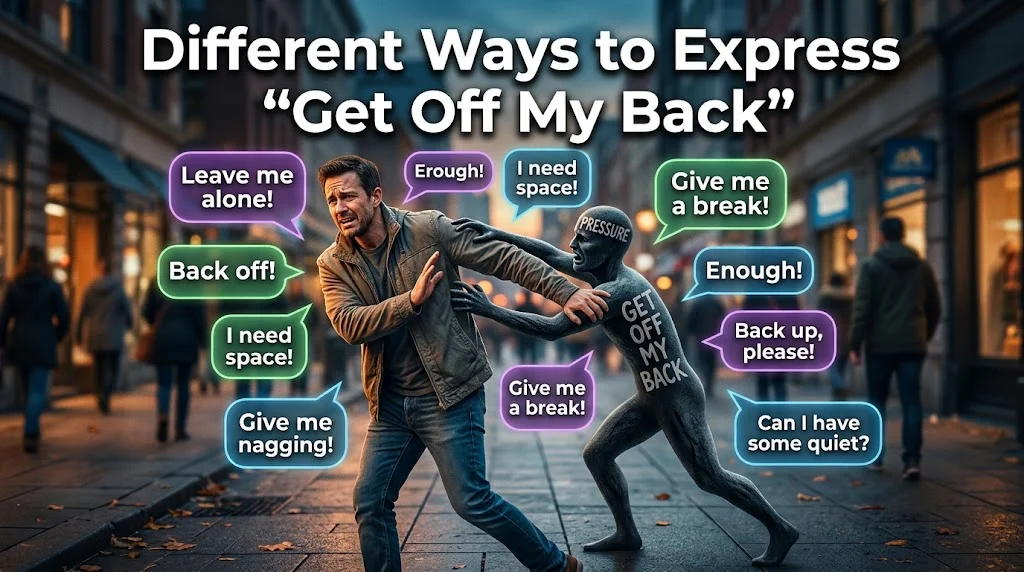
Depending on your audience and setting, you can replace this blunt idiom with several variations:
Professional and Neutral Expressions
- Give me some space to handle this
- Allow me to focus on my priorities
- Please grant me some autonomy
- Let me manage this independently
Polite and Considerate Expressions
- I would appreciate some room to breathe
- Please give me a moment to catch up
- I have this under control, thank you
- Could we step back from this for a moment?
Positive, Encouraging, and Reassuring Expressions
- Rest assured, I am on top of it
- Trust me to deliver the results
- You can count on me to follow through
Casual, Conversational, and Idiomatic Expressions
- Give me a break
- Stop breathing down my neck
- Back off for a second
- Cut me some slack
Where Does “Get Off My Back” Fit Best in Everyday Communication?
In everyday life, “Get off my back” works best in casual, high-familiarity environments where emotional directness is accepted or expected. It is commonly heard in spoken conversations between close friends, siblings, family members, or peers who have an established relationship. In these contexts, the phrase quickly sets a boundary when someone feels unfairly hounded about chores, personal decisions, or minor tasks.
In creative writing, fiction, and dramatic dialogue, the phrase serves as an effective literary tool to convey frustration, tension, or defensive interpersonal dynamics. However, in professional emails, workplace meetings, academic papers, and formal digital communications, using “get off my back” is generally unsuitable because its harsh tone can disrupt workplace harmony and undermine professional credibility.
When Is It Better to Choose a Different Expression?
You should choose an alternative expression whenever you are communicating in formal, professional, or emotionally delicate settings. In corporate environments, telling a manager or client to “get off my back” will likely be perceived as insubordinate, unprofessional, or hostile. In such cases, professional phrases like “allow me to manage this independently” convey your need for space while preserving mutual respect.
Similarly, in customer service, academic writing, legal correspondence, or resolution of sensitive personal conflicts, blunt idioms escalate tension. Opting for polite or reassuring alternatives ensures your need for autonomy is clearly understood without alienating the listener or damaging long-term relationships.
How Does “Get Off My Back” Sound to Different Audiences?
“Get off my back” carries a distinctly informal, direct, and emotionally charged undertone. Native English speakers hear it as a sharp, defensive expression of annoyance. It signals that the speaker has reached a frustration limit regarding ongoing pressure or criticism.
While the phrase clearly communicates a request for boundaries, its politeness level is low. In peer-to-peer personal relationships, it may be dismissed as brief venting, but when directed toward authority figures, clients, or acquaintances, it often sounds confrontational. Modern communicators must weigh this emotional weight against their communicative goals before using it.
What Makes This Expression Useful, and Where Can It Fall Short?
The primary strength of “get off my back” lies in its absolute clarity and emotional efficiency. It leaves zero room for misinterpretation, instantly signaling that a boundary has been crossed and that immediate relief from pressure is required. Its idiomatic nature makes it familiar and natural in casual spoken English.
Conversely, its main limitation is its lack of nuance and risk of tone mismatch. It provides no diplomatic buffer, making it unsuitable for nuanced negotiations or formal environments. Additionally, overuse can make a speaker appear defensive, short-tempered, or resistant to constructive feedback.
How People Use “Get Off My Back” in Real Communication
- Workplace Dialogue (Casual Peer-to-Peer): “Look, I know the deadline is coming up, but you need to get off my back while I finish the actual code.”
- Everyday Family Conversation: “I told you I’ll clean the garage this afternoon, so please get off my back about it!”
- Text Message Between Friends: “Seriously, get off my back about dating again 😂 I’m fine being single right now!”
- Fiction / Scriptwriting: “The detective turned around, eyes narrowed. ‘Get off my back, chief. I’m following the only lead we have.'”
How Does “Get Off My Back” Differ From Other Similar Expressions?
| Phrase | Meaning Difference | Tone Difference | Best Use Scenario |
| Get off my back | Demands an end to persistent nagging or criticism. | Informal, direct, mildly aggressive. | Casual arguments or venting to close peers. |
| Stop breathing down my neck | Focuses specifically on close, excessive supervision. | Informal, expressive, frustrated. | Complaining about micromanagement at work. |
| Cut me some slack | Asks for leniency, understanding, or reduced judgment. | Informal, persuasive, defensive. | Asking for an extension or forgiveness for a mistake. |
| Give me some space | Broadly requests physical or emotional room. | Neutral, clear, composed. | Setting boundaries in personal or professional settings. |
| Leave me alone | Demands total isolation and complete end to interaction. | Blunt, direct, emotionally detached. | Stopping all interaction immediately during severe frustration. |
Common Mistakes to Watch Out for When Using “Get Off My Back”
- Using It Upward in Professional Hierarchies: Addressing a supervisor or boss with “get off my back” is a major professional misstep that risks disciplinary action. Correction: Use “I have this task prioritized and will update you by the end of the day.”
- Confusing It With “Watch My Back”: “Watch my back” means to look out for someone’s safety, which is the exact opposite of asking someone to stop bothering you.
- Overusing It in Written Business Communication: Including this phrase in emails or Slack threads makes the sender appear hostile and unprofessional.
- Misinterpreting Constructive Feedback: Using the phrase when someone offers genuine, helpful advice can make you seem uncoachable or overly defensive.
The Communication Habits Behind the Popularity of “Get Off My Back”
The enduring popularity of “get off my back” stems from the cognitive efficiency of idiomatic language. Metaphorical idioms allow speakers to express complex emotional states—such as feeling overwhelmed by external demands—in a brief, universally understood phrase. Human communication naturally leans toward shortcuts that maximize impact with minimal effort. In moments of stress, high-friction explanations require significant cognitive energy, whereas an established idiom like “get off my back” instantly conveys emotional boundaries.
Is “Get Off My Back” Used Differently in American and British English?
“Get off my back” is fully understood and widely used across all varieties of English, including American, British, Canadian, and Australian English. There is no structural or semantic difference in how the phrase is interpreted between regions.
In British English, speakers might occasionally pair or alternate it with regional idioms such as “get off my case” or “stop nagging,” but “get off my back” remains standard across the UK. Tone and formality expectations remain consistent globally: it is considered casual and potentially abrasive in all major English-speaking countries.
How “Get Off My Back” Appears in Today’s Digital Conversations
In modern digital environments, “get off my back” frequently appears in social media posts, public forums, and informal messaging apps (like WhatsApp or iMessage) to express frustration over trending topics or personal pressures.
In professional digital spaces like Slack, Microsoft Teams, or workplace email, the expression is generally avoided. Because digital text lacks vocal inflection and body language, writing “get off my back” in a chat message magnifies its aggressiveness, making it sound more hostile than it might in a spoken exchange.
What Does “Get Off My Back” Communicate Beyond Its Literal Meaning?
Emotional Meaning and Subtext
Beyond its explicit demand for non-interference, “get off my back” signals emotional saturation. The subtext communicates that the speaker feels unfairly targeted, micromanaged, or burdened beyond their capacity. It conveys a mix of stress, resentment, and a desire to reclaim personal agency.
Direct and Indirect Communication
“Get off my back” sits on the far end of the directness spectrum. While indirect communication relies on hints, softer phrasing, or delayed feedback to preserve harmony, this phrase breaks polite social conventions to deliver an unambiguous command.
Professional Communication Perspective
In corporate environments, colleagues and managers view the phrase as an indicator of poor stress management or defensive behavior. Using it suggests an inability to handle oversight or process feedback constructively, which can harm workplace trust.
Why Experienced Communicators Choose Alternatives
Skilled communicators replace “get off my back” with diplomatic alternatives to maintain boundary control without destroying rapport. By choosing phrases that reassure the other party or clearly state priorities, they resolve interpersonal friction smoothly.
Social Meaning and Audience Perception
Your choice of vocabulary shapes how others judge your emotional intelligence. Using polite or neutral expressions in stressful moments highlights maturity and composure, whereas resorting to abrasive idioms can make a speaker appear reactive.
Practical Tone Guidance
Match your phrasing to your objective. If your goal is to preserve a working relationship while securing independence, select a professional or polite alternative. Reserve intense idioms only for personal situations where clear, immediate boundaries are necessary.
Conclusion:
“Get off my back” remains a colorful and effective idiom when you need to set immediate, blunt boundaries against nagging or excessive criticism in casual settings. However, because language choices shape how others perceive your professionalism, emotional intelligence, and composure, relying on a single abrasive phrase can hinder effective communication. Exploring professional, polite, reassuring, or casual alternatives empowers you to adjust your delivery to match any environment. Whether you choose “give me some space to handle this” for a workplace email or “cut me some slack” for a conversation with a friend, selecting the right phrasing preserves your relationships while achieving the autonomy you need. Ultimately, mastering these variations ensures that your message remains clear, impactful, and tailored to your specific audience.
FAQ:
What does the phrase “get off my back” mean?
“Get off my back” is an informal English idiom that means asking or demanding that someone stop harassing, criticizing, nagging, or micromanaging you. People use it when they feel overwhelmed by continuous pressure or unwanted scrutiny and want to establish a firm boundary.
Is “get off my back” rude to use in conversation?
Yes, “get off my back” is generally considered blunt and mildly abrasive. While it is acceptable in casual conversations among close friends or family members, using it in professional settings or with authority figures is viewed as impolite and unprofessional.
What is a professional synonym for “get off my back”?
A strong professional alternative is “give me some space to handle this” or “let me manage this independently.” These expressions set clear boundaries regarding your workload without sounding defensive, hostile, or insubordinate in workplace environments.
Can I use “get off my back” in an email?
You should avoid using “get off my back” in formal or professional emails. Because written text lacks vocal tone, the phrase can sound aggressive. Instead, use polite, clear alternatives such as “I have this under control, thank you” or “allow me to focus on my priorities.”
Where did the idiom “get off my back” come from?
The idiom originated in 20th-century American English, drawing on the visual metaphor of carrying a heavy burden on one’s back. The nagging person is conceptualized as an unwanted physical weight that needs to be removed so the speaker can move forward.
How do American and British English usage of “get off my back” differ?
There is no significant difference in meaning or formality between American and British English. Both regions use “get off my back” as an informal, expressive idiom to demand space from pressure, though British English also frequently uses variations like “get off my case.”
What is the difference between “get off my back” and “cut me some slack”?
“Get off my back” demands an immediate end to nagging or criticism, often carrying an annoyed tone. In contrast, “cut me some slack” asks for understanding, leniency, or reduced pressure, making it a softer, more persuasive request for empathy.
Is “get off my back” appropriate for ESL learners to use?
ESL learners should understand “get off my back” when listening to native speakers or watching media, but they should exercise caution when using it. Because of its harsh tone, opting for neutral alternatives like “give me some time to handle this” is safer in most daily interactions.
What is a polite way to tell a boss to “get off my back”?
To communicate this to a supervisor politely, reframe the request around productivity and reassurance. Use phrasing such as: “Rest assured, I am on top of this project and will provide a complete progress report by the end of the afternoon.”
Why do people prefer idioms like “get off my back” in speech?
People use idioms like “get off my back” because they deliver high emotional impact with minimal words. Metaphorical language reduces cognitive effort during moments of frustration, instantly communicating emotional boundaries to listeners.

I am passionate about the English language, grammar, vocabulary, and effective communication. Through Grammar Hub Pro, I aim to help students, professionals, teachers, and English learners improve their language skills. I enjoy exploring English grammar rules, discovering useful words, explaining idioms and phrases, and sharing practical writing tips. My goal is to make learning English simple, clear, and enjoyable for everyone. I create helpful, easy-to-understand content with practical examples so readers can use English more confidently in everyday conversations, academic studies, and professional communication. I believe learning English should be accessible to everyone.