
Have you ever typed “he intimated her voice perfectly” and paused, wondering if that sentence actually made sense? You’re not alone. Imitated and intimated are two words that sound similar, share a few letters, and trip up even confident English speakers. But they mean completely different things.
In this guide, you’ll learn exactly what each word means, where they came from, how to pronounce them, and how to use them correctly in real sentences. By the end, you won’t just avoid the mistake — you’ll understand these words the way a language teacher does.
Why Do People Confuse Imitated and Intimated?
The confusion isn’t random. It happens for three clear reasons.
First, the words look alike. Both start with “i,” both have three syllables in their base form, and both end in “-ated” once conjugated. Your eyes see a familiar pattern and your brain fills in the rest.
Second, they sound somewhat similar when spoken quickly. In fast, casual speech, the middle syllables can blur together, especially for non-native speakers still training their ear to English rhythm.
Third, both words can appear in similar contexts — conversations, workplace communication, and descriptions of behaviour. A sentence like “She ___ the plan” could grammatically take either word, even though the meaning changes entirely depending on which one you choose.
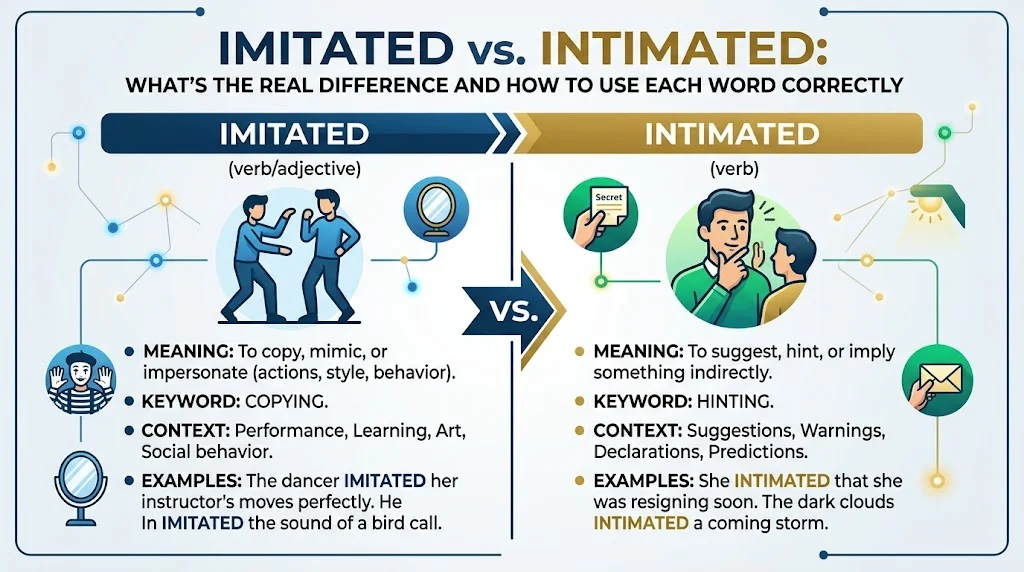
Here’s the short version before we go deep:
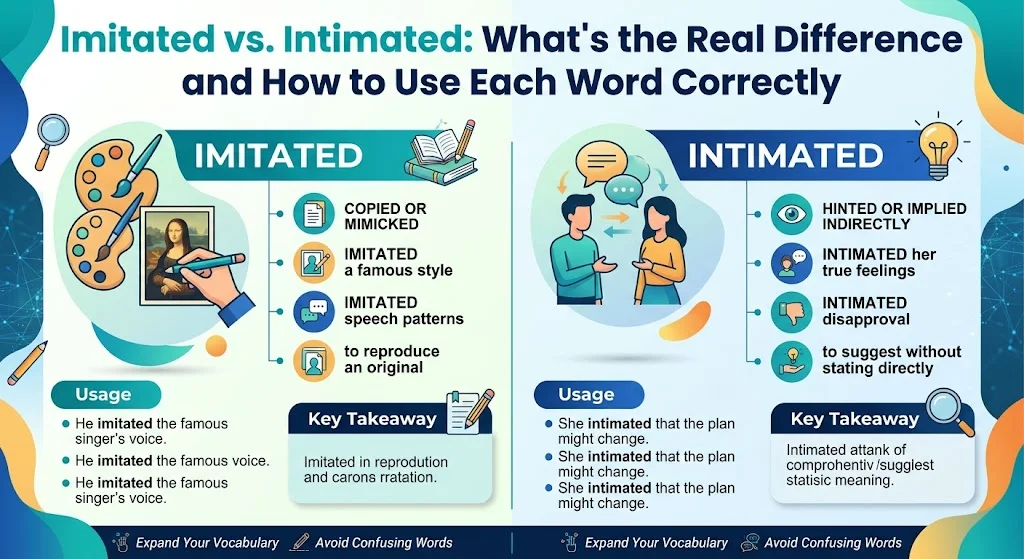
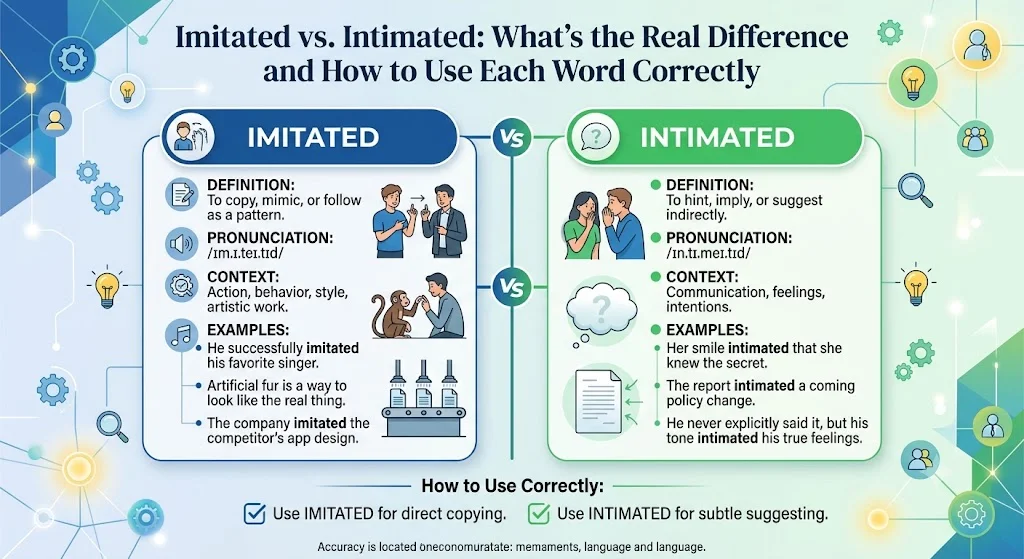
- Imitated means to copy or mimic something.
- Intimated means hinted at or suggested something indirectly.
Now let’s break down each word properly.
Understanding “Imitate”: Meaning, Origin, and Usage
Definition and Core Meaning
Imitate (verb) means to copy the actions, appearance, sound, or style of someone or something else. It’s about reproduction — making one thing resemble another.
Pronunciation: ih-MIT-ayt (/ˈɪm.ɪ.teɪt/)
When you imitate someone, you’re deliberately or naturally mirroring their behavior. A child imitates a parent’s accent. A comedian imitates a celebrity’s mannerisms. A student imitates a native speaker’s pronunciation to improve their own.
Etymology and Historical Context
Imitate comes from the Latin word imitari, meaning “to copy or portray.” This root traveled through Middle French before settling into English in the 1500s. The Latin root also gives us related words like imitation and imitator, all tied to the core idea of copying.
Understanding this Latin root helps you remember the meaning permanently: imitari = to copy. If you ever see a word built on “imit-,” think “copy.”
Using “Imitated” Correctly
Imitated is the past tense and past participle form of “imitate.” It follows regular verb conjugation rules:
| Form | Word |
| Base form | imitate |
| Past tense | imitated |
| Past participle | imitated |
| Present participle | imitating |
| Third person singular | imitates |
Correct usage examples:
- The parrot imitated the sound of the doorbell perfectly.
- Young artists often imitate the style of masters before finding their own voice.
- She imitated her manager’s tone so well that the whole office laughed.
- Fashion trends are frequently imitated by fast-fashion brands within weeks.
Common mistakes:
- ❌ “He imitated that he was tired.” (Wrong — imitate needs an object you copy, not a suggestion.)
- ✅ “He acted like he was tired.” or “He hinted that he was tired.”
Imitate always needs something concrete to copy — a voice, a style, a gesture, a product. It cannot be used to describe hinting at an idea.
Formal vs. Informal Usage
Imitate works comfortably in both formal and informal settings.
- Formal: “The study examined how children imitate observed behavior.”
- Informal: “Stop imitating my accent, it’s annoying!”
Synonyms, Similar Words, and Opposites
| Category | Words |
| Synonyms | mimic, copy, replicate, emulate, mirror, impersonate |
| Similar words | simulate, reproduce, echo |
| Opposites | originate, create, innovate, invent |
Related phrases and collocations:
- imitate a style
- imitate a voice
- imitate someone’s behavior
- closely imitated
- widely imitated
- imitation jewelry / imitation leather (as an adjective use of the noun form)
Quick Tips to Remember “Imitate”
- Think: Imitate = I-Mirror-it-Late (you copy something after seeing it first).
- Link the root “imit-” to “imitation,” a word most people already know refers to a copy or fake version of something.
- If your sentence involves copying an action, sound, or style, “imitate” is your word.
The Noun Form: “Imitation”
Imitation is the noun form of imitate. It refers to a copy, replica, or act of copying something.
Definition: A thing made to look like or resemble another thing, or the act of copying behavior.
Examples:
- The bag was a cheap imitation, not the real designer brand.
- Children learn language partly through imitation.
- Flattery is often called the sincerest form of imitation.
Common collocations: imitation leather, imitation crab, pale imitation, mere imitation, act of imitation.
Grammar note: “Imitation” can function as a noun (“It’s an imitation”) or as a modifier before another noun (“imitation leather,” “imitation jewelry”). In the second case, it behaves like an adjective but remains grammatically a noun used attributively.
Understanding “Intimate” as a Verb: Meaning, Origin, and Usage
Now let’s shift to the word that causes most of the confusion.
Definition and Core Meaning
Intimate (verb) means to suggest, hint, or communicate something indirectly, often without stating it outright. It’s a formal, somewhat reserved way of implying an idea rather than announcing it directly.
Pronunciation (verb form): IN-tih-mayt (/ˈɪn.tɪ.meɪt/) — note the final syllable is pronounced like “mate,” not “mit.”
This is actually one of the biggest pronunciation clues that separates the two words. As a verb, “intimate” ends with a full “-ate” sound. As an adjective (which we’ll cover shortly), it’s pronounced differently: IN-tih-mit.
Etymology and Historical Usage
Intimate (the verb) comes from the Latin intimare, meaning “to announce or make known,” which itself derives from intimus, meaning “innermost.” Historically, to intimate something was to bring an inner thought partially into the open — not fully declared, but no longer fully hidden either.
This etymology explains why “intimated” carries a sense of subtlety. You’re not stating something plainly; you’re revealing just enough for the listener to understand your meaning.
Using “Intimated” Correctly
Intimated is the past tense and past participle of the verb “intimate.”
| Form | Word |
| Base form | intimate |
| Past tense | intimated |
| Past participle | intimated |
| Present participle | intimating |
| Third person singular | intimates |
Correct usage examples:
- The manager intimated that layoffs might happen next quarter, without confirming it directly.
- She intimated her disapproval with a raised eyebrow rather than words.
- The report intimated a connection between the two events without stating it explicitly.
- He intimated that he was considering resignation, though he never said it plainly.
Common mistakes:
- ❌ “The comedian intimated the president’s voice.” (Wrong — you cannot “intimate” a voice or sound.)
- ✅ “The comedian imitated the president’s voice.”
- ❌ “She imitated that she was upset about the decision.”
- ✅ “She intimated that she was upset about the decision.”
This is the exact swap that causes the most embarrassment in writing. Remember: intimate deals with meaning and suggestion, imitate deals with copying and appearance.
Formal vs. Informal Usage
Intimate (verb) is a formal, somewhat literary word. You’ll see it far more often in legal writing, journalism, academic papers, and professional correspondence than in casual conversation.
- Formal: “The board intimated its intention to restructure the department.”
- Informal alternative: “The board hinted they might restructure things.”
In everyday speech, people usually say “hint,” “suggest,” or “imply” instead of “intimate.” Using “intimate” in casual conversation can sound overly formal or even a bit stiff, so reserve it for professional or written contexts.
Synonyms, Similar Words, and Opposites
| Category | Words |
| Synonyms | hint, suggest, imply, insinuate, indicate, signal |
| Similar words | allude, convey, communicate indirectly |
| Opposites | declare, state outright, announce, proclaim |
Related phrases and collocations:
- intimated concern
- intimated displeasure
- intimated an intention
- gently intimated
- strongly intimated
Quick Tips to Remember “Intimate” (the Verb)
- Think: Intimate = INner meaning, not fully stated. The root “intimus” means innermost, so intimating is bringing something from the inside partway out.
- Pair it mentally with “hint” — both start similarly in feeling, both mean indirect suggestion.
- If your sentence involves hinting, suggesting, or implying, “intimate” is correct.
Adjective Form: “Intimate”
Here’s where things get a little more interesting. “Intimate” isn’t only a verb — it’s also a common adjective, and the pronunciation changes.
Pronunciation (adjective form): IN-tih-mit (/ˈɪn.tɪ.mɪt/) — ending in a soft “it” sound, not “ate.”
Definition: Closely personal, private, or characterized by close familiarity and warmth.
Examples:
- They shared an intimate conversation about their fears.
- The restaurant had a small, intimate atmosphere.
- Close friends often have an intimate understanding of each other’s habits.
Common collocations: intimate relationship, intimate details, intimate setting, intimate knowledge, intimate friendship.
Grammar note: As an adjective, “intimate” describes nouns directly (an intimate dinner, an intimate bond) and never takes an “-ed” ending, since adjectives don’t conjugate like verbs.
Common mistake: Confusing the adjective’s meaning (“close and personal”) with the verb’s meaning (“to hint”). Context and pronunciation both help distinguish them, but in writing, only context tells you which one is meant.
Imitated vs. Intimated: Side-by-Side Comparison Table
| Feature | Imitated | Intimated |
| Base word | Imitate | Intimate |
| Meaning | Copied, mimicked | Hinted, suggested indirectly |
| Word type | Verb (past tense) | Verb (past tense) |
| Pronunciation | ih-MIT-ay-ted | IN-tih-may-ted |
| Latin root | imitari (to copy) | intimare (to announce inwardly) |
| Typical object | A voice, style, action, product | An idea, feeling, intention |
| Formality | Neutral, used in all registers | Formal, mostly written/professional |
| Common synonym | Mimicked, copied | Hinted, implied |
| Opposite | Originated, created | Declared, stated outright |
| Noun form | Imitation | Intimation |
Practical Tips to Avoid Confusing These Words Forever
Here are memory tricks that actually work, tested the way a teacher tests them with real students.
- The “Copy vs. Clue” trick. Imitate = copy. Intimate = clue. If the sentence is about copying something visible or audible, use imitate. If it’s about giving a subtle clue about something unseen, use intimate.
- Check the object of the sentence. You imitate things that can be observed — a voice, a walk, a painting style. You intimate things that are abstract — an intention, a feeling, a possibility.
- Listen to the middle syllable. Imitate has a short “mit” sound. Intimate (verb) has a longer “ma” sound before “ate.” Saying both words aloud slowly will train your ear over time.
- Remember the roots. Imitari = to copy. Intimus = innermost. One is about the outside (copying appearance), the other is about the inside (revealing a hidden thought).
- Use substitution as a test. Before writing either word, try substituting “copied” or “hinted.” Whichever fits naturally is your answer.
Common Mistakes Checklist
- ❌ “He intimated her accent for the show.” → ✅ “He imitated her accent for the show.”
- ❌ “She imitated that she was unhappy.” → ✅ “She intimated that she was unhappy.”
- ❌ “The design was intimated from an older model.” → ✅ “The design was imitated from an older model.”
- ❌ “He imitated a threat without saying it directly.” → ✅ “He intimated a threat without saying it directly.”
Real-Life Examples and Case Studies
In Academia
Students and professors both encounter these words in writing regularly.
- A literature professor might say: “This poet clearly imitated the sonnet structure used by earlier Romantic writers.”
- A research paper might state: “The data intimated a possible correlation, though further testing was required to confirm it.”
Notice how academic writing often uses “intimated” specifically because researchers are cautious about overstating conclusions. Saying data “intimated” something is more careful than saying it “proved” something.
In the Professional Workplace
Workplace communication relies heavily on tone, and these words carry very different professional weight.
- “The client imitated our previous proposal almost word for word.” (A complaint about plagiarism or copying.)
- “During the meeting, leadership intimated that budget cuts were coming, though nothing was confirmed in writing.” (A description of subtle, unofficial communication.)
Understanding this distinction matters in HR documentation, performance reviews, and legal correspondence, where the difference between “hinting” and “copying” can carry real consequences.
In Pop Culture
Entertainment writing uses both words often, especially in reviews and interviews.
- “The impressionist imitated five different celebrity voices during his set.”
- “In the interview, the actress intimated that a sequel was already in development, without confirming any details.”
Entertainment journalists frequently choose “intimated” over “confirmed” or “revealed” specifically because it signals that the information was implied, not officially announced — an important nuance for accurate reporting.
Intimation vs. Imitation: Don’t Confuse the Nouns Either
Just as the verbs confuse people, so do the nouns.
- Imitation = a copy or the act of copying.
- Intimation = a hint or indirect suggestion.
Examples:
- “The painting was a clever imitation of Van Gogh’s brushwork.”
- “There was an intimation of trouble in her voice, even though she said everything was fine.”
Related Words You Should Also Know
Building your vocabulary around these words strengthens your overall understanding.
| Word | Meaning | Example |
| Insinuate | To suggest something negative indirectly | He insinuated that she was lying. |
| Imply | To suggest without stating directly | Her silence implied disagreement. |
| Mimic | To imitate closely, often for humor | The kids mimicked their teacher’s walk. |
| Emulate | To imitate in order to match or exceed | He emulated his mentor’s work ethic. |
| Allude | To refer to something indirectly | The speech alluded to recent events. |
Notice how “insinuate” and “intimate” are close cousins in meaning, though “insinuate” usually carries a more negative or sneaky connotation, while “intimate” is more neutral or professional.
Practice Exercises
Test yourself with these sentences. Choose “imitated” or “intimated” for each blank.
- The singer ______ the original artist’s tone so closely that fans were amazed.
- During negotiations, the seller ______ that a lower price might be possible.
- His handwriting ______ his father’s style almost perfectly.
- The email ______ dissatisfaction without stating it outright.
- The comedian ______ three politicians in under a minute.
Answers: 1. imitated, 2. intimated, 3. imitated, 4. intimated, 5. imitated
Summary and Key Takeaways
- Imitated means copied or mimicked something observable, like a voice, style, or action.
- Intimated means hinted at or suggested something indirectly, usually an idea, feeling, or intention.
- Their Latin roots reveal the core difference: imitari (to copy) versus intimare (to reveal inwardly).
- Pronunciation differs in the middle syllable — train your ear to catch it.
- “Intimate” is also a common adjective meaning close or personal, pronounced differently from the verb form.
- Use the “Copy vs. Clue” test whenever you’re unsure which word fits your sentence.
Final Thoughts
Mixing up imitated and intimated is one of the most common vocabulary slips in English, but it’s also one of the easiest to fix once you understand the logic behind each word. Imitate is about copying something you can see or hear. Intimate is about revealing something indirectly, often something private or not yet confirmed.
Once you connect each word to its Latin root — copy versus inner meaning — the distinction becomes permanent in your memory. Practice using both words in your own sentences, read them aloud, and pay attention to how professional writers use them in news articles, workplace emails, and academic papers. With a little attention, this confusion disappears for good.
Frequently Asked Questions
Q1: What does “imitated” mean?
“Imitated” means copied or mimicked someone or something, usually their appearance, voice, actions, or style. For example, “She imitated her favorite singer’s stage presence.” It comes from the Latin imitari, meaning “to copy.”
Q2: What does “intimated” mean?
“Intimated” means hinted at or suggested something indirectly, without stating it plainly. For example, “He intimated that changes were coming, though nothing was confirmed.” It comes from Latin intimare, meaning “to make known from within.”
Q3: How can I avoid confusing these words?
Use the “Copy vs. Clue” trick: if you’re describing copying something visible or audible, use imitated. If you’re describing an indirect hint about an idea or feeling, use intimated. Reading each sentence aloud and testing substitution with “copied” or “hinted” also helps confirm the right choice.
Q4: Are these words commonly confused by learners?
Yes, very commonly. Both English learners and native speakers mix them up because they look similar in spelling and share a Latin-based structure. The confusion usually happens in written English, since spoken pronunciation differences (especially in the middle syllable) offer a helpful clue that writing doesn’t provide.
Q5: Can understanding these words improve my English?
Absolutely. Mastering near-homophones like these sharpens your overall vocabulary precision, improves your writing clarity, and helps you sound more confident in professional and academic settings. Small distinctions like this often separate strong writers from average ones.
Q6: Is “intimate” always formal?
As a verb, yes — “intimate” leans formal and appears mostly in professional, legal, or journalistic writing. As an adjective (meaning close or personal), it’s used comfortably in both formal and casual conversation, such as describing a relationship or a cozy setting.
Q7: What’s the difference between “intimate” and “insinuate”?
Both suggest something indirectly, but “insinuate” usually implies something negative or sly, like insinuating dishonesty. “Intimate” is more neutral and professional, often used for cautious or diplomatic hints rather than accusations.
Q8: Can “imitate” be used for ideas, not just actions?
Not typically. “Imitate” works best with observable things — voices, styles, behaviors, designs. For abstract ideas or intentions, “intimate,” “imply,” or “suggest” are the correct choices instead.
Q9: What is the noun form of “intimate,” and how is it different from “imitation”?
The noun form of the verb “intimate” is “intimation,” meaning a hint or indirect suggestion. “Imitation” is the noun form of “imitate,” meaning a copy or replica. They look alike but mean entirely different things, just like their verb counterparts.
Q10: Does the pronunciation really help tell these words apart?
Yes, significantly. “Imitated” stresses a short “mit” sound in the middle, while “intimated” has a longer “ma” sound before the final syllable. Practicing both words aloud slowly, several times, trains your ear to catch the difference even in fast speech.