
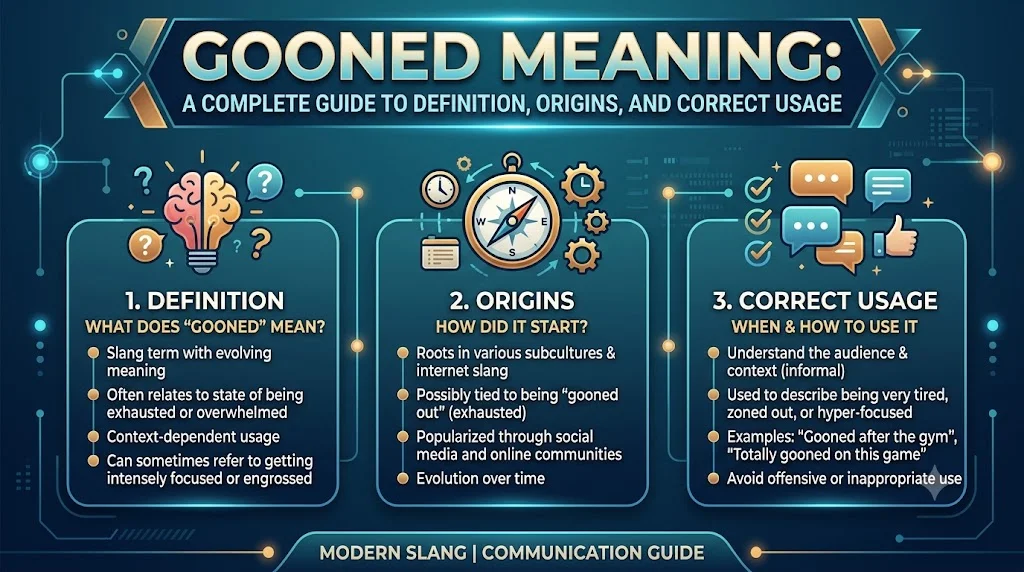
If you have seen the word “gooned” online and felt confused, you are not alone. This word has several meanings, and they are very different from each other. One meaning is old and harmless. Another meaning is modern internet slang that is NSFW (not safe for work). This guide will explain every meaning clearly, like a patient English teacher would, with grammar notes, real examples, and simple tips to help you remember it.
What Does “Gooned” Mean? (Quick Definition)
Gooned is the past tense form of the verb “goon.” It has three main meanings, depending on the context:
- Older, general slang: to be tricked, fooled, or made to look foolish.
- Sports slang: to be roughed up or intimidated by a “goon” (an enforcer player).
- Modern internet slang (18+): to be in a dazed, exhausted, or overstimulated state, most often used to describe someone after a long period of intense sexual arousal or masturbation, sometimes linked to porn overuse.
The third meaning is by far the most common one people search for today. It comes from the word “gooning,” a term that spread through Reddit, TikTok, and other social platforms starting in the early 2020s.
| Meaning | Register | Where You’ll Hear It |
| Tricked or fooled | Informal, dated | Older slang dictionaries, older films |
| Roughed up by an enforcer | Informal, niche | Hockey and other contact sports |
| Dazed after extended arousal (NSFW) | Very informal, internet slang | Reddit, TikTok, X (Twitter), meme culture |
Quick Tip: If someone uses “gooned” online in 2024–2026, they almost always mean the third, NSFW definition. Context matters a lot with this word.
Pronunciation and Word Form
- Pronunciation: /guːnd/ — rhymes with “spooned” or “mooned.”
- Word class: Verb (past tense/past participle of “goon,” used informally as a verb)
- Base form: goon (informal verb) — note that “goon” is more commonly a noun (a thug or foolish person); its use as a verb is newer and mostly internet-driven.
- Related noun: gooning (the ongoing action, used as a gerund)
- Related adjective phrase: “gooned out” (informal, meaning completely dazed or exhausted)
Grammar Note: In standard English, “goon” is a noun. The verb form (“to goon,” “gooned,” “gooning”) is a case of verbing — turning a noun into a verb. This is common in slang (think of “adulting” from “adult”). Because it is slang, it will not appear in most formal grammar guides, but it follows regular English verb rules: goon → gooned (past tense) → gooning (present participle).
Word Origin and Etymology
The word “goon” is much older than “gooned.” Understanding where “goon” came from helps explain why “gooned” can mean such different things today.
- 1920s–1930s: “Goon” appeared in American English to describe a slow-witted or clumsy person.
- 1933: The comic strip Popeye introduced a character named Alice the Goon, a large, simple-minded creature. This character helped popularize the word.
- 1930s labor disputes: “Goon” was also used for hired thugs who intimidated striking workers — this is where the “enforcer” or “tough guy” meaning comes from.
- 2020s internet slang: The verb “goon” and its forms (“gooned,” “gooning”) emerged from online forums, especially in NoFap (a community focused on quitting pornography) and adult content spaces, where “gooning” described a trance-like, extended state of arousal.
Tip to Remember: Think of the timeline as three waves — 1930s (foolish person), mid-1900s (thug/enforcer), and 2020s (internet slang). The word keeps getting a new life with each generation.
The Older, General Meaning of “Goon” and “Gooned”
Before the internet slang took over, “gooned” simply meant tricked, deceived, or made to look silly.
Example sentences:
- “I got gooned into paying full price for a ticket that was on sale.”
- “Don’t let that salesman goon you — check the price online first.”
Formal vs Informal: This use is informal and now considered old-fashioned. It would not appear in a business email or academic paper.
Similar words: duped, fooled, conned, played, scammed Opposite words: outsmarted (someone else), came out ahead
The Internet Slang Meaning of “Gooned”
Where the Term Comes From
The modern, most searched meaning of “gooned” started in online communities that discuss pornography addiction and recovery, such as NoFap. Members used “gooning” to describe a state some people enter during extended masturbation sessions — a foggy, trance-like mental state. Over time, the term spread beyond these communities into general internet slang, memes, and casual conversation, often used jokingly or as an exaggeration for being tired, dazed, or “brain-dead” after screen time in general.
What “Gooned” Means in This Context
In this usage, someone who is “gooned” or “gooned out” is described as:
- Mentally foggy or dazed
- Unable to focus
- Physically drained
- Overstimulated after a long period of arousal
Because of its sexual origin, this word is NSFW and is not appropriate for formal, academic, or professional settings. It is used almost exclusively in casual, often joking, online conversation.
Example sentences (kept general and non-graphic):
- “He’s been on his phone all night, he looks completely gooned.”
- “I’m so gooned from staring at screens all day I can barely think straight.”
Quick Tip: Many young internet users now use “gooned” loosely to mean “completely exhausted” or “brain-fried” from any activity — gaming, scrolling, studying — even when there is no sexual meaning intended. Always check the context before assuming which meaning is being used.
Common Mistake: Using this slang term in a professional email, resume, or classroom assignment. Because of its sexual origin, it can come across as inappropriate or even offensive, even in its “joking” sense.
“Gooned” in Other Contexts
Athletic Context
In sports, especially ice hockey, a “goon” is a player whose main job is to intimidate or fight opposing players rather than score goals. If a player says they got “gooned,” they usually mean they were roughed up, checked hard, or intimidated by an enforcer.
Example: “Our star player got gooned in the first period and had to sit out the rest of the game.”
This use is informal but not offensive — it is accepted slang in hockey and contact-sport commentary.
Academic and Professional Context
Here is an important correction: “gooned” has no accepted meaning in academic or professional English. Some competitor articles claim it has a special professional use, but this is misleading. In reality:
- It never appears in business writing, reports, or academic papers.
- If used casually among coworkers, it usually borrows the “exhausted” meaning from internet slang.
- It should be avoided entirely in resumes, emails, presentations, and formal speech.
Correct Usage Tip: In a professional context, replace “gooned” with words like exhausted, drained, overwhelmed, or burned out.
Popular Media, Gaming, and Literature
“Goon” appears in classic media as a stock character — the clumsy or intimidating side character. Examples include:
- Alice the Goon from Popeye (the original pop-culture goon).
- “Goon squads” in gangster films and video games, referring to a group of henchmen.
- Modern gaming slang where a “goon” is a weak, disposable enemy character (similar to “mob” or “grunt” in RPGs).
The verb form “gooned” is rare in formal literature and mostly limited to internet culture, memes, and casual online writing.
Grammar Breakdown of “Gooned”
Let’s break this word down the way an English teacher would in a grammar lesson.
| Form | Word | Example |
| Base verb (informal) | goon | “Don’t goon around, focus on your work.” (older use: to act foolish) |
| Past tense | gooned | “He got gooned by the sun and forgot his sunscreen.” |
| Present participle / gerund | gooning | “He was gooning around instead of studying.” |
| Adjective phrase | gooned out | “She looked totally gooned out after finals week.” |
Grammar Explanation: “Gooned” follows the regular pattern of English verbs: add -ed for the past tense (like “walked” or “jumped”). This makes it easy to use grammatically, even though it is slang. The irregular part is not the grammar — it’s the meaning, which shifts heavily depending on the community using it.
Sentence structure tip: “Gooned” is most often used in the passive voice — “He got gooned,” “I was gooned” — rather than the active voice (“He gooned me”), although both are grammatically possible.
How to Use “Gooned” Correctly
Formal vs. Informal Usage
| Setting | Should You Use “Gooned”? | Better Alternative |
| Text messages with friends | Yes, informally | — |
| Social media captions | Yes, casually | — |
| Work email | No | “exhausted,” “drained” |
| Academic essay | No | “fatigued,” “overwhelmed” |
| Public speech | No | “worn out,” “burned out” |
| Sports commentary | Yes, in the “roughed up” sense | — |
Common Mistakes
- Using it in professional writing. This is the most common and most damaging mistake. Because of its NSFW internet origin, it can embarrass the writer.
- Assuming it always means “tired.” Depending on the audience, listeners may assume the sexual slang meaning, not the general “exhausted” meaning.
- Confusing “goon” (noun) with “gooned” (verb). A “goon” is a person; “gooned” is something that happens to a person.
- Spelling it “gooed” or “goonned.” The correct spelling is g-o-o-n-e-d, with one “n.”
Quick Tip: When in doubt, don’t use it in writing meant for a wide or professional audience. Save it for casual chats with people who already know internet slang.
Synonyms, Similar Words, and Opposites
Synonyms for “gooned” (informal / exhausted sense):
- drained
- wiped out
- fried
- burned out
- zoned out
- dazed
Synonyms for “gooned” (tricked sense):
- duped
- conned
- played
- fooled
Opposite words:
- energized
- alert
- refreshed
- sharp
- focused
Similar slang words to know:
- “Brain rot” — mental fog from too much low-quality content online
- “Zonked” — extremely tired
- “Wired” — the opposite state, overly alert (often from caffeine)
Common Collocations and Related Phrases
| Collocation | Meaning |
| “gooned out” | completely dazed or exhausted |
| “get gooned” | to become dazed, tricked, or roughed up |
| “gooning session” | internet slang for an extended period tied to the NSFW meaning |
| “goon squad” | a group of thugs or henchmen (unrelated to “gooned”) |
| “act like a goon” | to behave foolishly (older meaning) |
Related phrases in everyday English:
- “I’m fried” (exhausted)
- “I’m running on empty” (very tired)
- “I got played” (tricked)
Comparison Table: Goon vs. Gooned vs. Gooning
| Word | Part of Speech | Core Meaning | Example |
| Goon | Noun | A thug, henchman, or foolish person | “Two goons blocked the door.” |
| Gooned | Verb (past tense) | To be tricked, roughed up, or left dazed (NSFW sense common online) | “I got gooned after scrolling all night.” |
| Gooning | Verb (gerund) / Noun | The ongoing action tied to the NSFW internet meaning | “He spent the whole night gooning on his phone.” |
Tip to Remember the Difference: Goon is a person. Gooned is something that happens to a person. Gooning is the action in progress.
Cultural Impact and Controversies
The rapid spread of “gooned” and “gooning” reflects how internet slang moves quickly from niche communities to mainstream meme culture. It has sparked debate for a few reasons:
- Confusion between meanings: Many people encounter the word without knowing its NSFW origin, leading to awkward misunderstandings.
- Overuse as a joke: Younger users increasingly use “gooned” loosely to mean “brain-fried from screens,” stripping away the original sexual meaning — a process linguists call semantic bleaching (when a word’s original strong meaning weakens through casual overuse).
- Concerns from mental health commentators: Because the term’s roots are tied to porn-addiction discussion boards, some writers use “gooning” as shorthand when discussing compulsive online habits and screen overuse.
Where This Might Go Next: Like many slang terms (think “salty” or “lit”), “gooned” may keep softening in meaning as it spreads to younger, broader audiences who use it as an all-purpose word for “exhausted” or “out of it,” with less awareness of its original context.
Tips to Remember the Meaning
- Check the context first. Sports article? Probably means “roughed up.” Random online comment? Probably the NSFW internet meaning.
- When unsure, don’t use it in writing for a general audience.
- Remember the “-ed” rule: it just marks past tense, like any regular verb.
- Separate “goon” (the person) from “gooned” (the state).
- Avoid it completely in professional and academic writing.
Practice Examples
Try identifying which meaning is being used in each sentence below.
- “The rookie got gooned in the corner and lost the puck.” — (Sports meaning: roughed up)
- “I feel so gooned after that 10-hour flight with no sleep.” — (General meaning: exhausted)
- “Careful buying from that stall, tourists get gooned on prices all the time.” — (Older meaning: tricked)
- “He was gooning on his phone instead of doing homework.” — (Internet slang meaning: dazed from screen overuse)
Answer Key: 1) sports, 2) exhausted, 3) tricked, 4) internet slang (general “screen fatigue” use)
Final Thoughts
“Gooned” is a small word with a surprisingly complicated story. It started as slang for being tricked, grew into sports language for getting roughed up by an enforcer, and has now become a widely used internet term, most often tied to extended arousal or general screen-induced exhaustion. Because its most common modern meaning is NSFW, it’s best kept out of formal writing, resumes, and classroom work. Understanding all its layers — origin, grammar, and context — helps you use language confidently and avoid embarrassing mix-ups, whether you’re chatting online or writing something more serious.
FAQs
1. What does “gooned” mean in slang? In modern internet slang, “gooned” usually describes someone in a dazed, exhausted, or overstimulated state, often linked to extended masturbation or porn use. Casually, it’s also used to mean “brain-fried” from too much screen time, even without the sexual meaning.
2. Is “gooned” a bad word? It isn’t a slur or curse word, but its most common modern meaning is NSFW (sexual). This makes it inappropriate for formal, academic, or professional settings, even though it’s commonly used casually online.
3. Where does the word “goon” come from? “Goon” dates back to the 1930s, popularized by the Popeye comic character Alice the Goon. It originally meant a foolish or clumsy person, later expanding to mean a hired thug or enforcer.
4. What does “gooned” mean in hockey? In hockey, being “gooned” means getting roughed up, checked hard, or intimidated by a “goon” — a player whose role is physical intimidation rather than scoring.
5. Is “gooning” the same as “gooned”? “Gooning” is the ongoing action (present participle), while “gooned” is the completed state (past tense). Both come from the same slang root but describe different points in time.
6. Can I use “gooned” in a professional email? No. Because of its NSFW internet meaning, “gooned” should never appear in professional writing. Use words like “exhausted,” “drained,” or “overwhelmed” instead.
7. Is “gooned” a real English word? It is not found in standard dictionaries as a formal entry, but it is widely recognized internet and youth slang, following normal English grammar rules for verb conjugation.
8. What is the opposite of “gooned”? Opposites include “energized,” “alert,” “refreshed,” and “focused” — words describing someone sharp and full of energy rather than dazed or drained.
9. Why do people say “gooned out”? “Gooned out” is an intensified version of “gooned,” emphasizing a deeper state of mental fog, exhaustion, or overstimulation, often used humorously about screen or phone overuse.
10. Is “gooned” appropriate for teenagers to use? Because of its sexual internet origin, parents and educators may want to be aware of the term. Many teens use it casually to mean “tired” without knowing its original NSFW context, which can cause confusion in mixed-age conversations.