
If you’ve ever paused mid-sentence wondering whether to say “any problem” or “any problems,” you’re not alone. This is one of the most common mix-ups for English learners, and honestly, even native speakers use it inconsistently without realizing there’s a rule behind it.
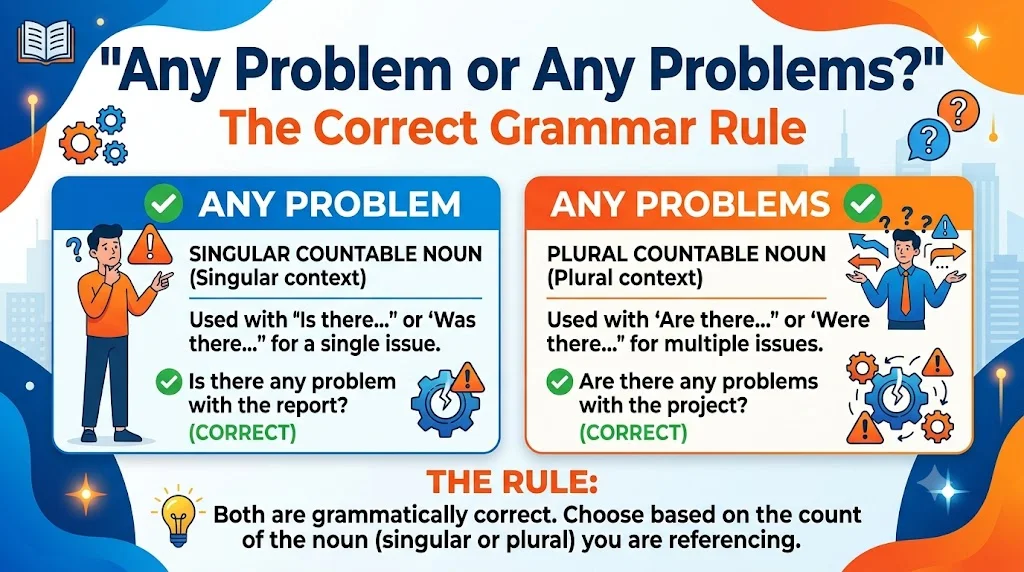
Here’s the short version: both are correct — they just aren’t interchangeable. The word “any” doesn’t force a singular or plural noun by itself. What matters is the sentence type, the context, and whether you’re talking about one specific issue or an open, general category of issues.
By the end of this guide, you’ll know exactly which form to use, why native speakers lean toward one over the other in casual speech, and how to avoid the small mistakes that make non-native speakers sound slightly “off” even when their grammar is technically fine.
Let’s break it down like a grammar lesson, not a textbook.
Quick Answer (For Readers in a Hurry)
- “Any problem” (singular) is used in negative sentences, formal writing, and when you mean “even one single problem.”
- “Any problems” (plural) is used in questions, offers, and everyday spoken English, especially when the answer could involve more than one issue.
- In casual conversation, “any problems” is far more common, especially in questions like “Any problems with the order?”
- Both are grammatically correct; the choice depends on meaning and register, not on a strict grammar violation.
Now let’s go deeper.
What Is the Difference Between “Any Problem” and “Any Problems”?
Meaning and Definition
“Problem” is a countable noun. It refers to a difficulty, an obstacle, or a situation that needs to be solved. Because it’s countable, it can appear in singular form (problem) or plural form (problems).
- Any problem = referring to a single, unspecified difficulty, viewed as one unit.
- Any problems = referring to one or more unspecified difficulties, viewed as an open set or category.
Think of “any” as a spotlight. It doesn’t create the difference between singular and plural — the noun itself does. “Any” simply tells the listener that you’re not pointing to a specific problem; you’re leaving the door open for whichever one (or however many) might exist.
Grammar Explanation
“Any” is a determiner. Determiners like any, some, no, and every combine with nouns to show quantity or indefiniteness. Depending on the noun that follows, “any” can pair with:
| Noun Type | Example | Correct? |
| Singular countable noun | any problem | ✅ Yes |
| Plural countable noun | any problems | ✅ Yes |
| Uncountable noun | any trouble | ✅ Yes |
| Singular noun without context | any problems (as a general question) | ✅ Yes, common in speech |
So grammatically, English allows “any” with both singular and plural countable nouns. The rule isn’t about right or wrong — it’s about which one matches your intended meaning.
Pronunciation
- Any — pronounced /ˈɛn.i/ (EH-nee)
- Problem — pronounced /ˈprɒb.ləm/ (PROB-lum)
- Problems — pronounced /ˈprɒb.ləmz/ (PROB-lumz), with a voiced “z” sound at the end, not an “s” sound
A common pronunciation mistake among learners is saying “problems” with a hard “s” sound (like “bus”). In natural English, the plural “-s” after “m” is voiced, so it sounds like “-mz.”
Word Origin
- Any comes from Old English ǣnig, related to ān (meaning “one”). Its root sense is “any one, whichever one,” which explains why it works naturally with singular nouns even though it’s also used with plurals.
- Problem comes from Greek problēma, meaning “something thrown forward” (a task or a puzzle put before someone), passed into English through Latin and French around the 14th century.
Knowing the origin helps explain why “any problem” still carries that old sense of “even one single thing” — it’s baked into the word’s history.
Why Does the Word “Any” Change the Meaning?
“Any” doesn’t literally change singular to plural or vice versa. What it does is change the scope of the sentence.
- In a positive statement, “any” often means “it doesn’t matter which one.”
- Take any problem from the list and solve it. (Pick one — any single one.)
- In a negative statement or question, “any” means “even one” or “some, if they exist.”
- I don’t see any problems with your plan. (Not even a single one.)
- Do you have any problems? (Are there some, however many?)
This is why the plural form “any problems” feels more natural in questions and negatives — you’re asking about the existence of problems in general, not counting them.
Grammar Rule: When to Use Singular vs. Plural After “Any”
Here’s the rule stripped down to its simplest form:
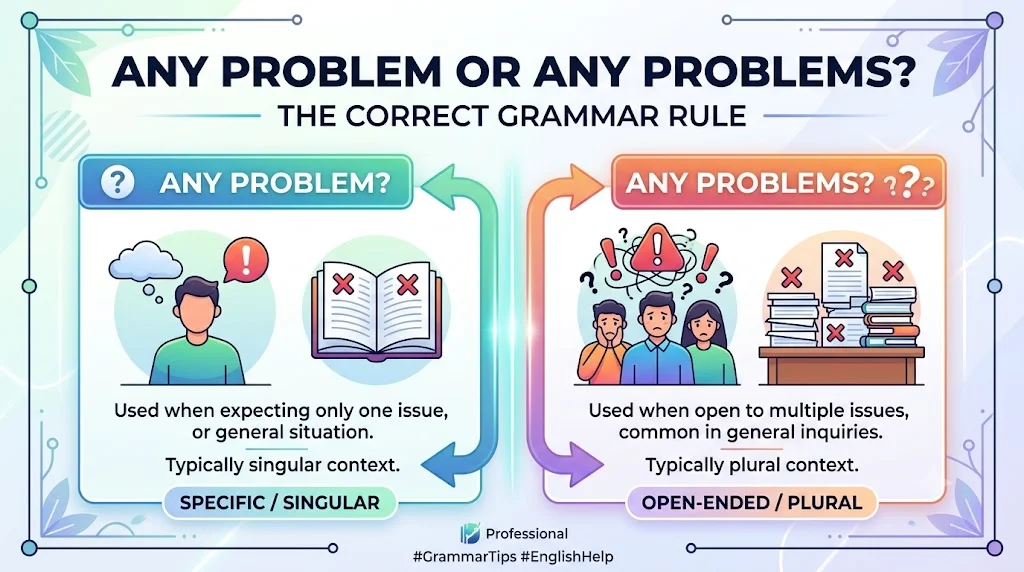
- Use the singular (“any problem”) when you’re emphasizing “even one” or referring to one unspecified item from a group.
- Use the plural (“any problems”) when you’re referring to an open, general quantity — zero, one, or many.
- In everyday questions and offers, native speakers default to the plural, even if only one problem is likely.
Use “Any Problem” When…
- You want to stress “not even a single one.”
- There isn’t any problem with the schedule.
- You’re speaking formally or in writing, especially legal, academic, or business contexts.
- The manager confirmed that any problem should be reported immediately.
- You’re using it in a conditional or generic statement.
- If any problem arises, contact support.
Use “Any Problems” When…
- You’re asking a general question about difficulties.
- Are there any problems with the software?
- You’re making an offer or checking in.
- Let me know if you have any problems.
- You expect the answer could involve more than one issue.
- We didn’t find any problems during the inspection.
Quick Tip: If you can mentally replace “any” with “some” and the sentence still makes sense, the plural form usually sounds more natural.
Which One Sounds More Natural in Everyday English?
In spoken, everyday English, “any problems” wins by a wide margin — especially in questions and casual check-ins. Native speakers rarely say “Any problem?” as a standalone question; they almost always default to “Any problems?”
However, “any problem” isn’t unnatural — it just shows up more in formal writing, legal language, and specific sentence structures like “if any problem occurs.”
| Context | More Natural Form | Example |
| Casual spoken question | Any problems | “Any problems getting here?” |
| Formal/legal writing | Any problem | “Any problem shall be reported in writing.” |
| Customer service check-in | Any problems | “Any problems with your order?” |
| Conditional clause | Any problem | “If any problem occurs, restart the device.” |
Real-Life Examples in Different Situations
At Work
- “Did you run into any problems with the report?”
- “Please flag any problem before the deadline, no matter how small.”
- “There weren’t any problems during the client meeting.”
In School
- “Raise your hand if you have any problems understanding the lesson.”
- “Any problem with your homework, ask the teacher before class ends.”
- “The teacher said there weren’t any problems with our essays.”
In Customer Service
- “Is there any problem with your order today?”
- “Let us know if you experience any problems with the device.”
- “Our team resolves any problem within 24 hours.”
In Daily Conversations
- “Any problems with the new apartment?”
- “I don’t think there’s any problem with that idea.”
- “Call me if any problem comes up while I’m away.”
Is “Any Problem?” Correct as a Standalone Question?
Grammatically, yes — “Any problem?” can work as a short, informal question, but it sounds slightly unusual compared to the far more common “Any problems?”
- ✅ Natural: “Any problems?” (checking in generally)
- ⚠️ Less common but not wrong: “Any problem?” (usually implies you already suspect one specific issue)
In real conversation, “Any problem?” is sometimes used when someone senses tension and wants to ask directly, almost like “Is something wrong?” It carries a slightly more pointed, personal tone than the open-ended “Any problems?”
Common Sentences Using “Any Problem” and “Any Problems”
| Sentence Using “Any Problem” | Sentence Using “Any Problems” |
| Contact us if any problem occurs. | Contact us if you have any problems. |
| There isn’t any problem with your account. | There aren’t any problems with your account. |
| Solve any problem you find first. | Are there any problems you’d like to discuss? |
| Any problem should be reported to HR. | Report any problems to HR. |
| I can’t find any problem in your code. | I can’t find any problems in your code. |
Common Grammar Mistakes to Avoid
- Mismatched verb agreement
- ❌ There isn’t any problems.
- ✅ There isn’t any problem. / There aren’t any problems.
- Using “any problem” in a general question
- ❌ You have any problem with the internet?
- ✅ Do you have any problems with the internet?
- Dropping “do” in questions
- ❌ You have any problems? (missing auxiliary verb)
- ✅ Do you have any problems?
- Confusing “any” with “some” in negatives
- ❌ I don’t have some problems.
- ✅ I don’t have any problems.
- Overusing the singular in casual speech, which can sound stiff or overly formal.
Quick Tip: Always check subject-verb agreement first. “Isn’t” pairs naturally with singular (“any problem”), while “aren’t” pairs with plural (“any problems”).
Any Problem vs. Any Problems (Quick Comparison Table)
| Feature | Any Problem | Any Problems |
| Noun form | Singular | Plural |
| Common use | Formal writing, conditionals | Casual speech, questions, offers |
| Verb agreement | is / isn’t / occurs | are / aren’t / occur |
| Typical sentence type | Statements, conditionals | Questions, negatives |
| Frequency in speech | Less common | Very common |
| Tone | Slightly formal | Neutral to casual |
| Example | “If any problem arises, call us.” | “Any problems with the delivery?” |
Synonyms You Can Use Instead
Sometimes “problem” isn’t the best word choice for your tone or context. Here are close synonyms and how they behave with “any.”
Any Issue / Any Issues
“Issue” is a slightly softer, more neutral synonym for “problem,” often preferred in professional and customer service settings.
- “Do you have any issues with the setup?”
- “There isn’t any issue with your payment.”
Any Difficulty / Any Difficulties
“Difficulty” suggests something is hard to do, rather than something broken or wrong.
- “Let me know if you face any difficulty during the exam.”
- “We didn’t encounter any difficulties on the trip.”
Any Concern / Any Concerns
“Concern” leans toward worry or doubt rather than a technical fault.
- “Do you have any concerns about the contract?”
- “There isn’t any concern from the legal team.”
Any Trouble
“Trouble” is uncountable in most uses, so it doesn’t take a plural form — a useful contrast to “problem.”
- “Are you having any trouble logging in?”
- ❌ “Any troubles logging in?” (unnatural in standard English)
| Synonym | Countable? | Plural Form Exists? | Common Register |
| Problem | Yes | Yes | Neutral |
| Issue | Yes | Yes | Professional |
| Difficulty | Yes | Yes | Formal |
| Concern | Yes | Yes | Formal/professional |
| Trouble | Usually uncountable | Rare | Casual |
Opposite Expressions and Related Phrases
Understanding the opposite side of “any problem/problems” helps lock in the meaning.
- Opposite:no problem / no problems — the negative counterpart, meaning zero difficulties exist.
- “No problem, I’ll handle it.”
- “There were no problems during the flight.”
- Related phrase:some problem(s) — used when you’re fairly sure at least one issue exists.
- “There’s some problem with the connection.”
- Related phrase:a bit of a problem — an informal way to soften bad news.
- “We have a bit of a problem with the schedule.”
Common Collocations With “Problem”
- face a problem — to deal with a difficulty
- run into a problem — to unexpectedly encounter a difficulty
- solve a problem — to fix a difficulty
- pose a problem — to create a difficulty
- the root of the problem — the main cause of a difficulty
- problem-solving skills — the ability to fix difficulties effectively
Formal vs. Informal Usage
| Situation | Recommended Form | Example |
| Legal or contract writing | Any problem | “Any problem arising from this agreement shall be resolved by arbitration.” |
| Business email | Any problems (slightly informal but professional) | “Please let us know if you experience any problems.” |
| Text message to a friend | Any problems | “Any problems with the plan tonight?” |
| Academic essay | Any problem | “Any problem identified in the data must be addressed methodically.” |
| Customer support chat | Any problems | “Are you facing any problems with the app?” |
Tip for learners: When writing formally, singular forms with “any” tend to sound more polished. In speech, don’t overthink it — plural is almost always the safe, natural choice.
British English vs. American English Usage
The good news: there’s no major regional grammar difference between British and American English when it comes to “any problem” vs. “any problems.” Both dialects follow the same core rule.
That said, there are small stylistic tendencies:
- British English speakers slightly favor phrases like “Any problems at all?” in polite customer service settings.
- American English speakers often use “Any issues?” interchangeably with “Any problems?” in casual workplace speech.
- Formal legal writing in both dialects tends to favor the singular “any problem” in conditional clauses.
What Do Native English Speakers Usually Say?
Ask any native speaker to check in on a friend, coworker, or customer, and you’ll almost always hear the plural form:
- “Any problems?”
- “Everything okay? Any problems?”
- “Let me know if there are any problems.”
Native speakers reserve the singular “any problem” mostly for:
- Written instructions (“If any problem occurs…”)
- Formal statements (“There isn’t any problem with your request.”)
- Emphatic statements (“I don’t see any problem at all with that plan.”)
What Do English Grammar Books Recommend?
Standard English grammar references classify “any” as a determiner that can precede both singular and plural countable nouns, along with uncountable nouns. Grammar guides typically note that:
- “Any” pairs with singular countable nouns mainly in conditional, negative, or generic statements.
- “Any” pairs with plural countable nouns in questions, negatives, and general offers.
- The choice is a matter of meaning and emphasis, not a fixed rule that only one form is correct.
In short, grammar books agree with what we’ve covered here: context decides the form, not a rigid rule.
Quick Grammar Quiz
Test yourself. Choose the correct form: “any problem” or “any problems.”
- Do you have _____ with the new update? (any problems)
- If _____ occurs, contact the front desk immediately. (any problem)
- We didn’t find _____ during the audit. (any problems)
- There isn’t _____ with your reservation. (any problem)
- Please report _____ to your supervisor. (any problems)
- I don’t see _____ with this approach. (any problem)
- Are there _____ with the shipment? (any problems)
- Any _____ should be documented in writing. (problem)
- Let us know if you run into _____. (any problems)
- Any _____ arising from the contract will be handled by legal. (problem)
Answer Key: 1. any problems, 2. any problem, 3. any problems, 4. any problem, 5. any problems, 6. any problem, 7. any problems, 8. problem, 9. any problems, 10. problem
Pro Tips to Never Make This Mistake Again
- Match your verb first. “Isn’t/is” → singular (“any problem”). “Aren’t/are” → plural (“any problems”).
- Questions almost always sound better in plural. Default to “any problems” when checking in casually.
- Formal writing leans singular, especially in conditionals (“if any problem occurs”).
- Swap “any” for “some” mentally. If it still sounds natural, plural is usually correct.
- Listen to native speech patterns. Podcasts, customer service calls, and workplace conversations are full of natural “any problems?” examples.
Practice Examples
Fill in the blank with the correct form:
- I hope you didn’t have _____ finding the office.
- There isn’t _____ with the current design.
- If _____ shows up during testing, log it immediately.
- Did you notice _____ with the new software?
- We couldn’t find _____ in the final report.
(Answers: 1. any problems, 2. any problem, 3. any problem, 4. any problems, 5. any problems)
“Any Problem’s” — A Common Spelling Trap
One more mistake worth flagging: some learners accidentally add an apostrophe, writing “any problem’s” instead of “any problems.” This is a spelling error, not a grammar choice.
- ❌ Do you have any problem’s with the printer?
- ✅ Do you have any problems with the printer?
An apostrophe + “s” shows possession (“the problem’s cause”) or a contraction (“problem’s” for “problem is”), never a simple plural. Keep this distinction in mind, especially in written work like emails and reports, where this small typo can look careless even if your grammar is otherwise strong.
Quick Tip: If you’re just adding more than one problem, drop the apostrophe. Only use it if you mean “belonging to the problem” or “the problem is.”
Final Answer: Which One Should You Use?
Both “any problem” and “any problems” are grammatically correct. Use “any problem” when you mean “not even one” or when writing formally, especially in conditionals. Use “any problems” in everyday questions, offers, and casual conversation — it’s the far more common and natural choice in spoken English.
When in doubt, default to the plural. It’s safer, more natural, and matches how native speakers actually talk.
Final Thoughts
“Any problem” and “any problems” aren’t a case of right versus wrong — they’re a case of context versus context. The singular form leans formal and emphatic, showing up in legal writing, conditionals, and careful statements. The plural form dominates everyday speech, especially in questions and casual check-ins.
Once you understand that “any” doesn’t force a fixed number but instead signals openness, the choice becomes intuitive rather than something you have to memorize. Pay attention to your verb (“is” versus “are”), your sentence type, and your tone, and you’ll naturally land on the correct form almost every time. With a little practice using the examples and quiz above, this grammar point will stop feeling tricky and start feeling automatic.
Frequently Asked Questions
1. Is “any problem” grammatically correct? Yes. “Any problem” is correct when used with a singular verb, especially in formal writing, conditionals, or emphatic statements like “I don’t see any problem with that.” It emphasizes “not even one” difficulty.
2. Is “any problems” grammatically correct? Yes. “Any problems” is correct with a plural verb and is the more common choice in everyday questions, such as “Are there any problems?” It’s widely used in spoken English.
3. Which is more common: “any problem” or “any problems”? “Any problems” is far more common in everyday spoken English, especially in questions and check-ins. “Any problem” appears more often in formal or written contexts.
4. Can I say “Any problem?” as a short question? Yes, but it sounds less natural than “Any problems?” It’s grammatically fine but often implies you already sense a specific issue rather than asking generally.
5. What’s the opposite of “any problem” or “any problems”? The opposite is “no problem” or “no problems,” meaning zero difficulties exist, as in “No problems here, everything’s fine.”