
If you’ve ever paused mid-sentence wondering whether to say “she has” or “she have,” you’re not alone. This is one of the most common subject-verb agreement questions in English, and it trips up beginners and even confident speakers who learned English informally.
The short version: “She has” is correct. But the full explanation — including why “have” sometimes does follow “she” — is more interesting than a one-line rule. This guide breaks it down the way a patient English teacher would, with real examples, comparison tables, and practice exercises so the rule actually sticks.
The Quick Answer: Is It “She Has” or “She Have”?
“She has” is grammatically correct in standard English. “She have” is incorrect in almost every situation, except inside certain question forms, negative forms, and after modal verbs — and even then, it’s not really “she have” standing alone; it’s “have” working with another helping word.
Here’s the rule in one sentence:
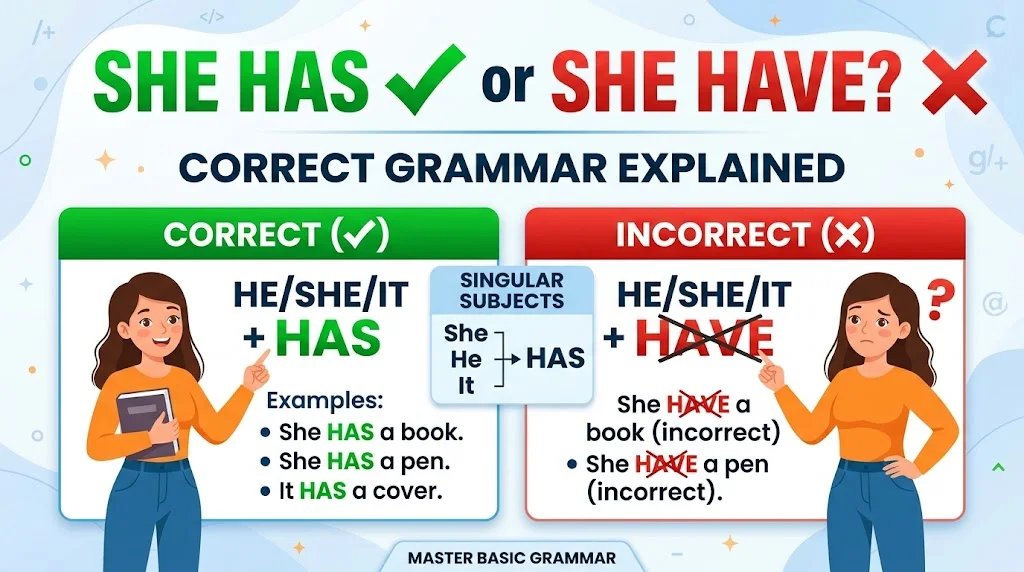
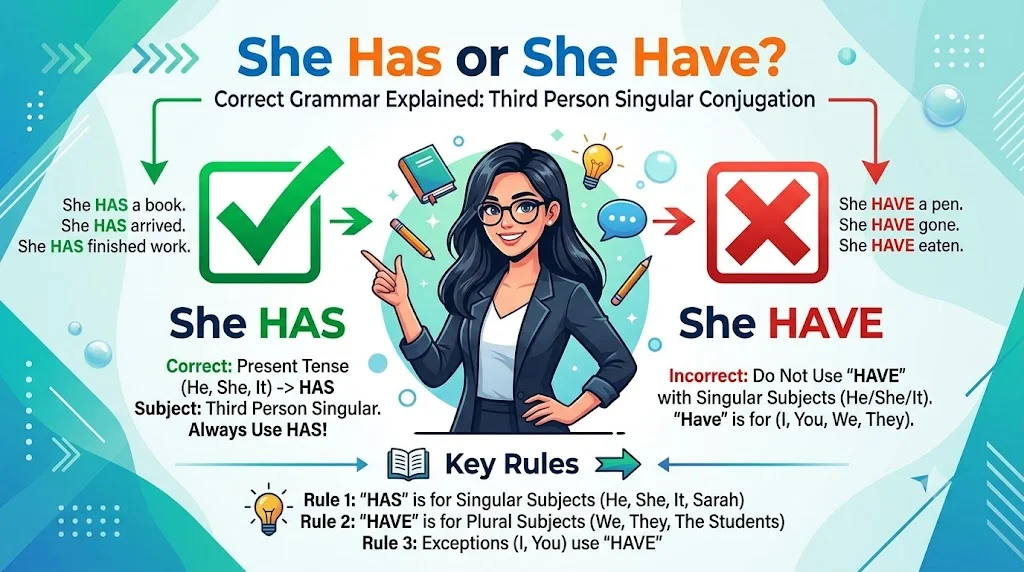
With the pronoun “she” (third-person singular), the verb “have” changes to “has” in the present tense.
| Sentence | Correct? | Why |
| She has a car. | ✅ Correct | “She” is third-person singular |
| She have a car. | ❌ Incorrect | Verb doesn’t match subject |
| Does she have a car? | ✅ Correct | Question form uses base verb |
| She doesn’t have a car. | ✅ Correct | Negative form uses base verb |
| She has had a car for years. | ✅ Correct | Present perfect: has + had |
This pattern isn’t random. It comes from a core grammar rule called subject-verb agreement, which we’ll unpack in detail below.
Why Do People Say “She Have” Instead of “She Has”?
Before correcting a mistake, it helps to understand where it comes from. Learners and even native speakers of certain dialects say “she have” for a few clear reasons:
- First-language influence. In many languages, verbs don’t change form based on the subject the way English does. Speakers of Spanish, Chinese, Vietnamese, and many other languages often carry that pattern into English, saying “she have” instead of “she has.”
- Overgeneralizing the base verb. Learners often memorize “I have,” “you have,” “we have,” “they have” — and then assume “have” works everywhere, including with “she,” “he,” and “it.”
- Dialect and regional speech patterns. In African American Vernacular English (AAVE) and some regional or informal dialects, “she have” can appear as a recognized dialectal feature. This is a linguistically valid dialect, not “bad grammar,” but it differs from Standard English, which is the form expected in school writing, business communication, and most formal contexts.
- Mishearing spoken English. In fast speech, “she has” can sound like “she’s” or blend together, causing learners to mishear the actual verb form.
Understanding why the mistake happens makes it much easier to correct — because once you know the rule, the “why” disappears.
The Grammar Rule: Why “She Has” Is Correct
What Is Subject-Verb Agreement?
Subject-verb agreement is a grammar rule stating that the subject of a sentence and its verb must match in number (singular or plural) and person (first, second, or third).
Definition: Subject-verb agreement means choosing the verb form that correctly corresponds to the subject performing the action.
In the present tense, most English verbs add an -s or -es when the subject is third-person singular (he, she, it, or a singular noun like “the dog” or “my sister”).
| Person | Pronoun | Verb “have” |
| First person singular | I | have |
| Second person | you | have |
| Third person singular | he/she/it | has |
| First person plural | we | have |
| Second person plural | you | have |
| Third person plural | they | have |
Notice that “has” only appears in one row — third-person singular. That’s the entire rule in visual form.
Common mistake: Treating “have” as a one-size-fits-all verb. Correct usage: Switch to “has” whenever the subject is he, she, it, or a singular noun.
Why “She” Always Takes “Has”
“She” refers to one female person or a singular female entity. Because it is singular and third-person, English grammar requires the irregular form “has” instead of the regular “have.”
This isn’t optional or stylistic — it’s a fixed grammar rule in Standard English, similar to how “he” takes “goes” instead of “go,” or “it” takes “runs” instead of “run.”
Examples:
- She has a meeting at 3 p.m.
- My sister has three cats.
- The manager has approved the request. (singular noun “manager” behaves like “she/he”)
Quick Tip: If you can replace the subject with “she,” “he,” or “it,” the verb needs the “-s” or “-es” ending: has, goes, runs, watches, does.
Has vs Have: What’s the Difference?
“Has” and “have” are both forms of the verb “to have,” one of the most important verbs in English. The difference between them isn’t meaning — it’s grammatical agreement with the subject.
Meaning: “To have” expresses possession, relationships, experiences, obligation, or illness (e.g., “She has a headache”).
Pronunciation:
- Has: /hæz/ (rhymes with “jazz”)
- Have: /hæv/ (rhymes with “gave,” but with a shorter vowel sound)
Word origin: Both come from the Old English verb habban, meaning “to hold” or “to possess.” Over centuries, English developed irregular third-person forms for common verbs like “have,” which is why “has” doesn’t simply follow the regular “-s” spelling pattern of most verbs.
When to Use Has
Use “has” with:
- He, she, it
- Singular nouns (the teacher, the company, the phone)
- Singular indefinite pronouns (someone, everybody, each)
Examples:
- He has a new laptop.
- Everybody has an opinion.
- The company has grown quickly.
When to Use Have
Use “have” with:
- I, you, we, they
- Plural nouns (the students, the dogs, the teachers)
- Base verb forms after modals and in questions/negatives
Examples:
- I have two brothers.
- They have finished the project.
- The students have submitted their essays.
Has vs Have Comparison Table
| Subject | Correct Verb | Example Sentence |
| I | have | I have a question. |
| You | have | You have great ideas. |
| He | has | He has a dog. |
| She | has | She has a dog. |
| It | has | It has four legs. |
| We | have | We have a meeting. |
| They | have | They have arrived. |
| Singular noun | has | The child has homework. |
| Plural noun | have | The children have homework. |
Similar words: possesses, owns, holds (formal synonyms for “has” when referring to possession) Opposite meaning: lacks, is missing, doesn’t have
How to Use “She Has” Correctly
“She has” isn’t limited to simple possession sentences. It appears in several grammar structures. Understanding each one helps you use it naturally and confidently.
She Has + Noun
This is the most basic structure, expressing possession, relationships, or characteristics.
Examples:
- She has a beautiful voice.
- She has two children.
- She has a strong work ethic.
Common collocations: she has a chance, she has a point, she has a plan, she has an idea, she has experience, she has a right
She Has + Past Participle (Present Perfect)
Here, “has” acts as an auxiliary (helping) verb to form the present perfect tense, which connects the past to the present.
Grammar explanation: Present perfect = has/have + past participle. It’s used for actions that started in the past and continue now, or past actions with present relevance.
Examples:
- She has finished her homework.
- She has traveled to over ten countries.
- She has worked here for five years.
Formal vs informal usage: In spoken, informal English, this often contracts to “she’s”: “She’s finished her homework.” Both are correct; the contraction is simply more casual and conversational.
She Has + To + Verb
This structure expresses obligation or necessity, similar to “must.”
Examples:
- She has to submit the report by Friday.
- She has to leave early today.
- She has to study for the exam.
Related phrase: “has got to” (informal) — “She’s got to leave now.”
Real-Life Examples
- Email: “She has reviewed the contract and approved it.”
- Conversation: “She has such a great sense of humor.”
- News: “The company has confirmed she has been appointed CEO.”
Practice examples (fill in with “has”):
- She ___ a new phone.
- She ___ already eaten lunch.
- She ___ to finish the report today.
When Can “Have” Come After “She”?
This is where many learners get confused, because “have” does sometimes appear near “she” — just not directly attached the way “has” is.
Questions (Does She Have…?)
In questions, English uses the auxiliary verb “does,” which already carries the third-person singular agreement. This means the main verb returns to its base form: “have,” not “has.”
Rule: Does + subject + base verb (have)
Examples:
- Does she have a car?
- Does she have any siblings?
- Does she have time today?
Common mistake: “Does she has a car?” ❌ Correct: “Does she have a car?” ✅
Why this happens: “Does” already signals singular agreement, so adding “-s” again to “have” would be redundant — grammatically, only one verb in the sentence needs the agreement marker.
Negative Sentences (She Doesn’t Have…)
The same logic applies to negatives. “Doesn’t” (does + not) carries the agreement, so “have” stays in its base form.
Examples:
- She doesn’t have a pet.
- She doesn’t have much free time.
- She doesn’t have any questions.
Common mistake: “She doesn’t has a pet.” ❌ Correct: “She doesn’t have a pet.” ✅
Modal Verbs (Can, Should, Will, Must, May, Could)
After modal verbs, all verbs — including “have” — return to their base form, regardless of the subject.
Examples:
- She can have some cake.
- She should have a backup plan.
- She will have more time next week.
- She must have a valid reason.
- She might have already left.
Grammar tip: Modal verbs never change form, and they never take “-s.” The verb that follows a modal is always in its base form.
Common Mistakes with “She Has” and “She Have”
Incorrect Sentences
- ❌ She have a new job.
- ❌ Does she has a laptop?
- ❌ She don’t have a car.
- ❌ She haven’t finished yet.
Correct Sentences
- ✅ She has a new job.
- ✅ Does she have a laptop?
- ✅ She doesn’t have a car.
- ✅ She hasn’t finished yet.
Why Learners Make These Mistakes
- Mixing up “don’t” and “doesn’t” (both should be “doesn’t” with “she”)
- Applying “have” as a universal default verb
- Forgetting that “has” changes to “have” in question and negative structures
- Confusing “haven’t” with “hasn’t” — remember, “she” always pairs with “hasn’t,” not “haven’t”
Quick Tip: If the sentence has “does,” “doesn’t,” or a modal verb, use “have.” If “she” is directly followed by the verb with no helper, use “has.”
She Has vs She Have: Side-by-Side Examples
| Situation | She Has | She Have |
| Simple present statement | She has a dog. | ❌ Incorrect |
| Present perfect | She has finished. | ❌ Incorrect |
| Question with “does” | — | Does she have a dog? ✅ |
| Negative with “doesn’t” | — | She doesn’t have a dog. ✅ |
| After a modal verb | — | She should have a dog. ✅ |
| Standalone statement | She has time. | She have time. ❌ (Non-standard) |
Practice Exercises (Test Yourself)
Fill in the Blanks
- She ___ a beautiful garden. (has/have)
- Does she ___ a driver’s license? (has/have)
- She ___ never been to Japan. (has/have)
- She doesn’t ___ any siblings. (has/have)
- She should ___ told me earlier. (has/have)
Choose the Correct Sentence
- a) She have a meeting today. b) She has a meeting today.
- a) Does she has your number? b) Does she have your number?
- a) She hasn’t called yet. b) She haven’t called yet.
Answers and Explanations
- has — simple present, singular subject
- have — “does” carries the agreement
- has — present perfect, singular subject
- have — “doesn’t” carries the agreement
- have — modal verb “should” requires base form
Choose the Correct Sentence — Answers:
- b) She has a meeting today.
- b) Does she have your number?
- a) She hasn’t called yet.
Quick Tips to Remember “Has” and “Have”
Easy Memory Trick
Think of “HAS” as reserved for He, A singular noun, and She/it. If you can substitute the subject with “he,” “she,” or “it,” use “has.” Everywhere else, use “have.”
Another trick: “she,” “he,” and “it” are all short, singular words — and they pair with the short, sharp-sounding verb “has.” Longer or plural subjects (I, you, we, they) pair with “have.”
Pronoun Chart
| Singular | Verb | Plural | Verb |
| I | have | We | have |
| You | have | You (plural) | have |
| He | has | They | have |
| She | has | — | — |
| It | has | — | — |
Common Grammar Rules
- Singular third-person subjects (he, she, it) take “-s” or “-es” verb endings in the present tense.
- Auxiliary verbs like “does,” “doesn’t,” “did,” and modals absorb the agreement, so the main verb stays in base form.
- Irregular verbs like “have” don’t follow the regular “-s” spelling pattern (have → has, not “haves”).
Frequently Asked Questions
1. Is it correct to say “she have”? No, “she have” is not correct in Standard English when used as a standalone statement. The correct form is “she has.” “She have” only sounds acceptable in certain informal dialects, but it’s considered nonstandard in formal writing, school, and business English.
2. Why does “she” use “has” instead of “have”? Because “she” is a third-person singular pronoun, and English requires third-person singular subjects (he, she, it) to take the irregular verb form “has” instead of the base form “have” in the present tense.
3. Is “does she have” or “does she has” correct? “Does she have” is correct. The helper verb “does” already carries the singular agreement, so the main verb “have” stays in its base form. Adding “-s” to both words is a common but incorrect double marking.
4. What is the difference between “has” and “have”? Both come from the verb “to have,” but “has” is used with third-person singular subjects (he, she, it), while “have” is used with I, you, we, they, and plural nouns. The meaning is identical; only the grammatical agreement differs.
5. Is “she haven’t” correct? No. The correct negative contraction with “she” is “hasn’t,” not “haven’t.” Correct: “She hasn’t finished yet.” Incorrect: “She haven’t finished yet.”
6. Can “have” ever follow “she” correctly? Yes, in specific structures: questions with “does” (“Does she have…?”), negatives with “doesn’t” (“She doesn’t have…”), and after modal verbs like can, should, will, or must (“She should have…”).
Final Thoughts
The confusion between “she has” and “she have” almost always comes down to one grammar rule: third-person singular subjects like “she” require the irregular verb form “has” in the present tense. Once that rule is clear, everything else — questions, negatives, and modal verb structures — falls into place naturally, since those patterns shift the agreement onto helper words like “does,” “doesn’t,” “should,” or “can.”
The best way to master this isn’t memorization alone. Practice with real sentences, notice the pattern in everyday reading, and say the sentences out loud until “she has” feels automatic. Grammar becomes natural through repetition, not just rules — and this is one rule worth repeating until it’s second nature.