
If you have ever paused mid-sentence wondering whether to type reorder or re-order, you are not alone. This is one of the most common hyphenation questions in American English, and the confusion makes sense — both forms look reasonable, both show up online, and even professional writers disagree.
The short version: “reorder” (no hyphen) is the standard, dictionary-preferred spelling in American English. But that is not the whole story, and understanding why will help you handle dozens of similar words with confidence. Let’s break it down like a grammar lesson, not just a quick fix.
Quick Answer: Is It “Reorder” or “Re-Order”?
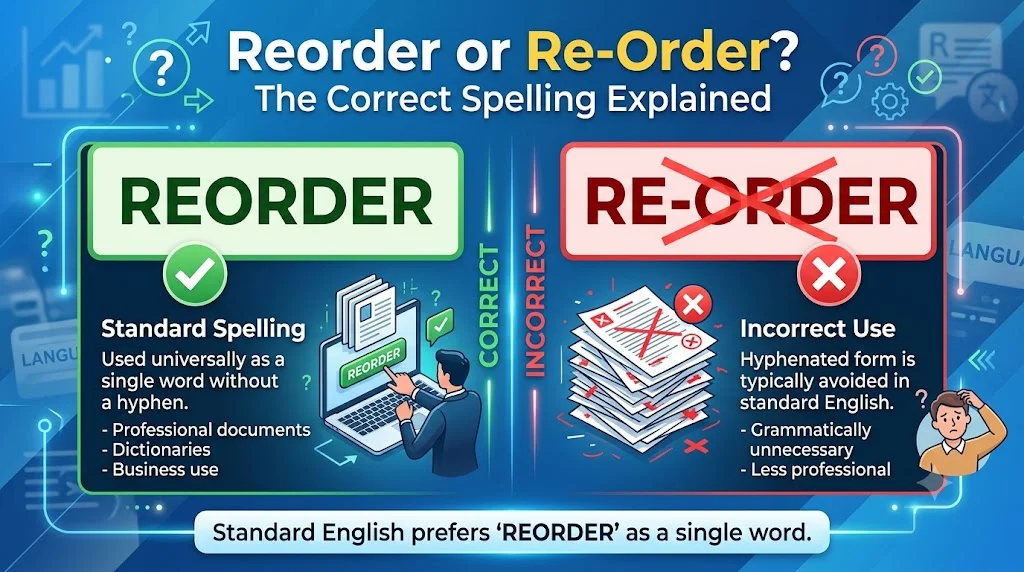
Use “reorder” (one word, no hyphen) in almost every situation in American English. Major dictionaries — Merriam-Webster, American Heritage, and Oxford (American edition) — all list “reorder” as the standard spelling.
- ✅ Correct (standard): I need to reorder printer ink.
- ⚠️ Acceptable but non-standard: I need to re-order printer ink.
- ❌ Incorrect: I need to re order printer ink (two separate words is never correct).
Quick Tip: When in doubt, drop the hyphen. American style guides consistently favor closed-up “re-” words unless the hyphen prevents confusion or awkward letter combinations.
What Does “Reorder” Mean?
Meaning and Definition
Reorder (verb) has two related meanings:
- To order something again — to place a new order for a product or service you have purchased before. Example: The café reorders coffee beans every two weeks.
- To arrange something in a different sequence — to change the order or organization of items. Example: Please reorder these slides so the introduction comes first.
Grammar Explanation
“Reorder” is a transitive verb, meaning it needs a direct object to complete its meaning (you reorder something). It follows regular verb conjugation:
| Form | Word |
| Base form | reorder |
| Third-person singular | reorders |
| Past tense | reordered |
| Past participle | reordered |
| Present participle | reordering |
| Noun form | reorder / reordering |
Pronunciation
Reorder is pronounced ree-OR-der (/riːˈɔːrdər/), with stress on the second syllable. The “re” sounds like the letter “R” plus a long “e,” not like “reh.”
Word Origin
“Reorder” combines the prefix re- (from Latin, meaning “again” or “back”) with the base word order (from Latin ordinem, meaning “row, rank, arrangement”). This prefix-plus-word structure is one of the most productive patterns in English — it’s how we get hundreds of words like rebuild, rewrite, and rethink.
Common Mistakes
- Writing “re order” as two separate words (not a word in English).
- Using “reoder” or “reordar” (misspellings).
- Confusing “reorder” with “reordain” (a religious term) or “reorganize.”
Correct Usage
- Formal: “Customers may reorder items directly from their account history.”
- Informal: “Just hit reorder if you liked it last time!”
Similar Words
Reissue, repurchase, restock, resequence, rearrange.
Opposite Words
Cancel, discontinue, unorder (rare), disorganize (for the sequencing meaning).
Related Phrases and Collocations
- Reorder a product / reorder stock / reorder inventory
- Reorder the list / reorder priorities / reorder the agenda
- “One-click reorder” (common in e-commerce)
- “Reorder point” (a supply-chain term for the inventory level that triggers a new order)
Synonyms
Repurchase, restock, resupply (for buying again); rearrange, resequence, reshuffle (for changing sequence).
Tips to Remember
Think of “re-” as a reusable Lego piece that snaps onto “order” without needing glue (a hyphen). Most common re- words don’t need one.
Practice Examples
- The pharmacy will _______ your prescription automatically. (reorder)
- Can you _______ these columns alphabetically? (reorder)
- We had to _______ due to a shipping error. (reorder)
Understanding the Re- Prefix and Hyphen Rule
This is the heart of the confusion, so let’s slow down and treat it like a real grammar lesson.
The General Rule
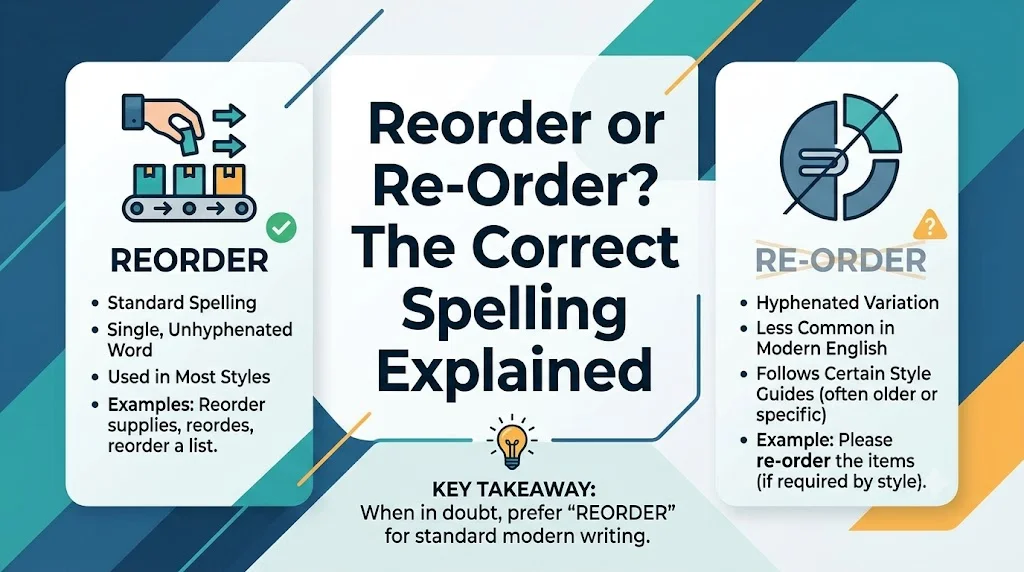
In American English, most words formed with the prefix “re-” are written as one word, without a hyphen. This has been the trend for decades, driven by style guides that favor simpler, cleaner text.
When a Hyphen IS Needed
You hyphenate a “re-” word only in specific situations:
- To avoid confusion with another word. Example: re-cover (to cover again) vs. recover (to get better or retrieve something).
- To avoid awkward double vowels. Example: re-enter, re-elect, re-examine (though some style guides now write these solid too: reenter).
- Before a proper noun or capitalized word. Example: re-Americanize.
- When the base word already contains a hyphen or is a compound. Example: re-sign (to sign again) vs. resign (to quit a job).
“Order” contains no double vowels, isn’t a proper noun, and doesn’t create a homograph clash with “reorder” — so no hyphen is needed.
Grammar Explanation: Why the Hyphen Usually Disappears
Historically, English hyphenated more prefix combinations. Over time, as words became familiar, publishers dropped the hyphens because readers no longer needed the visual “pause” to parse the word correctly. “Reorder” followed the same path as “reopen,” “restart,” and “rebuild” — common enough that the hyphen became unnecessary clutter.
Quick Tip
Ask yourself: Does removing the hyphen create a different, real word or an awkward letter cluster? If not, skip the hyphen.
When Should You Use “Reorder” Without a Hyphen?
Use the no-hyphen spelling in nearly all everyday and professional contexts:
- Business writing and emails
- Marketing copy and e-commerce buttons (“Reorder Now”)
- Academic and journalistic writing
- Technical documentation and software interfaces
- Casual conversation and texting
Example sentences:
- The app lets you reorder your favorite meals in seconds.
- She reordered the paragraphs to improve the essay’s flow.
- Our supplier automatically reorders parts when stock runs low.
When Should You Use “Re-Order” With a Hyphen?
Honestly? Almost never in standard American English. “Re-order” is not incorrect in the sense of being unreadable, but it is considered non-standard and outdated by current dictionaries and style guides.
You might still see the hyphenated form in:
- Older publications or documents written before spelling conventions simplified.
- British or international English sources (though even UK dictionaries now often list “reorder” first).
- Stylistic choices in branding, where a company intentionally uses “Re-Order” for visual emphasis or design purposes.
Formal vs. Informal Usage:
| Context | Preferred Spelling |
| Business email | Reorder |
| Legal or technical document | Reorder |
| Marketing slogan (stylistic choice) | Re-Order (rare, intentional) |
| Academic paper | Reorder |
| Casual text message | Reorder |
Examples of “Reorder” vs. “Re-Order” in Sentences
Business & E-commerce Examples
- ✅ Click “Reorder” to purchase this item again.
- ✅ The system flags products that customers frequently reorder.
- ⚠️ We will re-order the missing inventory by Friday. (acceptable but non-standard)
Technology Examples
- ✅ Drag and drop to reorder your playlist.
- ✅ The algorithm reorders search results based on relevance.
- ✅ Developers can reorder array elements using a sort function.
Everyday Writing Examples
- ✅ I need to reorder my grocery list by aisle.
- ✅ Let’s reorder the seating chart before the wedding.
- ✅ Can you reorder these photos chronologically?
AP Stylebook Rules for “Reorder”
The Associated Press (AP) Stylebook generally favors closed compounds for common prefixes like “re-” unless the resulting word is confusing or hard to read. AP style writers and journalists overwhelmingly use “reorder” without a hyphen, consistent with AP’s broader guidance to avoid unnecessary hyphens with prefixes such as co-, de-, non-, pre-, and re-, except when a double vowel or awkward combination occurs (as in re-elect).
Quick Tip: If you write for news, blogs, or journalistic content, default to “reorder.”
Chicago Manual of Style (CMOS) Rules
The Chicago Manual of Style, widely used in publishing and academic writing, also favors closing up prefixes when the meaning stays clear. CMOS’s hyphenation guidance treats “re-” much like AP does: hyphenate only for clarity (as with re-cover vs. recover) or to prevent an odd string of vowels. Since “reorder” creates no such issue, CMOS-aligned writing uses the solid form.
APA and MLA Style Guidelines
Academic style guides don’t always list every prefixed word individually, but they follow the same underlying logic:
- APA (7th edition): Recommends checking a current dictionary (typically Merriam-Webster) for prefix words not explicitly listed. Merriam-Webster lists “reorder” as the standard entry.
- MLA: Defers to standard dictionary spelling and favors consistency over hyphenation for common prefixed verbs.
Bottom line: Every major American style guide — AP, CMOS, APA, and MLA — supports “reorder” as the correct, standard spelling.
Words That Follow Different Hyphen Rules
Not every “re-” word behaves like “reorder.” Some genuinely require a hyphen to avoid confusion. Here’s a comparison table:
| Word Pair | Meaning Without Hyphen | Meaning With Hyphen |
| recover / re-cover | to get better; to retrieve | to cover again |
| resign / re-sign | to quit a job | to sign again |
| reform / re-form | to improve a system | to form again physically |
| recount / re-count | to narrate a story | to count again |
| recreate / re-create | to relax, have leisure | to create again |
| reorder / re-order | to order again or rearrange | (same meaning; hyphen optional but non-standard) |
Notice that “reorder” doesn’t have a competing homograph — that’s precisely why it doesn’t need a hyphen the way “re-cover” does.
Common Mistakes Writers Make
Over-Hyphenation
Many writers add hyphens out of habit or caution, assuming it looks more “correct.” This creates unnecessary clutter.
- ❌ Please re-order the files by date.
- ✅ Please reorder the files by date.
Why it happens: Writers often confuse “re-” hyphenation rules with rules for compound adjectives (like “well-known” or “up-to-date”), which are unrelated.
Under-Hyphenation
Less common, but some writers drop hyphens even when they’re genuinely needed for clarity, creating confusing sentences.
- ❌ He decided to reform the shattered vase. (unclear — does he mean “improve” or “physically reshape”?)
- ✅ He decided to re-form the shattered vase. (clear — reshape it)
Ignoring Dictionary or Style Guide
The biggest mistake is guessing instead of checking. When unsure, a 10-second dictionary search resolves the question instantly. Merriam-Webster, American Heritage, and Dictionary.com all list “reorder” as the primary entry.
Quick Tip: Bookmark Merriam-Webster.com. If a word isn’t hyphenated there, don’t hyphenate it in your writing.
American vs. British English: Is There Any Difference?
There is very little difference. Both American and British dictionaries now list “reorder” as the standard spelling. British English historically hyphenated more prefixed words than American English, but modern British style guides (including Oxford) have moved toward closed compounds for common “re-” words too.
| Variety | Preferred Spelling | Notes |
| American English | reorder | Standard in all major US dictionaries |
| British English | reorder | Increasingly standard; older texts may show “re-order” |
Tip for global writers: If you’re writing for an international audience, “reorder” is safe in both American and British contexts.
Should You Use “Reorder” in Titles and Headlines?
Yes — and it should stay unhyphenated. Headlines and titles follow the same spelling rules as body text; only capitalization rules change (title case vs. sentence case), not hyphenation.
Example headlines:
- ✅ “How to Reorder Your Favorite Products in One Click”
- ✅ “5 Ways to Reorder Your Priorities This Year”
- ❌ “How to Re-Order Your Favorite Products” (non-standard, avoid in SEO titles)
SEO Tip: Search engines treat “reorder” and “re-order” as closely related but not always identical queries. Using the standard spelling (“reorder”) in your titles and headers aligns with how most dictionaries, and most searchers, spell the word — helping both readability and search relevance.
Quick Hyphenation Cheat Sheet for Re- Words
| Rule | Example |
| Default: close up the word | reorder, rewrite, restart, rebuild |
| Hyphenate to avoid a homograph clash | re-cover vs. recover, re-sign vs. resign |
| Hyphenate to avoid double-vowel awkwardness (optional, style-dependent) | re-enter / reenter, re-elect / reelect |
| Hyphenate before a proper noun | re-Americanize |
| Never write as two separate words | ❌ re order, ❌ re cover |
Frequently Confused Re- Words
Recreate or Re-create
- Recreate = to relax or engage in leisure activity (as a noun-derived idea) — though today it’s mostly used as “recreation” (the noun). As a verb, it commonly means the same as “re-create” in casual use.
- Re-create = to create something again or reproduce it exactly.
- Example: Historians tried to re-create the ancient ritual for the documentary.
- Common mistake: Writing “recreate” when you mean “reproduce exactly” can look casual; many style guides still prefer the hyphen here for clarity.
Recover or Re-cover
- Recover = to get better (health) or retrieve something lost.
- Re-cover = to put a new cover on something.
- Example: We need to re-cover the sofa cushions; the old fabric is worn out.
- Example: She is starting to recover from her surgery.
Resign or Re-sign
- Resign = to quit a job or position.
- Re-sign = to sign a contract again (common in sports writing).
- Example: The team plans to re-sign their star quarterback.
- Example: He decided to resign from the board.
Reform or Re-form
- Reform = to improve a system, policy, or behavior.
- Re-form = to form again physically.
- Example: Lawmakers pushed to reform the tax code.
- Example: The clay will re-form into a new shape once reheated.
Recount or Re-count
- Recount = to narrate or tell a story.
- Re-count = to count again (common in elections).
- Example: Election officials ordered a re-count of the ballots.
- Example: She loved to recount stories from her childhood.
Quick Tip: In every one of these pairs, the hyphenated version means “to do the base action AGAIN,” while the closed version usually carries a distinct, often figurative, meaning. “Reorder” is the exception — both spellings mean essentially the same thing, which is exactly why the hyphen is unnecessary.
Why Dictionaries Prefer “Reorder”
Dictionaries base their entries on corpus data — massive databases of real-world writing that show how people actually use words. Because “reorder” doesn’t create ambiguity with another word (unlike “re-cover” or “re-sign”), there’s no linguistic reason to keep the hyphen. Lexicographers track usage frequency, and “reorder” has appeared as the dominant form in edited American English for decades, which is why Merriam-Webster, American Heritage, and Dictionary.com all list it as the primary, unhyphenated headword.
This reflects a broader trend called hyphen erosion — the natural tendency of frequently used prefixed words to lose their hyphens over time as they become familiar (think “email,” which used to be “e-mail”).
Final Verdict: Reorder or Re-Order?
“Reorder” is the correct, standard, dictionary-approved spelling in American English. Use “re-order” only if you’re intentionally matching an older text, a specific brand style, or British publishing conventions from decades past — and even then, it’s increasingly rare.
For everyday writing, business communication, SEO content, academic work, and virtually every professional context, choose “reorder” without a hyphen.
Conclusion
Spelling questions like “reorder vs. re-order” might seem small, but they matter — consistent, correct spelling builds trust with your readers and shows attention to detail, which search engines and human readers both reward. The rule here is refreshingly simple: American English has settled on “reorder“ as the standard form, backed by every major dictionary and style guide.
Once you understand the broader logic behind the “re-” prefix and hyphenation, you’ll be able to confidently handle tricky look-alikes like “recover/re-cover” and “resign/re-sign” too. When in doubt, check a dictionary, trust the closed-up form, and keep your writing clean and modern.
FAQs
1. Is “reorder” one word or two? “Reorder” is one word, written without a space or hyphen. It combines the prefix “re-” with “order” to mean ordering again or rearranging something. Writing it as two separate words (“re order”) is always incorrect in standard English.
2. Is “re-order” ever correct? “Re-order” isn’t technically wrong, but it’s non-standard in modern American English. Dictionaries and style guides prefer “reorder.” You may still see the hyphenated form in older texts, British publications, or stylistic branding choices.
3. What does “reorder” mean in business? In business and e-commerce, “reorder” means placing a new order for a product or service you’ve purchased before. It’s commonly used in phrases like “reorder point” or “one-click reorder” within supply chain and retail contexts.
4. How do you pronounce “reorder”? “Reorder” is pronounced ree-OR-der (/riːˈɔːrdər/), with the stress on the second syllable. The first syllable sounds like the letter “R” followed by a long “e” sound.
5. What is the past tense of “reorder”? The past tense and past participle of “reorder” are both “reordered.” Example: “She reordered the ingredients online yesterday.”