
If you’ve ever paused mid-sentence wondering whether to call your grandfather “bespeckled” or “bespectacled,” you’re not alone. These two words look almost identical, share the same old-fashioned “be-” prefix, and even sound alike when you say them quickly. But here’s the twist most articles won’t tell you plainly: these words don’t mean anything close to the same thing.
One describes spots. The other describes glasses. Mixing them up isn’t just a minor style slip — it’s a genuine meaning error, the kind an English teacher would circle in red pen. Let’s fix that for good.
Quick Answer: Bespeckled vs Bespectacled
Here’s the one-line version before we go deep:
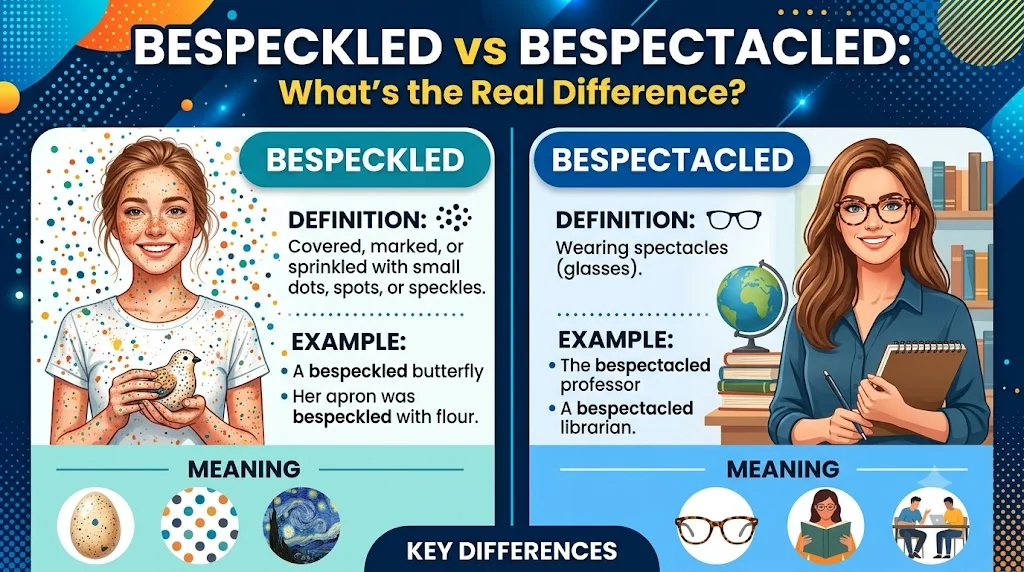
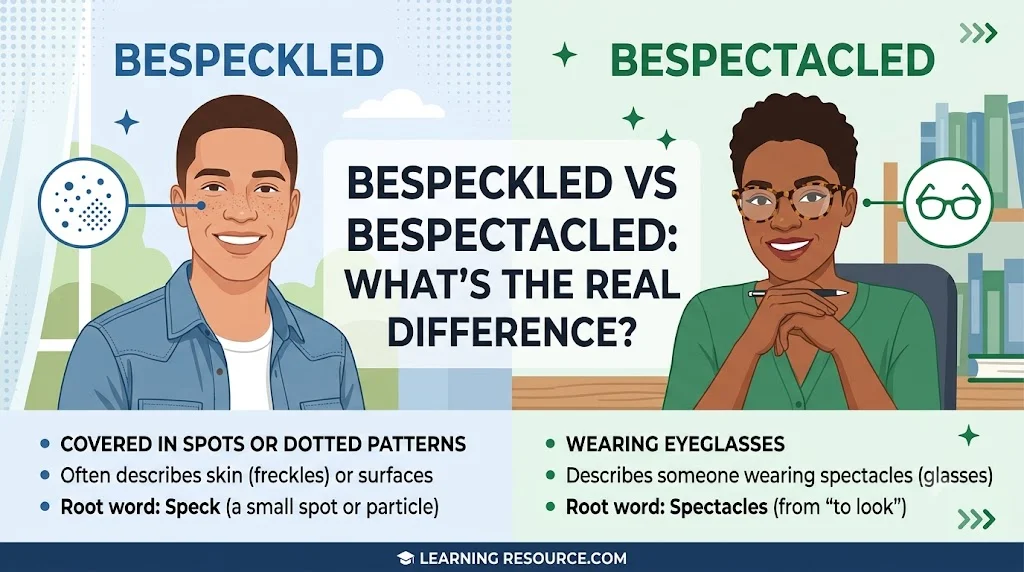
- Bespeckled means covered with small spots, dots, or speckles (like a bespeckled egg or a bespeckled leopard).
- Bespectacled means wearing eyeglasses or spectacles (like a bespectacled professor).
If you’re describing someone’s glasses, the correct word is almost always bespectacled. Bespeckled belongs to spots, freckles, and patterns — not eyewear.
Which Word Should You Use?
Ask yourself one simple question: Am I describing spots, or am I describing glasses?
- Talking about a person’s face full of freckles or a bird’s speckled feathers? Use bespeckled.
- Talking about a character, teacher, or scientist who wears glasses? Use bespectacled.
There’s no situation where the two words are interchangeable, even though writers often treat them that way by accident.
The Main Difference in One Minute
| Feature | Bespeckled | Bespectacled |
| Core meaning | Covered in small spots or speckles | Wearing eyeglasses |
| Root word | Speckle (a small spot or mark) | Spectacles (eyeglasses) |
| Used for | Skin, eggs, animals, surfaces, patterns | People (and occasionally animated characters) wearing glasses |
| Common image | A speckled bird’s egg, freckled skin | A librarian, professor, or owl-like character with glasses |
| Formality | Literary, descriptive | Slightly formal, descriptive, still common today |
Why People Confuse Bespeckled and Bespectacled
The confusion isn’t random — it happens for three clear reasons, and understanding them is the fastest way to stop making the mistake.
1. They share the same prefix. Both words start with “be-,” an old English prefix that means “to cover with” or “to provide with.” That shared beginning tricks the brain into assuming a shared meaning.
2. They sound similar when spoken fast. “Bes-PECK-uld” and “bes-PECK-tuh-kuld” roll off the tongue in almost the same rhythm, especially in casual conversation.
3. Glasses and spots share a visual link in some readers’ minds. People sometimes picture round glasses lenses as “spots” on a face, which unconsciously nudges them toward “bespeckled” when they actually mean glasses.
Once you see the pattern, the confusion stops making sense — and that’s exactly the goal of this article.
What Does Bespeckled Mean?
Definition
Bespeckled (adjective): covered or marked with small spots, specks, or speckles.
Think freckled skin, a speckled bird’s egg, or a leopard’s spotted coat. If something has a scattered pattern of small marks, “bespeckled” is the accurate, vivid word for it.
Origin and Etymology
“Bespeckled” comes from the prefix be- (meaning “thoroughly” or “all over”) combined with speckle, a Middle English word referring to a small spot or mark. Add the past-participle suffix “-ed,” and you get an adjective describing something entirely covered in small spots. The word has been used in English literature since at least the 1600s, often in poetic or descriptive nature writing.
Common Uses
- Describing skin with freckles
- Describing animals with spotted patterns (birds, fish, insects, reptiles)
- Describing surfaces with paint splatters or natural markings
- Descriptive, literary, and nature writing
Example Sentences
- The bespeckled hen’s egg sat quietly in the nest.
- Her bespeckled cheeks turned pink in the summer sun.
- The trout’s bespeckled skin shimmered under the water.
- Autumn leaves lay bespeckled with morning frost.
What Does Bespectacled Mean?
Definition
Bespectacled (adjective): wearing eyeglasses or spectacles.
This is the word you want when describing a person’s appearance in relation to their glasses — whether it’s a strict teacher, a curious child, or a wise-looking cartoon owl.
Origin and Etymology
“Bespectacled” comes from the prefix be- combined with spectacles, the older, more formal term for eyeglasses (from Latin spectaculum, meaning “a sight” or “a thing to look at”). The word entered common English usage in the 18th and 19th centuries, a period when spectacles became more widely worn and written about in literature.
Common Uses
- Describing a person’s physical appearance
- Character descriptions in fiction (professors, detectives, students)
- Journalism and biography writing
- Everyday descriptions of people who wear glasses
Example Sentences
- The bespectacled professor adjusted his glasses before the lecture.
- A young, bespectacled boy sat quietly in the front row.
- She remembered him as a bespectacled teenager buried in books.
- The bespectacled owl in the illustration looked wise and alert.
Grammar Explanation: How These Words Work in a Sentence
Both “bespeckled” and “bespectacled” are adjectives, and both are formed the same grammatical way: the prefix be- attaches to a noun (speckle or spectacles), and the suffix -ed turns that noun into a descriptive word. This pattern is common in English — think of words like “bejeweled” (covered in jewels) or “besotted” (overcome with affection). Once you recognize the pattern, you can often guess the meaning of similar “be-” words just by identifying the root noun hiding inside them.
Grammatically, both words can sit in two positions:
- Attributive position (before the noun): the bespectacled teacher, a bespeckled trout.
- Predicative position (after a linking verb): The teacher was bespectacled, The trout looked bespeckled.
Neither word changes form for plural nouns or for gender — they stay exactly the same whether you’re describing one person or a hundred.
- ✅ “The bespectacled students walked into the hall.” (plural noun, same adjective form)
- ✅ “The twins were both bespeckled with freckles.” (plural subject, same adjective form)
Quick Tip: Because both words are adjectives, they can never stand alone as the subject or object of a sentence. You always need a noun (a person, animal, or object) for them to describe.
Word Family: Related Forms of Bespeckled and Bespectacled
Understanding the “family” of words around each term makes both easier to remember and use correctly.
Bespeckled word family:
- Speckle (noun) — a small spot or mark
- Speckle (verb) — to mark with speckles
- Speckled (adjective) — a shorter, more common alternative to “bespeckled”
- Speckling (noun) — the pattern of speckles itself
Bespectacled word family:
- Spectacle (noun) — a visually striking display, or (plural) eyeglasses
- Spectacles (noun, plural) — the formal word for glasses
- Spectacular (adjective) — impressive or eye-catching (different meaning, same root)
- Spectator (noun) — someone who watches; shares the same Latin root, spectare (“to watch”)
Notice that “bespectacled,” “spectacular,” and “spectator” all trace back to the same Latin root meaning “to look” or “to watch.” That shared history is a helpful clue: anything with “spec-” or “spect-” in it usually has something to do with seeing, watching, or looking — which is exactly what glasses are for.
Bespeckled vs Bespectacled: Side-by-Side Comparison
| Category | Bespeckled | Bespectacled |
| Part of speech | Adjective | Adjective |
| Meaning | Covered with small spots | Wearing glasses |
| Root | Speckle | Spectacles |
| Syllables | 3 (bes-peck-uld) | 4 (bes-pek-tuh-kuld) |
| Used to describe | Objects, animals, skin | People |
| Tone | Poetic, descriptive | Neutral, descriptive |
| Frequency today | Less common, mostly literary | Common in writing and speech |
Pronunciation of Bespeckled and Bespectacled
Getting the pronunciation right helps lock in the meaning too, since the words don’t actually sound as similar as they look on paper.
- Bespeckled: /bih-SPEK-uld/ — three syllables, stress on the second syllable.
- Bespectacled: /bih-SPEK-tuh-kuld/ — four syllables, stress also on the second syllable.
Quick Tip: Say both words slowly. “Bespeckled” ends quickly after “speck.” “Bespectacled” carries an extra “-tac-” sound from “spectacles.” That extra syllable is your clue that the word relates to glasses.
When to Use Bespeckled Correctly
Everyday Situations
Use “bespeckled” when describing anything with a natural pattern of small spots — think freckled skin, speckled paint, or a spotted animal.
- “Her nose was bespeckled with freckles after the beach trip.”
Literary Writing
“Bespeckled” shows up often in poetry, fiction, and nature writing because of its soft, descriptive sound.
- “The bespeckled meadow bloomed with wildflowers of every color.”
Common Contexts
- Nature and wildlife writing
- Descriptions of skin, fruit, eggs, or fabric patterns
- Creative and literary prose
When to Use Bespectacled Correctly
Everyday Situations
Use “bespectacled” whenever you’re describing a person (or a personified character) who wears glasses.
- “The bespectacled cashier smiled and handed me my receipt.”
Formal Writing
“Bespectacled” appears comfortably in journalism, biographies, and formal character descriptions.
- “The bespectacled scientist presented her findings to the committee.”
Common Contexts
- Character description in novels and screenplays
- News articles and profiles
- Everyday conversation about someone’s appearance
Real-Life Examples of Bespeckled and Bespectacled
Seeing both words in realistic, everyday sentences makes the difference stick. Below are examples across different writing styles, so you can see how naturally each word fits into formal, informal, and narrative contexts.
Everyday conversation:
- The bespeckled trout darted beneath the rocks. (spots on a fish)
- My bespectacled neighbor waved from his porch. (a person wearing glasses)
Shopping and market descriptions:
- The bespeckled quail eggs sat in a neat row at the market. (spotted eggs)
- The shop assistant, a bespectacled young man, rang up my order. (a person wearing glasses)
News and journalism style:
- The bespectacled senator addressed reporters outside the courthouse. (a public figure wearing glasses)
- Wildlife officials photographed a rare bespeckled moth near the reserve. (a spotted animal)
Fiction and storytelling:
- The bespectacled child solved the puzzle before anyone else. (a child wearing glasses)
- Sunlight fell bespeckled across the forest floor, broken by the leaves above. (a pattern of light and shadow)
Formal biography or profile writing:
- Colleagues remembered him as a quiet, bespectacled man who rarely raised his voice.
- The naturalist’s field notes described a bespeckled frog species never recorded before.
Notice how “bespectacled” almost always attaches to a person, while “bespeckled” attaches to animals, surfaces, food, or natural patterns. That distinction holds true across every style of writing, from casual texts to published journalism.
Is Bespeckled an Archaic Word?
Not exactly archaic, but definitely less common in everyday speech today. “Bespeckled” survives mainly in literary, poetic, and nature writing, where its soft, old-fashioned tone adds texture to a description. You’re far more likely to encounter it in a novel or a nature documentary script than in a casual text message.
Is Bespectacled Still Used in Modern English?
Yes, and quite comfortably so. “Bespectacled” remains a standard, actively used word in modern English — you’ll find it in newspapers, novels, biographies, and everyday conversation. It hasn’t faded the way some “be-” words have, largely because glasses themselves remain a common and relevant topic of physical description.
Bespeckled vs Bespectacled in British and American English
Both words are used in British and American English without any real difference in meaning or spelling. Neither word changes form across dialects (unlike, say, “color” vs “colour”). The main difference between regions is tone: British English writers, especially in literary fiction, tend to reach for “bespeckled” slightly more often for atmospheric, descriptive effect, while American English leans more heavily on “bespectacled” in everyday character description.
Synonyms of Bespeckled and Bespectacled
Synonyms for bespeckled:
- Speckled
- Spotted
- Dotted
- Mottled
- Freckled
- Flecked
Synonyms for bespectacled:
- Wearing glasses
- Spectacled
- Wearing eyeglasses
- Glasses-wearing (informal)
Opposite Words
Opposites of bespeckled:
- Plain
- Unmarked
- Smooth
- Unblemished
Opposites of bespectacled:
- Bare-eyed (informal)
- Glasses-free
- Unspectacled (rare, but used)
Related Phrases and Common Collocations
With bespeckled:
- bespeckled skin
- bespeckled eggs
- bespeckled wings
- bespeckled fabric
With bespectacled:
- bespectacled professor
- bespectacled face
- bespectacled gentleman
- little bespectacled boy/girl
Can You Use Bespeckled for Someone Wearing Glasses?
No — this is the single biggest mistake writers make with these two words. “Bespeckled” never means “wearing glasses.” If you write “the bespeckled teacher adjusted his glasses,” you’ve technically described a teacher covered in spots, not a teacher wearing eyewear. It’s a common eggcorn (a word swapped for a similar-sounding one that changes the meaning), and it’s worth catching every time.
Common Mistakes Writers Make
Incorrect Usage
- ❌ “The bespeckled man took off his glasses.” (should be bespectacled)
- ❌ “Her bespectacled skin was covered in freckles.” (should be bespeckled)
- ❌ “He wore bespeckled glasses.” (nonsensical combination)
How to Avoid These Errors
Quick Tip: Before you write either word, ask: “Am I describing spots or glasses?” If the answer is “glasses,” the word must contain “spectacle” — think of “spectacles” hiding inside “bespectacled.” If the answer is “spots,” the word must contain “speckle.”
Memory Tricks to Remember the Difference
Mnemonic Trick
- SPECtacled = SPECtacles (glasses). Both start with “SPEC.”
- SPECKled = SPECKS (small spots). Both start with “SPECK.”
Notice the tiny but crucial difference: spec-TA-cled has an extra “TA” sound borrowed from “spectacles,” while speck-led stays short and simple, just like the word “speck.”
Visual Association
Picture a bespectacled owl wearing round glasses in a cartoon. Now picture a bespeckled egg with brown dots scattered across its shell. Keep those two images in your head, and you’ll never mix up the words again.
Modern Usage: Which Word Is More Common Today?
In modern English, bespectacled is used far more frequently than bespeckled. This makes sense — describing someone’s glasses comes up constantly in fiction, journalism, and everyday conversation, while describing spotted patterns is a more specialized, occasional need. If you had to guess which word appears in a random news article or novel, “bespectacled” is the safer bet.
How Dictionaries Define Bespeckled and Bespectacled
Standard dictionaries consistently separate these two words with distinct definitions:
- Bespeckled: marked or covered with speckles; spotted.
- Bespectacled: wearing spectacles or eyeglasses.
No major dictionary treats these words as synonyms or variants of each other, which confirms what this article has been building toward — they are simply two different words that happen to look alike.
Examples From Famous Books and Literature
Writers have long used both words to add vivid, precise detail to their descriptions:
- Nature and animal writing frequently uses “bespeckled” to describe birds’ eggs, fish scales, and forest floors dotted with light and shadow.
- Classic and modern fiction often uses “bespectacled” to introduce scholarly, bookish, or intellectual characters at a glance — the glasses becoming shorthand for curiosity or wisdom.
This literary pattern is a useful shortcut: if a character is being introduced as thoughtful, studious, or observant, “bespectacled” is almost always the word an author reaches for.
Why Small Word Differences Matter in English
A single letter or syllable can completely change what a sentence communicates. “Bespeckled” and “bespectacled” are a perfect example — swap one for the other, and you’ve described a completely different physical feature. Precision matters most in writing that people trust: journalism, academic work, professional emails, and published fiction. Getting small word pairs right is part of what builds credibility with readers.
Similar Confusing Word Pairs
If bespeckled vs bespectacled tripped you up, these commonly confused pairs are worth reviewing too.
Affect vs Effect
“Affect” is usually a verb meaning “to influence” (The rain affected our plans). “Effect” is usually a noun meaning “a result” (The effect was immediate).
Compliment vs Complement
“Compliment” means a nice remark (She gave me a compliment). “Complement” means something that completes or pairs well with something else (The scarf complements the coat).
Toward vs Towards
Both are correct. “Toward” is more common in American English, while “towards” is more common in British English. There’s no meaning difference between them.
Practice Exercises: Test Yourself
The best way to lock in any grammar lesson is to practice it. Try filling in the blank with either bespeckled or bespectacled before checking the answer key below.
- The ______ librarian pointed us toward the reference section.
- A ______ hen’s egg is often prized by collectors for its unique pattern.
- My uncle has been ______ since he was seven years old.
- The forest floor looked ______ with patches of morning light.
- The ______ detective in the novel never removed his round glasses.
- Her arms were lightly ______ with freckles after the summer.
- The ______ scientist explained the experiment slowly and clearly.
- The trout’s ______ skin made it easy to identify.
- He was a shy, ______ boy who loved reading in the corner of the library.
- The butterfly’s wings were ______ with tiny golden dots.
Answer Key:
- bespectacled
- bespeckled
- bespectacled
- bespeckled
- bespectacled
- bespeckled
- bespectacled
- bespeckled
- bespectacled
- bespeckled
How did you do? If you got 8 or more correct, you’ve mastered the difference. If you missed a few, go back to the “Mnemonic Trick” section and review the root-word method — it works every time.
Editor’s Tip: Choosing the Right Word Every Time
When you’re unsure which word to use, break it down to its root before you write. “Spectacles” hides inside “bespectacled” — a direct clue that it relates to glasses. “Speckle” hides inside “bespeckled” — a direct clue that it relates to spots. This one habit, checking the root word, will solve almost every confusing word pair you run into, not just this one.
Frequently Asked Questions
1. Is bespeckled a real word? Yes, “bespeckled” is a real, dictionary-recognized adjective meaning covered with small spots or speckles. It’s used mainly in descriptive, literary, and nature writing rather than everyday casual speech.
2. Is bespectacled a real word? Yes, “bespectacled” is a standard English adjective meaning “wearing eyeglasses.” It’s commonly used in fiction, journalism, and everyday descriptions of people.
3. Can bespeckled describe a person? Yes, but only in terms of spots or freckles on their skin — never in terms of glasses. For example, “her bespeckled arms” refers to freckles, not eyewear.
4. What’s the correct word for someone wearing glasses? The correct word is “bespectacled.” It directly comes from “spectacles,” the formal term for eyeglasses.
5. Why do bespeckled and bespectacled sound alike? Both words share the prefix “be-” and start with a similar “spec” sound, which makes them easy to confuse, even though their meanings are completely unrelated.
Final Thoughts
Bespeckled and bespectacled might look like word twins, but they describe two completely different things — one is about spots, the other is about glasses. The mix-up usually comes down to their similar sound and shared old-fashioned prefix, not any real overlap in meaning. Once you remember that “spectacles” hides inside “bespectacled,” and “speckle” hides inside “bespeckled,” the confusion disappears for good.
Whether you’re writing a novel, a school essay, or a quick text about your bespectacled coworker, choosing the right word adds precision and polish to your writing. Small distinctions like this one are exactly what separates careful writers from careless ones — and now you’re firmly in the careful category.