

If you have ever paused mid-sentence wondering whether to write “I am giving you this book” or “I have given you this book,” you are not alone. This is one of the most common mix-ups English learners — and even native speakers — make.
The confusion makes sense. Both words come from the same root verb, “give,” but they play very different grammatical roles. Giving is a present participle and gerund. Given is a past participle and adjective. Once you understand why each word exists, the confusion disappears for good.
In this guide, we will break down the meaning, grammar, pronunciation, and real-life usage of both words. You will also get comparison tables, tense breakdowns, common mistakes, memory tricks, and a practice quiz — everything you need to master giving vs given permanently.
Giving vs Given: What’s the Real Difference?
Quick Answer
Here is the short version before we go deeper:
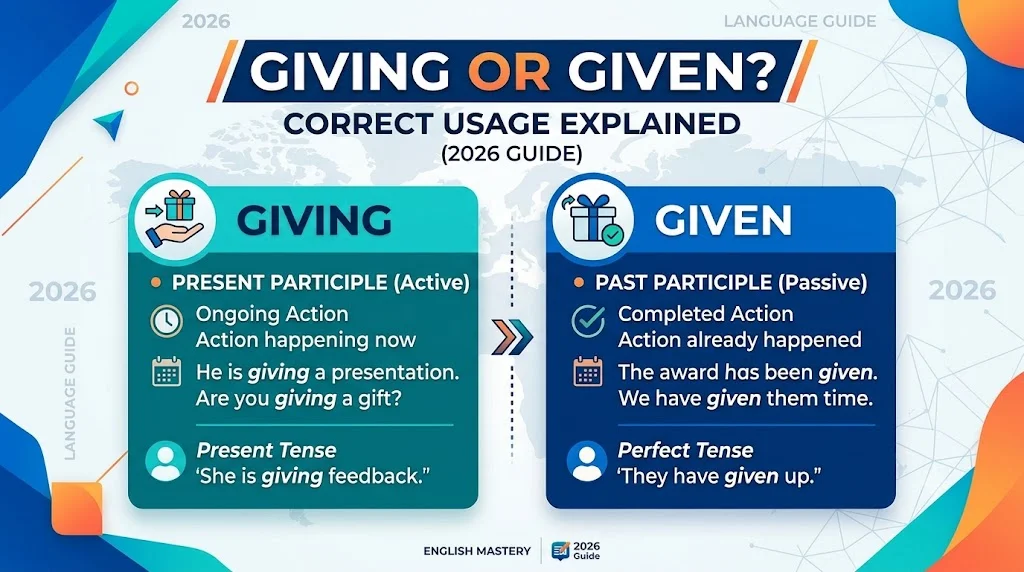
- Giving = the present participle/gerund form of “give.” Use it after am/is/are/was/were (continuous tenses) or as a noun (gerund). Example: She is giving a speech.
- Given = the past participle form of “give.” Use it after have/has/had (perfect tenses) or be (passive voice), or as an adjective. Example: She has given a speech.
Both words are grammatically correct — the difference lies entirely in context and sentence structure, not in meaning.
Comparison Table (Giving vs Given)
| Feature | Giving | Given |
| Word type | Present participle / Gerund | Past participle / Adjective |
| Base verb | Give | Give |
| Used with | am/is/are/was/were | have/has/had, be (passive) |
| Tense function | Continuous tenses | Perfect tenses, passive voice |
| Example | I am giving a gift. | I have given a gift. |
| Can be a noun? | Yes (gerund) | No |
| Can be an adjective? | No | Yes |
| Pronunciation | /ˈɡɪvɪŋ/ | /ˈɡɪvən/ |
Meaning of “Giving”
Giving comes from the Old English verb giefan, meaning “to hand over” or “to bestow.” The “-ing” ending marks it as either a present participle or a gerund, depending on how it’s used in the sentence.
Giving as a Verb
As part of a continuous (progressive) tense, giving shows an action that is currently happening, was happening, or will be happening.
Example: He is giving a presentation right now.
Grammar explanation: Formed with be + verb-ing. It always needs a helping verb (am, is, are, was, were, will be) before it.
Common mistake: Using “giving” without any helping verb — “She giving me a ride” is incorrect. It should be “She is giving me a ride.”
Giving as a Present Participle
A present participle describes an ongoing action or modifies a noun.
Example: The teacher, giving instructions to the class, paused for a question.
Here, “giving” acts like an adjective describing “the teacher,” without needing a helping verb.
Giving as a Gerund
A gerund is the “-ing” form of a verb used as a noun.
Example: Giving is better than receiving.
Grammar explanation: In this sentence, “giving” is the subject of the sentence, functioning exactly like a noun (e.g., “kindness” or “generosity”).
Formal usage: Giving to charity reflects strong personal values. Informal usage: Giving stuff away feels great, honestly.
Meaning of “Given”
Given is the irregular past participle of “give.” Unlike regular verbs that simply add “-ed” (like “walked” or “played”), “give” changes form entirely: give → gave → given.
Given as a Past Participle
Used with have/has/had to form perfect tenses, or with be to form the passive voice.
Example: They have given generously to the local shelter.
Grammar explanation: Perfect tense structure = have/has/had + past participle. Never use “give” or “giving” here — only “given.”
Common mistake: “I have gave him the keys” is wrong. The correct form is “I have given him the keys.”
Given as an Adjective
“Given” can describe a noun directly, meaning “specific” or “particular.”
Example: At any given moment, the system can process thousands of requests.
Here, “given” functions just like “particular” or “specific” — a true adjective, not part of a verb phrase.
Given as a Preposition
“Given” can also mean “considering” or “taking into account.”
Example: Given the circumstances, the team performed well.
This usage introduces a reason or condition, similar to “considering” or “in light of.”
Grammar Rules for Using Giving and Given
Here are the core rules to lock in:
- Giving always follows a form of “be” (am, is, are, was, were, will be, being) when used as a verb.
- Given always follows a form of “have” (have, has, had) in perfect tenses.
- Given follows a form of “be” in passive voice (is given, was given, has been given).
- Giving can stand alone as a gerund (a noun).
- Given can stand alone as an adjective or preposition, without any helping verb.
Quick Tip: If you can replace the word with “considering,” you need given. If you can replace it with “the act of,” you need giving.
When to Use Giving (With Examples)
Use giving in these situations:
- Continuous action: We are giving away free samples today.
- Past continuous: She was giving a lecture when the fire alarm rang.
- Future continuous: I will be giving my presentation at 3 p.m.
- As a gerund (subject): Giving feedback is part of my job.
- As a gerund (object): I enjoy giving compliments.
- After a preposition: He left without giving an explanation.
- As a present participle: Giving him one last chance, she waited by the phone.
When to Use Given (With Examples)
Use given in these situations:
- Present perfect: I have given my full effort this year.
- Past perfect: By the time I arrived, she had already given her speech.
- Future perfect: By next week, we will have given three donations.
- Passive voice: The award was given to the top student.
- As an adjective: Given the current data, the plan seems solid.
- As a preposition: Given his experience, he was the obvious choice.
- Fixed expression: That’s a given (meaning something is obvious or certain).
Giving vs Given in Different English Tenses
Present Continuous
Structure: am/is/are + giving Example: She is giving a tour of the museum.
Present Perfect
Structure: have/has + given Example: He has given his notice at work.
Past Perfect
Structure: had + given Example: They had given up before help arrived.
Future Perfect
Structure: will have + given Example: By June, she will have given over fifty workshops.
Giving vs Given in Passive Voice
Passive voice always uses given, never “giving,” because passive voice requires a past participle.
Active: The manager gave the employees a bonus. Passive: The employees were given a bonus by the manager.
Common mistake: “The employees were giving a bonus” is incorrect — it accidentally suggests the employees are the ones giving something, which reverses the meaning.
Giving vs Given in Everyday English Sentences
| Sentence | Correct Word | Why |
| I am ___ you my honest opinion. | giving | Continuous tense (am + giving) |
| She has ___ me great advice. | given | Perfect tense (has + given) |
| ___ the weather, we should stay home. | Given | Preposition meaning “considering” |
| ___ to others makes me happy. | Giving | Gerund as subject |
| He was ___ a second chance. | given | Passive voice |
Common Collocations With Giving
- Giving feedback
- Giving advice
- Giving birth
- Giving thanks
- Giving directions
- Giving a speech
- Giving permission
- Giving credit
Common Collocations With Given
- Given name
- Given the chance
- Given circumstances
- Take it as given
- Given up
- Given away
- Given birth (passive: “was given birth to”)
- A given day
Most Common Mistakes (And How to Fix Them)
Using Giving After Have/Has/Had
Incorrect: I have giving him the report. Correct: I have given him the report.
Why it happens: Learners often assume “-ing” always follows helping verbs, but perfect tenses specifically require the past participle.
Confusing Gerund and Participle
Incorrect: Giving is what he was doing it, and he doesn’t stop giving it. (Overuse/confusion) Correct: He kept giving without expecting anything back.
Tip: If “giving” is the subject or object of the sentence, it’s a gerund. If it describes an ongoing action with a helping verb, it’s a participle.
Using Given Incorrectly in Active Sentences
Incorrect: She given me a call yesterday. Correct: She gave me a call yesterday. (Simple past uses “gave,” not “given.”)
Quick Tip: “Given” always needs a helper (have/has/had/be) unless it’s working as an adjective or preposition. It never stands alone as a main verb in simple past.
Giving vs Given: Side-by-Side Examples
| Giving | Given |
| I am giving my seat to her. | I have given my seat to her. |
| We were giving out flyers. | We were given a warning. |
| She enjoys giving gifts. | She was given a gift. |
| Giving up isn’t an option. | He has given up smoking. |
| They are giving a discount. | A discount was given. |
Memory Tricks to Never Confuse Giving and Given Again
- “ING is happening. EN is done.” Words ending in “-ing” describe action in progress; words like “given” (ending in a consonant + “-en” sound) describe completed action.
- Pair it with the helper: “BE + giving” and “HAVE + given.” Memorize these two pairs like a chant.
- Think of “given” as a gift already delivered — it’s finished, wrapped, and handed over. “Giving” is still in your hands, mid-motion.
- Test with “considering”: If you can swap the word for “considering,” it must be “given.”
American vs British English Usage
The good news: giving and given follow identical grammar rules in both American and British English. There is no regional difference in the participle forms themselves.
However, some minor stylistic differences exist:
- British English slightly favors “given that” in formal writing (Given that the report is late, we must adjust the schedule), while American English often shortens it to just “given” (Given the report is late…), though both are acceptable in each dialect.
- “Given name” (first name) is used in both American and British English, though British English also commonly uses “Christian name” in older or more traditional contexts.
Practice Quiz (Test Yourself)
Choose the correct word: giving or given.
- She is ___ a speech tonight.
- I have ___ this a lot of thought.
- ___ the results, we should proceed.
- He enjoys ___ to charity.
- The prize was ___ to the winner.
- By next year, they will have ___ over $10,000.
- ___ up now would be a mistake.
- We were ___ a tour of the factory.
Answers: 1. giving | 2. given | 3. Given | 4. giving | 5. given | 6. given | 7. Giving | 8. given
Cheat Sheet: Giving vs Given at a Glance
| If your sentence has… | Use |
| am / is / are / was / were | giving |
| have / has / had | given |
| be + verb (passive voice) | given |
| the word functioning as a noun | giving |
| the word functioning as “considering” | given |
| the word describing a specific noun (“a given task”) | given |
Final Thoughts
The words giving and given are not interchangeable, but they are easy to master once you understand their grammatical jobs. Giving belongs with “be” verbs and works as a gerund or present participle. Given belongs with “have” verbs, passive voice, and functions as an adjective or preposition.
Whenever you’re unsure, ask yourself two questions: What helping verb comes before it? And is the action still happening, or already complete? Answering these two questions will guide you to the correct word almost every time. With a little practice, this grammar point becomes second nature.
Frequently Asked Questions
Is it “have given” or “have giving”?
The correct form is “have given.” Perfect tenses always use the past participle after “have,” “has,” or “had.” “Giving” is a present participle and cannot follow “have” in this structure. For example: I have given my answer is correct, while I have giving my answer is incorrect.
Can “giving” be used as a noun?
Yes. When “giving” acts as a gerund, it functions as a noun. For example: Giving is a core value in our family, or She finds joy in giving. In both cases, “giving” behaves exactly like a noun such as “generosity” or “kindness.”
Can “given” be used as an adjective?
Yes. “Given” often describes a specific or particular noun, as in a given situation or at any given time. In this role, it means “specific” or “particular,” and it doesn’t require any helping verb before it.
What is the past participle of “give”?
The past participle of “give” is “given.” The full irregular conjugation is: give (base form) → gave (simple past) → given (past participle). “Given” is used in perfect tenses and passive voice constructions.
How can I easily remember the difference between giving and given?
Remember this simple rule: “giving” pairs with be (am, is, are, was, were), while “given” pairs with have (have, has, had) or be in passive voice. Think of “giving” as an action still happening and “given” as an action that is already complete.
Is “giving” always followed by an object?
Not always, but it’s common. In sentences like She is giving a gift, “gift” is the object. However, “giving” can also stand alone, as in Giving feels good or He stopped giving after the request felt unreasonable.