
The expression all bark, no bite means that someone makes loud threats, speaks harshly, or behaves aggressively but does not take meaningful action. It comes from the behavior of dogs. A dog may bark loudly to appear threatening, but barking does not necessarily mean it will attack. Similarly, a person may use strong language, make intimidating statements, or act tough without having the intention or courage to follow through. Mastering idioms like “all bark and no bite”—alongside related expressions such as paper tiger, empty threats, and all talk—helps expand your expressive vocabulary, improves conversational fluency, and adds natural polish to your writing.
It suggests that a person may sound frightening, confident, or confrontational without actually intending to cause harm. For example, someone who constantly threatens to punish others but never follows through can be described as all bark, no bite. This informal expression is commonly used in everyday conversations, workplaces, schools, and social situations to distinguish between threatening words and actual behavior.
Meaning and Explanation
The phrase “all bark and no bite” functions as an adjectival idiom, most commonly applied to people, management styles, or aggressive posturing.
Figurative vs. Literal Meaning
- Literal Meaning: Refers to a noisy dog that barks loudly at passersby but refuses to snap, lunge backward, or run away if approached.
- Figurative Meaning: Refers to someone who uses tough language, angry gestures, or dramatic warnings to intimidate others, yet backs down the moment they are confronted or asked to follow through.
Tone and Context
This expression is informal to conversational. While commonly used in spoken English, informal business discussions, opinion pieces, and everyday writing, it is generally avoided in formal academic papers or strict legal contexts. Calling someone “all bark and no bite” carries a mild to moderate negative connotation, labeling them as overly aggressive, blustering, or unreliable.
Origin & History of “All Bark, No Bite”
The expression is closely related to the older English saying “His bark is worse than his bite,” which dates back to the early 19th century. An earlier version of the same idea appeared in John Heywood’s collection of English proverbs around 1550, reflecting the traditional observation that dogs that bark loudly do not necessarily bite.
One of the earliest recorded versions appeared in The Colonial Times newspaper in November 1829, using the wording “his bark is worse than his bite.” The more recognizable expression, “all bark and no bite,” appeared in print in The Banner newspaper in October 1853.
Here are 12 useful alternatives.
1. All Talk, No Action
2. Empty Threats
3. Full of Hot Air
4. Big Talker
5. Doesn’t Follow Through
6. More Show Than Substance
7. All Show, No Go
8. Paper Tiger
9. Bluffing
10. Big Words, Little Action
11. Toothless Threats
12. Barking Without Biting
Quick Comparison of Similar Expressions
| Expression | Main emphasis |
| All bark, no bite | Aggressive words without action |
| All talk, no action | Words without meaningful results |
| Empty threats | Threats that are not carried out |
| Paper tiger | Appearance of power without real strength |
| Full of hot air | Exaggerated or meaningless talk |
| Toothless threats | Threats without real force or authority |
Synonyms and Alternative Expressions
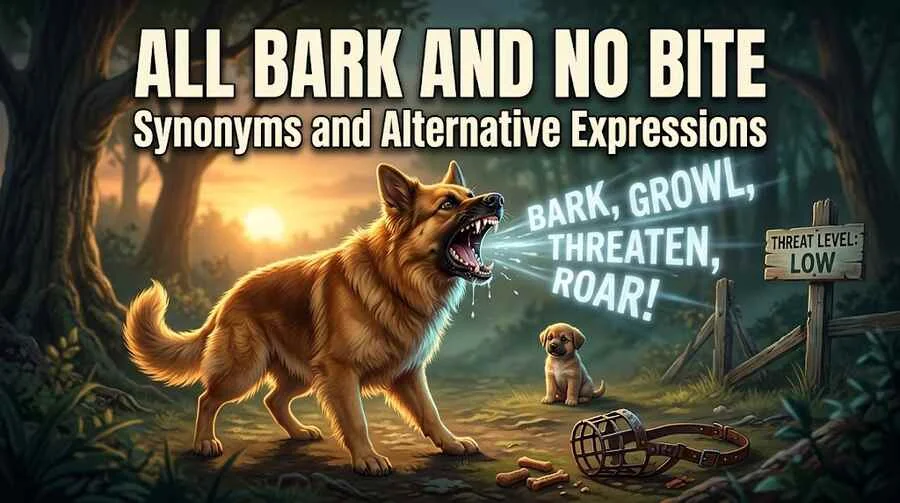
Here are 12 natural synonyms and alternative expressions to describe someone who makes empty threats or acts tougher than they are:
| Expression | Meaning | Example Sentence | Nuance / Difference |
| Empty threats | Warnings or promises of punishment that will never be carried out. | Don’t worry about his warnings; they’re just empty threats. | Focuses specifically on the warnings rather than the person’s character. |
| All talk (and no action) | Speaking ambitious or intimidating words without taking concrete steps. | She claims she’ll quit her job tomorrow, but she’s all talk. | Applies to both unfulfilled goals and empty threats, not just aggression. |
| Paper tiger | Something or someone that appears powerful but is actually harmless. | The new regulatory body turned out to be a paper tiger. | Often used in political, corporate, or institutional contexts. |
| Sabre-rattling | Displays of force or aggressive rhetoric intended to intimidate. | The manager’s loud speech was just corporate sabre-rattling. | Usually describes formal, strategic, or public displays of aggression. |
| Full of hot air | Full of empty, boastful, or meaningless talk. | Ignore the consultant; he’s full of hot air. | Emphasizes foolish boasting rather than hostile threats. |
| All show and no go | Having an impressive outward appearance without performance capacity. | That modified car looks fast, but it’s all show and no go. | Commonly applied to objects, vehicles, or physical appearances. |
| Blowhard | A boastful, loud person who talks tough or brags constantly. | Nobody listens to Marcus because he’s known to be a blowhard. | A noun used to label the person directly. |
| Wolf in sheep’s clothing (Opposite) | Someone who appears harmless but is secretly dangerous. | Be careful around Sarah; she’s a wolf in sheep’s clothing. | Direct opposite: Looks gentle, but actually bites. |
| Big talker | Someone who boasts or makes grand claims without backing them up. | He’s a big talker in meetings, but he never delivers results. | Focuses on self-promotion and grand promises rather than hostility. |
| All hat and no cattle | Displaying the outer symbols of expertise or power without substance. | He wears expensive suits, but as an investor, he’s all hat and no cattle. | A regional (American Western) idiom focused on status and wealth. |
| Toothless | Lacking the legal authority or power to enforce rules. | Without enforcement powers, the new policy remains entirely toothless. | Used primarily for laws, committees, or corporate policies. |
| Bluster | Loud, aggressive, or indignant talk with little real impact. | Behind all his theatrical bluster, the director was surprisingly timid. | Refers to the stormy, loud tone of speech itself. |
Everyday Usage and Real-Life Examples
The idiom easily adapts to personal relationships, office dynamics, school environments, and casual conversations.
Realistic Example Sentences
- Workplace: “Our department head threatens to write people up every Friday, but he’s all bark and no bite.”
- Sports: “The opposing team did a lot of pre-game trash talk, but they proved to be all bark, no bite once the match began.”
- Social Media: “Internet trolls are almost always all bark and no bite when you address them directly.”
- School / Academics: “Professor Davis acts extremely strict on the first day of class, but she’s all bark and no bite—she extends deadlines all the time.”
- Customer Service: “The customer swore he would sue the company over a five-dollar fee, but the staff knew he was all bark and no bite.”
- Parenting: “If you don’t enforce screen-time limits, your kids will realize your rules are all bark and no bite.”
- Negotiation: “During contract talks, their legal team used aggressive rhetoric, but our negotiators realized it was all bark and no bite.”
- Daily Life: “Don’t be afraid of the neighbor’s golden retriever; he makes a lot of noise, but he’s all bark and no bite.”
Practical Dialogues
Scenario 1: Dealing with a Tough Boss
Alex: “Did you hear Mr. Henderson shouting about cancelling our bonuses if we miss the Tuesday deadline?”
Sam: “Yeah, but don’t panic. He says that every quarter. He’s all bark and no bite.”
Scenario 2: Neighborly Advice
Elena: “I’m nervous about talking to the landlord about the heating issue. He always sounds so angry on the phone.”
Jordan: “Trust me, he’s all bark, no bite. Just state your request clearly, and he’ll handle it.”
Correct Usage and Common Mistakes
Sentence Structure and Grammar Patterns
- As a Predicate Adjective: Placed after linking verbs like be, seem, turn out to be, or prove to be.
- Grammar Structure: [Subject] + [Linking Verb] + all bark and no bite
- Example: “The supervisor is all bark and no bite.”
- With or Without “And”: Both “all bark and no bite” and “all bark, no bite” are grammatically acceptable and widely recognized.
Common Learner Mistakes
| Incorrect Usage | Corrected Version | Explanation |
| ❌ He is all bark but no bite. | ✅ He is all bark and no bite. | While “but” makes logical sense, the fixed idiomatic expression uses “and” (or a comma). |
| ❌ She has all bark and no bite. | ✅ She is all bark and no bite. | The idiom functions as an adjectival phrase modifying the subject via a linking verb (is), not a noun phrase of possession (has). |
| ❌ The dog barked no bite. | ✅ The dog is all bark and no bite. | The words “bark” and “bite” function as nouns within the fixed idiomatic phrase. |
| ❌ He was all bite and no bark. | ✅ He was all bark and no bite. | Reversing the terms changes the order of the established idiom. |
Related Words and Practical Tips
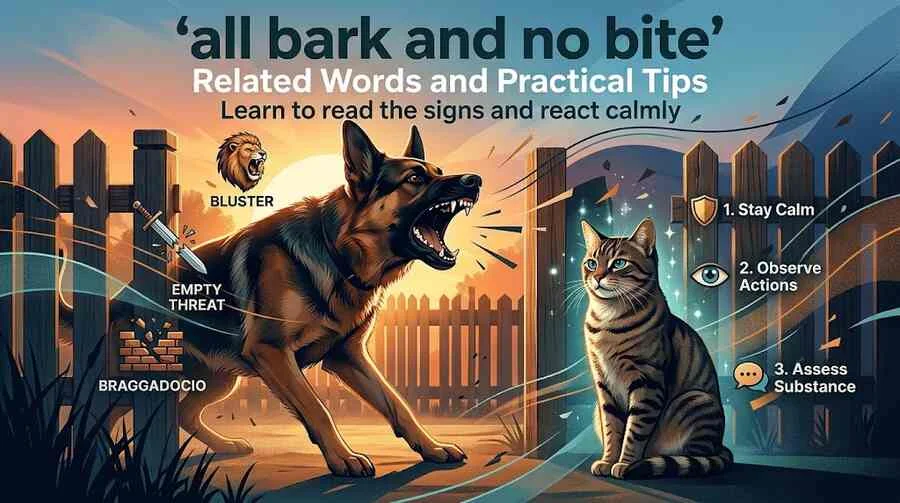
Related Terminology
- Blusterer / Blowhard (Noun): A person who behaves in a loud, threatening manner without substance.
- Bragging / Boasting (Verb/Noun): Speaking with excessive pride about achievements or abilities.
- Posturing (Noun): Behavior intended to impress or mislead others regarding one’s power or intentions.
4 Practical Tips to Master the Idiom
- Associate with Dogs: Picture a small dog barking loudly behind a sturdy fence. If the gate opens, it runs away. This mental image instantly locks in the phrase’s meaning.
- Remember the Linking Verb: Always pair the idiom with verbs like is, was, seems, or turns out to be. (e.g., “He is all bark…”)
- Use for Harmless Threats: Reserve this phrase for situations where someone’s hostility is harmless. Do not use it if real danger or actual risk is present.
- Keep the Fixed Order: Always place bark before bite. Reversing them breaks the flow of standard English speech.
Linguistic & Communication Insight
Understanding “all bark, no bite” requires more than knowing its dictionary definition. The expression carries an implied judgment about credibility, intention, and the relationship between language and behavior.
Emotional weight and subtext
When native English speakers use this idiom, they often communicate skepticism as well as description. The speaker is not merely reporting that someone has made threats; they are suggesting that those threats are unlikely to lead to meaningful action.
Depending on context, the phrase can signal reassurance, amusement, frustration, or contempt. Saying it about a friend may sound playful, while saying it about a manager may undermine that person’s authority.
Direct versus indirect phrasing
“All bark, no bite” is relatively direct because it assigns a recognizable label to someone’s behavior. Softer alternatives can communicate the same concern without making the person feel personally attacked.
Compare these statements:
- Direct: “He’s all bark, no bite.”
- Neutral: “He has made several strong statements without following through.”
- Collaborative: “Let’s focus on what actions have been taken and what remains outstanding.”
The first is concise and expressive. The second is more factual. The third encourages problem-solving rather than judgment.
Professional communication perspective
In the workplace, language can influence whether people feel respected, challenged, or dismissed. Describing someone as “all bark, no bite” may be appropriate in an informal discussion, but it is rarely the strongest choice for documentation or formal feedback.
A more useful professional approach separates three things: what someone said, what they did, and what remains uncertain. This structure improves accuracy and makes it easier to discuss next steps.
Why experienced communicators choose alternatives
Professionals often select neutral wording to reduce defensiveness, maintain working relationships, and keep discussions focused on results.
For example, “The proposed deadline has not been supported by a delivery plan” identifies a practical concern without questioning someone’s character. It gives the other person an opportunity to explain the situation or offer a solution.
Social signaling
Word choice also signals the speaker’s communication style. A sharp idiom can project confidence or humor, but it can also suggest impatience. Neutral phrasing tends to signal fairness and a willingness to distinguish evidence from assumptions.
Tone and context guidance
Before using the phrase, consider three questions:
- Audience: Will the listener understand the idiom and its intended tone?
- Purpose: Are you joking, reassuring someone, criticizing behavior, or documenting a concern?
- Evidence: Have you observed a repeated pattern, or are you guessing what someone will do?
If your purpose is to explain a pattern informally, the idiom can work well. If your purpose is to make a decision, assess risk, or give professional feedback, use specific and verifiable language.
Pros and Cons of Using “All Bark, No Bite”
The expression has several advantages, but it also carries limitations that are worth considering.
Advantages
- Clarity: It quickly communicates the difference between threatening words and actual behavior.
- Efficiency: A short idiom can replace a longer explanation when the context is already clear.
- Accessibility: Many English speakers recognize it, making it useful in everyday communication.
- Memorability: Its familiar comparison makes the underlying idea easy to remember.
- Expressiveness: It can convey skepticism, mild humor, or criticism without requiring a lengthy explanation.
Potential Drawbacks
- Oversimplification: It may ignore legitimate reasons why someone has not acted.
- Tone mismatch: It can sound disrespectful in formal or sensitive situations.
- Repetition: Overusing the idiom makes writing predictable and less precise.
- Unverified assumptions: It can encourage people to assume that a threat is harmless without sufficient evidence.
- Relationship damage: Using the expression about a colleague or client may make an already difficult relationship worse.
The best approach is to use the idiom when its conversational impact is useful and switch to precise, evidence-based wording when the consequences matter.
FAQ:
What is the origin of “all bark and no bite”?
The idiom stems from centuries-old proverbs observing canine behavior. Early English variations date back to the 16th and 17th centuries, including phrases like “barking dogs seldom bite.” Over time, the phrasing evolved into the modern adjectival shorthand “all bark and no bite.”
Is “all bark and no bite” offensive?
It is not inherently vulgar, but it can be perceived as critical or patronizing. Calling someone “all bark and no bite” directly to their face implies that they are weak, cowardly, or dishonest about their capabilities. Use it with discretion in professional settings.
Can you use “all bark and no bite” for non-human subjects?
Yes. You can apply the idiom to organizations, laws, committees, software warnings, or security systems that project an intimidating presence but lack actual enforcement power or consequences (e.g., “The new office policy is all bark and no bite”).
What is the difference between “all bark and no bite” and “all talk”?
“All bark and no bite” specifically emphasizes aggressive threats, tough posturing, or intimidation that yields no action. “All talk” is broader, applying to empty promises, unfulfilled personal goals, bragged-about plans, or general talkativeness without follow-through.
What is the opposite of “all bark and no bite”?
Common opposites include phrases like “a quiet force,” “bites without barking,” or “a wolf in sheep’s clothing.” These expressions describe individuals who say very little or seem harmless, yet possess substantial power, authority, or lethal force when provoked.
Can “all bark and no bite” be used in business writing?
It is acceptable in casual business commentary, opinion articles, blog posts, and internal conversations. However, formal executive summaries, legal filings, and official client reports should use professional alternatives such as “lacks enforcement mechanism,” “ineffective deterrence,” or “paper tiger.”
Is it “all bark and no bite” or “all bark, no bite”?
Both versions are correct and widely used by native speakers. “All bark and no bite” is slightly more common in traditional writing, while “all bark, no bite” appears frequently in casual conversation and headline writing.
How do you punctuate “all bark and no bite” when it modifies a noun?
When placed directly before a noun as a compound modifier, hyphenate the phrase: “He is an all-bark-and-no-bite manager.” When placed after a linking verb, leave it unhyphenated: “The manager is all bark and no bite.”
Conclusion:
The idiom “all bark and no bite” remains one of the most vivid ways in the English language to describe someone whose aggressive behavior hides a complete lack of substance or bravery. By distinguishing between literal noise and actual consequences, this phrase allows writers and speakers to capture complex human behavior in a few simple words.
Mastering idioms like “all bark and no bite”—alongside related expressions such as paper tiger, empty threats, and all talk—helps expand your expressive vocabulary, improves conversational fluency, and adds natural polish to your writing. Try incorporating it into your next informal discussion or writing project to describe loud posturing with precision and confidence.

I am passionate about the English language, grammar, vocabulary, and effective communication. Through Grammar Hub Pro, I aim to help students, professionals, teachers, and English learners improve their language skills. I enjoy exploring English grammar rules, discovering useful words, explaining idioms and phrases, and sharing practical writing tips. My goal is to make learning English simple, clear, and enjoyable for everyone. I create helpful, easy-to-understand content with practical examples so readers can use English more confidently in everyday conversations, academic studies, and professional communication. I believe learning English should be accessible to everyone.