
Articles are an essential part of English grammar because they help readers understand which person, place, thing, or idea a sentence refers to. Although words such as a, an, and the may seem small, they play an important role in making sentences clear and meaningful. Learning how to use articles correctly can improve your speaking, writing, and overall communication skills.
In English, there are three main articles: a, an, and the. These words are divided into two categories: definite and indefinite articles. Each category has its own purpose and usage rules. Once you understand the differences, choosing the correct article becomes much easier.
What Are Articles in English Grammar?
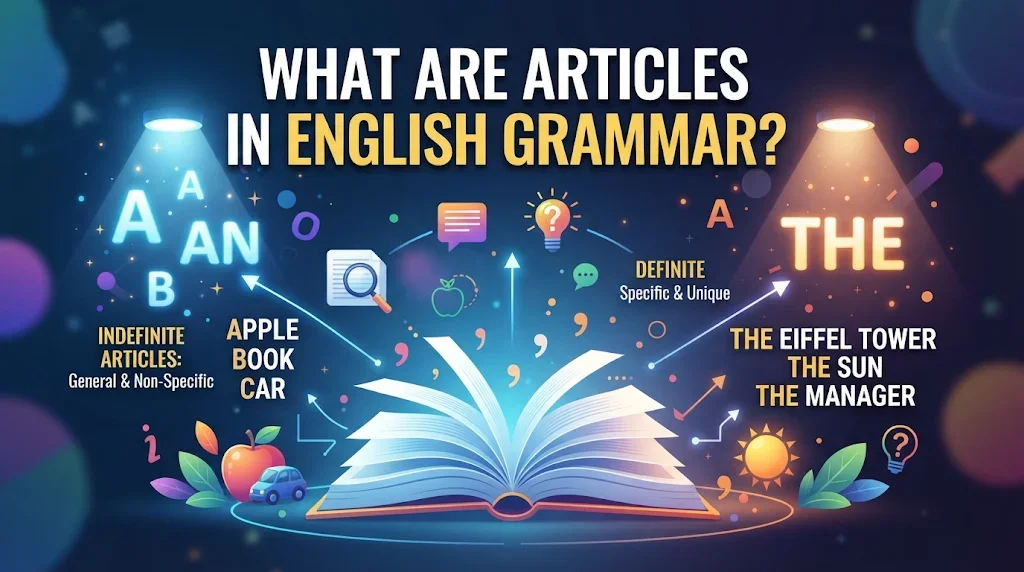
Articles are words placed before nouns to show whether we are referring to something particular or something general. They provide information about the noun and help establish its meaning within a sentence.
For example:
- I saw a bird sitting on the tree.
- The bird was singing beautifully.
In the first sentence, a bird refers to any bird that has not been identified. In the second sentence, the bird refers to the particular bird mentioned earlier. Articles usually appear before nouns, but they can also come before adjectives that describe nouns.
For example:
- She bought a beautiful dress.
- He is reading an interesting book.
Understanding this basic concept is the first step toward using English articles correctly.
Types of Articles in English
English grammar has three articles: a, an, and the. These articles belong to two main groups.
1. Definite Article (The)
2. Indefinite Articles (A and An)
The word the is called the definite article. It is used when the speaker or writer refers to a particular person, place, object, or thing that is already known or identifiable.
The definite article can be used with singular nouns, plural nouns, and uncountable nouns.
Examples:
- Please close the door.
- The children are playing outside.
- The water in this bottle is cold.
- We visited the museum yesterday.
- The teacher explained the lesson.
In these examples, the article the points toward something specific rather than something general.
2. Indefinite Articles (A and An)
The words a and an are known as indefinite articles. They are generally used with singular countable nouns when referring to something that is not specifically identified.
Although both words have similar meanings, their usage depends on pronunciation.
Examples:
- She wants a new phone.
- I found an old photograph.
- He adopted a puppy.
- We watched an exciting movie.
- My father purchased a bicycle.
Remember that a and an are not interchangeable in every situation. The correct choice depends on the first sound of the following word.
Difference Between A, An, and The
Although all three words are articles, they serve different purposes. The following table highlights their main differences.
| Article | Type | Main Usage | Example |
| A | Indefinite | Before consonant sounds | A student |
| An | Indefinite | Before vowel sounds | An artist |
| The | Definite | Before specific nouns | The student |
Remember:
- A introduces a general singular countable noun with a consonant sound.
- An introduces a general singular countable noun with a vowel sound.
- The identifies a particular noun that is known or identifiable.
Why Are Articles Important in English?
Articles may be short words, but they contribute significantly to sentence meaning. Using them correctly helps speakers and writers communicate more naturally.
Here are some important benefits of learning articles:
- Clear Communication: Articles help readers understand whether a noun is general or specific.
- Better Grammar: Correct article usage makes sentences grammatically accurate.
- Improved Writing: Articles make written communication more natural and polished.
- Natural Speaking: Understanding articles helps English learners speak more fluently.
- Stronger Reading Skills: Recognizing articles makes it easier to understand sentence structure and meaning.
Whether you are writing an email, preparing an assignment, or having a conversation, articles help make your message easier to understand.
When to Use A and An
One of the most important rules of English grammar is knowing when to use a and when to use an.The basic rule is simple:
- Use a before a word that begins with a consonant sound.
- Use an before a word that begins with a vowel sound.
Use A Before Consonant Sounds
The indefinite article a is used when the next word starts with a consonant sound.
Examples:
- A cat is sleeping on the sofa.
- She works in a hospital.
- He bought a new computer.
- I need a pencil for writing.
- They live in a small village.
Use An Before Vowel Sounds
Use an when the following word begins with a vowel sound, such as the sounds represented by A, E, I, O, and U.
Examples:
- She ate an apple.
- He is an intelligent student.
- I saw an elephant at the zoo.
- We waited for an hour.
- This is an unusual situation.
Important: Focus on Sounds, Not Just Letters
A common mistake is choosing an article based only on the first written letter. However, English articles follow pronunciation rather than spelling.
Consider these examples:
| CorrectExpression | Explanation |
| A university | Begins with a /y/ consonant sound |
| An umbrella | Begins with a vowel sound |
| A European country | Begins with a /y/ consonant sound |
| An honest person | The initial h is silent |
| A one-way street | Begins with a /w/ consonant sound |
| An hour | The initial h is silent |
This rule also applies to abbreviations and initialisms:
- An FBI agent
- An MBA student
- A UNESCO organization
- An SOS signal
Always listen to the first pronounced sound before selecting an article.
Using Articles Before Adjectives
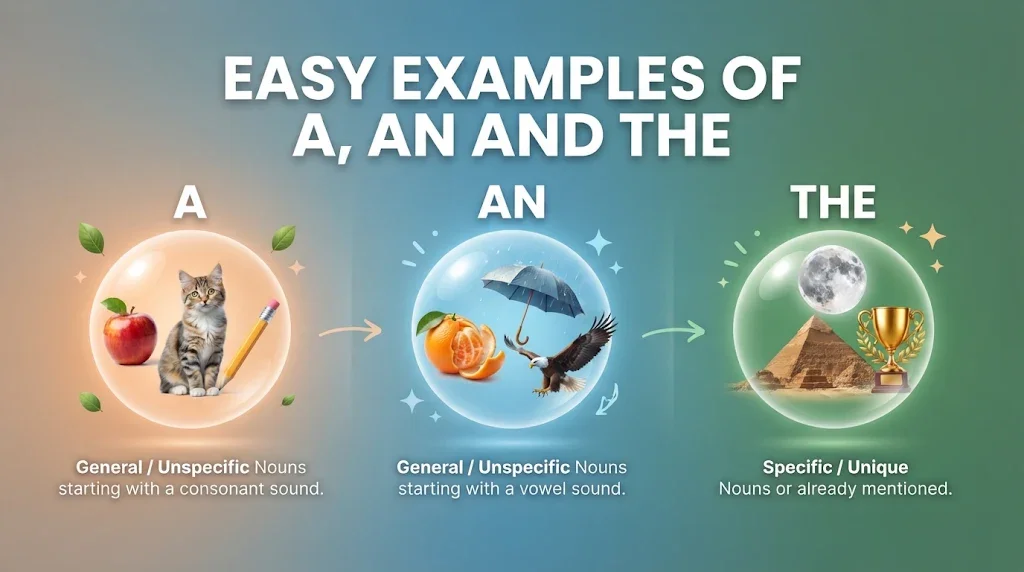
Articles are not limited to situations where a noun appears immediately after them. They can also come before adjectives that describe nouns.
When an adjective comes between an article and a noun, select a or an according to the adjective’s first sound.
Examples:
- She purchased a beautiful necklace.
- He shared an amazing experience.
- They live in a comfortable house.
- I received an unexpected gift.
- We visited the famous restaurant.
Notice that the article is selected according to the word immediately following it, not the noun at the end.
For example:
- A useful tool.
- An interesting idea.
- A wonderful opportunity.
Rules for Using the Definite Article The
The article the has several important uses in everyday English. It helps identify specific nouns and makes communication more precise.
1. Use The for Something Already Mentioned
When a noun has already been introduced, use the when referring to that same noun again.
Example:
I bought a notebook yesterday. The notebook has a blue cover.
2. Use The for Unique Things
Use the before nouns that refer to something considered unique in a particular context.
Examples:
- The sun rises in the east.
- The moon looks beautiful tonight.
- The Earth revolves around the Sun.
3. Use The with Superlative Adjectives
The definite article generally appears before superlative forms.
Examples:
- She is the smartest student in the class.
- This is the most interesting book I have read.
- He chose the cheapest option.
4. Use The with Certain Geographical Names
The article the is used with certain geographical names, including rivers, oceans, seas, mountain ranges, and some country names.
Examples:
- The Nile
- The Pacific Ocean
- The Mediterranean Sea
- The Himalayas
- The United States
However, most individual country names and city names do not require the definite article.
Examples:
- Canada
- France
- London
- Tokyo
When Not to Use Articles
Although articles are important, English does not require them before every noun. In some situations, leaving out an article is grammatically correct.
This usage is commonly called the zero article.
1. Do Not Use A or An with Uncountable Nouns
Uncountable nouns refer to things that are not normally counted individually.
Examples include information, furniture, advice, water, sugar, and knowledge.
Incorrect: She gave me an advice.
Correct: She gave me some advice.
More examples:
- I need information about the course.
- Water is essential for life.
- We purchased new furniture.
To refer to a specific quantity, use expressions such as a piece of, a glass of, or a bottle of.
Examples:
- A piece of information.
- A glass of water.
- A bottle of milk.
2. Do Not Use Articles Before Most Personal Pronouns
Personal and possessive pronouns generally do not need articles before them.
Examples:
- She is my best friend.
- They invited us to their house.
- He completed his assignment.
- We enjoyed our vacation.
Incorrect: The my brother is a doctor.
Correct: My brother is a doctor.
3. Do Not Usually Use Articles Before Languages
Language names generally appear without articles when referring to the language itself.
Examples:
- English is widely spoken.
- She is learning Spanish.
- I studied French at school.
4. Do Not Usually Use Articles Before Meals
When referring to meals in a general sense, articles are usually omitted.
Examples:
- We had breakfast early.
- They are preparing lunch.
- I enjoy dinner with my family.
However, an article can be used when describing a particular meal.
Example: We had a delicious dinner last night.
5. Do Not Usually Use Articles Before Plural Nouns Used Generally
When talking about people or things as a general group, articles are often unnecessary.
Examples:
- Dogs are loyal animals.
- Teachers help students learn.
- Books improve vocabulary.
- Computers make many tasks easier.
Compare:
- Children need education. (Children in general)
- The children in my class are hardworking. (A particular group)
Common Mistakes When Using English Articles
Even advanced English learners sometimes make mistakes with articles. Understanding these common errors can help you avoid confusion and improve your grammar.
| Incorrect Sentence | Correct Sentence |
|---|---|
| She is a honest woman. | She is an honest woman. |
| He bought an car. | He bought a car. |
| I need an advice. | I need some advice. |
| The Mount Everest is high. | Mount Everest is high. |
| She is a intelligent girl. | She is an intelligent girl. |
| He plays the football. | He plays football. |
| I have a umbrella. | I have an umbrella. |
| The my father is kind. | My father is kind. |
Conclusion:
Articles are a fundamental part of English grammar, and learning their rules can make a noticeable difference in your communication skills. The three articles—a, an, and the—help identify whether a noun refers to something general or specific. By understanding their differences, recognizing vowel and consonant sounds, and learning when articles should be omitted, you can avoid common grammatical mistakes. Regular practice with examples and everyday sentences will help you use English articles naturally and confidently.
FAQ:
1. What are articles in English grammar?
Articles are short words used before nouns to identify them as specific or general. English has three articles: a, an, and the. They help establish the meaning of nouns within sentences.
2. How many articles are there in English?
There are three main articles in English: a, an, and the. They are divided into two categories: definite and indefinite articles.
3. What is the difference between definite and indefinite articles?
The definite article the refers to a particular or identifiable noun. The indefinite articles a and an refer to general, unspecified singular countable nouns.
4. When should I use A instead of An?
Use a before words that begin with consonant sounds. For example, a book, a university, and a European country.
5. When should I use An instead of A?
Use an before words that begin with vowel sounds. For example, an apple, an elephant, and an honest person.
6. Can I use articles with uncountable nouns?
You can use the article with uncountable nouns when referring to something specific. However, you generally cannot use a or an directly before an uncountable noun.
7. What is the zero article in English?
The zero article refers to situations where no article is needed before a noun. It commonly occurs with general plural nouns, languages, meals, and many uncountable nouns.

I am passionate about the English language, grammar, vocabulary, and effective communication. Through Grammar Hub Pro, I aim to help students, professionals, teachers, and English learners improve their language skills. I enjoy exploring English grammar rules, discovering useful words, explaining idioms and phrases, and sharing practical writing tips. My goal is to make learning English simple, clear, and enjoyable for everyone. I create helpful, easy-to-understand content with practical examples so readers can use English more confidently in everyday conversations, academic studies, and professional communication. I believe learning English should be accessible to everyone.