
Choosing between “by which” and “in which” trips up even confident English speakers. Both phrases show up in formal writing, academic papers, and business emails, but they are not interchangeable. Pick the wrong one, and your sentence can sound awkward or even change meaning.
This guide breaks down both phrases the way a grammar teacher would explain them one-on-one: plain language, real examples, and simple rules you can actually remember. By the end, you’ll never second-guess yourself again.
Quick Answer: What Is the Difference Between “By Which” and “In Which”?
Here’s the short version before we go deep.
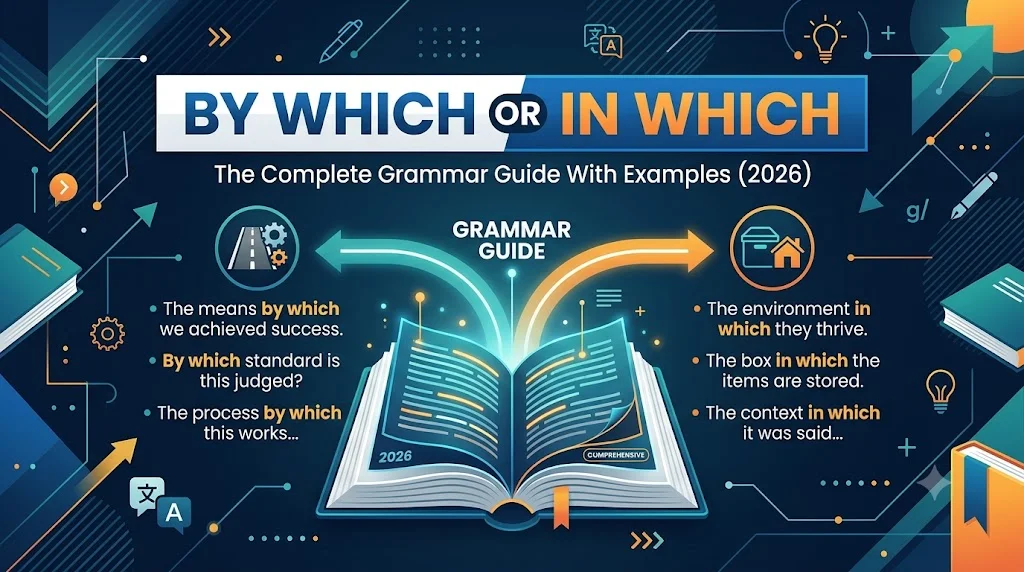
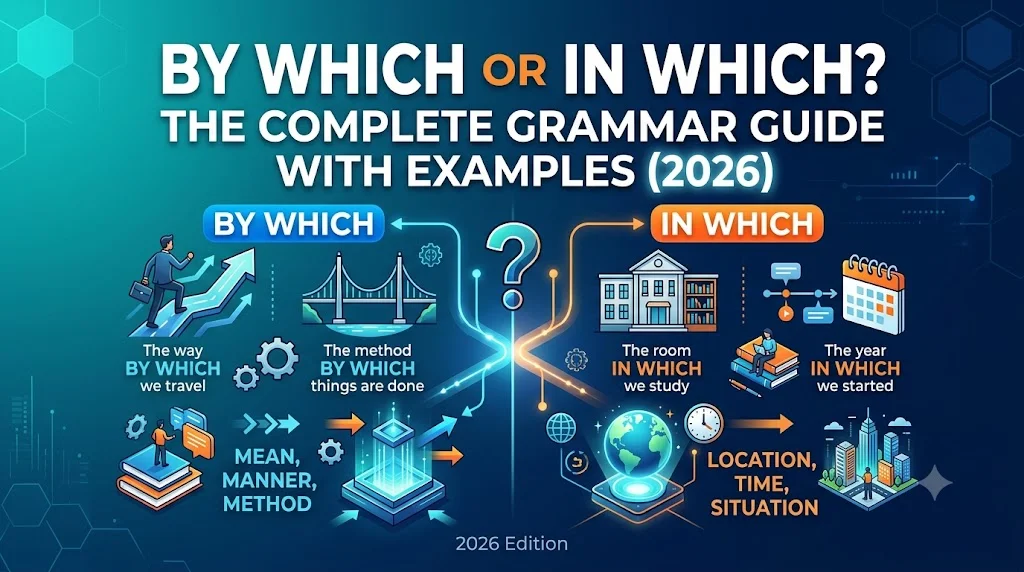
- “By which” shows the method, means, or process used to do something. Think “the way something happens.”
- “In which” shows location, position, or containment — literal or figurative. Think “the place something happens.”
Example:
- The system by which votes are counted is transparent. (method)
- The room in which the votes are counted is locked. (location)
Both are relative pronoun phrases built from a preposition + “which,” and both usually replace “that” in formal writing. The preposition you choose depends entirely on the verb or noun that comes before it in the sentence.
Why This Distinction Matters for Your Writing
Getting this right isn’t just about sounding fancy. It affects three things:
- Clarity — the wrong preposition can confuse your reader about how versus where something happened.
- Professionalism — “by which” and “in which” appear constantly in legal writing, academic papers, business reports, and formal essays. Using them incorrectly signals weaker command of English.
- Precision — native speakers instinctively feel when a preposition is “off,” even if they can’t explain why. Learning the rule helps you write like a native speaker, not just a fluent one.
If you’re a non-native English speaker preparing for IELTS, TOEFL, or professional writing, this is exactly the kind of small, high-value grammar rule that separates a good score from a great one.
Relative Clauses 101: The Grammar Foundation
Before we go further, let’s cover the basics, because “by which” and “in which” are both types of relative clauses.
What Is a Relative Clause?
A relative clause is a group of words that gives more information about a noun. It usually starts with a relative pronoun: who, whom, whose, which, that.
Example: The book that I bought is on the table.
Here, “that I bought” is the relative clause. It tells us more about “the book.”
How Relative Clauses Work With Prepositions
Sometimes a relative clause needs a preposition to make sense. Compare these:
- Informal: This is the method which I use.
- Formal: This is the method by which I use it — wait, that’s wrong. Let’s fix it: This is the method by which I work.
Notice how the preposition “by” moves in front of “which” in formal English. In casual speech, we usually push the preposition to the end of the sentence instead:
- Casual: This is the method which I work by.
- Formal: This is the method by which I work.
Why Prepositions Matter So Much Here
The preposition is the piece that carries the relationship between the clause and the noun it describes. Change the preposition, and you change the meaning:
| Preposition + Which | Meaning Conveyed |
| in which | location, containment, time period |
| by which | method, means, process |
| through which | path, medium, channel |
| for which | purpose, reason |
| with which | tool, accompaniment |
This is why English learners can’t just memorize “by which” and “in which” as a pair — you need to understand what job each preposition is doing.
When to Use “By Which”
Definition and Meaning
“By which” is a relative pronoun phrase used to describe the method, process, mechanism, or means through which something is accomplished. It answers the question “how?”
- Pronunciation: /baɪ wɪtʃ/
- Word origin: “By” comes from Old English “bi,” meaning “near” or “through the agency of.” Combined with “which” (from Old English “hwilc”), the phrase developed in Middle English legal and formal writing to describe method or means — a usage that has stayed remarkably stable for centuries.
Grammar Rules for “By Which”
- “By which” always follows a noun that represents a process, system, method, mechanism, or means.
- It introduces a relative clause that explains how that process works.
- It’s most common in formal and academic writing, though it appears in everyday English too.
Structure:
[Noun: method/process] + by which + [subject] + [verb]
Example: The procedure by which applications are reviewed takes three weeks.
Real-Life Examples of “By Which”
- The mechanism by which the vaccine works targets specific proteins.
- Voting is the process by which citizens choose their leaders.
- This is the method by which we calculate monthly revenue.
- The manner by which she solved the problem impressed everyone.
- Photosynthesis is the process by which plants convert sunlight into energy.
Common Mistakes With “By Which”
Mistake 1: Using “by which” for location.
- ❌ The office by which I work is downtown.
- ✅ The office in which I work is downtown.
Mistake 2: Dropping “which” and leaving a dangling preposition in formal writing.
- ❌ (Formal report) This is the system by we operate.
- ✅ This is the system by which we operate.
Mistake 3: Confusing it with “which by.”
- ❌ The tool which by we measure temperature.
- ✅ The tool by which we measure temperature.
Quick Tip: If you can replace the phrase with “how,” “by what method,” or “by what means,” use by which.
When to Use “In Which”
Definition and Meaning
“In which” is a relative pronoun phrase used to indicate location, position, containment, or a time period. It answers the question “where?” or “in what?”
- Pronunciation: /ɪn wɪtʃ/
- Word origin: “In” descends from Old English “in,” expressing enclosure or position. Paired with “which,” the phrase has long served in English to describe both physical spaces and abstract or figurative “containers,” such as situations, years, or fields of study.
Grammar Rules for “In Which”
- “In which” follows a noun describing a place, situation, time period, field, or state.
- It introduces a relative clause explaining what happens inside or within that noun.
- It’s extremely common in academic writing, journalism, and formal reports.
Structure:
[Noun: place/situation/time] + in which + [subject] + [verb]
Example: The year in which the company was founded remains a mystery.
Real-Life Examples of “In Which”
- The house in which she grew up was sold last year.
- This is a situation in which honesty is the best policy.
- 1969 was the year in which humans first walked on the moon.
- The field in which he specializes is neuroscience.
- The report describes the conditions in which the workers operated.
Formal vs Informal Usage
In casual, spoken English, native speakers almost always avoid “in which” and use “where” or restructure the sentence instead.
| Formal | Informal |
| The city in which I was born is small. | The city where I was born is small. |
| This is the situation in which we find ourselves. | This is the situation we’re in. |
| The year in which she graduated was 2020. | The year she graduated was 2020. |
Quick Tip: Save “in which” for essays, reports, emails to clients, and academic writing. Use “where” or simpler phrasing in conversation and casual writing.
Common Mistakes With “In Which”
Mistake 1: Using “in which” for method instead of location.
- ❌ The process in which we approved the loan was fast.
- ✅ The process by which we approved the loan was fast.
Mistake 2: Overusing it in casual writing, making the tone stiff.
- ❌ (Text message) The restaurant in which we ate was amazing!
- ✅ (Text message) The restaurant where we ate was amazing!
Mistake 3: Missing the noun it refers to.
- ❌ In which the meeting took place was unclear.
- ✅ The room in which the meeting took place was unclear.
By Which vs In Which: Side-by-Side Comparison Table
| Feature | By Which | In Which |
| Core meaning | Method, means, process | Location, position, time, situation |
| Answers the question | How? | Where? / In what? |
| Common nouns before it | method, process, system, means, mechanism, manner | place, year, situation, field, room, era, context |
| Register | Formal, academic, technical | Formal, academic, journalistic |
| Casual alternative | “how,” “the way” | “where,” “when” |
| Example | The method by which it works… | The place in which it happened… |
| Can replace “that” + preposition | Yes | Yes |
How Prepositions Change the Entire Meaning of a Sentence
This is the single most important concept for mastering “by which” and “in which.” The preposition isn’t decoration — it’s the meaning.
Compare these three sentences, which use the same noun but different prepositions:
- The process by which the chemicals react is called oxidation. (method)
- The lab in which the chemicals react is on the second floor. (location)
- The container through which the chemicals pass is glass. (path/medium)
Same topic, completely different information. This is why native-level writers pause before choosing a preposition — they’re asking, “What relationship am I actually describing?”
Teacher’s Tip: Before writing “which,” ask yourself: Am I describing HOW something happens, or WHERE it happens? That single question solves 90% of the confusion.
By Which vs In Which vs Where
When “Where” Is a Better Choice
“Where” is the natural, everyday word for physical or figurative location. It’s simpler and less formal than “in which.”
- The restaurant where we met is closing down.
- I remember the moment where everything changed. (technically informal but very common in speech)
Can “Where” Replace “In Which”?
Yes, in most cases — but only in certain contexts:
| Sentence With “In Which” | Can “Where” Replace It? |
| The house in which she lives is old. | ✅ The house where she lives is old. |
| The year in which he was born. | ⚠️ Awkward — use “when,” not “where” |
| This is a case in which honesty matters. | ⚠️ Sounds odd with “where”; keep “in which” |
Rule of thumb: “Where” works well for physical places. For abstract situations, time periods, or formal writing, stick with “in which.”
By Which vs In Which vs Wherein
“Wherein” is an older, more literary word meaning “in which” — often used in legal documents, contracts, and formal or archaic writing.
- The agreement, wherein both parties consent to the terms, was signed Monday.
- This is the same as: The agreement, in which both parties consent to the terms, was signed Monday.
Quick Tip: “Wherein” is a one-word substitute for “in which,” mostly seen in legal or highly formal contexts. It’s rarely used in everyday writing today.
| Word | Meaning | Register |
| in which | Location/situation | Formal, common |
| wherein | Same as “in which” | Very formal, legal, literary |
| where | Location | Neutral, common |
Sentence Examples: Correct vs Incorrect Usage
Correct Examples
- The way by which she communicates is respectful and clear.
- I don’t understand the logic by which he made that decision.
- The neighborhood in which they live has excellent schools.
- 2020 was a year in which many businesses struggled.
- The strategy by which the team won was simple: defense first.
- The context in which the joke was told mattered a lot.
Incorrect Examples
- ❌ The neighborhood by which they live has excellent schools.
- ❌ The strategy in which the team won was simple: defense first.
- ❌ I don’t understand the logic in which he made that decision.
- ❌ 2020 was a year by which many businesses struggled.
Why the Incorrect Examples Are Wrong
Each error swaps “method” language for “location” language, or vice versa. “Neighborhood” is a place — it needs in which. “Strategy” is a method — it needs by which. “Logic” describes a reasoning process — it needs by which, not in which. “Year” is a time period — it needs in which, never by which.
Common Expressions Using “By Which” and “In Which”
Common Expressions With “By Which”
- the method by which
- the means by which
- the process by which
- the manner by which
- the criteria by which
- the standard by which
- the way by which (less common; “the way in which” is more standard)
Common Expressions With “In Which”
- the way in which
- the situation in which
- the case in which
- the environment in which
- the context in which
- the year/era/period in which
- the field in which
Interesting note: “The way in which” is actually far more common than “the way by which,” even though “way” often relates to method. This is one of English’s small irregularities — treat it as a fixed expression to memorize.
Common Grammar Mistakes Learners Make
- Mixing up method and location (the most frequent error, covered above).
- Using “in which” or “by which” in casual conversation, making speech sound stiff. Use “where,” “how,” or simpler restructuring instead.
- Forgetting the noun that “which” refers to. Every relative clause needs a clear noun (antecedent) before it.
- Using “which” alone and stranding the preposition awkwardly in very formal writing. (“The system which we rely on it” is redundant and incorrect — drop “it.”)
- Confusing “in which” with “which… in.” Both can be correct, but register differs: “the room in which we met” (formal) vs. “the room which we met in” (also acceptable, slightly less formal, though many style guides prefer “that” here: “the room that we met in”).
How to Choose Between “By Which” and “In Which”
Simple Decision Rules
Ask yourself these two questions in order:
- Does the sentence describe HOW something is done, works, or happens? → Use by which.
- Does the sentence describe WHERE, WHEN, or IN WHAT situation something happens? → Use in which.
If you’re still unsure, try substituting “how” or “where”:
- “The system ___ we operate” → “The system HOW we operate” doesn’t sound right unless rephrased as “the system by which”… Actually the cleanest test: replace with “the way” (method) vs “the place/situation” (location).
Quick Memory Tricks
- “By” = “by doing it this way.” Think of “by” as pointing to an action or tool. By which = by what method.
- “In” = “inside a space or situation.” Think of “in” as pointing to a container. In which = inside what place, time, or situation.
- Picture a toolbox for “by which” (methods and tools) and a room for “in which” (places and situations).
Using “By Which” and “In Which” in Different Writing Styles
Academic Writing
Academic writing uses both phrases frequently to sound precise and objective.
- The methodology by which the data was collected is outlined in Chapter 3.
- This study examines the conditions in which stress affects memory.
Business Writing
Business reports and emails often use these phrases to sound professional and specific.
- Please clarify the process by which refunds are issued.
- We need to review the market in which we operate before expanding.
Everyday English
In daily conversation, simpler alternatives are almost always preferred.
- Formal: The manner by which he apologized was sincere.
- Everyday: How he apologized was sincere. / The way he apologized felt sincere.
- Formal: The city in which she was raised shaped her values.
- Everyday: The city where she grew up shaped her values.
Synonyms, Similar Words, and Related Phrases
| Phrase | Type | Notes |
| through which | Similar to “by which” | Emphasizes a channel or medium |
| whereby | Similar to “by which” | One-word, formal/legal synonym |
| wherein | Similar to “in which” | One-word, formal/legal synonym |
| where | Similar to “in which” | Informal, everyday |
| how | Similar to “by which” | Informal, everyday |
| for which | Different meaning | Shows purpose or reason, not method or place |
| with which | Different meaning | Shows a tool or accompaniment |
There is no true “opposite” of these phrases, since they express relationships (method or location) rather than qualities with clear antonyms. However, you could contrast “by which” (method) against “in which” (location) as functional opposites within this specific grammar pair.
Practice Exercises With Answers
Fill in the blank with “by which” or “in which.”
- The strategy ____ we increased sales was mostly digital marketing.
- The town ____ he was born no longer exists on modern maps.
- This is the exact process ____ bread rises.
- 1998 was the year ____ she started her first company.
- The situation ____ we currently find ourselves is complicated.
- The technique ____ the artist mixed colors was unique.
- The department ____ she works has twelve employees.
- Please explain the method ____ this machine calculates results.
Answers:
- by which (method)
- in which (location)
- by which (process)
- in which (time)
- in which (situation)
- by which (technique/method)
- in which (location)
- by which (method)
Quick Summary (Cheat Sheet)
- By which = method, means, process → answers “how?”
- In which = location, situation, time → answers “where?” or “in what?”
- Both are formal; use “how,” “where,” “when,” or simpler phrasing in casual writing.
- “Whereby” = one-word version of “by which.”
- “Wherein” = one-word version of “in which.”
- Common phrases: “the way in which,” “the process by which,” “the situation in which,” “the method by which.”
- Test yourself: Can you replace it with “how”? Use by which. Can you replace it with “where/when”? Use in which.
Final Thoughts
“By which” and “in which” both add precision and formality to your writing, but they serve different jobs. “By which” points to method — the how. “In which” points to location, time, or situation — the where. Once you train yourself to ask “Is this about method or place?” before choosing, the decision becomes automatic.
These phrases matter most in formal writing: essays, reports, research papers, and professional emails. In everyday conversation, simpler words like “how,” “where,” and “when” usually sound more natural. Mastering both registers — formal and casual — is what separates competent English from truly confident, native-like English.
Frequently Asked Questions
Is “by which” grammatically correct?
Yes, “by which” is completely grammatically correct and widely used in formal and academic English. It functions as a relative pronoun phrase that introduces a clause describing the method or process by which something happens. It’s especially common in academic writing, technical explanations, and professional reports, and it has been standard English for centuries.
Can I replace “in which” with “where”?
In most cases involving physical locations, yes — “where” works as a more casual substitute for “in which.” For example, “the house in which she lives” becomes “the house where she lives.” However, for abstract situations, time periods, or highly formal writing, “in which” often sounds more precise and natural than “where.”
What is the difference between “by which” and “through which”?
“By which” emphasizes the method or means used to achieve something, while “through which” emphasizes a channel, path, or medium something passes through. For example: “the process by which decisions are made” (method) versus “the pipe through which water flows” (physical or figurative pathway). They sometimes overlap but aren’t always interchangeable.
Why are “by which” and “in which” used in formal writing?
Both phrases sound polished, precise, and objective, which is why they appear so often in academic papers, legal documents, and business reports. They allow writers to avoid ending a sentence with a preposition (a style some formal writing avoids) and to clearly signal the exact relationship — method or location — between ideas in a sentence.
How can I remember when to use each phrase?
Use this simple trick: “By” relates to action, so by which answers “how.” “In” relates to space, so in which answers “where” or “in what situation.” Picture a toolbox for “by which” and a room for “in which.” This mental image makes the choice almost automatic once you’ve practiced it a few times.
Is “in which” more formal than “where”?
Yes. “In which” is considered more formal and is favored in academic, legal, and professional writing. “Where” is the everyday, conversational choice for the same idea when referring to physical places. Using “in which” in casual speech can sound overly stiff, while using “where” in a formal essay may feel slightly too casual, depending on context.