
If you have ever typed “I mine as well go to bed” and then paused, wondering if that looked right, you are not alone. This is one of the most common mix-ups in English, and it trips up native speakers just as often as learners. The good news is that the answer is simple once you understand where the confusion comes from.
In this guide, I will walk you through the correct phrase, the grammar behind it, why the mistake happens, and how to never make it again. Think of this as a one-on-one lesson with your English teacher — clear, practical, and packed with real examples.
The Quick Answer: Is It “Mine As Well” or “Might As Well”?
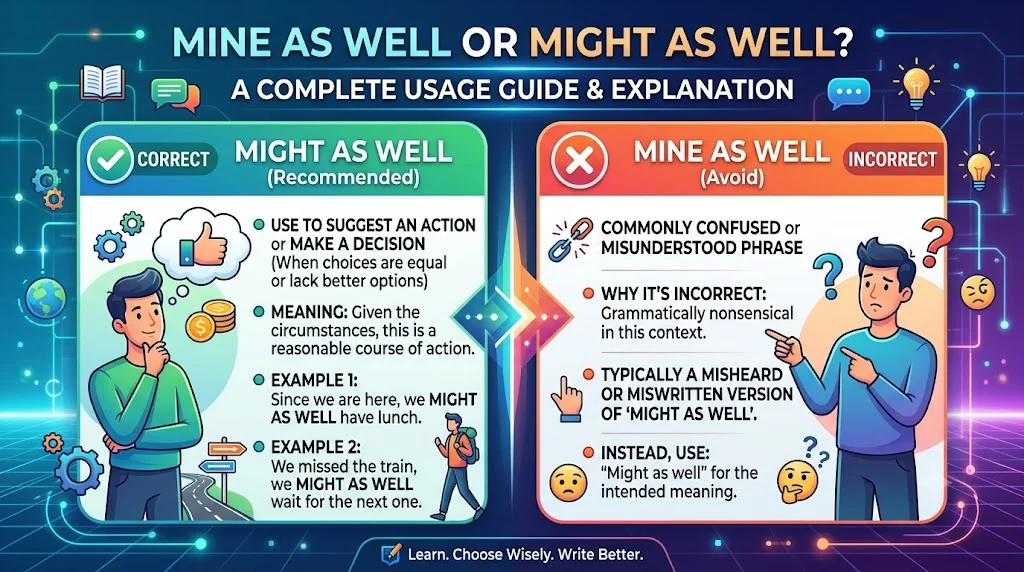
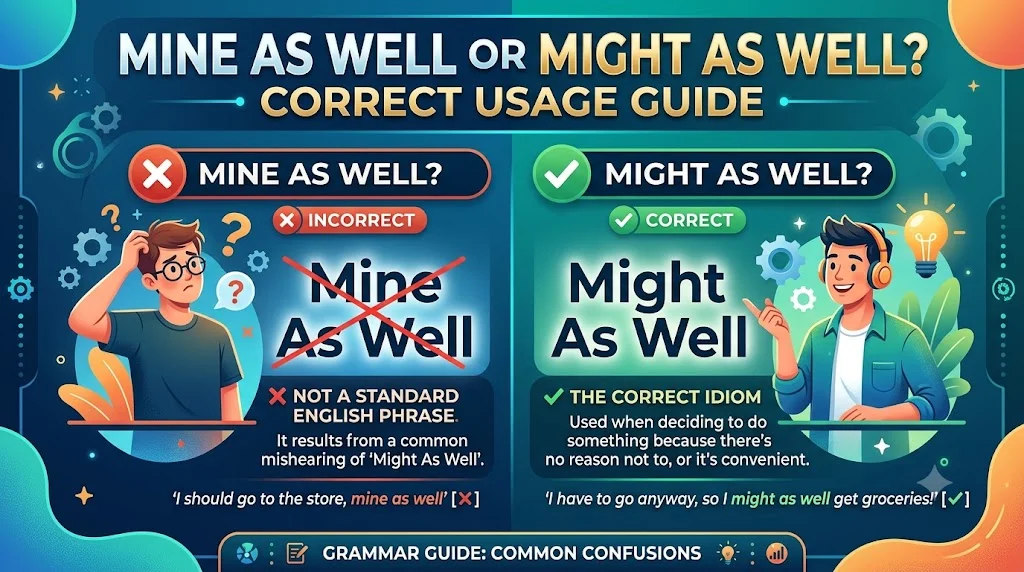
“Might as well” is the correct phrase. “Mine as well” is a common misspelling that happens because the two phrases sound almost identical when spoken quickly.
“Might as well” is an idiomatic expression built from the modal verb might. It means that doing something is a reasonable choice, usually because there is no better option, no real cost to doing it, or it simply makes sense given the situation.
“Mine as well” is not a standard English expression. “Mine” is a possessive pronoun (as in this book is mine), and it does not fit grammatically into this phrase at all. The only reason people write it is that it sounds the same as “might” in casual speech.
Quick Tip: If you can replace the word with “might” and the sentence still makes sense as a suggestion or a resigned decision, you are using the correct phrase.
Why Do People Confuse “Mine As Well” With “Might As Well”?
This mix-up is not a sign of poor English skills. It is a completely natural result of how spoken English works. Let’s break down exactly why it happens.
The Phonetic Similarity Between Mine and Might
In fast, natural speech, English speakers often drop or soften the final consonant sounds in words. The “t” at the end of “might” is frequently unreleased or barely pronounced, especially before the “as” that follows it.
Say “might as well” out loud at a normal conversational speed. The “t” almost disappears, and what your ear picks up sounds closer to “mine as well” or “mine-zwell.” This phenomenon is called assimilation, where neighboring sounds blend together in connected speech.
Because most people learn phrases by ear long before they see them written down, this small sound shift is enough to create a lasting spelling mistake.
Pronunciation note: “Might as well” is pronounced /maɪt əz wɛl/. In casual speech, it often comes out as “mightz well” or “my-tez-well,” which easily gets misheard as “mine as well.”
Commonly Misheard English Phrases
“Might as well” belongs to a larger family of expressions called eggcorns — phrases that get misheard and then rewritten using different, but similarly sounding, words. Recognizing this pattern helps explain why the mistake is so widespread.
Other well-known examples include:
| Misheard Version | Correct Phrase |
| For all intensive purposes | For all intents and purposes |
| Escape goat | Scapegoat |
| Old-timers’ disease | Alzheimer’s disease |
| Could care less | Couldn’t care less |
| Mind as well | Might as well |
If you have ever caught yourself using one of these, you are in good company. Eggcorns happen because the brain replaces an unfamiliar or oddly spelled phrase with something that makes more intuitive sense — or simply matches the sound better.
What Does “Might As Well” Mean?
Meaning and Definition
“Might as well” is an idiomatic expression used to suggest that an action is worth doing, usually because:
- There is nothing better to do instead.
- The action carries little to no downside.
- The circumstances make the choice obvious or unavoidable.
- Refusing to do it would not really change the outcome.
In simple terms, it means “there’s no good reason not to” or “it makes sense to.”
The Grammar Behind “Might As Well”
“Might as well” is built from three parts:
- Might — a modal verb expressing possibility.
- As well — an adverbial phrase meaning “also” or “in addition,” which here is fixed into the idiom and no longer carries its literal meaning.
- Together, they form a fixed modal idiom that is always followed by the base form of a verb (the infinitive without “to”).
Because “might” is a modal verb, it never changes form. You do not say “mights as well” or “mighted as well.” It stays the same regardless of subject or tense context.
Grammar structure:
Subject + might as well + base verb
Example: She might as well leave now.
Word Origin
“Might as well” has been used in English since at least the 17th century. It combines the old modal verb “might” (from Old English meahte, related to “may”) with the phrase “as well,” which historically meant “equally” or “just as much.” Over time, the combination fused into a single idiomatic unit with its own specific meaning — a suggestion made out of practicality rather than enthusiasm.
When to Use “Might As Well” in Everyday English
You will hear “might as well” constantly in daily conversation. It fits naturally into:
- Casual suggestions: “We’re already here, so we might as well look around.”
- Resigned decisions: “I lost my umbrella anyway, so I might as well get wet.”
- Practical advice: “You might as well finish the report today instead of tomorrow.”
Formal vs. informal usage: “Might as well” is mostly informal and conversational. It works well in emails to colleagues, texts, and everyday speech. In highly formal writing — legal documents, academic papers, or official reports — it is better to use alternatives like “it would be reasonable to” or “there is little reason not to.”
“Might As Well” With Infinitive Verbs
A key grammar rule: “might as well” is always followed by the bare infinitive (the verb without “to”).
Correct:
- You might as well ask him directly.
- We might as well wait here.
Incorrect:
- You might as well to ask him directly. ❌
- We might as well waiting here. ❌
Quick Tip: Treat “might as well” the same way you treat other modal verbs like “can,” “should,” or “must” — the verb right after it never takes “to” or an “-ing” ending.
Is “Mine As Well” Correct English?
When “Mine As Well” Can Be Grammatically Possible
Here is where it gets interesting: “mine” is a real word, and in very specific, unrelated contexts, “mine” and “as well” can appear near each other — just not as this idiom.
For example:
- “That car is mine as well as yours.” (Here, “mine” is a possessive pronoun, and “as well as” means “in addition to.”)
- “I own this house, and the land is mine as well.” (Meaning: the land also belongs to me.)
In these sentences, “mine as well” is grammatically fine, but it means something completely different from the idiom we are discussing. It is about ownership and addition, not about suggestion or resignation.
Why “Mine As Well” Is Usually a Mistake
When people write “I mine as well go home,” there is no possessive meaning intended at all. The writer means “I might as well go home” — a suggestion, not a statement about ownership. In this context, “mine as well” is grammatically broken because “mine” cannot function as a modal verb, and the sentence has no logical subject-verb structure.
Common mistake: Confusing the possessive pronoun “mine” with the modal verb “might” simply because they sound alike in fast speech.
Mine As Well vs Might As Well: Key Differences
Meaning Difference Between Mine and Might
| Word | Part of Speech | Meaning | Example |
| Mine | Possessive pronoun | Belonging to me | “This pen is mine.” |
| Might | Modal verb | Expressing possibility or suggestion | “I might go later.” |
Grammar Difference Between the Two Phrases
| Feature | “Might As Well” | “Mine As Well” |
| Function | Modal idiom for suggestion | Not a standard idiom |
| Followed by | Base verb (infinitive without “to”) | No natural verb structure |
| Grammatical role | Modal verb + adverb | Possessive pronoun + adverb (different meaning) |
| Standard usage | Yes, widely accepted | No, considered an error in this context |
Which Phrase Is Correct in Modern English?
In modern English, “might as well” is the only correct choice when you want to express a practical suggestion or a resigned decision. “Mine as well” should never be used in this sense, in either formal or informal writing. Spell checkers and grammar tools consistently flag it as incorrect for this reason.
Might As Well vs Mine As Well Examples
Correct Examples Using “Might As Well”
- We might as well order pizza since no one wants to cook.
- Since the store is closing anyway, I might as well shop now.
- You might as well tell me the truth; I’ll find out eventually.
- If it’s already raining, we might as well cancel the picnic.
- He might as well apologize now instead of waiting.
Incorrect Examples Using “Mine As Well”
- I mine as well go to bed. ❌ (Should be: I might as well go to bed.)
- She mine as well quit her job. ❌ (Should be: She might as well quit her job.)
- We mine as well try the new restaurant. ❌ (Should be: We might as well try the new restaurant.)
Side-by-Side Sentence Comparison
| Incorrect (Common Mistake) | Correct Version |
| I mine as well stay home. | I might as well stay home. |
| You mine as well ask him. | You might as well ask him. |
| They mine as well cancel the trip. | They might as well cancel the trip. |
| It’s mine as well finish this today. | I might as well finish this today. |
Common Mistakes With “Might As Well”
Using “Mine” Instead of “Might”
This is the single most common mistake, and it happens purely because of pronunciation. The fix is simple: always write “might,” never “mine,” when the sentence expresses a suggestion or a lack of a better alternative.
Confusing “Mind As Well” With “Might As Well”
Another close cousin of this mistake is “mind as well.” This one is trickier because “mind” is also a real, common word (as in “I don’t mind” or “mind your manners”). However, “mind as well” is not a standard phrase either — it is another eggcorn based on the same sound confusion.
Incorrect: I mind as well go with you. Correct: I might as well go with you.
Adding “As Well” Without Understanding the Meaning
Some learners try to use “as well” alone, thinking it carries the same suggestion meaning as the full idiom. But “as well” by itself simply means “also” or “in addition,” and it does not express the idea of practicality or resignation.
Incorrect meaning shift: “I go as well” only means “I also go,” not “It makes sense for me to go.”
Incorrect Usage in Questions and Replies
“Might as well” is naturally a statement structure, not a question structure. While it can appear in tag questions or replies, be careful with word order.
Correct: “Might as well, right?” (as a short reply) Incorrect: “As well might I go?” ❌
What Does “Mind As Well” Mean?
Is “Mind As Well” a Real English Expression?
No. “Mind as well” is not a recognized standard English idiom. It is a mishearing of “might as well” that has spread because “mind” is a familiar, everyday word, which makes the mistake feel more natural to write than it actually is.
Why People Write “Mind As Well” by Mistake
The confusion again comes down to sound. In relaxed speech, “might” can sound close to “mind” when the final “t” softens and blends with the following “as.” Since “mind” already has meanings related to thinking, caring, or paying attention (as in “do you mind?”), some speakers assume there’s a logical connection — but there isn’t one in this idiom.
Tip to remember: If you are tempted to write “mind as well,” stop and ask yourself whether you mean “might as well” (a suggestion). In almost every case, the answer is yes.
How to Use “Might As Well” Correctly in Sentences
Using “Might As Well” for Suggestions
Use this structure when recommending an action because it seems like the sensible thing to do.
- “We might as well start the meeting early since everyone is here.”
- “You might as well take the highway; traffic looks lighter.”
Using “Might As Well” When There Are No Better Options
This is one of the most common uses — expressing that an action is worth doing simply because there is nothing better to do or lose.
- “There’s no signal here anyway, so I might as well turn off my phone.”
- “The store is closed, so we might as well head home.”
Using “Might As Well” With Results and Consequences
Sometimes “might as well” points out that two choices lead to a similar outcome, so one option is just as reasonable as another.
- “If you’re not going to listen to my advice, I might as well stop giving it.”
- “He talks so much, you might as well be having a conversation with a radio.”
Synonyms, Similar Words, and Related Phrases
Understanding related expressions helps you use “might as well” with more confidence and variety.
Synonyms and similar phrases:
- Just as well (to) — “It’s just as well you stayed home; the trip was canceled.”
- May as well — a slightly more formal variant with the same meaning.
- There’s no harm in — “There’s no harm in asking.”
- It wouldn’t hurt to — “It wouldn’t hurt to double-check.”
Opposite meaning phrases:
- There’s no point in — expresses that an action is not worth doing.
- It’s not worth it — signals the opposite conclusion, that the action should be avoided.
Common collocations with “might as well”:
- might as well + go, try, ask, admit, tell, stay, leave, give up, start, finish
Related grammar structures:
- Modal verbs of suggestion: should, could, ought to
- Idiomatic expressions with fixed word order: as far as, as long as, as soon as
American vs British English Usage
Do Americans and British Speakers Use It Differently?
“Might as well” is used identically in American and British English, both in meaning and grammar. There is no regional difference in correctness — it is standard in both varieties.
Informal Speech and Regional Variations
The main difference is not in the phrase itself but in pronunciation patterns. Because both American and British speakers naturally reduce sounds in casual speech, the “mine as well” mishearing happens across all English-speaking regions, not just in one country. “May as well” is also common in both dialects as a slightly softer alternative.
Simple Tricks to Remember the Correct Phrase
The Substitution Test Method
Here’s a foolproof trick: replace the confusing word with another modal verb, like “could” or “should.”
- “I might as well go” → “I could go” ✅ Makes sense.
- “I mine as well go” → “I could go” using “mine”? ❌ Doesn’t work, because “mine” is not a modal verb.
If the substitution test works with a modal verb, “might” is correct.
Understanding Modal Verbs in English
Modal verbs — including can, could, may, might, shall, should, will, would, and must — express ability, possibility, permission, or necessity. They are always followed by a base verb and never change form based on the subject. Recognizing “might” as a member of this family makes it easier to remember that “mine” (a pronoun) simply does not belong in this slot.
Avoiding Common Typing Mistakes
- Turn on autocorrect and grammar-checking tools, which typically flag “mine as well” as an error.
- When proofreading, read your sentence aloud slowly and listen for the modal verb sound.
- Keep a mental note: “Might” shows possibility. “Mine” shows possession. They are never interchangeable.
Practice Exercise: Choose Mine As Well or Might As Well
Fill in the Blank Questions
Choose the correct phrase for each sentence.
- Since it’s already late, we _______ stay overnight.
- This umbrella is _______ as well as yours; we bought two.
- You _______ tell me now instead of later.
- I _______ finish the project today.
- That jacket is _______; I left it here yesterday.
Correct Answers and Explanations
- might as well — expresses a practical suggestion based on the late hour.
- mine (as well as yours) — expresses possession and addition, not suggestion.
- might as well — a suggestion to act sooner rather than later.
- might as well — expresses that finishing today makes sense.
- mine — expresses ownership of the jacket.
Notice that sentences 2 and 5 use “mine” correctly because they are about possession, not the idiom we’ve been studying.
Final Verdict: Mine As Well or Might As Well?
The correct phrase, in almost every situation where you’re expressing a suggestion or a practical decision, is “might as well.” “Mine as well” is a spelling mistake rooted in how the phrase sounds when spoken quickly, and it should be avoided in this context. “Mind as well” falls into the same category of common, understandable, but incorrect substitutions.
Conclusion
Language mistakes like this one are rarely about intelligence — they’re about how our ears interpret fast, connected speech. Once you understand that “might” is a modal verb showing possibility, and “mine” is a possessive pronoun showing ownership, the difference becomes much easier to keep straight. From now on, whenever you’re tempted to write “mine as well” or “mind as well,” pause and picture the modal verb family — “might” belongs there, and the other two simply don’t.
Final Thoughts
Mixing up “might as well” and “mine as well” is one of the most understandable mistakes in English because it comes from how we hear language, not from a lack of grammar knowledge. The moment you remember that “might” is a modal verb of possibility, while “mine” only ever shows ownership, the confusion disappears for good.
Practice the substitution test, read your writing aloud, and lean on grammar tools when in doubt. With a little attention, this mistake becomes one you’ll never make again — and you’ll be able to explain it clearly to anyone else who asks.
Frequently Asked Questions About Mine As Well or Might As Well
Is “Mine As Well” grammatically correct?
Only in unrelated contexts, such as “This car is mine as well as yours,” where “mine” shows possession and “as well” means “also.” It is incorrect when used to express a suggestion or resignation — that meaning requires “might as well,” which uses the modal verb “might,” not the possessive pronoun “mine.”
Why do people say “Mine As Well”?
Because “might” and “mine” sound similar in fast, casual speech, especially since the “t” in “might” often softens before “as.” Since most people learn spoken phrases before written ones, this sound similarity leads to a common spelling mistake that spreads through habit rather than grammar rules.
What is the meaning of “Might As Well”?
“Might as well” means that doing something makes sense, usually because there’s no better alternative, little downside, or the circumstances make the choice obvious. It’s commonly used for practical suggestions, such as “We might as well leave now since the meeting ended early.”
Can I use “Might As Well” in formal writing?
“Might as well” is mostly informal and works well in everyday emails, conversations, and casual writing. In highly formal contexts like academic papers or legal documents, it’s better to use alternatives such as “it would be reasonable to” or “there is little reason not to” instead.
Is “Mind As Well” the same as “Might As Well”?
No. “Mind as well” is not a standard English phrase; it’s another common mishearing of “might as well,” caused by the same sound-blending pattern in speech. Whenever you’re tempted to write “mind as well,” it almost always means you actually intend “might as well.”