
A simple question that helps you gain clarity, explore an idea more deeply, and keep the conversation moving productively is “Can you elaborate”? It means “Can you explain this in more detail?” or “Can you provide additional information?” It is a request for someone to expand on a statement, clarify an idea, or share further details about a particular topic.
The phrase “Can you elaborate?” is useful in professional conversations, academic discussions, emails, interviews, and everyday communication. However, depending on your tone and relationship with the other person, it can sometimes sound formal, direct, or slightly demanding. Imagine a colleague shares an interesting idea during a meeting, but you need more information to understand their point clearly. You might ask, “Can you elaborate?” to encourage them to explain their thoughts in greater detail.
Choosing the right alternative helps you communicate more naturally. For example, “Could you explain that a little further?” sounds polite, while “Can you tell me more about that?” feels conversational and approachable.
Origin & History of “Can You Elaborate?”
The phrase “Can You Elaborate?” originates from the Latin verb elaborare, meaning “to work out,” “to develop,” or “to produce through effort.” The word elaborate entered English around the late 16th and early 17th centuries and gradually came to mean explaining, expanding, or presenting something in greater detail.
The complete expression “Can you elaborate?” does not have a documented individual inventor or a specific historical event associated with its creation; instead, it developed naturally from the English verb combined with the modal verb “can” to form a question requesting further explanation. Over time, the phrase became widely useful in educational, professional, academic, and everyday conversations.
20 Best Synonyms for “Can You Elaborate?” (Examples)
- Can You Explain Further?
- Could You Clarify?
- Can You Provide More Details?
- Could You Expand on That?
- Can You Explain in More Detail?
- Could You Give More Information?
- Can You Tell Me More?
- Could You Elaborate Further?
- Can You Clarify Your Point?
- Could You Explain Your Reasoning?
- Would You Mind Explaining Further?
- Could You Provide Additional Context?
- Can You Expand on Your Thoughts?
- Could You Be More Specific?
- Can You Shed More Light on This?
- Could You Offer Further Details?
- Would You Explain That Further?
- Can You Give Me an Example?
- Could You Go into More Detail?
- Can You Explain What You Mean?
Meaning, Usage & Examples for Each Alternative
The following 10 alternatives cover professional requests, polite follow-ups, conversational questions, and expressions that encourage someone to share their thinking. Each includes its meaning, practical use, tone, and a realistic example.
Could You Explain That Further?
Meaning: A polite request for a fuller explanation of a statement, idea, or decision.
Why This Phrase Works: It communicates the need for more information without suggesting that the original explanation was wrong.
Real-World Usage Insight: This expression is particularly useful when someone has introduced an important point but has not provided enough background to make it clear.
Best Use: Professional emails, academic discussions, meetings, and presentations.
Avoid When: You only need a simple fact or a specific missing number.
Tone: Polite, professional, and neutral.
Example (Email / Message / Meeting): “Thanks for explaining the revised schedule. Could you explain that further, particularly how the new deadlines will affect the testing phase?”
Could You Provide More Details?
Meaning: A request for additional facts, information, or specifics about a topic.
Why This Phrase Works: It tells the recipient that you need more concrete information rather than simply a different explanation.
Real-World Usage Insight: This is especially effective when reviewing reports, project proposals, invoices, and business updates.
Best Use: Emails, administrative requests, project documentation, and formal discussions.
Avoid When: You want to invite someone to share their feelings or explore a personal experience; a warmer question may be more appropriate.
Tone: Formal, clear, and businesslike.
Example (Email / Message / Meeting): “I reviewed the supplier’s estimate this morning. Could you provide more details about the installation charges before we approve the final amount?”
Could You Clarify Your Point?
Meaning: A request to make a statement or idea easier to understand by resolving ambiguity.
Why This Phrase Works: It focuses on what is unclear instead of asking the speaker to expand on everything they have said.
Real-World Usage Insight: It is a strong choice when two people interpret an instruction or statement differently.
Best Use: Meetings, written feedback, technical discussions, and conversations about requirements.
Avoid When: You already understand the point and simply want additional examples or supporting information.
Tone: Direct, professional, and neutral.
Example (Email / Message / Meeting): “I understand that the client wants a simpler design, but could you clarify your point about removing the navigation menu? I want to make sure we’re interpreting the feedback correctly.”
Could You Expand on That?
Meaning: An invitation to develop an existing idea with additional explanation, reasoning, or examples.
Why This Phrase Works: It recognizes that the speaker has already introduced a point and invites them to develop it further.
Real-World Usage Insight: This phrase is particularly effective during discussions where several ideas are being explored, and one deserves more attention.
Best Use: Brainstorming, presentations, workshops, interviews, and academic writing.
Avoid When: The statement is confusing or contradictory and needs clarification before it can be developed.
Tone: Collaborative, professional, and constructive.
Example (Email / Message / Meeting): “You mentioned that returning customers are responding differently to the new campaign. Could you expand on that and explain which changes you’ve noticed?”
Can You Tell Me More?
Meaning: A broad, conversational invitation to share additional information about something.
Why This Phrase Works: It feels approachable and allows the other person to decide which details matter most.
Real-World Usage Insight: This is often a better choice than “Can you elaborate?” when you want to show interest without making a conversation feel formal.
Best Use: Everyday conversations, interviews, informal messages, and friendly workplace discussions.
Avoid When: You need precise evidence, a formal explanation, or a specific technical answer.
Tone: Friendly, relaxed, and curious.
Example (Email / Message / Meeting): “You mentioned that you’ve been helping with the new community project. That sounds interesting! Can you tell me more about what you’ve been working on?”
Could You Walk Me Through That?
Meaning: A request for someone to explain a process, sequence, or decision step by step.
Why This Phrase Works: It makes clear that you want to understand how something works, not merely hear a longer description.
Real-World Usage Insight: It is particularly useful when learning unfamiliar software, reviewing a workflow, or understanding how a colleague reached a decision.
Best Use: Training sessions, onboarding, troubleshooting, technical meetings, and process reviews.
Avoid When: You only need a brief definition or a single additional fact.
Tone: Helpful, practical, and collaborative.
Example (Email / Message / Meeting): “I can see the figures in the dashboard, but I’m not sure how the report calculates the monthly total. Could you walk me through that when you have a moment?”
Could You Give Me Some Context?
Meaning: A request for background information that helps explain a statement, event, or decision.
Why This Phrase Works: It identifies missing background as the problem rather than implying that the speaker’s explanation is inadequate.
Real-World Usage Insight: Context is often more useful than extra detail when someone refers to a decision, event, or disagreement you did not witness.
Best Use: Project handovers, workplace updates, news discussions, and conversations about unfamiliar situations.
Avoid When: You already have the background and need a detailed explanation of a specific mechanism or process.
Tone: Neutral, thoughtful, and professional.
Example (Email / Message / Meeting): “I saw the comments on the design document, but I joined the project after the initial review. Could you give me some context before I respond to the feedback?”
Can You Break That Down for Me?
Meaning: A request to explain something complicated in simpler, more manageable parts.
Why This Phrase Works: It makes the need for a simpler explanation explicit and encourages the speaker to avoid unnecessary complexity.
Real-World Usage Insight: The expression is particularly useful when dealing with unfamiliar terminology, complex calculations, or complicated instructions.
Best Use: Informal workplace discussions, tutorials, technical explanations, and conversations with beginners.
Avoid When: A highly formal document or sensitive professional exchange requires more conventional wording.
Tone: Casual, approachable, and practical.
Example (Email / Message / Meeting): “I follow the overall strategy, but the pricing model is confusing me. Can you break that down for me using a simple example?”
Could You Give Me an Example?
Meaning: A request for a specific illustration that makes a general statement easier to understand.
Why This Phrase Works: It turns an abstract explanation into something concrete that the listener can evaluate or apply.
Real-World Usage Insight: Examples are particularly useful when someone describes a concept, rule, strategy, or expected outcome without demonstrating how it works in practice.
Best Use: Training, education, interviews, presentations, and professional feedback.
Avoid When: You need a complete explanation of the underlying reasoning and an example alone would not resolve your question.
Tone: Neutral, constructive, and inquisitive.
Example (Email / Message / Meeting): “You mentioned that we should make the onboarding process more user-friendly. Could you give me an example of a change that would make the biggest difference?”
I’d Love to Hear More About Your Idea
Meaning: An encouraging invitation for someone to share additional details about an idea or proposal.
Why This Phrase Works: It expresses interest before asking for further information, helping the speaker feel that their contribution is welcome.
Real-World Usage Insight: Positive framing can encourage participation during brainstorming and early-stage discussions, when ideas may not yet be fully developed.
Best Use: Team brainstorming, creative projects, mentoring, informal meetings, and supportive conversations.
Avoid When: You need an immediate factual answer or must communicate a serious concern without suggesting approval.
Tone: Warm, encouraging, and collaborative.
Example (Email / Message / Meeting): “Your idea for simplifying the booking process sounds promising. I’d love to hear more about your idea, especially how you think it would help first-time users.”
When Should You Use “Can You Elaborate?”
Use this phrase when a person has shared an idea or statement that deserves further explanation. It works particularly well when you need to understand the reasoning behind a suggestion or gather information before making a decision.
Professional settings
In the workplace, “Can you elaborate?” is useful during project discussions, performance reviews, planning meetings, and conversations about business decisions.
For example, if a manager says, “We should change our onboarding process,” you might ask, “Can you elaborate on which parts of the process you think we should change?”
This question invites specific details without immediately agreeing or disagreeing with the proposal.
Casual conversations
In everyday conversations, the phrase works when you are genuinely interested in what someone is saying. However, “Tell me more” or “What do you mean?” may sound more natural among friends.
For example:
- “I had a really unexpected experience yesterday.”
- “Oh, really? Can you tell me more?”
Writing, presentations, and digital communication
The phrase can be effective in emails, online meetings, discussion forums, and written feedback. It is especially useful when responding to a brief explanation that leaves an important question unanswered.
For example, you might write, “Your report mentions a change in customer behavior. Could you elaborate on the findings supporting that conclusion?”
When it is especially effective
Use “Can you elaborate?” when:
- You need more context before making a decision.
- Someone introduces an unfamiliar idea.
- You want to understand the reasoning behind a recommendation.
- A presentation contains a point that needs further development.
- You want to encourage a more detailed discussion.
Practical tip: Whenever possible, specify what you want the person to elaborate on. Asking about a particular decision, example, or result usually produces a more useful response than asking a broad question.
When Should You Avoid “Can You Elaborate?”
Although the phrase is generally appropriate, certain situations call for a more specific or considerate alternative.
Overly formal situations
In highly formal correspondence, “Could you please provide further details?” may be more suitable. It communicates the same request while maintaining a conventional professional tone.
Legal, academic, or sensitive contexts
Legal statements, academic claims, and sensitive personal discussions may require precise wording. Instead of asking someone to elaborate generally, identify the information you need.
For example:
- Academic: “Could you explain the evidence supporting this conclusion?”
- Legal: “Could you clarify the meaning of this clause?”
- Sensitive conversation: “Would you feel comfortable telling me a little more about what happened?”
In legal matters, the exact wording should reflect the question being asked and the applicable requirements.
Situations where nuance may be lost
If someone has already explained a complicated point, repeating “Can you elaborate?” may suggest that you did not listen carefully. It can also sound like a challenge when the speaker is discussing a sensitive decision.
A more constructive alternative is to acknowledge what you understood before asking your follow-up question.
For example: “I understand the main concern is timing. Could you explain how the proposed schedule would address it?”
This approach demonstrates attention and makes your request more specific.
Pros and Cons of Using “Can You Elaborate?”
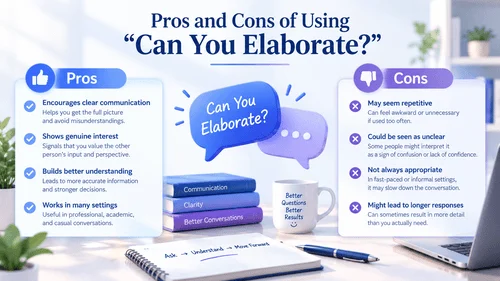
| Pros | Cons |
| Promotes clarity | Can be too broad |
| Short and easy to understand | May sound overly formal |
| Useful in professional settings | Can feel repetitive |
| Encourages further discussion | May sound challenging |
| Invites detailed explanations | Expectations may be unclear |
Real-Life Examples of “Can You Elaborate?” by Context
The following examples demonstrate how the phrase works in realistic situations.
Emails
Hi Maya,
Thanks for sharing the updated proposal. I noticed the section about changing the launch schedule, and I’d like to understand that recommendation a little better.
Could you elaborate on the main reasons for the proposed change and how it might affect the delivery date?
Thanks,
Daniel
Why it works: The question identifies the relevant section and explains which information is needed.
Meetings
Project manager: “I think we should move the testing phase forward by a week.”
Team member: “Can you elaborate on how that would affect the development timeline?”
Why it works: The question requests the reasoning and practical implications behind a proposed change.
Presentations
Presenter: “Our latest customer survey suggests that expectations have changed.”
Audience member: “Could you elaborate on which expectations have changed most significantly?”
Why it works: The question asks for specific information rather than a general repetition of the presentation.
Conversations
Friend: “I’ve been thinking about changing my career path.”
You: “Really? Can you tell me more about what’s making you consider that?”
Why it works: A conversational alternative encourages the person to share more without sounding like an interviewer.
“Can You Elaborate?” in Digital & Modern Communication
Digital communication makes concise questions especially useful, but it also increases the importance of context.
Emails
In professional emails, use the phrase when a report, proposal, or recommendation needs more explanation.
Example: “Could you elaborate on the assumptions behind the revised budget?”
For a warmer tone, add a short acknowledgment before the question.
Slack and WhatsApp
In workplace chats, “Can you elaborate?” is concise and recognizable. However, it can appear abrupt when sent without context.
Compare:
- “Can you elaborate?”
- “Thanks for the update. Could you elaborate on the timeline change?”
The second message tells the recipient what you are asking about and why the follow-up is relevant.
In informal WhatsApp conversations, “What do you mean?” or “Tell me more” may be more natural, depending on the relationship.
Social media
On social platforms, the phrase can invite someone to expand on a post or opinion. If you disagree with the person, consider whether your question could be interpreted as a challenge.
“Could you explain what you mean by that?” may be more appropriate when the original statement is ambiguous.
AI-generated summaries
When using an AI assistant or working with automated summaries, “Can you elaborate?” can request a deeper explanation of a summarized point.
For better results, identify the specific topic and the type of detail you need.
For example: “Can you elaborate on the main findings and provide a practical example of each?”
A specific prompt is more likely to produce a useful answer than a broad request for additional information.
Linguistic & Communication Insight
“Can you elaborate?” expresses curiosity and asks for more details. Its meaning depends on the situation: it can show interest in a friendly conversation, encourage explanation during a presentation, or request clarification during a disagreement.
Emotional Weight and Subtext
The phrase can sound friendly or critical depending on tone and context. A polite tone and a specific follow-up question make it feel more respectful and collaborative.
Direct vs. indirect phrasing
“Can you elaborate?” is relatively direct because it immediately asks the other person to provide more detail. Directness is not inherently impolite; in many workplaces, it helps people communicate efficiently.
Indirect alternatives soften the request:
- Direct: “Can you elaborate on that?”
- Polite: “Could you elaborate a little on that?”
- Indirect: “I’d be interested in hearing a little more about that.”
The direct version is efficient, while the indirect version places more emphasis on the speaker’s interest and the other person’s willingness to respond.
Conclusion:
Understanding the meaning of “Can You Elaborate?” can help you communicate more clearly and confidently in professional, academic, and everyday situations. This phrase is a polite way to ask someone to explain an idea further, provide additional details, or clarify information that may be unclear. Whether you are participating in a business meeting, writing an email, discussing a school assignment, or having a casual conversation, knowing when and how to use this expression can improve your communication skills.
Although “Can you elaborate?” is widely accepted, alternatives such as “Could you explain further?” “Can you provide more details?” and “Could you expand on that?” may sound more appropriate depending on the context. Choosing the right expression helps you maintain a respectful tone while encouraging meaningful discussion.
Ultimately, learning synonyms for “Can you elaborate?” allows you to express curiosity without sounding repetitive. By considering your audience, purpose, and level of formality, you can choose the most suitable phrase for any situation. Practice these alternatives regularly to strengthen your vocabulary, improve your English fluency, and make your conversations more effective.
FAQs
1. What Does “Can You Elaborate?” Mean?
“Can you elaborate?” means asking someone to explain something in more detail.
It is used when you need additional information or clarification.This expression is common in conversations, meetings, and academic discussions.For example: “Can you elaborate on your idea?”
2. How Do You Use “Can You Elaborate?” in a Sentence?
You can use this expression when you want someone to explain their thoughts further.It is suitable for professional, educational, and everyday conversations.For example: “Can you elaborate on your recent discovery?”It helps you gain a clearer understanding of a topic.
3. Is “Can You Elaborate?” a Polite Expression?
Yes, “Can you elaborate?” is generally considered polite and professional.
It shows that you want to understand someone’s statement more clearly.
For formal situations, you can say, “Could you please elaborate?”
Your tone also helps make the question sound respectful.
4. What Is the Difference Between “Elaborate” and “Explain”?
“Explain” means making something clear or easy to understand.
“Elaborate” means adding more details to an existing explanation or idea.
For example, “Explain this rule” asks for clarity.
“Elaborate on this rule” requests additional information.
5. What Are Some Alternatives to “Can You Elaborate?”
You can say “Could you explain that in more detail?” to request clarification.“Could you expand on that?” is another natural alternative.“Can you provide more information?” works well in professional settings.These expressions help you communicate clearly and politely.
6. What Is the Correct Grammar for Using “Elaborate”?
The verb “elaborate” is commonly followed by the preposition “on.”For example, “Can you elaborate on this topic?” is grammatically correct.You can also simply say, “Could you please elaborate?”Avoid saying “Can you elaborate me this topic?”
7. When Should You Use “Can You Elaborate?”
Use this expression when you need more details about a statement or idea.It is useful in classrooms, meetings, interviews, and everyday conversations.For example, “Could you elaborate on your suggestion?”It helps improve communication and encourages meaningful discussions.

I am passionate about the English language, grammar, vocabulary, and effective communication. Through Grammar Hub Pro, I aim to help students, professionals, teachers, and English learners improve their language skills. I enjoy exploring English grammar rules, discovering useful words, explaining idioms and phrases, and sharing practical writing tips. My goal is to make learning English simple, clear, and enjoyable for everyone. I create helpful, easy-to-understand content with practical examples so readers can use English more confidently in everyday conversations, academic studies, and professional communication. I believe learning English should be accessible to everyone.