
If you’ve ever paused mid-sentence wondering whether you mean impatient or inpatient, you’re not alone. These two words look almost identical, sound similar when read quickly, and yet mean completely different things. One describes a feeling. The other describes a type of medical care. Mixing them up in an email, a report, or a school essay can confuse your reader — or worse, make your writing sound unprofessional.
In this guide, I’ll walk you through both words the way I would explain them to a student in my classroom: slowly, clearly, and with plenty of real examples. By the end, you won’t just know the difference — you’ll never confuse them again.
Quick Answer: What’s the Difference Between Impatient and Inpatient?
Let’s start with the short version before we go deep.
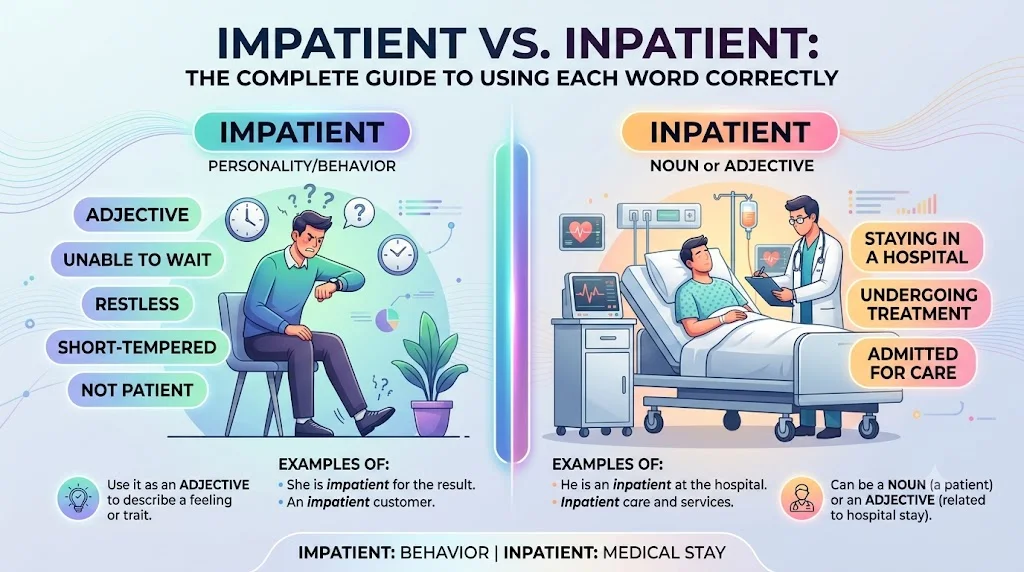
- Impatient (adjective) describes a person who is unwilling to wait calmly. It relates to emotion and behavior.
- Inpatient (adjective/noun) describes a patient who stays overnight in a hospital for treatment. It relates to medical care.
They are spelled almost the same, but they don’t share a root meaning. That’s exactly why so many people mix them up — the brain sees similar letters and assumes similar meaning. It’s a completely understandable mistake, and one we’re going to fix for good.
| Feature | Impatient | Inpatient |
| Part of speech | Adjective | Adjective / Noun |
| Meaning | Lacking patience; restless | A patient admitted to stay in a hospital |
| Prefix | im- (not) | in- (inside) |
| Field | Everyday emotion/behavior | Medical/healthcare |
| Pronunciation | im-PAY-shent | IN-pay-shent |
| Opposite | Patient | Outpatient |
Now let’s break each word down properly.
Defining “Impatient”
Meaning and Definition
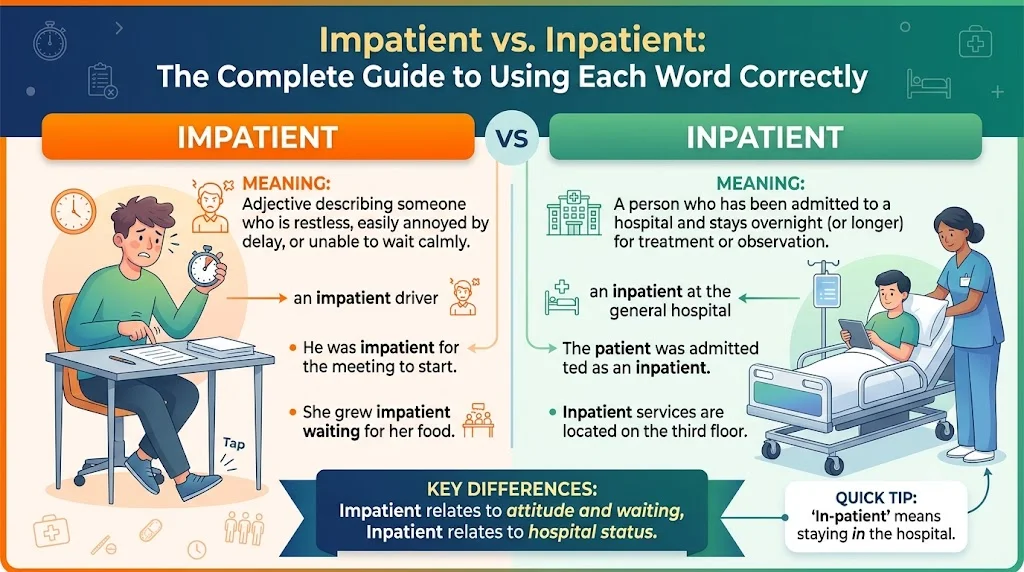
Impatient is an adjective that describes someone who does not want to wait, or who becomes annoyed, restless, or irritable while waiting. It can also describe someone who wants something to happen quickly and shows frustration when it doesn’t.
Dictionary-style definition: unable or unwilling to endure delay, difficulty, or annoyance without becoming irritated or restless.
Pronunciation
Impatient is pronounced im-PAY-shent (/ɪmˈpeɪʃənt/). The stress falls on the second syllable, “PAY.” Many learners accidentally stress the first syllable — try saying it slowly: im-PAY-shent, not IM-pay-shent.
Word Origin
The word comes from the Latin impatiens, formed from im- (a variant of “in-,” meaning “not”) plus patiens (meaning “suffering” or “enduring,” related to “patience”). So literally, impatient means “not enduring” — someone who cannot endure waiting.
Grammar Explanation
Impatient is an adjective, so it describes a noun or pronoun.
- Before a noun: an impatient customer
- After a linking verb: She seemed impatient.
- With a preposition: He was impatient with the slow service. / They grew impatient for the results.
Common structure: be + impatient + with/for/about
- Impatient with someone (a person)
- Impatient for something (an outcome)
- Impatient about a situation
Key Characteristics of Being Impatient
People who are impatient often show these signs:
- Tapping their foot or fingers while waiting
- Interrupting others mid-sentence
- Checking the clock repeatedly
- Sighing loudly in queues
- Rushing others to finish a task
- Feeling irritated by small delays
Quick Tip: If someone “can’t wait” in a negative, frustrated way (not the excited way), that’s impatience.
Formal vs. Informal Usage
- Formal: “The client expressed impatience regarding the delayed shipment.” (noun form: impatience)
- Informal: “Ugh, I’m so impatient today, I just want this meeting to end.”
Both are grammatically correct; the difference is tone and word choice, not correctness.
Common Expressions and Phrases Using “Impatient”
Native speakers use several natural phrases built around this word:
- “Growing impatient” — becoming increasingly impatient over time. Example: The crowd was growing impatient as the concert start time passed.
- “Impatiently waiting” — waiting while showing signs of impatience. Example: She stood impatiently waiting for the bus.
- “Don’t be so impatient” — a common phrase used to calm someone down.
- “Impatient to start” — eager and restless to begin something. Example: The students were impatient to start their summer break.
- “Patience is a virtue” — an idiom often used as a gentle reminder to someone being impatient.
Common Collocations with “Impatient”
| Collocation | Example Sentence |
| grow impatient | He grew impatient waiting in line. |
| impatient sigh | She let out an impatient sigh. |
| impatient tone | Don’t use that impatient tone with me. |
| increasingly impatient | Investors are increasingly impatient for results. |
| impatient gesture | He made an impatient gesture toward the door. |
Synonyms for Impatient
- Restless
- Irritable
- Edgy
- Eager (in a positive sense)
- Fidgety
- Testy
- Anxious to proceed
Opposite (Antonym) of Impatient
- Patient — willing to wait calmly without complaint.
Similar Words That Are Often Confused
- Impatient vs. Anxious: Anxious refers to worry or nervousness; impatient refers to unwillingness to wait. You can be anxious without being impatient, and impatient without being anxious.
- Impatient vs. Eager: Eager is enthusiastic anticipation; impatient adds a layer of frustration or restlessness.
Common Mistakes with “Impatient”
- Spelling confusion with “inpatient.” This is the #1 mistake — writing “inpatient” when you mean the emotional state.
- ❌ She was very inpatient waiting for the results.
- ✅ She was very impatient waiting for the results.
- Wrong preposition.
- ❌ He was impatient of the delay.
- ✅ He was impatient with the delay. (or “impatient about the delay”)
- Using it as a verb. Impatient is only an adjective; there’s no verb form “to impatient.”
- ❌ Don’t impatient me.
- ✅ Don’t make me impatient.
Real-Life Examples of “Impatient”
- The teacher noticed the students were impatient to leave for recess.
- My grandfather always says young people today are too impatient.
- The impatient driver honked his horn the second the light turned green.
- She tapped her pen impatiently during the long meeting.
- Investors are growing impatient with the company’s slow growth.
Defining “Inpatient”
Meaning and Definition
Inpatient is both a noun and an adjective used almost exclusively in medical and healthcare contexts. As a noun, an inpatient is a person who is admitted to a hospital and stays there for one or more nights to receive treatment. As an adjective, it describes care, services, or facilities related to this kind of hospital stay.
Dictionary-style definition: a patient who is admitted to a hospital for treatment that requires at least one overnight stay.
Pronunciation
Inpatient is pronounced IN-pay-shent (/ˈɪnˌpeɪʃənt/). Unlike “impatient,” the stress here falls on the first syllable: IN-pay-shent.
Word Origin
“Inpatient” is a compound word formed from in (meaning “inside” or “within”) and patient (from Latin patiens, “one who suffers or endures,” referring to someone receiving medical treatment). So an inpatient is literally a patient who stays in the hospital, as opposed to one who visits and leaves the same day.
Grammar Explanation
Inpatient functions in two ways:
- As a noun: “The hospital admitted three new inpatients today.”
- As an adjective (usually before a noun): “She is receiving inpatient care.” / “The inpatient unit is on the third floor.”
It is almost never used with a linking verb the way “impatient” is (you wouldn’t say “He seemed inpatient” to mean hospitalized — you’d say “He was admitted as an inpatient” or “He is an inpatient”).
Key Characteristics
Situations that typically involve inpatient status:
- Surgery requiring recovery time and monitoring
- Childbirth and postnatal care
- Serious injuries (fractures, trauma)
- Mental health treatment programs
- Intensive treatments like chemotherapy in some cases
- Conditions requiring 24-hour observation
Quick Tip: If the person sleeps at the hospital as part of their treatment, they are an inpatient. If they walk in, get treated, and go home the same day, they are an outpatient (more on this below).
Formal vs. Informal Usage
- Formal/Medical: “The patient was transitioned from inpatient to outpatient rehabilitation.”
- Everyday/Informal: “She’s staying in the hospital for a few days — she’s an inpatient right now.”
This word is almost always used in a semi-formal or professional context (medical billing, hospital records, insurance forms), so there isn’t much of a casual slang version.
Common Phrases and Collocations with “Inpatient”
| Collocation | Example Sentence |
| inpatient care | He is receiving inpatient care after his surgery. |
| inpatient treatment | The rehab center offers inpatient treatment programs. |
| inpatient unit/ward | She was moved to the inpatient psychiatric unit. |
| inpatient admission | Inpatient admission requires a doctor’s referral. |
| inpatient facility | The clinic isn’t an inpatient facility, so they transferred him. |
| inpatient services | The hospital expanded its inpatient services last year. |
Synonyms for Inpatient
- Hospitalized patient
- Admitted patient
- Resident patient (less common)
There isn’t a wide range of true synonyms because this is a technical/medical term, not a descriptive one.
Opposite (Antonym) of Inpatient
- Outpatient — a patient who receives treatment without an overnight hospital stay.
Inpatient vs. Outpatient: A Crucial Related Comparison
Since “outpatient” is the real opposite of “inpatient” (not “impatient”), it’s worth understanding this pair too — competitor articles often skip this, but it’s essential for full search intent.
| Feature | Inpatient | Outpatient |
| Hospital stay | Overnight or longer | Same-day, no overnight stay |
| Example situations | Surgery, childbirth, ICU care | Check-ups, minor procedures, therapy sessions |
| Monitoring | Continuous, 24-hour | Periodic, scheduled visits |
| Cost (generally) | Higher | Lower |
| Recovery location | Hospital | Home |
Example sentence: “After his knee surgery, he was an inpatient for two nights, then continued his recovery as an outpatient.”
Common Mistakes with “Inpatient”
- Confusing it with “impatient.”
- ❌ He is being inpatient with the nurses. (meaning he’s restless)
- ✅ He is being impatient with the nurses.
- Using it outside medical context.
- ❌ I’m feeling inpatient about the exam results. (This should be “impatient.”)
- Hyphenating incorrectly. Some learners write “in-patient.” Both “inpatient” and “in-patient” appear in dictionaries, but “inpatient” (one word, no hyphen) is now the standard modern spelling, especially in US English.
Real-Life Examples of “Inpatient”
- My uncle was an inpatient at the city hospital for a week after his heart attack.
- The clinic only offers outpatient services; it does not have an inpatient facility.
- Insurance often covers inpatient stays differently than outpatient visits.
- She works as an inpatient nurse on the surgical ward.
- The rehabilitation center provides both inpatient and outpatient treatment options.
Contextual Clarity: Using “Impatient” and “Inpatient” in Sentences
The best way to lock in the difference is to see both words side by side in similar sentence structures.
| Sentence with “Impatient” | Sentence with “Inpatient” |
| She grew impatient waiting for the doctor. | She was admitted as an inpatient last night. |
| He is impatient with slow internet. | He is receiving inpatient treatment for his injury. |
| The kids were impatient for dinner. | The kids’ ward houses inpatient children recovering from surgery. |
| Don’t be impatient — the results take time. | The hospital’s inpatient unit has 40 beds. |
| Her impatient tone surprised everyone. | Her father is currently an inpatient at Mercy Hospital. |
Quick Test: Ask yourself — “Am I describing a feeling, or a hospital stay?” Feeling = impatient. Hospital stay = inpatient.
The Linguistic Origins of Both Words: A Deeper Look
Understanding etymology helps the difference stick permanently, so let’s compare the two prefixes side by side.
- Im- in “impatient” is a form of the Latin negative prefix in- that changes to im- before the letter “p” (a rule called assimilation, also seen in words like impossible, immature, and imperfect). It means “not.”
- In- in “inpatient” is a completely different in-, meaning “inside” or “within” (as in indoor, income, inland). It has nothing to do with negation.
This is the real reason these words look alike but mean nothing alike — they use the same three letters (“in”) for two unrelated grammatical purposes. Once you know this, the confusion mostly disappears, because you can ask: “Is this word negating something, or placing something inside something else?”
Teacher’s Tip: Think of “impatient” as “im- + patient” = NOT patient (a feeling). Think of “inpatient” as “in- + patient” = a patient WHO STAYS IN (a place). The word “patient” itself is hiding inside both — but only “inpatient” is actually about a patient.
Common Mistakes Students and Professionals Make
Let’s go through the most frequent errors I see, whether I’m grading essays or reviewing workplace emails.
1. Autocorrect and Spellcheck Errors
Many word processors don’t flag “inpatient” as wrong even when you meant “impatient,” because both are real words. Spellcheck won’t save you here — you have to know the meaning.
2. Mixing Them in Medical Writing
This is especially risky. In healthcare documentation, writing “the patient became inpatient” when you meant “impatient” (restless) — or vice versa — can create real confusion in patient records.
- ❌ The patient became inpatient during the wait.
- ✅ The patient became impatient during the wait.
3. Using “Impatient” for Hospital Status
- ❌ He has been impatient at the hospital for three days.
- ✅ He has been an inpatient at the hospital for three days.
4. Forgetting the Noun Form of “Inpatient”
Impatient has a noun form: impatience. Inpatient itself is already a noun (referring to the person). Learners sometimes try to say “inpatience,” which isn’t a standard word in this context.
- ❌ The hospital measures inpatience rates. (incorrect — should be “inpatient admission rates” or similar)
- ✅ Her impatience was obvious.
5. Pronunciation Slip-Ups
Because the stress pattern changes (im-PAY-shent vs. IN-pay-shent), mispronouncing one as the other in speech can genuinely confuse listeners, especially in medical settings.
Common Mistakes Summary Table
| Mistake | Wrong | Correct |
| Spelling swap | inpatient waiting | impatient waiting |
| Context swap | impatient care | inpatient care |
| Wrong preposition | impatient of | impatient with/for |
| Unnecessary hyphen | in-patient (older style) | inpatient (preferred modern spelling) |
| Wrong word form | inpatience | impatience |
Practical Tips and Tricks to Remember the Difference
Here are memory tricks I give my own students — pick whichever clicks for you.
- The “M” for Mood trick: Impatient has an M, and so does eMotion / teMper. If the sentence is about mood or emotion, use the one with the “m” — impatient.
- The “Hospital IN” trick: Inpatient starts with “IN,” and a hospital inpatient stays IN the building overnight. If they’re staying in, use inpatient.
- Say it out loud: im-PAY-shent (feeling) vs. IN-pay-shent (hospital). The different stress patterns act as an audio clue.
- Replace and test: Try substituting “restless” into the sentence. If it still makes sense, you need “impatient.” Try substituting “hospitalized.” If that fits, you need “inpatient.”
- Remember the opposite: Impatient’s opposite is patient (calm). Inpatient’s opposite is outpatient (day visit). If you know which opposite fits your sentence, you know which word to use.
Advanced Usage and Nuances
Using “Impatience” and Related Noun Forms
- Impatience (noun): the state of being impatient. “His impatience cost him the deal.”
- There is no common standalone noun “inpatience” used to describe a feeling — don’t invent it.
Idiomatic and Figurative Use of “Impatient”
Impatient can be used figuratively beyond people — for example, describing markets, weather, or abstract situations that seem “restless” or “eager.”
- “The impatient economy demanded faster results.”
- “Impatient winds signaled the coming storm.” (literary/poetic use)
Compound and Related Medical Terms Using “Patient”
Since both words share the root “patient,” it helps to know the wider word family used in healthcare and everyday English:
- Outpatient — treated without an overnight stay
- Patient — a person receiving medical care, or someone calm and tolerant
- Patience — the noun form describing calm tolerance
- Patiently — the adverb form (“She waited patiently.”)
- Impatiently — the adverb form of impatient (“He tapped his foot impatiently.”)
Register and Tone Differences
“Impatient” appears comfortably in casual conversation, literature, workplace emails, and even poetry. “Inpatient” is almost entirely restricted to healthcare, insurance, and administrative writing — you’re unlikely to hear it in casual chat unless someone is discussing a hospital visit specifically.
Recap and Actionable Takeaways
Let’s summarize everything into a quick-reference checklist:
- Impatient = a feeling; unwilling to wait; adjective only.
- Inpatient = a hospital status; someone admitted overnight; noun and adjective.
- Impatient’s opposite is patient. Inpatient’s opposite is outpatient.
- Pronunciation stress differs: im-PAY-shent vs. IN-pay-shent.
- Use the “M for mood” and “IN for inside the hospital” memory tricks.
- Always double-check medical or professional writing — spellcheck won’t catch this error.
- Practice with real sentences until the choice becomes automatic.
Practice Exercises
Try filling in the blank with impatient or inpatient before checking the answers below.
- The children were _______ for the movie to start.
- She was admitted as an _______ after her accident.
- He gave an _______ sigh when the waiter forgot his order.
- The hospital’s _______ unit was recently renovated.
- Investors grew _______ waiting for quarterly earnings.
Answers: 1. impatient, 2. inpatient, 3. impatient, 4. inpatient, 5. impatient
Conclusion
Impatient and inpatient may share nine letters, but they belong to completely different worlds — one lives in our emotions, the other in hospital records. Once you understand the roots (im- meaning “not,” in- meaning “inside”), remember the stress pattern in pronunciation, and practice with real sentences, the confusion disappears for good. Whether you’re writing a casual text message or a formal medical report, you now have every tool you need to choose the right word with confidence, every single time.
FAQs
1. What is the main difference between impatient and inpatient? Impatient describes a feeling of restlessness or unwillingness to wait, while inpatient describes a person admitted to a hospital for an overnight stay or longer. They share similar spelling but completely different meanings and uses, one emotional and one medical.
2. How do you pronounce impatient vs. inpatient correctly? Impatient is pronounced im-PAY-shent, with stress on the second syllable. Inpatient is pronounced IN-pay-shent, with stress on the first syllable. Listening for this stress difference can help you tell the words apart when speaking or listening.
3. Is “inpatient” one word or two? Modern US English treats “inpatient” as one word without a hyphen. You may still see the older hyphenated form “in-patient” in some older texts, but “inpatient” is the preferred and more common spelling today.
4. What is the opposite of inpatient? The opposite of inpatient is outpatient, which refers to a patient who receives treatment without staying overnight at a hospital. This is different from the opposite of impatient, which is simply “patient” (calm and willing to wait).
5. Can “inpatient” be used as an adjective? Yes. Inpatient can function as an adjective before a noun, such as “inpatient care,” “inpatient treatment,” or “inpatient unit.” It can also function as a noun referring to the hospitalized person directly.
6. Is impatient always negative? Mostly, yes, impatient carries a slightly negative or restless tone, suggesting annoyance or discomfort with waiting. However, it can occasionally describe excited anticipation, such as being “impatient” to open a gift, which leans more positive.
7. What is the noun form of impatient? The noun form of impatient is “impatience,” which refers to the state or quality of being unwilling to wait calmly. For example, “Her impatience showed when she kept checking her phone.”
8. Why do these two words get confused so often? They get confused because they look almost identical and both contain the word “patient.” However, they use two different prefixes, “im-” (not) and “in-” (inside), which happen to look alike but carry unrelated meanings.
9. Can a hospital patient be both impatient and an inpatient at the same time? Yes, actually. A person could be an inpatient (staying overnight in the hospital) while also feeling impatient (restless about waiting for test results or discharge), since these words describe two entirely separate aspects of their situation.
10. Is there a word “inpatience”? No, “inpatience” is not a standard English word. The correct noun form for the feeling of impatience is simply “impatience.” If you’re referring to hospital data, use terms like “inpatient admissions” instead.