
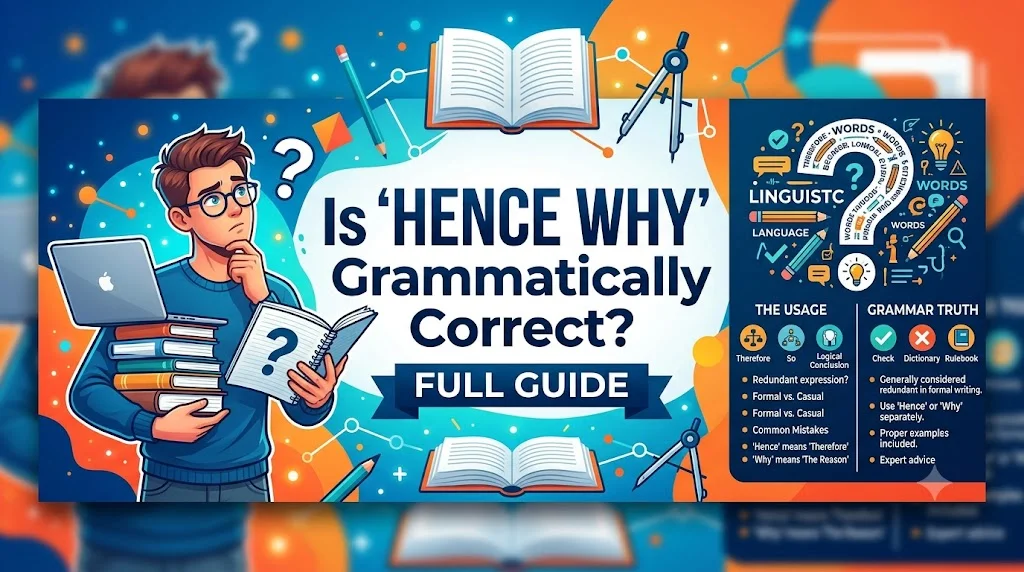
If you have ever typed the phrase “hence why” and then paused, wondering if you just made a grammar mistake, you are not alone. This little phrase shows up constantly in emails, essays, and everyday conversation, yet many grammar teachers raise an eyebrow at it. In this guide, I will walk you through exactly what “hence why” means, whether it is grammatically correct, why so many style guides frown on it, and what to use instead when you want your writing to sound polished and professional.
Think of this as a one-stop lesson from your English teacher’s desk — clear, practical, and packed with real examples you can use today.
What Does “Hence Why” Mean?
Meaning: “Hence why” is used to introduce a reason or a result. People use it the same way they would use “that’s why” or “which is why.”
Definition: The phrase combines two words:
- Hence — an adverb meaning “for this reason” or “as a result of this”
- Why — a question word or relative adverb that introduces a reason or cause
When joined together, “hence why” is meant to signal a cause-and-effect relationship, usually at the start of a clause that explains a consequence.
Example sentence:
“The flight was delayed for six hours, hence why we missed our connection.”
Pronunciation: “Hence” is pronounced /hɛns/ (rhymes with “tense”). “Why” is pronounced /waɪ/. Together: HENS-why.
Word origin: “Hence” comes from Middle English “hennes,” related to Old English “heonan,” meaning “from this place” or “from this time.” Over centuries, its meaning shifted from a physical direction (“go hence”) to a logical one (“therefore, for this reason”). “Why,” on the other hand, comes from Old English “hwī,” a form used to ask or explain a reason. When speakers began combining the two, they were essentially stacking two “reason” words on top of each other — which is exactly why the phrase raises grammar flags.
Is “Hence Why” Grammatically Correct?
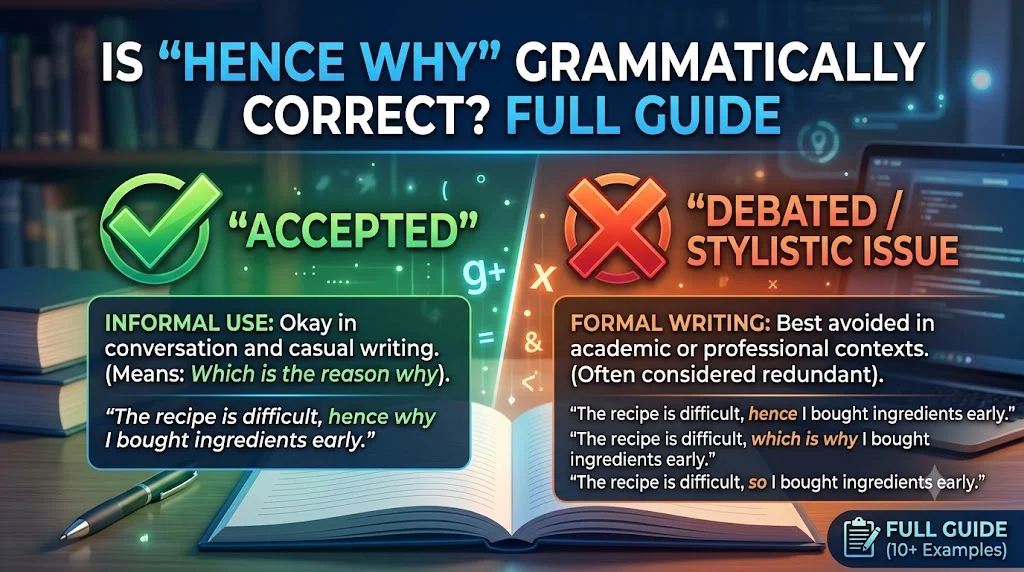
Here is the short answer: “Hence why” is grammatically redundant, though it is widely used and understood.
It is not technically “wrong” in the sense of breaking a hard grammar rule, the way a subject-verb disagreement would be wrong. Instead, it is a case of redundancy — using two words that both do the same job, when only one is needed.
“Hence” already means “for this reason” or “and this is why.” Adding “why” after it repeats the same idea. It is similar to saying:
- “Return back” instead of “return”
- “Free gift” instead of “gift”
- “PIN number” instead of “PIN”
Grammar explanation: “Hence” functions as a conjunctive adverb. It connects two independent ideas and shows a result, similar to “therefore” or “thus.” A conjunctive adverb does not need a second explanatory word like “why” tacked onto it, because it already carries that cause-and-effect meaning on its own.
Compare these two sentences:
| Sentence | Grammatically Sound? | Why |
| “It rained all day, hence the flooding.” | Yes | “Hence” alone introduces the result. |
| “It rained all day, hence why the streets flooded.” | Redundant | “Why” repeats the reason-giving job “hence” already does. |
So while you will hear “hence why” in casual speech and even see it in published writing, most grammar authorities recommend dropping the “why” for cleaner, more precise sentences.
Why Many Grammar Experts Consider “Hence Why” Redundant
Grammar experts and style guides point to a few specific reasons why “hence why” doesn’t hold up under close inspection.
1. “Hence” already means “for this reason.” Since “hence” is a self-contained conjunctive adverb, it does not need help from “why” to explain a cause. Saying “hence why” is like saying “for this reason why,” which sounds clearly repetitive once you spell it out.
2. It mixes two grammatical functions. “Hence” is an adverb. “Why” is typically used as a relative adverb or interrogative word, most often following a noun (“the reason why”) or starting a question (“Why did you leave?”). Jamming them together creates an awkward grammatical hybrid that doesn’t match either pattern cleanly.
3. Style guides prefer economy of language. Modern style guides, including those used in academic and business writing, value concise sentences. Any phrase that repeats meaning is usually flagged during editing, and “hence why” is a common target.
4. It rarely appears in edited, formal publications. Search through major newspapers, academic journals, or professionally edited books, and “hence why” shows up far less often than “hence” alone or “that’s why.” This tells us that professional editors tend to remove it.
Quick Tip: If you can delete “why” from your sentence and it still makes complete sense, that is a strong sign “why” was unnecessary.
How to Use “Hence” Correctly in English
Let’s slow down and look at “hence” on its own, since understanding it properly is the key to avoiding the “hence why” trap.
Meaning: “For this reason”; “as a consequence of this.”
Grammar explanation: “Hence” is a conjunctive adverb. It usually sits at the start of a clause or sentence and connects it logically to the previous statement. It does not need a subject or verb directly after it — it can be followed by a noun phrase instead of a full clause.
Formal vs. informal usage: “Hence” leans formal. You will see it often in academic writing, legal documents, business reports, and news analysis. In casual conversation, English speakers are more likely to say “so” or “that’s why.”
Correct Examples of “Hence”
- “The bridge is closed for repairs; hence, traffic is being redirected.”
- “She trained for two years, hence her confidence on stage.”
- “Profits dropped sharply, hence the company’s decision to cut costs.”
- “He arrived late, hence the missed meeting.”
Notice that “hence” can be followed by either a full clause (“hence, traffic is being redirected”) or just a noun phrase (“hence her confidence”). Both are correct.
Common Mistakes When Using “Hence”
- Pairing it with “why.” (“Hence why he left early” → should be “hence he left early” or “which is why he left early.”)
- Using it mid-sentence without punctuation. A comma usually comes before “hence” when it links two clauses: “The roads were icy, hence the accident.”
- Confusing it with “henceforth.” “Henceforth” means “from now on,” while “hence” means “for this reason.” They are not interchangeable.
- Overusing it in casual writing. “Hence” can sound stiff in a friendly email or text message. Save it for more formal contexts.
Tips to remember: Think of “hence” as a formal cousin of “so.” If you would naturally say “so,” and you want to sound more formal, swap in “hence” — but do not add “why” afterward.
Practice examples: Try rewriting these using “hence” correctly.
- “It was raining, so we canceled the picnic.” → “It was raining, hence we canceled the picnic.”
- “He studied hard, so he passed the exam.” → “He studied hard, hence his success on the exam.”
Examples of “Hence Why” in Real Sentences
Even though we now know “hence why” is redundant, it helps to see how it actually appears in real writing across different contexts, so you can recognize it and revise it when needed.
Academic Writing
“The sample size was too small, hence why the results cannot be generalized.”
Better version: “The sample size was too small, hence the results cannot be generalized.”
Academic writing especially benefits from precision. Professors and journal reviewers often mark redundant phrasing like this during peer review.
Business Writing
“Our supplier missed the shipment deadline, hence why the launch was postponed.”
Better version: “Our supplier missed the shipment deadline, which is why the launch was postponed.”
In business communication, clarity and brevity matter. Removing the redundancy makes the sentence sound sharper and more confident.
Everyday English
“I was exhausted, hence why I skipped the gym today.”
Better version: “I was exhausted, which is why I skipped the gym today,” or simply, “I was exhausted, so I skipped the gym today.”
In casual conversation, “hence why” is common and rarely causes confusion. Native speakers use it without thinking twice. It just is not the most polished choice for formal writing.
Better Alternatives to “Hence Why”
If you want to keep your writing clean and avoid redundancy, here are five reliable alternatives, each with its own tone and use case.
Hence
Meaning: For this reason. Formality: Formal. Example: “The airport was fogged in, hence the delay.”
Therefore
Meaning: As a logical result of what was just stated. Formality: Formal, common in academic and legal writing. Example: “The evidence was inconclusive; therefore, the case was dismissed.”
Thus
Meaning: In this way; as a result. Formality: Formal, slightly more literary than “therefore.” Example: “The market shifted rapidly, thus forcing companies to adapt.”
That’s Why
Meaning: For that reason (conversational equivalent of “hence”). Formality: Informal to neutral, ideal for everyday speech and casual writing. Example: “I forgot my umbrella — that’s why I got soaked.”
As a Result
Meaning: Because of what happened previously. Formality: Neutral, works well in both formal and semi-formal contexts. Example: “Sales increased 20 percent last quarter. As a result, the company hired more staff.”
Comparison Table: Choosing the Right Word
| Word/Phrase | Formality Level | Best Used In | Example |
| Hence | Formal | Academic, legal, business | “Hence, the proposal was rejected.” |
| Therefore | Formal | Academic, legal | “Therefore, we conclude the results are valid.” |
| Thus | Formal/Literary | Essays, reports | “Thus, the theory was proven correct.” |
| That’s why | Informal | Conversation, casual writing | “That’s why I left early.” |
| As a result | Neutral | Business, journalism | “As a result, prices rose.” |
“Hence Why” vs. “That’s Why”: What’s the Difference?
Both phrases point to a reason, but they belong to different registers of English.
- “Hence why” blends a formal word (“hence”) with a conversational structure (“why”), creating a mismatch in tone and a redundancy in meaning.
- “That’s why” is naturally conversational. It matches informal speech patterns and does not repeat itself grammatically.
Example comparison:
- Redundant and mismatched: “I missed the bus, hence why I was late.”
- Natural and informal: “I missed the bus, that’s why I was late.”
- Natural and formal: “I missed the bus; hence, I was late.”
Tip to remember: If your sentence sounds casual, use “that’s why.” If it sounds formal, use “hence” alone, without “why.”
“Hence” vs. “Therefore” vs. “Thus”
These three words often get grouped together because they all signal cause and effect, but they carry subtle differences in tone and usage.
| Word | Tone | Typical Context | Sentence Position |
| Hence | Formal, slightly old-fashioned | Business, academic writing | Usually starts a clause |
| Therefore | Formal, logical | Legal writing, arguments, essays | Start or middle of sentence |
| Thus | Formal, literary | Essays, formal reports | Start or middle of sentence |
Example sentences:
- “The data was flawed; hence, we redid the experiment.”
- “The data was flawed; therefore, we redid the experiment.”
- “The data was flawed; thus, we redid the experiment.”
All three work here, which shows how closely related they are. The choice often comes down to personal style or the tone of the surrounding text. “Therefore” tends to feel the most neutral and widely accepted across formal writing, while “hence” and “thus” carry a slightly more traditional, literary feel.
Synonyms of this group: consequently, accordingly, as a result, for this reason, so.
When Is It Acceptable to Use “Hence Why”?
Grammar rules exist to guide clear communication, not to punish natural speech. So when is “hence why” actually okay?
- In casual conversation: Native speakers use it all the time without anyone blinking. It sounds natural in spoken English.
- In informal writing: Texts, casual emails, social media posts, or personal blogs can comfortably include it.
- In dialogue within fiction: If a character speaks this way, it can add authenticity to their voice.
Where it becomes a problem is in formal writing — academic essays, professional reports, resumes, or any context where precision and polish matter. In those settings, stick to “hence,” “therefore,” or “which is why.”
Why Native Speakers Still Use “Hence Why”
If “hence why” is redundant, why do so many fluent, educated English speakers still say it? A few reasons explain this:
- Spoken language naturally repeats for emphasis. In real-time speech, speakers often add extra words without planning ahead, and repetition can even help listeners follow along.
- “Why” softens the formality of “hence.” Pairing a stiff word with a familiar one makes the sentence feel more approachable.
- Language change happens through repetition. Phrases that get used often enough start to feel “normal,” even if they began as redundant.
- It mirrors a common pattern in English. English already has “that’s why” and “which is why,” so “hence why” fits a familiar sentence mold, even though “hence” does not grammatically need “why” attached.
Language evolves through everyday use, not just textbook rules, so it makes sense that a redundant but understandable phrase like this one has stuck around.
The History and Evolution of “Hence Why”
“Hence” has been part of English for centuries, tracing back to Old and Middle English words meaning “from here” or “from this point.” Its meaning gradually shifted from describing physical direction to describing logical direction — moving from a cause to a conclusion.
“Why,” meanwhile, has long been used to introduce reasons, especially in the pattern “the reason why.” Over time, as spoken English blended structures for convenience, phrases like “hence why” and “reason why” started appearing side by side, especially in less formal speech.
Interestingly, “the reason why” faces the exact same redundancy criticism that “hence why” does, since “reason” and “why” also overlap in meaning. This shows that “hence why” is not an isolated slip — it is part of a broader pattern in English where speakers double up on cause-and-effect words for emphasis or rhythm, even when one word would technically do the job.
Common Redundant Expressions in English
“Hence why” belongs to a much larger family of redundant phrases in English. Recognizing these patterns will sharpen your editing eye across the board.
Free Gift
A gift is already free by definition, so “free” adds nothing new. Better: “gift”
Advance Planning
Planning, by nature, happens before something occurs. Better: “planning”
Past History
History, by definition, refers to the past. Better: “history”
End Result
A result already marks the end of a process. Better: “result”
Quick Tip: When editing your own writing, ask yourself: “Does this second word add new information, or does it just repeat the first word’s meaning?” If it repeats, cut it.
Common Cause-and-Effect Grammar Mistakes
Since “hence why” often trips people up around cause-and-effect language, let’s look at a few related mistakes worth mastering.
Because vs. Since
Because introduces a direct cause. Since can mean “because,” but it can also refer to time, which sometimes creates ambiguity.
- “Since I was tired, I went to bed.” (cause)
- “Since Monday, I have been tired.” (time)
Tip: If there is any chance of confusion with time, use “because” instead of “since.”
So vs. Therefore
So is casual and common in speech. Therefore is formal and common in writing.
- Informal: “I was late, so I missed the intro.”
- Formal: “I was late; therefore, I missed the introduction.”
Hence vs. Thus
Both are formal and largely interchangeable, though “thus” often appears slightly more often in academic or literary contexts, while “hence” leans toward business and general formal writing.
- “The results were inconsistent, hence the need for further testing.”
- “The results were inconsistent, thus prompting further testing.”
Quick Tips to Avoid Grammar Mistakes
- Read your sentence aloud and remove any word that repeats a meaning already present.
- When using “hence,” “therefore,” or “thus,” place a comma after them if they start a new clause.
- Reserve “hence,” “therefore,” and “thus” for formal writing; use “so” and “that’s why” in casual writing.
- Avoid stacking two cause-and-effect words together, such as “hence why,” “because since,” or “reason why because.”
- When editing, search your document for “hence why” and manually review each instance.
- If you are unsure whether a phrase is redundant, try removing one word at a time and check if the meaning holds.
Final Verdict: Should You Use “Hence Why”?
“Hence why” is not a grammar crime, but it is not the sharpest choice either. It works fine in casual speech and informal writing, where natural rhythm matters more than strict precision. But in formal writing — essays, reports, resumes, professional emails — it is best to trim the redundancy and choose “hence,” “therefore,” “thus,” or “which is why” instead.
Think of it this way: “hence why” is like wearing two belts. Your pants will stay up either way, but one belt does the job just as well, with less clutter. Good writing, like good style, often comes down to knowing what to leave out.
Frequently Asked Questions (FAQs)
Is “Hence Why” incorrect in formal writing?
It is not technically a grammar error, but most style guides consider it redundant in formal writing. “Hence” already means “for this reason,” so adding “why” repeats the same idea. In essays, reports, and professional documents, it is better to use “hence” alone or switch to “therefore” or “which is why” for a cleaner, more polished sentence.
Can I use “Hence Why” in academic essays?
It is best to avoid it. Academic writing values precision, and professors or reviewers often flag redundant phrasing during editing. Instead, use “hence,” “therefore,” or “thus” on their own. These alternatives carry the same meaning without repeating the reason-giving function that “why” adds unnecessarily after “hence.”
What should I use instead of “Hence Why”?
Strong alternatives include “hence,” “therefore,” “thus,” “that’s why,” and “as a result.” Choose based on formality: “hence,” “therefore,” and “thus” work well in formal writing, while “that’s why” and “as a result” suit both casual and semi-formal contexts. Each avoids the redundancy found in “hence why.”
Why do people still say “Hence Why”?
Spoken language often includes natural repetition for emphasis and rhythm, and “hence why” mirrors familiar patterns like “that’s why” and “which is why.” Over time, frequent use in everyday speech has made the phrase feel normal to many speakers, even though “hence” alone already carries the full meaning.
Is “Hence Why” acceptable in spoken English?
Yes. In casual conversation, “hence why” sounds completely natural, and native speakers use it often without any confusion. It only becomes an issue in formal writing, where redundancy is typically edited out. Spoken English generally allows more flexibility than the tighter standards expected in academic or professional documents.
Final Thoughts
“Hence why” sits in an interesting gray area of English. It is not a grammar rule violation, but it is a redundancy that careful writers usually trim. “Hence” already carries the full meaning of “for this reason,” so adding “why” repeats information the sentence does not need. In casual conversation, this phrase sounds completely natural, and native speakers use it without a second thought.
But in formal writing — essays, business reports, resumes — swapping it for “hence,” “therefore,” “thus,” or “which is why” will make your sentences sharper and more professional. Good grammar is not about rigid rules; it is about clear, confident communication. Once you understand why “hence why” repeats itself, you will naturally start writing cleaner, more precise sentences every time.