
If you’ve ever paused mid-sentence wondering whether you needed “propose” or “purpose,” you’re not alone. These two words look similar, share a Latin root, and even sound alike when spoken quickly. But they play completely different roles in English grammar, and mixing them up can confuse your reader or, worse, change the meaning of your sentence entirely.
In this guide, we’ll break down everything you need to know about propose vs purpose — meanings, grammar, pronunciation, word origins, common mistakes, collocations, synonyms, antonyms, and real-life examples. By the end, you’ll never second-guess yourself again.
Propose vs Purpose at a Glance
Before we go deep, here’s the short answer.
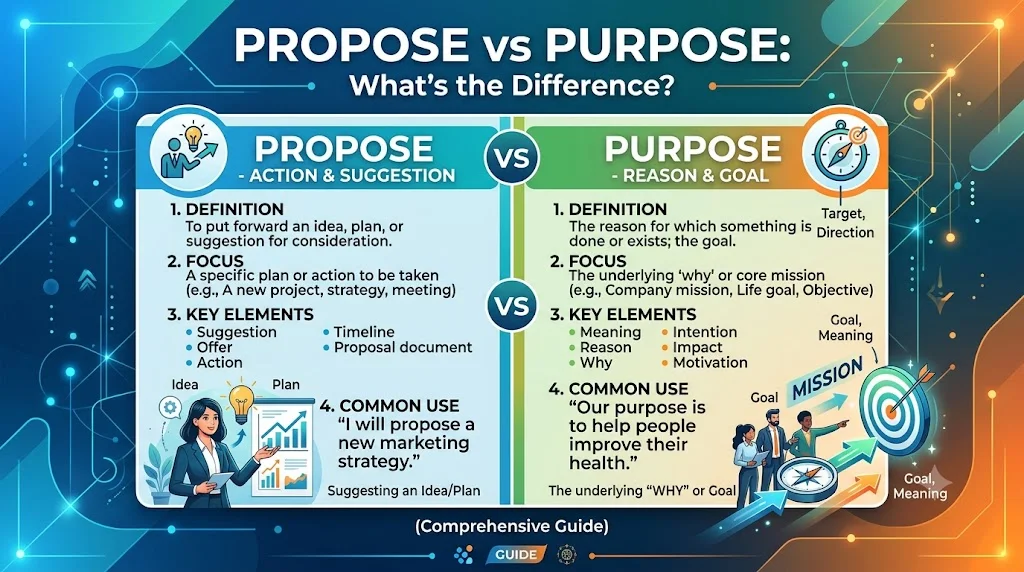
- Propose is a verb. It means to suggest an idea, to plan to do something, or to ask someone to marry you.
- Purpose is mainly a noun. It means the reason something exists or the goal behind an action.
That one distinction — verb versus noun — solves 90% of the confusion. Let’s unpack the rest.
Why Do “Propose” and “Purpose” Get Confused So Often?
Three reasons explain most of the mix-ups.
1. Visual similarity. Both words start with “pro/pur” and end in similar letter patterns. Fast readers and non-native speakers often skim over the middle letters and guess wrong.
2. Shared word origin. Both words trace back to the Latin word proponere and propositum, related to “putting forward” an idea. Because their roots overlap, learners assume the meanings overlap too — but modern English has split them into distinct grammatical categories.
3. Auto-correct and spell-check errors. Many writers type “purpose” when they mean “propose” (or vice versa), and spell-checkers won’t catch it because both are correctly spelled English words. Only a grammar-aware read catches the error.
Quick Tip: If your sentence needs an action (a verb), reach for “propose.” If your sentence needs a reason or goal (a noun), reach for “purpose.”
What Does “Propose” Mean?
Definition and Core Meaning
Propose (verb) means to put forward an idea, plan, or suggestion for others to consider. It can also mean to intend to do something, or — in its most romantic sense — to ask someone to marry you.
- Pronunciation: /prəˈpoʊz/ (pruh-POHZ) — stress falls on the second syllable.
- Word origin: From Old French proposer, from Latin proponere (“to put forth”), combining pro- (“forward”) and ponere (“to place”).
Propose as a Suggestion
This is the most common use of “propose” in everyday and professional English. It means offering an idea for others to evaluate, debate, or approve.
Examples:
- The manager proposed a new marketing strategy during the meeting.
- I propose that we move the deadline to next Friday.
- The committee will propose changes to the budget next week.
Formal vs Informal: “Propose” sounds formal and is common in business, academic, and legal writing. In casual conversation, people often say “suggest” instead.
Propose as a Marriage Proposal
This is the meaning most people recognize instantly. “Propose” here means to formally ask someone to marry you.
Examples:
- He proposed to her on a beach at sunset.
- She said yes when he proposed.
- They’ve been dating for five years, so everyone expects him to propose soon.
Related noun form: The noun for this event is “proposal” (not “proposement” — a common learner mistake).
Propose as an Intention or Plan
“Propose” can also mean to intend or plan to do something, often used in a slightly formal or old-fashioned tone.
Examples:
- How do you propose to solve this problem?
- I propose to finish the report by Monday.
- She proposed spending the summer abroad.
Grammar note: When “propose” is followed by a verb, that verb takes the “-ing” form (gerund) or “to + verb” (infinitive), depending on the sentence structure. Both “propose doing” and “propose to do” are grammatically correct.
What Does “Purpose” Mean?
Definition and Core Meaning
Purpose (noun) refers to the reason for which something is done, created, or exists. It’s the “why” behind an action, object, or plan.
- Pronunciation: /ˈpɜːrpəs/ (PUR-pus) — stress falls on the first syllable.
- Word origin: From Old French porpos, from Latin propositum (“something set forth” or “intention”), the past participle of proponere.
Purpose as an Aim or Goal
This is the most common everyday use. “Purpose” describes the objective behind an action or thing.
Examples:
- The purpose of this meeting is to discuss next quarter’s goals.
- What is the purpose of this tool?
- Her purpose in life is to help others.
Purpose as an Intention
Closely related to “aim,” this sense of “purpose” refers to what someone plans or means to do, often in a more personal or reflective tone.
Examples:
- He moved to the city with a clear purpose: to build a career in film.
- I write with the purpose of inspiring others.
- Their purpose was to raise awareness, not to make money.
Purpose as Determination or Resolve
“Purpose” can also describe inner drive, focus, or strength of will — often seen in the phrase “sense of purpose.”
Examples:
- She walked into the interview with real purpose.
- After retirement, he struggled to find a new sense of purpose.
- The team played with purpose in the second half.
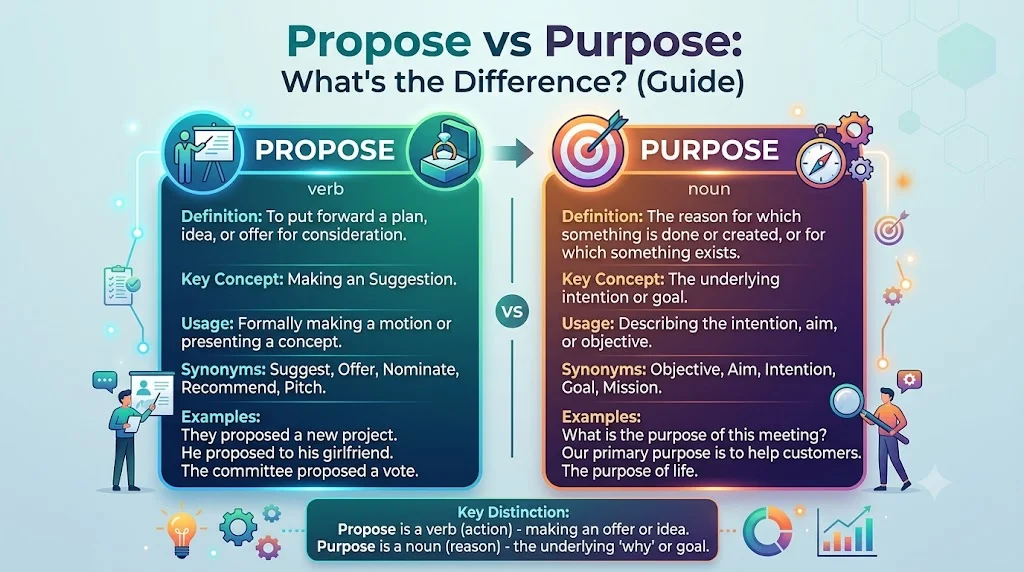
Propose vs Purpose: Side-by-Side Comparison Table
| Feature | Propose | Purpose |
| Part of speech | Verb | Noun (occasionally informal verb) |
| Pronunciation | /prəˈpoʊz/ (pruh-POHZ) | /ˈpɜːrpəs/ (PUR-pus) |
| Core meaning | To suggest, plan, or ask to marry | The reason or goal behind something |
| Stress pattern | Second syllable | First syllable |
| Noun form | Proposal | Purpose (same word) |
| Common collocations | Propose a plan, propose marriage | Main purpose, sense of purpose |
| Example sentence | I propose a new schedule. | The purpose of the schedule is efficiency. |
| Formality | Formal to neutral | Neutral, used in all registers |
Key Differences Between Propose and Purpose
Here’s the difference distilled into a few clear points:
- Function: “Propose” is an action word; “purpose” is a naming word for a reason or goal.
- Position in a sentence: “Propose” usually follows a subject and precedes an object or clause (“I propose X”). “Purpose” usually follows “the” or a possessive (“the purpose,” “my purpose”).
- Answerable question: “Propose” answers “What did you suggest or plan?” “Purpose” answers “Why does this exist?”
- Emotional weight: “Propose” often carries excitement (especially in marriage contexts). “Purpose” carries meaning, direction, or motivation.
Grammar Difference Between Propose and Purpose
Understanding the grammar difference is the fastest way to stop mixing these words up.
Propose (verb) conjugations:
| Tense | Form |
| Base form | propose |
| Third-person singular | proposes |
| Past tense | proposed |
| Past participle | proposed |
| Present participle | proposing |
Because “propose” is a verb, it needs a subject and often takes an object or clause: “She proposes a new rule.”
Purpose (noun) usage:
“Purpose” doesn’t conjugate because nouns don’t have tenses. Instead, it changes based on articles, possessives, and plurality.
- Singular: purpose (e.g., “the purpose”)
- Plural: purposes (e.g., “for different purposes”)
Common structures:
- “the purpose of + noun” (the purpose of the trip)
- “for the purpose of + gerund” (for the purpose of learning)
- “on purpose” (an idiom meaning “intentionally”)
Quick Tip: If the word in your sentence needs “to” before an action or comes right after a subject performing an action, it’s probably “propose.” If the word needs “the,” “a,” or “my” in front of it and describes a reason, it’s “purpose.”
Pronunciation Difference Between Propose and Purpose
Pronunciation is actually one of the easiest ways to tell these words apart in speech.
- Propose: pruh-POHZ (rhymes with “rose” or “close” as in “to close a door”). Stress is on the second syllable, and the ending sound is a soft “z.”
- Purpose: PUR-pus (rhymes with “surplus” without the “l”). Stress is on the first syllable, and the ending sound is a soft “s,” not a “z.”
Tip for learners: Say “I propose a purpose” out loud slowly. Notice how “propose” rises in stress at the end, while “purpose” is stronger at the beginning. Practicing this sentence trains your ear to hear the difference.
Is “Purpose” Ever Used as a Verb?
Yes, but rarely, and mostly in older or very formal English. As a verb, “purpose” means to intend or plan to do something — similar to one meaning of “propose.”
Example: “He purposed to travel the world before settling down.”
In modern everyday English, this verb usage sounds outdated. Most native speakers today would say “planned to,” “intended to,” or “proposed to” instead. You’ll mostly encounter “purpose” as a verb in classic literature, religious texts, or very formal legal writing.
Common mistake: Using “purpose” as a verb in casual writing makes your sentence sound stiff or old-fashioned. Stick to “purpose” as a noun in everyday English.
Is “Propose” a Noun or Only a Verb?
“Propose” is only a verb. There is no noun form spelled “propose.” The correct noun form is “proposal.”
Incorrect: He made a propose last night. Correct: He made a proposal last night.
Incorrect: What’s your propose for the project? Correct: What’s your proposal for the project?
This is one of the most frequent errors among English learners, especially those whose native language treats the verb and noun form as identical or very similar.
How to Use Propose and Purpose Correctly in Sentences
Here’s a simple framework to apply every time you’re unsure:
- Ask: Is this word doing an action, or naming a reason?
- Action → use “propose.”
- Reason/goal → use “purpose.”
- Check what comes before the word.
- “I,” “we,” “they,” or another subject right before it? Likely “propose.”
- “The,” “a,” “my,” or “for the” right before it? Likely “purpose.”
- Read the sentence aloud.
- If it sounds like a suggestion or an event (like a marriage proposal), it’s “propose.”
- If it sounds like an explanation of “why,” it’s “purpose.”
Practice Examples:
- I want to _____ a toast to the newlyweds. → propose
- What’s the _____ of this exercise? → purpose
- The board will _____ a new policy tomorrow. → propose
- She lives with a strong sense of _____. → purpose
Real-Life Examples of Propose vs Purpose
Workplace Examples
- The team proposed a four-day workweek to boost morale.
- What is the purpose of this quarterly report?
- Our manager proposes we launch the campaign in March.
- The purpose of the training session is to improve customer service.
Academic Examples
- The professor asked students to propose a research topic by Friday.
- The purpose of this study is to examine climate change effects.
- She proposed a new theory in her thesis.
- Every essay should have a clear purpose statement in the introduction.
Everyday Conversation Examples
- I propose we order pizza tonight.
- What’s the purpose of this app?
- He finally proposed to his girlfriend at the concert.
- Living with purpose makes people happier, according to psychologists.
Common Mistakes People Make with Propose and Purpose
Incorrect Examples
- What’s the propose of this meeting?
- I purpose we leave early.
- She made a beautiful propose at dinner.
- His main propose is to graduate this year.
Correct Examples
- What’s the purpose of this meeting?
- I propose we leave early.
- She received a beautiful proposal at dinner.
- His main purpose is to graduate this year.
Quick Tip: When in doubt, replace the word with “suggest” (for propose) or “reason” (for purpose). If “suggest” fits, use “propose.” If “reason” fits, use “purpose.”
Common Collocations with Propose
Propose a Solution
Used when someone offers a fix to a problem. Example: The engineer proposed a solution to the software bug.
Propose a Plan
Used when outlining a course of action. Example: The city proposed a plan to reduce traffic congestion.
Propose an Idea
Used broadly for any new suggestion. Example: She proposed an idea for the company’s anniversary event.
Propose Marriage
The formal way to describe asking someone to marry you. Example: He proposed marriage after two years of dating.
Propose a Motion
Common in formal meetings, debates, and legal settings. Example: The senator proposed a motion to amend the bill.
Common Collocations with Purpose
Main Purpose
Refers to the primary goal or reason. Example: The main purpose of the app is to track fitness goals.
Sense of Purpose
Refers to personal motivation or meaning in life. Example: Volunteering gave her a renewed sense of purpose.
Business Purpose
Used in professional and legal contexts. Example: This account was created for business purposes only.
Educational Purpose
Common in academic and instructional contexts. Example: This video is intended for educational purposes.
General Purpose
Describes something designed for multiple uses. Example: This is a general-purpose cleaning tool.
Synonyms of Propose
- Suggest
- Recommend
- Put forward
- Nominate
- Offer
- Propound (formal/rare)
Synonyms of Purpose
- Goal
- Aim
- Objective
- Intention
- Reason
- Function
Antonyms of Propose
- Withdraw
- Reject
- Oppose
- Retract
Antonyms of Purpose
- Aimlessness
- Randomness
- Meaninglessness
- Accident
Common Idioms and Expressions with “Purpose”
- On purpose – intentionally. Example: He broke the vase on purpose.
- To no purpose – without achieving anything. Example: We searched for hours, to no purpose.
- Serve a purpose – to be useful in some way. Example: This old box still serves a purpose.
- Cross purposes – when two people misunderstand each other’s goals. Example: We were talking at cross purposes during the negotiation.
- Purpose-built – designed specifically for one function. Example: This is a purpose-built training facility.
There isn’t an equally rich set of idioms for “propose,” since it functions mainly as a direct action verb rather than a figurative one.
British English vs American English Usage
Both “propose” and “purpose” are used identically in British and American English in terms of spelling and core meaning. There is no British/American spelling variation for either word (unlike “color/colour” or “organize/organise”).
The only minor difference is stylistic: British English sometimes favors the more formal verb use of “purpose” (as in “purposed to do”) slightly more often in traditional or literary writing, while American English almost always defaults to “propose,” “plan,” or “intend” instead.
Pronunciation is largely the same across both dialects, though British speakers may pronounce the “r” in “purpose” less distinctly (non-rhotic accent) compared to the clearer American “r” sound.
Propose vs Purpose in Exams and Competitive Tests
This word pair frequently appears in vocabulary and grammar sections of exams like IELTS, TOEFL, SAT, GRE, and various English proficiency tests. Test-makers love this pair because it checks whether students understand parts of speech, not just vocabulary memorization.
Common exam question formats:
- Fill-in-the-blank sentences requiring the correct word form.
- Multiple-choice questions testing noun vs verb usage.
- Sentence correction questions with “propose/purpose” errors intentionally inserted.
- Essay writing, where “purpose” often appears in thesis statements (“The purpose of this essay is…”).
Exam Tip: If the sentence has a blank right after a subject and needs an action, choose “propose.” If the blank is preceded by “the” or “a” and needs a noun describing intent, choose “purpose.”
Memory Tricks to Remember the Difference
Here are a few tricks that make this pair easy to remember permanently:
- “Propose” has an O for “Offer.” Both start with a similar sound, and proposing is about offering an idea (or a ring!).
- “Purpose” has a U for “yoU.” Your purpose is personal — it’s about you and your reasons.
- Rhyme trick: “Propose” rhymes with “close” — you propose to close a deal or close the distance between two people (as in a marriage proposal).
- Sentence trick: Remember the phrase “I propose a purpose” — say it a few times, and the word order will remind you that “propose” always comes with an action, while “purpose” always comes with a reason.
Quick Quiz: Can You Choose the Correct Word?
Test yourself with these five sentences. Answers are listed below.
- What is the main _____ of this document?
- The lawyer will _____ a new agreement tomorrow.
- He got down on one knee and _____ to her.
- This tool has a very specific _____.
- I _____ that we take a short break.
Answers: 1. purpose 2. propose 3. proposed 4. purpose 5. propose
Final Thoughts
The difference between “propose” and “purpose” comes down to one simple rule: propose is an action, purpose is a reason. Once you internalize that “propose” always needs a subject doing something — suggesting, planning, or asking someone to marry them — and “purpose” always describes the “why” behind something, the confusion disappears.
Practice by reading sentences aloud, noticing the stress pattern, and asking yourself whether the word is doing something or explaining something. With a little repetition, choosing between propose and purpose will become second nature, whether you’re writing an email, preparing for an exam, or planning the most important question of your life.
Frequently Asked Questions
Is it purpose or propose?
It depends on what you mean. Use “purpose” when referring to a reason, goal, or intention behind something (a noun). Use “propose” when you’re suggesting an idea, making a plan, or asking someone to marry you (a verb). Check whether your sentence needs an action or a reason to pick the right word.
What is the main difference between propose and purpose?
“Propose” is a verb meaning to suggest, plan, or ask someone to marry you. “Purpose” is a noun meaning the reason or goal behind something. The easiest way to remember: propose = action, purpose = reason. This grammatical difference solves almost every mix-up between the two words.
Can purpose be used as a verb?
Rarely. In older or very formal English, “purpose” can mean “to intend,” as in “He purposed to travel abroad.” However, this usage is outdated in modern English. Today, most speakers use “propose,” “intend,” or “plan” instead, so treat “purpose” as a noun in everyday writing and speech.
Is propose only used for marriage?
No. While “propose” is famous for marriage proposals, it also means to suggest an idea, plan, or solution in business, academic, and everyday contexts. For example, “I propose we change the schedule” has nothing to do with marriage — it simply means offering a suggestion for others to consider.
How can I remember the difference easily?
Try the sentence “I propose a purpose” — it shows that “propose” always comes with an action (suggesting or asking), while “purpose” always comes with a reason or goal. You can also remember that “purpose” contains “you,” since your purpose is personal and reflects your own goals or motivations.