
If you have ever typed “I’m soo excited” in a text message and then paused to wonder whether that second “o” was a mistake, you are not alone. This is one of the most common spelling questions in everyday English, and it trips up native speakers just as often as English learners.
In this guide, I’ll walk you through the difference between “so” and “soo” the way I would explain it to a student in my classroom — with clear definitions, grammar rules, real examples, and practical tips you can use immediately. By the end, you will never second-guess this spelling again.
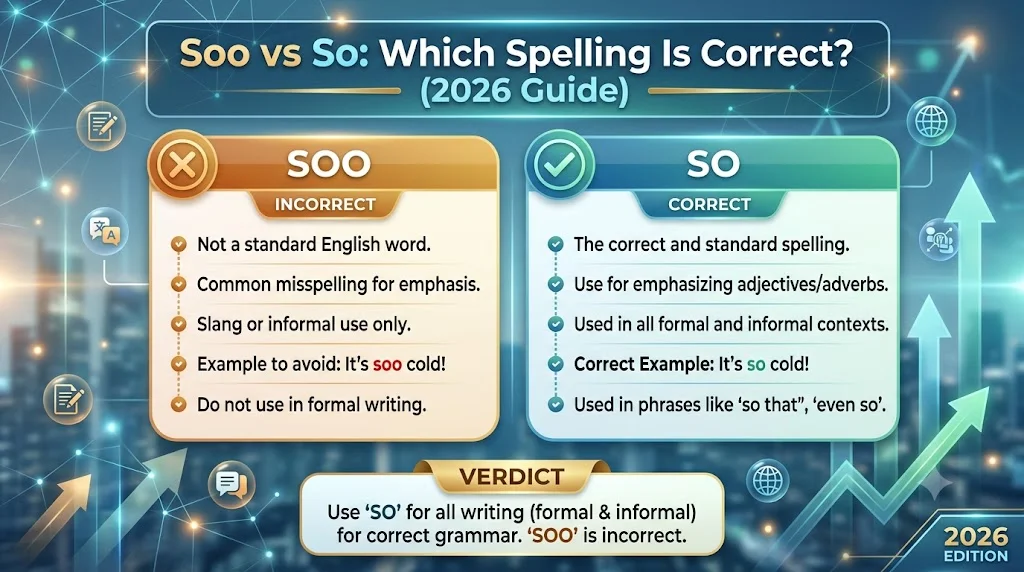
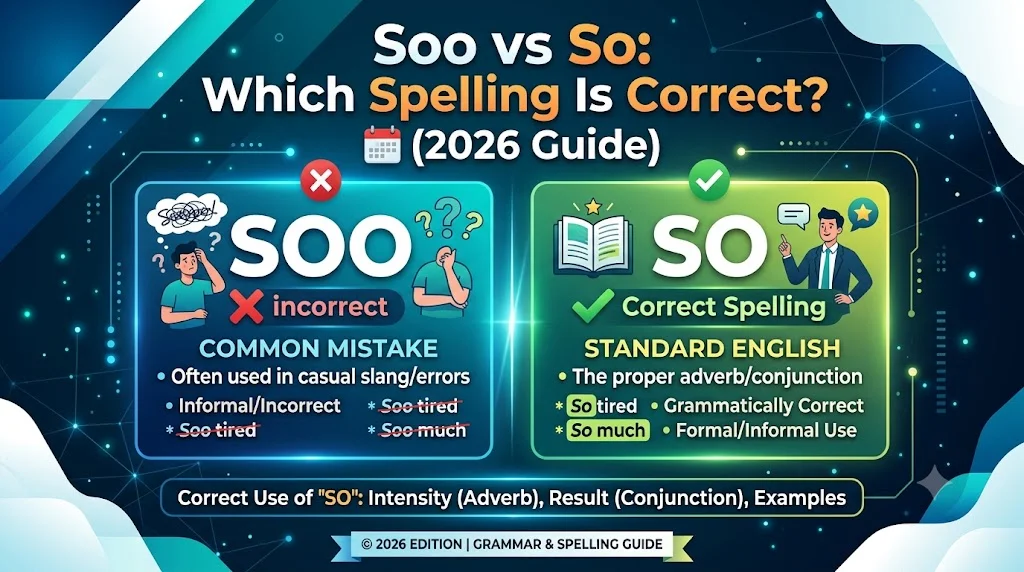
Quick answer: “So” is the only correct, standard English word. “Soo” is not a real word in formal or standard English — it’s an informal, stylized spelling used mostly in texting and social media to show extra emotion or emphasis.
Let’s break down exactly why, and when (if ever) “soo” is acceptable.
Why People Get Confused Between “So” and “Soo”
The confusion happens for a simple reason: in casual digital writing, people often stretch out words to show feeling. Think of “yesss,” “nooo,” or “heyyy.” These stretched spellings mimic how we exaggerate a word when speaking out loud.
“So” is a short, common word we use constantly — in speech, we often draw it out for emphasis (“I’m sooooo tired”). When people write the way they talk, that extra “o” creeps into their spelling. Over time, “soo” has become a familiar sight in texts, captions, and comments, even though it has never been accepted into standard dictionaries.
Another source of confusion is that some words genuinely do have double letters (like “too” or “book”), so learners sometimes assume “soo” might follow the same pattern. It doesn’t.
The One-Rule Memory Trick
Here’s the simplest rule I give my students:
If you can say the sentence out loud in a professional meeting, use “so.” If you’re texting a close friend and want to add emotional emphasis, “soo” is a stylistic choice — never a grammar rule.
One “o” is grammatically correct in 100% of contexts. Two “o’s” is a spelling choice, never a requirement, and it is never correct in formal writing.
What Does “So” Mean in English?
Meaning: “So” is a small but powerful word that can show degree, result, agreement, or connection between ideas.
Definition: According to standard English dictionaries, “so” functions primarily as an adverb and a conjunction, though it also appears as a pronoun, intensifier, and discourse marker.
Pronunciation: /soʊ/ — rhymes with “go,” “no,” and “row.” One syllable, one clear vowel sound.
Word origin: “So” comes from Old English “swā,” related to Old High German “sō” and Old Norse “svā.” It has existed in English for over a thousand years, which explains why it has so many overlapping uses today.
Because “so” is such a flexible word, it’s worth looking at each function separately.
So as an Adverb
Meaning: Shows degree or extent — “to this level.”
Grammar explanation: As an adverb, “so” usually modifies an adjective or another adverb.
Example: “The coffee was so hot I couldn’t drink it.”
Common mistake: Using “so” alone without a follow-up clause in formal writing (“The coffee was so hot” — hot compared to what?). In formal writing, pair “so” with “that” for clarity.
Correct usage: “The coffee was so hot that I burned my tongue.”
So as a Conjunction
Meaning: Connects two clauses to show cause and result.
Grammar explanation: “So” joins an independent clause showing a reason with a second clause showing the outcome.
Example: “It was raining, so we canceled the picnic.”
Common mistake: Starting every sentence with “So” as a filler word in professional writing. This weakens tone and can sound unpolished in emails or reports.
Tip: In business writing, replace sentence-starting “So” with “As a result,” “Therefore,” or “Consequently” for a more formal register.
So as an Intensifier
Meaning: Adds emphasis, similar to “very” or “extremely.”
Example: “This meal is so good!”
Formal vs informal: This use is common in speech and casual writing but should be limited in academic or business writing, where “extremely” or “remarkably” sound more professional.
So in Elliptical Responses
Meaning: Used in short replies to avoid repeating information.
Example:
- “I think it’s going to rain.” — “I hope so.”
- “Are you coming?” — “I don’t think so.”
Grammar explanation: Here, “so” stands in for the entire previous clause, making the reply shorter and more natural.
So as a Discourse Marker
Meaning: Signals a shift in conversation, often used to introduce a new topic, summary, or conclusion.
Example: “So, what do you think we should do next?”
Tip: This use is extremely common in spoken English and podcasts but should be used sparingly in formal writing.
So in Comparative and Result Clauses
Meaning: Used in the structure “so + adjective + that” to show a cause-and-effect relationship.
Example: “She was so tired that she fell asleep on the couch.”
Related structure: “such a/an + adjective + noun + that” carries a similar meaning: “It was such a long day that I went to bed early.”
Is “Soo” a Real English Word?
The Honest Answer
No. “Soo” does not appear in any major standard English dictionary (Merriam-Webster, Oxford, Cambridge, or Collins) as a legitimate word. It is not recognized in formal grammar, academic writing, or professional communication.
“Soo” is best described as an informal spelling variant of “so,” used purely for stylistic or emotional emphasis in casual digital communication.
Why “Soo” Exists on the Internet
Language evolves quickly online, especially in texting and social media, where people write the way they speak. Doubling or tripling letters is a common technique to represent tone, emphasis, or excitement that punctuation alone can’t capture. You’ll see the same pattern with:
- “yesss” instead of “yes”
- “nooo” instead of “no”
- “pleaseee” instead of “please”
- “soo” instead of “so”
This isn’t bad grammar in casual contexts — it’s a form of paralinguistic writing, meaning it tries to represent vocal tone (like stretching a word when speaking) through text.
Urban Dictionary vs Standard English
You may find “soo” listed on crowd-sourced sites like Urban Dictionary. These sites document how language is actually used online, but they are not grammar authorities. A word appearing on Urban Dictionary does not make it standard, correct, or appropriate for professional writing. Think of it as documentation of internet culture, not a grammar rulebook.
Soo vs So – Key Differences (Comparison Table)
| Feature | So | Soo |
| Standard English word | Yes | No |
| Found in dictionaries | Yes | No |
| Correct in formal writing | Yes | Never |
| Correct in academic writing | Yes | Never |
| Acceptable in texting/social media | Yes | Yes (stylistic only) |
| Grammar function | Adverb, conjunction, pronoun | None (spelling variant only) |
| Purpose | Standard communication | Emotional emphasis |
| Professional tone | High | Low |
Grammar Difference
“So” has clear grammatical roles (adverb, conjunction, discourse marker). “Soo” has no grammatical role — it is simply an alternate spelling meant to stretch the sound of “so” for emphasis.
Meaning Difference
Both words carry the same core meaning. “Soo” doesn’t add new meaning; it adds emotional intensity to the same meaning “so” already has.
Tone Difference
“So” is neutral and works in any context. “Soo” instantly signals a casual, playful, or emotional tone — the kind you’d use with friends, not colleagues.
Formal vs Informal Use
| Context | Recommended Word |
| Business email | So |
| Academic essay | So |
| Text to a friend | So or Soo |
| Instagram caption | So or Soo |
| Job application | So |
| Casual chat with emphasis | Soo (optional) |
When to Use “So”
Use “so” in every situation where you want your writing to be correct, clear, and professional. This includes essays, emails, reports, resumes, articles, books, and any formal communication.
Correct Sentence Examples
- “I was so tired after the meeting.”
- “She studied hard, so she passed the exam.”
- “He is so talented at drawing.”
- “We left early, so we missed the traffic.”
- “I hope so, but I’m not certain.”
Common Sentence Patterns with So
| Pattern | Example |
| So + adjective + that | “It was so cold that the lake froze.” |
| So + that (purpose) | “She whispered so that no one would hear.” |
| So far | “So far, everything looks good.” |
| So what | “So what if it rains? We’ll still go.” |
| So be it | “If that’s the decision, so be it.” |
Why Professional Writers Prefer “So”
Professional writers, editors, and publications follow standard English spelling rules because consistency builds trust with readers. A single unexpected spelling like “soo” can distract readers, weaken credibility, and make writing look careless — even if the rest of the content is well-written. In journalism, business, and academic writing, correctness is part of professionalism.
When Can You Use “Soo”?
“Soo” isn’t “wrong” in every context — it’s simply informal. There are casual spaces where a stretched spelling can add personality and warmth to your writing.
Text Messages
Among friends or family, “soo” can add a friendly, expressive tone.
Example: “I’m soo excited for the trip!”
Social Media Posts
Captions on Instagram, TikTok, or Twitter/X often use stretched spellings to sound more relatable and casual.
Example: “This sunset is soo pretty 🌅”
Casual Conversations
In informal chat apps like WhatsApp or iMessage, “soo” mimics the tone of speech, similar to drawing out the word when talking.
Marketing & Brand Voice
Some brands intentionally use playful spelling like “soo” in advertising or social captions to sound youthful and conversational. This is a deliberate stylistic choice, not a grammar rule, and should be used carefully depending on brand identity.
Quick Tip: If you wouldn’t say the word slowly with emphasis out loud, don’t stretch it in writing either.
When You Should Never Use “Soo”
Academic Writing
Essays, research papers, and academic reports require standard English at all times. “Soo” would be marked as a spelling error by any teacher or professor.
Business Emails
Professional emails should always use “so.” Using “soo” in a workplace email can come across as unprofessional or immature, even if unintentional.
Job Applications
Resumes, cover letters, and application emails are formal documents. A single instance of “soo” can create a negative impression of attention to detail.
Professional Documents
Reports, proposals, contracts, and official communication should never include informal spelling variants like “soo.”
Soo vs So in Formal and Informal Writing
Formal Writing Examples
- “The results were so significant that further research is recommended.”
- “I am writing to follow up on our meeting, so please let me know your availability.”
- “The project was so successful that leadership approved additional funding.”
Informal Writing Examples
- “This show is soo good, you need to watch it!”
- “I miss you soo much.”
- “That was soo funny 😂”
Tip to remember: Formal writing = one “o.” Informal texting with emotion = “soo” is a personal style choice, never a requirement.
Common Mistakes People Make
Using “Soo” in Professional Writing
The most common mistake is carrying texting habits into work or school writing without realizing the tone shift it creates.
Thinking “Soo” Is Correct Grammar
Some learners genuinely believe “soo” is an accepted spelling because they see it so often online. It isn’t — it’s purely stylistic.
Overusing “So” as a Filler
Starting every sentence with “So…” (especially in speech or interviews) can sound unpolished. Vary your sentence openers.
Instead of: “So, I went to the store. So, I bought some milk. So, then I came home.” Try: “I went to the store and bought some milk. Then I came home.”
Double Intensifiers
Avoid stacking “so” with other intensifiers, which is grammatically redundant.
Incorrect: “It was so very good.” Correct: “It was so good.” or “It was very good.”
Misplacing “So”
Incorrect: “I so am tired.” (This word order is nonstandard in formal English.) Correct: “I am so tired.”
American vs British English
Is There Any Difference?
No. “So” is spelled and used identically in American and British English. There is no regional variation in the correct spelling — both dialects reject “soo” as nonstandard.
Informal Spelling Trends
Stretched spellings like “soo,” “nooo,” and “yesss” appear across English-speaking internet culture worldwide, regardless of American or British origin. This is a feature of informal digital communication, not a dialect difference.
Common Expressions with “So”
So That
Shows purpose or result. Example: “I left early so that I wouldn’t be late.”
So…That
Shows cause and effect with intensity. Example: “The music was so loud that we couldn’t talk.”
So Much
Shows a large amount or degree. Example: “Thank you so much for your help.”
So Far
Shows progress up to the present moment. Example: “So far, the project is on schedule.”
So What?
An informal expression showing indifference or challenge. Example: “So what if we’re late? It’s not a big deal.”
So Be It
An expression accepting an outcome, even if unwanted. Example: “If they choose not to help, so be it.”
Synonyms for “so” (depending on context): therefore, thus, hence, consequently, very, extremely, also, too.
Related words: such, therefore, thus, hence, accordingly.
Opposite/contrast words: although, despite, however, but, yet (used to contrast rather than connect cause and result).
Real-Life Examples of So vs Soo
Social Media Examples
- Caption: “This view is soo unreal 😍” (casual, acceptable)
- Caption: “So grateful for this community.” (neutral, works in any tone)
Email Examples
- Correct: “So, following up on my last message, could you confirm the deadline?”
- Incorrect: “Soo, just following up on this!” (unprofessional in a work email)
Chat Examples
- Friend text: “I’m soo done with today lol”
- Formal text to a colleague: “So, are we still meeting at 3 PM?”
Classroom Examples
- Student writing (informal note to a friend): “This homework is soo hard.”
- Student writing (essay): “The homework was so difficult that many students requested an extension.”
Editing Tips to Fix “Soo” Instantly
One-Step Editing Method
Use your document’s find-and-replace tool to search for “soo” and manually review each instance. If the sentence appears in a formal document, replace it with “so.”
Tone Consistency Checklist
- Is this for work, school, or an official document? → Use “so.”
- Is this a personal message to a friend? → “So” or “soo” both work.
- Would I say this out loud in a meeting? → Use “so.”
- Am I trying to sound extra expressive on purpose? → “Soo” is a valid stylistic choice.
Quick Quiz (Test Yourself)
Choose the Correct Word
- I studied all night, ___ I passed the test. (so / soo)
- This cake is ___ delicious! (so / soo — informal caption context)
- She was ___ tired that she went to bed early. (so / soo)
- ___, what’s the plan for tomorrow? (So / Soo)
- I hope ___. (so / soo)
Answers: 1. so | 2. either works informally, but “so” is always safe | 3. so | 4. So | 5. so
Frequently Asked Questions
1. Is “soo” ever grammatically correct? No. “Soo” has no grammatical function and is not recognized as a standard word. It is purely a stylistic spelling used to show emphasis in casual, informal writing like texts or social media captions.
2. Why do people write “soo” instead of “so”? People stretch the word to mimic how they’d say it out loud with emotion, similar to saying “sooo good” when speaking. It’s a way of adding tone and feeling to written text.
3. Can I use “soo” in a work email? No. Business emails should always use standard spelling. “Soo” can make your writing look unprofessional, even if the rest of the message is well-written and appropriate.
4. Is “soo” listed in the dictionary? No major dictionary, including Merriam-Webster, Oxford, or Cambridge, recognizes “soo” as a standard English word. It only appears on informal, crowd-sourced sites like Urban Dictionary.
5. Does British English spell it differently? No. Both American and British English use “so” as the only correct spelling. There is no regional variation that makes “soo” acceptable.
Final Verdict
The rule is simple: “so” is always correct, and “soo” is never grammatically correct — it’s a stylistic choice reserved for casual, emotional writing. Use “so” in every formal, academic, or professional context without exception. Save “soo” for texts, captions, or messages where you want to add extra warmth or excitement, and only when your audience and tone clearly allow for informal spelling.
When in doubt, one “o” is always the safe, correct choice. Mastering this small distinction shows attention to detail — a skill that quietly builds credibility in everything you write, from a quick text to a professional email.