
If you have ever typed a quick text or email and paused to wonder whether it should be “thats” or “that’s,” you are not alone. This tiny apostrophe causes more confusion than almost any other punctuation mark in English. The good news is that the rule is simple once you understand it, and this guide will make sure you never second-guess yourself again.
By the end of this article, you will know exactly when to use “that’s,” why “thats” is not a real word, and how to avoid this mistake in every kind of writing — from casual texts to professional reports.
Quick Answer: “That’s” Is Correct, “Thats” Is Not
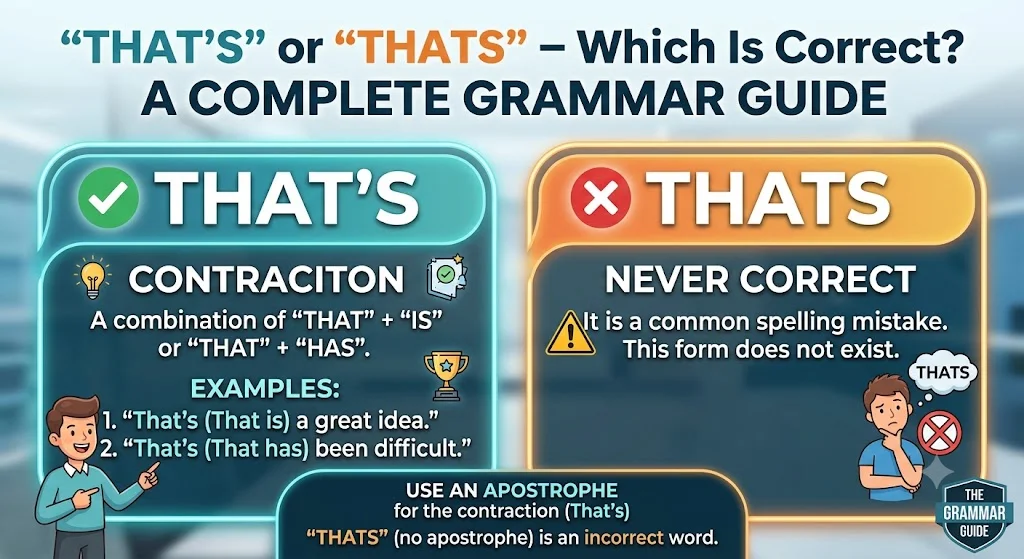
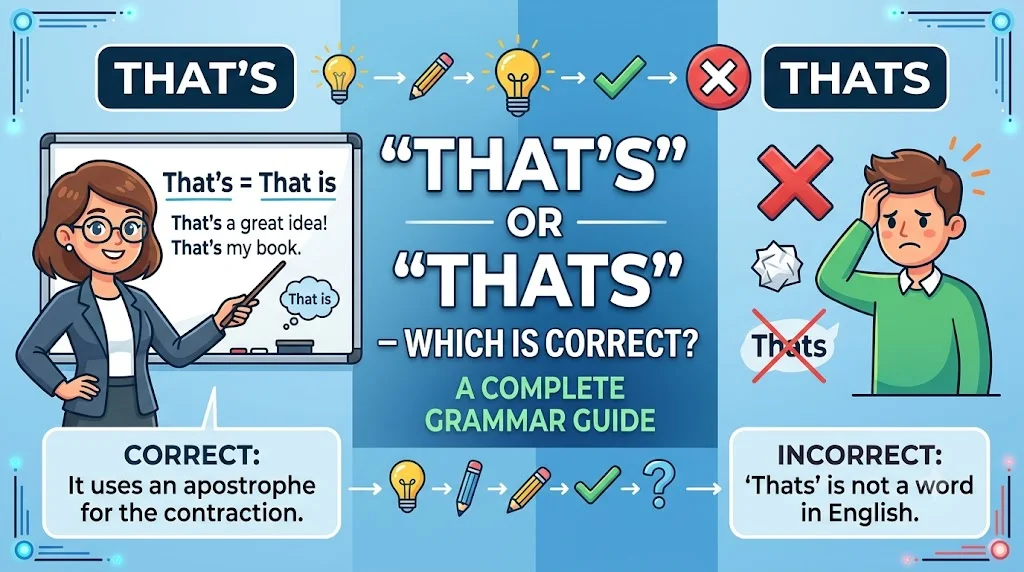
Let’s settle this right away. “That’s” is the correct spelling. It is a contraction, which means it combines two words into one shorter word using an apostrophe. “Thats” (without the apostrophe) is simply a misspelling. It is not a recognized word in any standard English dictionary.
| Form | Correct? | Why |
| That’s | ✅ Yes | Proper contraction of “that is” or “that has” |
| Thats | ❌ No | Missing apostrophe; not a real word |
| Thatz / Thas | ❌ No | Informal texting slang, not standard English |
Now let’s dig into the grammar, meaning, and real-world usage so you fully understand the “why” behind this rule.
Understanding “That’s” and “Thats”
What “That’s” Means
Meaning: “That’s” is a contracted form used to shorten two words into one in spoken and written English.
Definition: A contraction is a shortened version of two words, formed by removing certain letters and replacing them with an apostrophe. “That’s” specifically stands for either:
- “That is” (used for present statements)
- “That has” (used with present perfect tense)
Pronunciation: “That’s” is pronounced /ðæts/ — it rhymes with “cats” or “hats,” just with a “th” sound at the start.
Word origin: The word “that” comes from Old English “þæt,” a demonstrative pronoun used to point to something specific. Contractions using apostrophes became common in English writing around the 16th and 17th centuries as a way to reflect natural speech patterns in text.
What “Thats” Means (Spoiler: Nothing)
“Thats” has no meaning of its own. It is simply “that’s” typed without the apostrophe. Some people assume it might be a plural form of “that” (like “cats” is the plural of “cat”), but this is incorrect. “That” does not have a standard plural form in this sense — the plural pronoun is “those.”
Common mistake: Writing “thats” instead of “that’s,” assuming apostrophes are optional in casual writing.
Correct usage: Always insert the apostrophe: “that’s,” never “thats.”
When to Use “That’s”
“That’s” appears constantly in everyday English because it replaces two very common word combinations. Let’s break down each use case.
As a Contraction of “That Is”
Grammar explanation: When “that” acts as a subject and is followed by the verb “is,” you can combine them into “that’s.” This works with present tense statements describing facts, opinions, or things happening now.
Formal vs. informal: This contraction is acceptable in both formal and informal writing, though very formal academic writing (like a research paper) sometimes favors the full “that is” for a slightly more polished tone.
Real-life examples:
- That’s a great idea. (= That is a great idea.)
- That’s the restaurant we talked about. (= That is the restaurant we talked about.)
- I think that’s correct. (= I think that is correct.)
Similar words/phrases: “It’s” (it is), “there’s” (there is), “who’s” (who is) — all follow the same contraction pattern.
As a Contraction of “That Has”
Grammar explanation: “That’s” can also stand in for “that has,” typically used in present perfect tense to describe something that happened at an unspecified time before now.
Real-life examples:
- That’s been a long time coming. (= That has been a long time coming.)
- That’s already happened once this year. (= That has already happened once this year.)
- That’s got to be a mistake. (= That has got to be a mistake.)
Tip to remember: If you can naturally replace “that’s” with “that has” and the sentence still makes sense, you are using the perfect tense contraction correctly.
Everyday Examples in Sentences
Here are more natural examples showing “that’s” in daily conversation and writing:
- “That’s exactly what I meant.”
- “That’s not fair.”
- “That’s the last time I forget my keys.”
- “That’s why I called you earlier.”
- “That’s amazing news!”
Common collocations: “that’s right,” “that’s fine,” “that’s true,” “that’s enough,” “that’s all,” “that’s it,” “that’s why,” “that’s how,” “that’s when.”
Why “Thats” Is Usually Wrong
Typographical Error or Misspelling
Most of the time, “thats” appears simply because someone typed quickly and forgot the apostrophe. This is a typo, not a stylistic choice. Autocorrect on phones sometimes fails to catch it, especially if you are typing fast or swiping keyboards.
Quick Tip: If your phone keyboard doesn’t auto-insert the apostrophe, get in the habit of tapping it manually before moving on.
Confusion in Informal Texting
In casual texting culture, people often drop apostrophes to type faster — “dont,” “cant,” “wont,” and “thats” all show up this way. While this might be fine between friends in a text thread, it is still technically incorrect English.
Formal vs. informal: Even in informal contexts, dropping the apostrophe is a shortcut, not a grammar rule. It is tolerated in texting but not appropriate in emails, essays, or professional messages.
Impact on Professional Writing
Using “thats” in a work email, resume, cover letter, or report can make a strong first impression turn negative. Hiring managers, clients, and professors often view small grammar mistakes as a sign of carelessness.
Real-life example comparison:
- ❌ “Thats the report you asked for.”
- ✅ “That’s the report you asked for.”
The second version looks polished and professional. The first can distract a reader or make them question your attention to detail.
Misconceptions About “That’s”
People Think “Thats” Is Acceptable
Some writers genuinely believe apostrophes are optional decorative marks rather than functional grammar tools. This misconception often comes from seeing “thats” used casually online without correction.
Fact: Apostrophes in contractions are never optional in standard English. They signal that letters have been removed, and removing the apostrophe changes the word from a valid contraction into a spelling error.
Apostrophes in Contractions Are Optional
This is false. The apostrophe in “that’s” is not decorative — it replaces a missing letter (the “i” in “is” or the “ha” in “has”). Without it, the word is incomplete and grammatically incorrect.
Similar contractions that follow the same rule:
| Contraction | Full Form |
| That’s | That is / That has |
| It’s | It is / It has |
| Who’s | Who is / Who has |
| There’s | There is / There has |
| What’s | What is / What has |
Regional or Style Differences
There is no regional English variant (American, British, Australian, or otherwise) where “thats” is considered correct. Style guides like AP, Chicago Manual of Style, and MLA all agree: contractions require apostrophes. The confusion usually comes from informal internet writing, not from any legitimate regional dialect.
How Correct Usage Improves Communication
Clarity and Readability
Correct punctuation helps readers process sentences faster. When you write “that’s,” readers instantly recognize the contraction and understand the sentence structure without pausing. Missing apostrophes can create a split-second hesitation that disrupts reading flow.
Professionalism and Credibility
Good grammar builds trust. Whether you’re writing a blog post, a business proposal, or a school assignment, correct usage of “that’s” signals that you care about the quality of your communication. This is especially important for content that needs to demonstrate expertise and credibility to readers and search engines alike.
Boosting Confidence in Writing
Once you master small details like this, your overall writing confidence improves. You stop second-guessing simple words and can focus on bigger ideas — like clarity, tone, and structure — instead of getting stuck on punctuation.
Quick Tip: Read your sentence aloud. If you naturally say “that is” or “that has,” you need the apostrophe.
Exceptions and Special Cases
Brand Names or Titles
Occasionally, a brand, product, or stylized title may intentionally drop the apostrophe for design or trademark reasons (similar to how some brands stylize their names in all lowercase or without spaces). These are rare stylistic exceptions and do not apply to standard writing. If you are unsure, always default to correct grammar unless you’re referencing an official name exactly as trademarked.
Quoting Informal Speech
If you are transcribing dialogue or a text message exactly as someone wrote it — for example, in a novel, screenplay, or direct quote — you might reproduce “thats” if that is genuinely what the person typed. This is the only legitimate case for using “thats,” and it should always appear inside quotation marks to show it is a direct quote, not your own writing style.
Example: The text read, “thats so funny lol,” clearly typed in a rush.
Tips to Avoid Errors
Here are practical strategies to make sure you never mix up “that’s” and “thats” again:
- Say it out loud. If you can substitute “that is” or “that has” and the sentence still makes sense, you need the apostrophe.
- Slow down while typing. Most errors happen from typing fast, not from not knowing the rule.
- Turn on autocorrect. Most phones and computers will fix this automatically if the feature is enabled.
- Proofread before sending. A ten-second review of an email or message can catch this instantly.
- Use grammar-checking tools. Apps like Grammarly or built-in spell checkers can flag missing apostrophes.
- Practice with flashcards. Write out common contractions until they become automatic.
Similar Contraction Mistakes to Watch For
“That’s” is not the only contraction people struggle with. Here are related word pairs that follow the same apostrophe rule:
| Correct Contraction | Common Mistake | Full Form |
| It’s | Its (used incorrectly) | It is / It has |
| You’re | Your (used incorrectly) | You are |
| They’re | Their / There (used incorrectly) | They are |
| Who’s | Whos | Who is / Who has |
| Let’s | Lets | Let us |
Tip: Notice the pattern — every one of these mistakes comes from confusing a possessive word (its, your, their) or a plural-looking word with a contraction. The fix is always the same: check whether you can expand it into two full words.
Synonyms, Related Phrases, and Word Family
While “that’s” itself doesn’t have direct synonyms (since it’s a contraction, not a descriptive word), here are related expressions and phrases that serve similar communicative purposes:
- Related phrases: “that is to say,” “that being said,” “that means,” “which is”
- Words in the same family: that, this, those, these (demonstrative pronouns)
- Opposite/contrasting words: “this’s” does not exist as a word — English does not contract “this is” the same way, which is a common point of confusion for learners.
Common Mistake: Trying to contract “this is” into “this’s.” This is not standard English. Always write “this is” in full.
“That’s” vs. Other Confusing Contractions: Comparison Table
| Word | Meaning | Correct Example | Common Error |
| That’s | That is / That has | That’s true. | Thats true. |
| Its | Belonging to it | The dog wagged its tail. | The dog wagged it’s tail. |
| It’s | It is / It has | It’s raining. | Its raining. |
| Whose | Belonging to whom | Whose book is this? | Who’s book is this? |
| Who’s | Who is / Who has | Who’s coming tonight? | Whose coming tonight? |
Practice Examples
Test yourself with these practice sentences. Decide whether “that’s” or “thats” is correct (hint: it’s always “that’s”):
- _______ the best pizza I’ve ever had.
- I heard _______ why she left early.
- _______ been on my mind all week.
- _______ not what I ordered.
- _______ how you solve the problem.
Answers: All five should be “that’s” — 1) That’s, 2) that’s, 3) That’s, 4) That’s, 5) That’s.
Common Mistakes Recap
- ❌ That’s crazy. → ✅ That’s crazy.
- ❌ I know that’s true. → ✅ I know that’s true.
- ❌ That’s all, folks. → ✅ That’s all, folks.
- ❌ What’s up, that’s new? → ✅ What’s up, that’s new?
Summary
“That’s” is the only correct spelling when you mean “that is” or “that has.” “Thats,” without an apostrophe, is a common misspelling, not an acceptable alternative. This mistake usually happens due to fast typing, texting habits, or a misunderstanding that apostrophes are optional. In every formal or professional context, always include the apostrophe. The only exception is when directly quoting someone else’s exact (incorrect) typing.
Conclusion
Mastering “that’s” versus “thats” might seem like a small detail, but small details build strong writing. Every time you use correct grammar, you make your message clearer, more credible, and easier to trust. Whether you’re writing a text to a friend, an email to your boss, or a blog post for your audience, taking the extra second to add that apostrophe pays off. Practice the tips above, reread your work before hitting send, and “that’s” will soon become second nature.
FAQs
1. Is “thats” ever correct in English? No, “thats” is never grammatically correct in standard English writing. It is always a misspelling of “that’s.” The only exception is when quoting someone’s exact informal text message or speech, and even then, it should appear inside quotation marks.
2. Why do people forget the apostrophe in “that’s”? Most people forget the apostrophe because they are typing quickly, texting casually, or simply haven’t learned the contraction rule. Autocorrect sometimes doesn’t catch it either, especially on swipe keyboards or when typing very fast.
3. What does “that’s” stand for? “That’s” is a contraction of either “that is” or “that has.” You can tell which one is meant by looking at the rest of the sentence and checking whether “is” or “has” fits naturally.
4. Is “that’s” formal or informal? “That’s” is acceptable in both formal and informal writing. However, very formal documents like academic papers sometimes prefer the full form “that is” for a slightly more polished, traditional tone.
5. How can I remember to use the apostrophe correctly? Try saying the sentence out loud with the full words “that is” or “that has.” If it sounds natural, you need the apostrophe. Practicing this out-loud check will train your brain to catch mistakes automatically over time.
6. Does “thats” show up in dictionaries? No, “thats” does not appear as a valid word in Merriam-Webster, Oxford, Cambridge, or any other major English dictionary. Only “that’s” is recognized as the correct contracted form.
7. Is it “that’s” or “thats” in texting? Even in texting, “that’s” is technically correct. Some people drop the apostrophe for speed, but this is a shortcut, not a grammar rule. For clear, professional-looking texts, keep the apostrophe.
8. What’s the difference between “that’s” and “thats” grammatically? “That’s” is a proper contraction with a clear grammatical function, replacing “that is” or “that has.” “Thats” has no grammatical function at all — it is simply an error caused by a missing apostrophe.
9. Can “that’s” be used at the start of a sentence? Yes, “that’s” can begin a sentence, such as “That’s a good question” or “That’s exactly right.” There is no grammar rule against starting a sentence with a contraction in either formal or informal writing.
10. Are there other common apostrophe mistakes similar to “thats”? Yes, similar mistakes include confusing “its” with “it’s,” “your” with “you’re,” and “whose” with “who’s.” All of these follow the same rule: contractions need apostrophes, while possessive pronouns do not.