
“Who to contact” is correct in almost every situation you will write or speak today. It is the natural, modern, widely accepted form used in emails, business writing, websites, and everyday conversation.
“Whom to contact” is grammatically correct too, but it belongs to formal, academic, or legal writing. Most native English speakers no longer use it in daily communication.
So if you are asking, “Who to contact or whom to contact — which one should I use right now?” — the safe, natural answer is “who to contact.”
Save “whom to contact” for contracts, official letters, or very formal documents.
Quick Tip: If you are unsure, say the sentence out loud. If “whom” sounds stiff or old-fashioned in your context, use “who.” Native speakers prioritize natural flow over strict textbook grammar in daily communication.
Why Do People Confuse “Who” and “Whom”?
This confusion is one of the most common grammar struggles among English learners and even native speakers. There are clear reasons behind it.
Common Reasons Behind the Confusion
- “Whom” is disappearing from spoken English. Most people rarely hear it, so it feels unnatural or intimidating.
- The subject-object rule feels abstract. Many learners were never taught a simple trick to test the correct word.
- “Whom” sounds overly formal, so people avoid it even when it might technically be correct.
- Sentence structure with infinitives (like “to contact”) confuses learners because the object relationship is not obvious.
- English teachers often skip this topic because “whom” is considered a “dying” grammar rule in modern usage.
Understanding why this confusion happens is the first step toward mastering the difference permanently.
Who vs. Whom: What’s the Difference?
To understand “who to contact” or “whom to contact,” you first need to understand the core grammar rule behind who and whom.
Definition
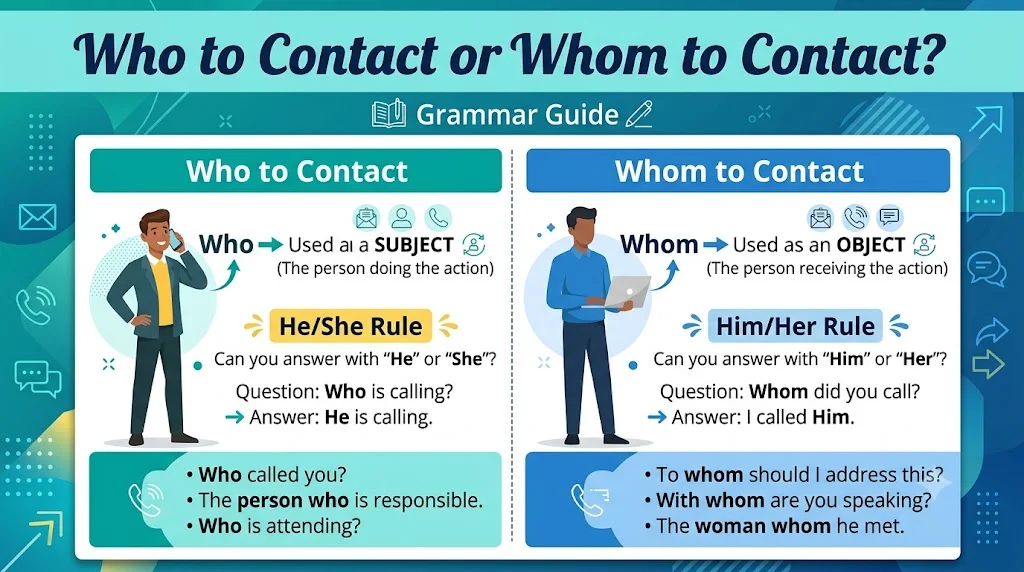
- Who is a subject pronoun. It refers to the person doing the action.
- Whom is an object pronoun. It refers to the person receiving the action.
Grammar Explanation
In English grammar, pronouns change form depending on their job in a sentence.
| Pronoun Type | Role in Sentence | Example |
| Subject pronoun | Performs the action | He called the manager. |
| Object pronoun | Receives the action | The manager called him. |
“Who” works like he, she, they (subject pronouns). “Whom” works like him, her, them (object pronouns).
Pronunciation
- Who — /huː/ (rhymes with “true”)
- Whom — /huːm/ (rhymes with “room”)
Word Origin
Both words come from Old English. “Who” descends from hwā, and “whom” comes from hwām, the dative case form used for objects. English has gradually dropped many case endings over centuries, which is why “whom” now feels formal and old-fashioned compared to “who.”
Simple Examples
- Who is calling? (subject — someone is doing the calling)
- Whom did you call? (object — someone received the call)
Quick Tip: Subject = doer. Object = receiver. This single idea solves 90% of who/whom confusion.
The He/Him Test (The Easiest Way to Choose Correctly)
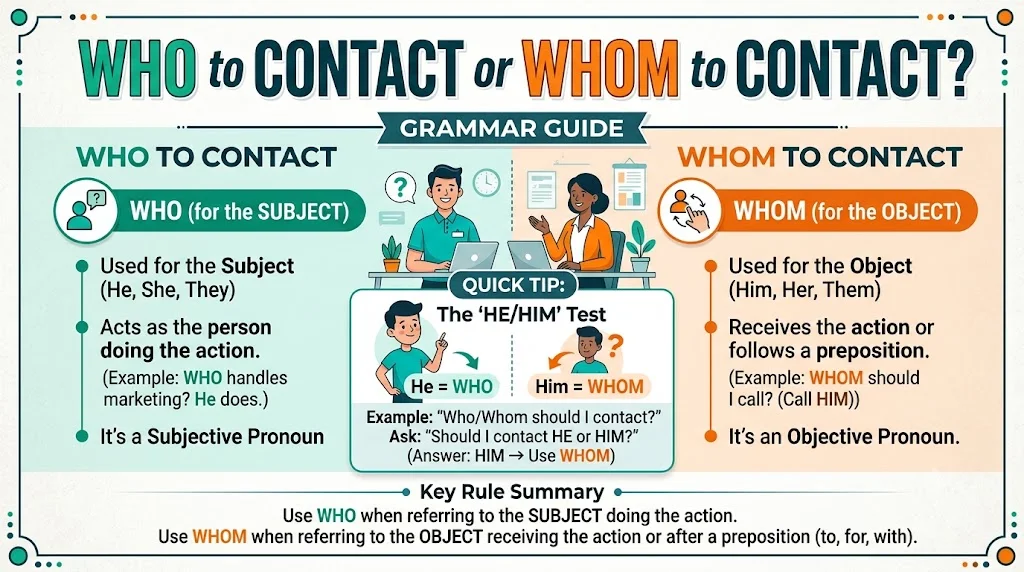
If you remember only one trick from this article, remember this one. English teachers call it the He/Him Test, and it works every time.
How It Works
- Take the sentence and turn it into a statement.
- Replace “who” or “whom” with he or him.
- If he fits, use who.
- If him fits, use whom.
This works because “who” and “he” are both subject pronouns, while “whom” and “him” are both object pronouns — and conveniently, both “whom” and “him” end in M, which makes the trick easy to remember.
Examples Using the He/Him Trick
| Original Question | Test Sentence | Correct Word |
| Who/Whom is coming to the meeting? | He is coming. | Who |
| Who/Whom did you meet yesterday? | I met him. | Whom |
| Who/Whom should I contact? | I should contact him. | Whom |
| Who/Whom is responsible for this? | He is responsible. | Who |
Quick Tip: M matches M. Whom = him. Both end in “m,” so they belong together.
Grammar Rule Explained (Without Complicated Terms)
Let’s simplify this without linguistic jargon.
- If the word is doing something → use who.
- If the word is receiving something → use whom.
- If the sentence has “to + verb” (an infinitive), the person is usually the object of that action.
This last rule is exactly why “who to contact” causes debate — because technically, the person you contact is the object of the verb “contact.”
So why do we still say “who to contact” instead of “whom to contact”? Let’s break it down.
Why “Who to Contact” Is Usually Correct
Here’s the twist that trips up many learners: even though grammar logic suggests “whom” is technically correct in “___ to contact,” modern English overwhelmingly prefers “who” in this exact phrase.
Sentence Breakdown
Consider this sentence:
“I don’t know who to contact about this issue.”
Grammatically, “whom” is the technically precise choice because the unnamed person is the object of “contact.” However, in real-world English:
- Spoken English almost always uses “who,” even in objective positions.
- Casual and semi-formal writing (blogs, emails, business messages) treats “who” as standard.
- Style guides like the Associated Press (AP) Stylebook and many modern grammar authorities acknowledge that “whom” is fading from everyday use.
- Native speakers rarely notice or mind “who” used this way — it does not sound like an error to most readers.
This is called register flexibility — the idea that grammar rules bend slightly depending on how formal or casual the communication is.
Quick Tip: In 2026, “who to contact” is the default choice for websites, emails, customer service messages, and everyday writing.
When Should You Use “Whom to Contact”?
“Whom to contact” is not wrong — it is simply reserved for specific formal contexts.
Formal Writing Examples
Use “whom to contact” when writing:
- Legal documents and contracts
- Academic papers and theses
- Government or official correspondence
- Formal business proposals
- Print journalism following strict style guides
- Diplomatic or ceremonial communication
Example (Formal):
“Please indicate to whom this letter should be addressed.”
Example (Formal):
“The applicant must specify whom to contact in case of an emergency.”
In these settings, “whom” signals precision, tradition, and professionalism.
Common Mistake: Using “whom to contact” in a casual email makes the message feel stiff or overly formal — almost like wearing a tuxedo to a casual lunch.
Real-Life Examples of “Who to Contact” vs. “Whom to Contact”
| Situation | Recommended Form | Example Sentence |
| Casual email | Who to contact | “Let me know who to contact for support.” |
| Business email | Who to contact | “Who should I contact regarding the invoice?” |
| Legal contract | Whom to contact | “The tenant shall specify whom to contact in emergencies.” |
| Job application form | Who to contact | “Who to contact if you cannot reach me directly.” |
| Customer support page | Who to contact | “Not sure who to contact? Reach out to our help desk.” |
| Academic paper | Whom to contact | “Researchers must clarify whom to contact for data access.” |
Common Mistakes People Make
Understanding common errors helps you avoid them permanently.
Using “Who” Instead of “Whom”
Mistake: “To who should I address this letter?” Correct (Formal): “To whom should I address this letter?”
After a preposition like to, with, for, from, by — traditional grammar always requires “whom” in formal writing.
Using “Whom” Everywhere
Mistake: “Whom is calling?” Correct: “Who is calling?”
This is called hypercorrection — using “whom” because it sounds fancy, even when “who” is grammatically required. This is one of the most common mistakes among English learners trying to “sound smart.”
Mistakes After Prepositions
Mistake: “Who did you give the package to?” More Formal/Correct: “To whom did you give the package?”
Both are used today, but the second is more traditionally “correct” and appears in formal writing.
Mistakes in Embedded Questions
Mistake: “I don’t know whom is in charge.” Correct: “I don’t know who is in charge.”
Here, “who” is the subject of “is in charge,” so “whom” is incorrect regardless of formality.
Quick Tip: Always check whether the pronoun is doing an action (who) or receiving one (whom) — never choose based on how formal the word sounds.
Practice Examples: Fix the Sentence
Try identifying the correct word before checking the answer in parentheses.
- “___ should I call about the delivery?” (Who — subject of “should call”)
- “I don’t know ___ they hired for the position.” (Whom — object of “hired”)
- “___ is responsible for this report?” (Who — subject of “is responsible”)
- “To ___ should I send my resume?” (Whom — object of the preposition “to”)
- “___ did you meet at the conference?” (Whom is technically correct, though “Who” is common in casual speech.)
Tip to Remember: Cover up everything except the pronoun and the verb closest to it. If the pronoun performs that verb, choose “who.” If something else performs the verb and the pronoun receives the action, choose “whom.”
Contextual Examples
Seeing “who to contact” and “whom to contact” in real situations makes the rule much easier to apply.
Emails
- “Who should I contact for a refund?”
- “Please tell me who to contact regarding my order.”
Job Applications
- “List who to contact as a professional reference.”
- “Whom to contact” (formal version): “Please state whom to contact in case of employment verification.”
Customer Support
- “Not sure who to contact? Start a live chat with our team.”
- “Who do I contact if my issue isn’t resolved?”
Business Communication
- “Who should be contacted about the delayed shipment?”
- Formal version: “Kindly advise whom to contact regarding the shipment delay.”
Everyday Conversations
- “Who do I call if the Wi-Fi goes down?”
- “I have no idea who to talk to about this.”
Professional Writing Tips
Better Alternatives
Sometimes, avoiding “who” or “whom” altogether creates cleaner, more professional writing.
| Instead of | Try |
| Who/whom to contact | The right contact person |
| Who to reach out to | The appropriate contact |
| Whom should I address | The recipient of this letter |
Example: Instead of “I don’t know who to contact,” you could write, “I’m not sure who the right contact person is.”
How to Sound Natural and Professional
- Use “who” in 95% of everyday and business writing.
- Reserve “whom” for legal, academic, or highly formal documents.
- When in doubt, rewrite the sentence to avoid the who/whom decision entirely.
- Read your sentence aloud — natural rhythm often reveals the right word.
Quick Tip: Professional writing values clarity over rigid formality. “Who to contact” is considered completely professional in 2026 business English.
American vs. British English: Is There Any Difference?
Both American and British English follow the same grammatical distinction between “who” and “whom.” However, usage habits differ slightly.
| Feature | American English | British English |
| Everyday speech | Strongly prefers “who” | Prefers “who,” but “whom” appears slightly more in formal contexts |
| Formal writing | “Whom” used in legal/academic writing | “Whom” more commonly retained in traditional formal writing |
| Style guides | AP Stylebook allows flexible “who” usage | Oxford style guides note “whom” as increasingly formal/literary |
Overall, British English retains “whom” slightly more often in formal or traditional writing, but both dialects treat it as optional in casual contexts. If you are writing for a global audience, “who to contact” is the safest, most universally natural choice regardless of which English variety your readers use.
What About “Whoever” and “Whomever”?
Once you understand who vs. whom, it’s worth learning their close relatives: whoever and whomever. These follow the same subject/object logic, just in a slightly different grammatical role.
Definition
- Whoever is the subject form, used when the pronoun acts within its own clause.
- Whomever is the object form, used when the pronoun receives the action within its own clause.
Examples
- “Give the prize to whoever finishes first.” (Whoever is the subject of “finishes.”)
- “Invite whomever you like.” (whoever is the object of “like.”)
Common Mistake
Many people assume that because a preposition like “to” comes before the pronoun, “whomever” is automatically correct. This is a frequent trap. In “Give the prize to whoever finishes first,” the entire clause “whoever finishes first” is the object of “to” — but within that clause, “whoever” is still the subject of “finishes.” The preposition governs the whole clause, not the pronoun directly.
Quick Tip: Just like with who/whom, use the He/Him Test inside the smaller clause to check whether the pronoun is a subject or object of its own verb.
Why “Whom” Is Becoming Less Common
Language evolves based on how people actually communicate — not just textbook rules.
Reasons “whom” is declining:
- English is simplifying grammatical case distinctions over time (a pattern seen throughout its history).
- Spoken language influences written language more than ever, especially through digital communication.
- Businesses prioritize clarity and approachability over strict formality.
- Style guides increasingly accept “who” in object positions in modern usage.
This does not mean “whom” is disappearing completely — it still exists strongly in formal, legal, and literary English.
Is “Whom” Still Correct in 2026?
Yes. “Whom” is still grammatically correct and fully valid in 2026. It has not disappeared from English — it has simply become register-specific, meaning it fits certain formal situations rather than everyday communication.
Use “whom” confidently when writing:
- Legal or contractual documents
- Academic essays
- Formal government communication
- Traditional or ceremonial writing
Avoid “whom” in:
- Text messages
- Casual emails
- Everyday conversation
- Most website and blog content
Quick Tip: Think of “whom” as a formal outfit — appropriate for specific occasions, unnecessary for everyday wear.
Common Phrases Using Who and Whom
| Phrase | Meaning |
| Who’s calling? | Asking the identity of a caller |
| To whom it may concern | Formal greeting in letters |
| Who’s in charge? | Asking who holds responsibility |
| With whom did you speak? | Formal way to ask who someone spoke to |
| Who cares? | Informal expression of indifference |
| For whom the bell tolls | Literary phrase (from John Donne, popularized by Hemingway) |
Common Collocations
- Who is responsible
- Who to ask
- Who to notify
- To whom it may concern
- Whom to address
- Whom shall I say
Synonyms and Similar Words
- Who (subject): which person, the person that
- Whom (object): which person (object form), the person whom
Opposite Concepts
There is no direct “opposite” of who/whom, but contrasting pronoun pairs include:
- I/me
- he/him
- she/her
- they/them
These follow the same subject/object pattern as who/whom.
Quick Decision Chart: Who or Whom?
Use this simple decision path whenever you’re unsure:
- Turn the question into a statement.
- Replace the pronoun with he or him.
- “He” fits → use “who.”
- “Him” fits → use “whom.”
- Still unsure? Use “who” — it’s accepted in nearly all modern writing.
| Question | Statement Test | Answer |
| Who/whom is available today? | He is available. | Who |
| Who/whom did they hire? | They hired him. | Whom |
| Who/whom should I email? | I should email him. | Whom (formal) / Who (common) |
Practical Tips to Avoid Mistakes
Read the Sentence Aloud
If “whom” sounds unnatural or overly stiff for your context, it probably is. Trust your ear, especially in everyday writing.
Replace With He/Him
This remains the most reliable grammar test in the English language for who/whom decisions.
Keep It Simple
When writing for a general audience — websites, emails, marketing content — “who” is almost always the safer, more natural choice.
Rephrase When Necessary
If you’re unsure and can’t decide, restructure the sentence to avoid the issue entirely.
Example: Instead of “I don’t know who/whom to contact,” try “I’m not sure who the right person is to contact.”
Revision Examples (Wrong vs Correct)
| Incorrect | Correct | Context |
| To who should I speak? | To whom should I speak? | Formal |
| Whom is calling? | Who is calling? | Everyday |
| I don’t know whom is in charge. | I don’t know who is in charge. | Everyday |
| Who did you give this to? | To whom did you give this? | Formal |
| Whom should I say is calling? | Who should I say is calling? | Everyday |
Final Verdict
“Who to contact” is the correct and natural choice for almost every modern writing situation — emails, websites, business communication, and everyday conversation. It follows how native English speakers actually talk and write in 2026.
“Whom to contact” remains grammatically valid, but it belongs in formal, legal, or academic writing where traditional grammar rules are strictly followed.
If you’re writing for a general audience, choose “who.” If you’re drafting a contract, legal notice, or academic paper, “whom” is the more precise and professional choice.
When in doubt, apply the He/Him Test — it will never fail you.
Frequently Asked Questions (FAQs)
1. Is “who to contact” grammatically correct? Yes. While “whom” is technically more precise in object position, “who to contact” is widely accepted in modern English, especially in spoken and everyday written communication, including business and web content.
2. Is “whom to contact” wrong? No, it’s not wrong — it’s simply more formal. “Whom to contact” is grammatically accurate and appropriate for legal, academic, or highly formal writing, but it can sound overly stiff in casual contexts.
3. What is the easiest way to know when to use who or whom? Use the He/Him Test. Replace the pronoun with “he” or “him” in a rephrased statement. If “he” fits, use “who.” If “him” fits, use “whom.”
4. Why do people avoid using “whom” today? “Whom” sounds formal and old-fashioned to many speakers. As English continues to simplify over time, “who” has become the natural default in most everyday and professional communication.
5. Should I use “whom” in a business email? Generally, no. Use “who” in business emails for a natural, approachable tone. Save “whom” for formal letters, contracts, or official documentation.