
If you have ever paused mid-sentence wondering whether the word you want is “emasculate” or “demasculate,” you are not alone. Thousands of English learners and even native speakers search for this comparison every month. The short answer: only one of these words is real. But the full answer — the one that actually helps you write and speak with confidence — takes a little more explaining.
In this guide, I’ll walk you through both words the way I would with a student sitting across from me: meaning first, then grammar, then real examples, then the common traps that catch people out. By the end, you will never second-guess yourself again.
What Does “Emasculate” Mean?
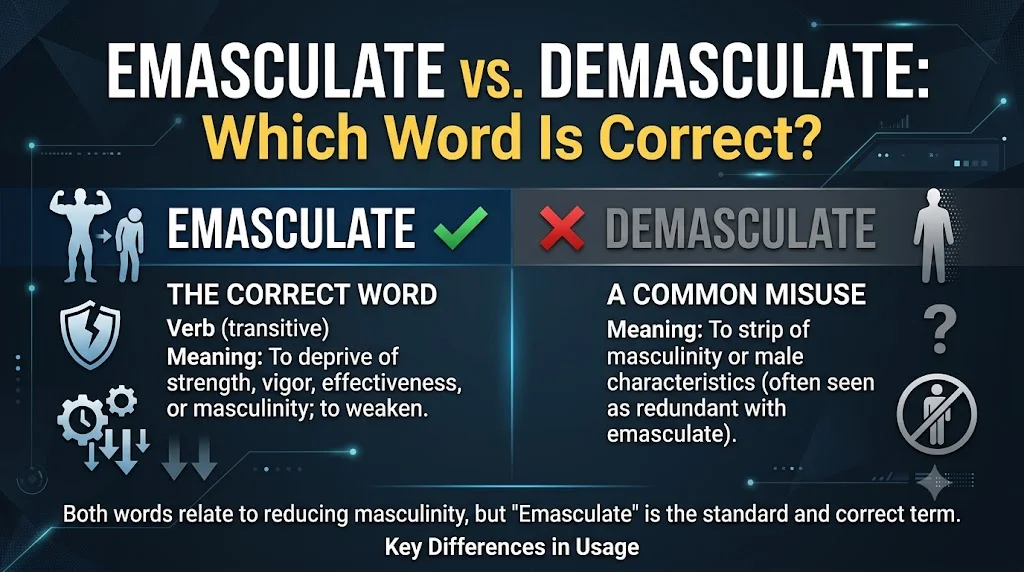
“Emasculate” is a verb (and sometimes an adjective) that means to weaken, deprive of power, or strip someone or something of strength, authority, or masculine qualities.
Dictionary Definition
Standard dictionaries define emasculate (verb) as:
- To deprive a man of his male role, power, or vigor; to make someone feel less masculine.
- To weaken or reduce the force, effectiveness, or impact of something (a law, an argument, a policy).
- (Biology/Botany) To remove the testes or, in plants, the male reproductive parts (stamens).
As an adjective, emasculate (pronounced differently, see below) is rare in modern English and means “lacking vigor or strength.”
Literal Meaning vs. Figurative Meaning
This is where a lot of confusion starts, so let’s separate the two clearly.
| Type of Meaning | Explanation | Example |
| Literal | To physically castrate a male person or animal, or remove the male part of a flower | The vet emasculated the young bull before it was moved to the herd. |
| Figurative | To weaken someone’s confidence, authority, or sense of masculinity, often through humiliation, criticism, or loss of control | Constant public criticism began to emasculate the manager’s authority over his team. |
In everyday conversation, the figurative sense is used far more often than the literal one. When someone says a decision “emasculated” a committee, they mean it stripped away its power — not anything physical.
Pronunciation and Verb Forms
Getting the pronunciation right matters, especially in professional or academic speech.
- Verb: ih-MAS-kyuh-layt (/ɪˈmæskjəleɪt/) — stress on the second syllable
- Adjective (rare): ih-MAS-kyuh-lit (/ɪˈmæskjəlɪt/) — the final syllable is shorter and unstressed
Verb forms of “emasculate” follow a regular pattern:
| Form | Word |
| Base form | emasculate |
| Third-person singular | emasculates |
| Past tense | emasculated |
| Past participle | emasculated |
| Present participle | emasculating |
| Noun form | emasculation |
| Adjective (descriptive) | emasculating |
Example sentences:
- He feared the new policy would emasculate his department’s budget.
- The board’s decision emasculated the CEO’s decision-making power.
- Critics say the amendment is emasculating the original bill.
Is “Demasculate” a Real Word?
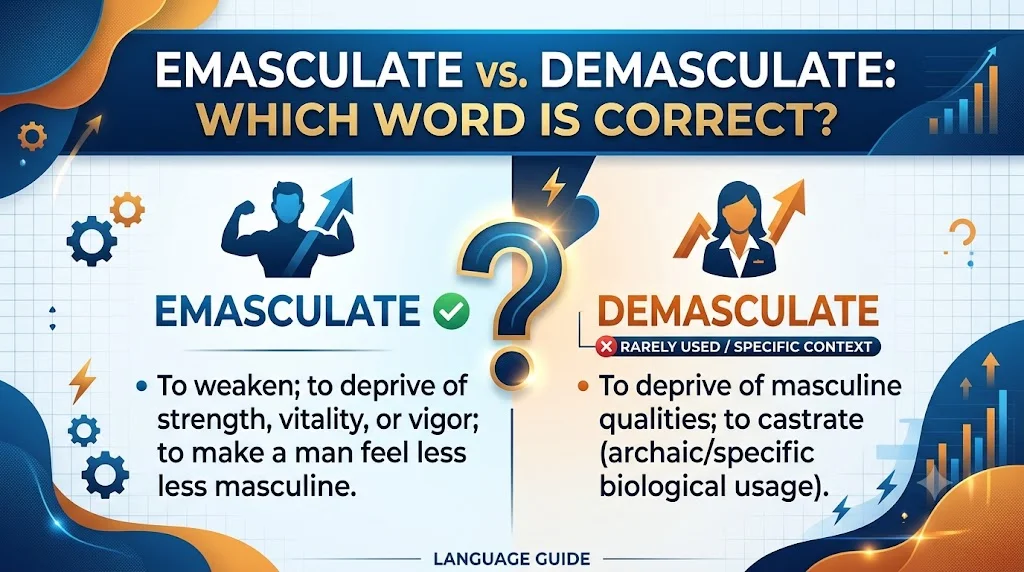
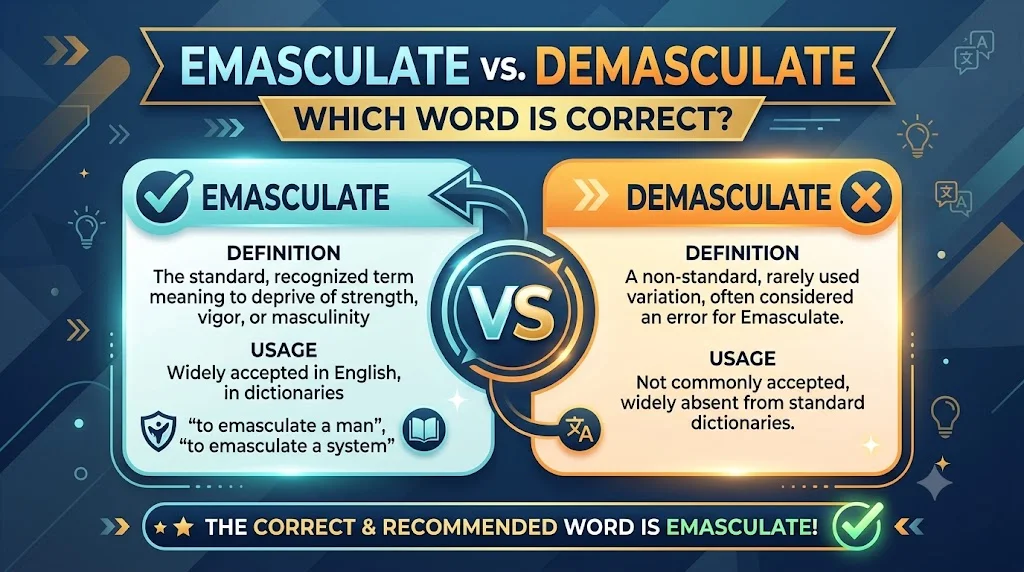
No. “Demasculate” is not a standard English word. You will not find it in Merriam-Webster, Oxford, Cambridge, or Collins dictionaries. It is a common misspelling or mishearing of “emasculate.”
Why People Search for “Demasculate”
There are three common reasons people type “demasculate” into a search bar:
- Prefix confusion. English uses “de-” for many words meaning “to remove” or “reverse” (deactivate, defrost, demotivate). It feels logical to assume “masculate” plus “de-” should work the same way, but “masculate” is not an independent English word.
- Mishearing. In fast speech, “emasculate” can sound like it starts with “de-,” especially to non-native speakers.
- Autocorrect and typing errors. People sometimes type “de-” out of habit when they mean “e-.”
Is It Found in English Dictionaries?
No major dictionary — print or online — lists “demasculate” as a valid headword. It does not appear in Merriam-Webster, Oxford English Dictionary, Cambridge Dictionary, or Collins English Dictionary. Some informal online forums and slang glossaries use it casually, but it has no recognized grammatical status, no accepted definition, and no historical usage record.
Why This Word Causes Confusion
The confusion largely comes down to English prefix patterns. Compare these real word pairs:
| Prefix Pattern | Real Word | Meaning |
| de- + activate | deactivate | to turn off |
| de- + motivate | demotivate | to reduce motivation |
| e- + masculate (not standard) | ❌ demasculate | not a real word |
| e- + vaporate | evaporate | to turn into vapor |
“Emasculate” comes from a different Latin construction (explained below), so it doesn’t follow the “de-” removal pattern that so many other English verbs use. That mismatch is exactly why the mistake is so common — and so easy to fix once you know it.
Emasculate vs. Demasculate: Key Differences
Side-by-Side Comparison Table
| Feature | Emasculate | Demasculate |
| Real word? | Yes | No |
| Dictionary status | Standard, widely recognized | Not listed in any major dictionary |
| Part of speech | Verb (also rare adjective) | None |
| Origin | Latin: emasculare | Informal error, no true origin |
| Correct usage | Weaken, strip of power/masculinity; biological removal | Should not be used in formal or academic writing |
| Grammar forms | emasculate, emasculates, emasculated, emasculating, emasculation | None standardized |
| Recommended use | Yes, for all contexts (formal, academic, everyday) | No |
Which Word Should You Use?
Always use “emasculate.” There is no situation — academic, professional, casual, or creative — where “demasculate” is the correct or accepted choice. If you’ve heard someone use it, they likely misspoke or misspelled the intended word.
Quick Summary of the Differences
- Emasculate = real, dictionary-approved English verb.
- Demasculate = not a word; a common error caused by prefix confusion.
- When in doubt, default to “emasculate” and check the spelling against the “e-” beginning, not “de-.”
Origin and Etymology of “Emasculate”
Latin Root and Word History
“Emasculate” comes from the Latin verb emasculare, formed from:
- e- (a variant of ex-, meaning “out of” or “away from”)
- masculus (meaning “male”)
Together, the roots literally mean “to remove maleness from” or “to make un-male.” The word entered English in the early 17th century, initially used in biological and medical writing before expanding into figurative use.
How Its Meaning Has Evolved
Originally, “emasculate” was used almost exclusively in a literal, physical sense — describing castration in humans and animals, or the removal of male parts in botany. Over the last two centuries, English speakers extended the word into metaphor: describing anything stripped of power, authority, or force, such as laws, arguments, institutions, or personal confidence. This figurative sense is now the dominant use in modern journalism, politics, and everyday speech.
How to Use “Emasculate” Correctly
Everyday Conversation Examples
- Losing his job made him feel emasculated in front of his family.
- She didn’t mean to emasculate him; she was just stating facts.
- He felt emasculated when his ideas were dismissed in the meeting.
Academic and Professional Examples
- The revised bill was emasculated by last-minute amendments, leaving it with little real power.
- Analysts argue that budget cuts have emasculated the agency’s ability to enforce regulations.
- The court’s ruling effectively emasculated the original contract’s protective clauses.
Common Grammar Patterns
“Emasculate” is a transitive verb, meaning it always needs a direct object — you emasculate something or someone.
| Pattern | Example |
| Subject + emasculate + object | The new law emasculated union bargaining power. |
| Passive voice: be + emasculated | The committee was emasculated by budget cuts. |
| Feel + emasculated (adjective use) | He felt emasculated after the public criticism. |
| Noun form: emasculation | The emasculation of local government authority worried voters. |
Common collocations:
- emasculate a law/bill/policy
- emasculate someone’s authority/power
- feel emasculated
- emasculated by (criticism, defeat, ridicule)
- the emasculation of an institution
Common Mistakes to Avoid
Using “Demasculate” Instead of “Emasculate”
This is the single most common error related to this word pair. Because “de-” prefixes are so common in English, writers instinctively reach for “demasculate” without realizing it isn’t a recognized word.
Incorrect vs. Correct Sentence Examples
| Incorrect | Correct |
| The new rule will demasculate his authority. | The new rule will emasculate his authority. |
| He felt demasculated after the argument. | He felt emasculated after the argument. |
| Critics say the bill was demasculated. | Critics say the bill was emasculated. |
| Don’t demasculate my opinion. | Don’t emasculate my opinion. |
Tips to Remember the Correct Usage
- Remember the “E for Ex” trick: “emasculate” starts with the Latin prefix e- (from ex-, meaning “out of”), the same family as “exit” and “export.”
- Think of “emasculate” as a cousin of “evaporate” and “eliminate” — all start with “e-,” not “de-.”
- If spellcheck underlines “demasculate,” trust it. That’s your signal to switch to “emasculate.”
Synonyms and Antonyms of “Emasculate”
Common Synonyms
- Weaken
- Undermine
- Debilitate
- Enfeeble
- Cripple (figurative)
- Neuter (figurative)
- Disempower
- Castrate (literal, biological)
Best Alternatives Based on Context
| Context | Best Synonym | Example |
| Institutional/legal power | Undermine, weaken | The ruling undermined the agency’s authority. |
| Personal confidence | Belittle, humiliate | His comments belittled her in front of the team. |
| Biological/medical | Castrate, neuter | The animal was neutered at six months old. |
| Formal/academic tone | Enfeeble, debilitate | Years of underfunding debilitated the program. |
Opposite Words (Antonyms)
- Empower
- Strengthen
- Fortify
- Reinforce
- Embolden
- Invigorate
Example: The mentorship program was designed to empower young leaders, not emasculate their confidence.
How “Emasculate” Is Used in Modern English
Everyday Language
In casual speech, “emasculate” often appears in conversations about relationships, workplace dynamics, and self-esteem. People describe feeling “emasculated” when their competence, authority, or masculinity is publicly challenged or diminished.
Literature and Media Examples
Writers, journalists, and commentators frequently use “emasculate” in a figurative sense when discussing politics, business, and gender roles — for example, describing a watered-down policy as having been “emasculated” by opposing lawmakers, or a character in fiction who feels “emasculated” by a controlling relationship. This figurative use dominates modern news writing, opinion pieces, and literary criticism.
Formal vs. Informal Usage
| Setting | Appropriate Use | Example |
| Formal/academic | Yes, common in policy, law, sociology writing | The reform emasculated the union’s collective bargaining power. |
| Informal/conversational | Yes, common when discussing feelings or relationships | He felt totally emasculated after being corrected in front of his friends. |
| Professional/business | Yes, used to describe reduced authority | The merger emasculated the smaller company’s decision-making role. |
Biological Meaning of “Emasculation”
Human and Animal Context
In its original, literal sense, “emasculation” refers to the surgical removal of the testes in males — a procedure more commonly called castration in modern medical and veterinary language. This term appears in older medical texts and is still occasionally used in clinical or legal documents describing this specific procedure.
Botanical Meaning
In botany, emasculation refers to the removal of the anthers (the male part of a flower) before pollination, typically done by plant breeders to control cross-pollination and produce hybrid varieties. This is a completely neutral, technical use of the word with no negative or figurative connotation.
Example: Researchers emasculated the flowers by hand before applying pollen from the selected parent plant.
Medical Usage
In modern medical writing, “castration” and “neutering” have largely replaced “emasculation” for describing the surgical procedure in humans and animals. “Emasculation” now survives mainly in botanical, legal-historical, and figurative contexts.
Psychological and Social Context
Masculinity and Social Expectations
The figurative use of “emasculate” is deeply tied to cultural ideas about masculinity — strength, control, authority, and independence. When a man’s ability to provide, lead, or assert control is challenged, some people describe that experience using the word “emasculated,” reflecting how tightly the term is linked to social expectations of manhood.
Emotional and Psychological Impact
Feeling “emasculated” is often associated with emotions like shame, inadequacy, frustration, or diminished self-worth. Using this word to describe someone’s feelings is a valid way to talk about a real emotional experience, but the word itself carries loaded cultural assumptions about gender roles that are increasingly discussed and debated.
Modern Discussions Around the Term
Contemporary conversations about masculinity, gender roles, and emotional expression have brought renewed attention to how the word “emasculate” is used in media, therapy, and everyday language. Some commentators argue the term reinforces rigid gender norms, while others see it as a useful, precise way to describe a specific kind of power loss tied to identity.
Words Commonly Confused with “Emasculate”
Emasculate vs. Castrate
| Word | Meaning | Usage Context |
| Emasculate | Broader; literal or figurative loss of power/masculinity | Formal, figurative, biological, botanical |
| Castrate | Almost always literal; surgical removal of testes | Medical, veterinary, biological |
Tip: “Castrate” is more clinical and almost always literal. “Emasculate” is more commonly figurative in modern usage.
Emasculate vs. Feminize
| Word | Meaning | Usage Context |
| Emasculate | To weaken or strip of masculine power/authority | Negative connotation; about loss of power |
| Feminize | To give something feminine qualities or characteristics | Neutral or descriptive; not inherently about power loss |
Example: Critics said the redesign feminized the brand’s logo — a purely descriptive statement, not a criticism of strength or power, unlike “emasculate.”
Emasculate vs. Demasculate
As established earlier, this isn’t really a comparison between two valid words — it’s a spelling and word-choice correction. “Emasculate” is correct in every context; “demasculate” should be avoided entirely.
Quick Tips to Remember the Difference
Easy Memory Trick
Picture the word “exit.” Both “exit” and “emasculate” start with the Latin-based prefix “e-,” meaning “out of” or “away from.” If you remember that “emasculate” means taking masculinity out of someone, the correct spelling becomes much easier to recall.
One-Minute Recap
- “Emasculate” = real word, correct spelling, means to weaken or strip of power/masculinity.
- “Demasculate” = not a real word; a common misspelling caused by prefix confusion.
- Use “emasculate” in formal, academic, professional, and everyday writing.
- Never use “demasculate” — spellcheck and dictionaries will flag it.
Final Comparison Table
| Category | Emasculate | Demasculate |
| Word status | Valid, dictionary-recognized | Invalid, not in any dictionary |
| Correct spelling | ✅ | ❌ |
| Recommended for writing | Always | Never |
| Grammar forms available | Yes (full conjugation) | No |
| Etymology | Latin emasculare | None (informal error) |
Final Thoughts
The comparison between “emasculate” and “demasculate” really comes down to one simple fact: only “emasculate” is a real, dictionary-approved English word. “Demasculate” is a natural but incorrect guess, shaped by how often English uses “de-” prefixes to mean “remove” or “reverse.”
Once you understand the Latin root of “emasculate” — e- meaning “out of,” plus masculus meaning “male” — the correct spelling becomes second nature. Whether you’re writing a formal report, a news article, or a personal reflection about confidence and identity, “emasculate” is the word you want. Keep this guide handy, and you’ll never mix the two up again.
Frequently Asked Questions
Is “Demasculate” a Real English Word?
No. “Demasculate” does not appear in any major English dictionary, including Merriam-Webster, Oxford, or Cambridge. It’s a common misspelling of “emasculate,” likely caused by confusion with “de-” prefixed words like “demotivate” or “deactivate.” Always use “emasculate” instead in both formal and informal writing.
What Is the Difference Between “Emasculate” and “Castrate”?
“Castrate” almost always refers to the literal, surgical removal of testes in humans or animals and is common in medical and veterinary contexts. “Emasculate” can be used the same way but is far more often used figuratively, describing a loss of power, authority, or confidence rather than a physical procedure.
Can “Emasculate” Be Used Figuratively?
Yes, and this is actually its most common modern use. People frequently say a law, policy, argument, or institution was “emasculated” when its power or effectiveness was significantly reduced. It’s also used to describe a person feeling stripped of confidence, authority, or masculinity in a social or emotional situation.
Is the Word “Emasculate” Offensive?
“Emasculate” isn’t inherently offensive, but it does carry cultural assumptions about masculinity and power that some people find outdated or reinforcing of rigid gender roles. Context matters: using it to describe a policy’s reduced power is neutral, while using it about a person’s identity can feel loaded or hurtful depending on tone and intent.
How Do You Use “Emasculate” in a Sentence?
Use “emasculate” as a transitive verb, meaning it needs a direct object. For example: “The new regulation emasculated the agency’s enforcement power,” or “He felt emasculated after being publicly corrected.” It also works in passive voice: “The bill was emasculated by last-minute amendments.”