
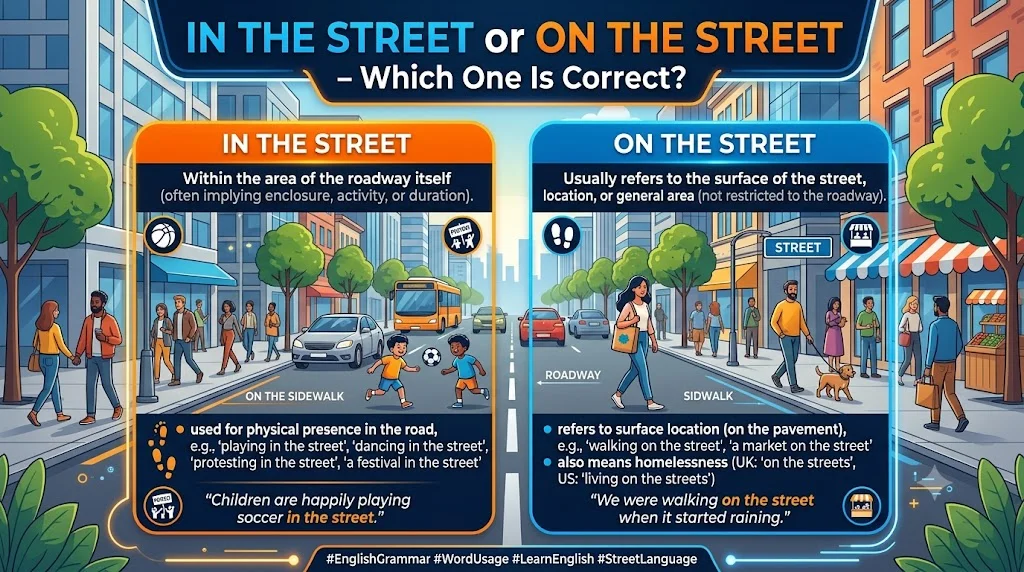
If you have ever paused mid-sentence wondering whether to say “the kids are playing in the street” or “the kids are playing on the street,” you are not alone. This is one of the most common preposition mix-ups for English learners, and honestly, even native speakers use these two phrases inconsistently without knowing exactly why.
The short answer: both are correct, but they are not always interchangeable. The right choice depends on your meaning, your region (British vs. American English), and the specific expression you are using.
In this guide, I will break this down the way I would for my own students — slowly, clearly, and with plenty of real examples. By the end, you will never have to guess again.
Quick Answer: In the Street or On the Street?
Here is the fast version, if you are in a hurry:
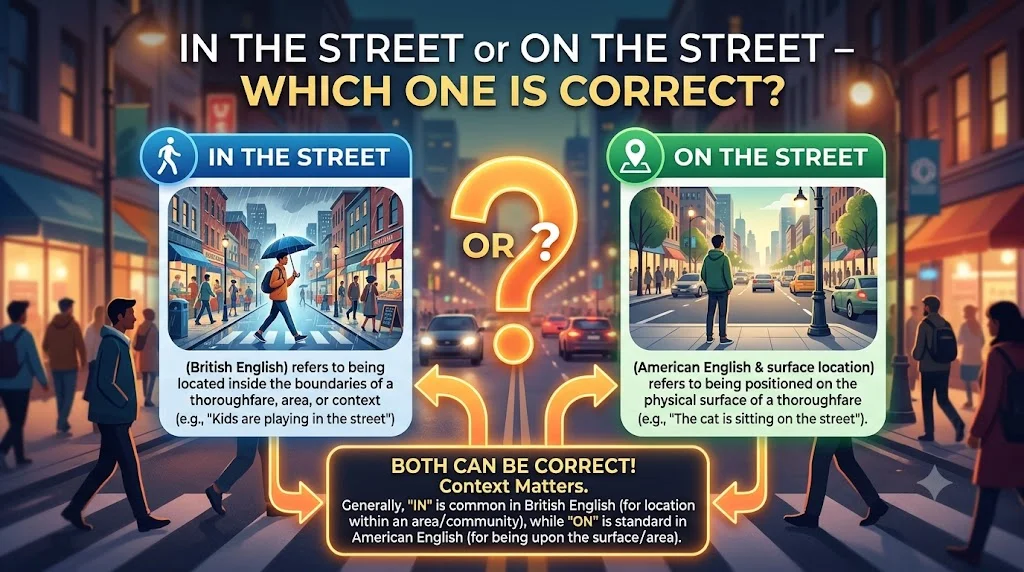
- “In the street” usually means the physical road surface itself — the space where cars drive, cyclists ride, or people might be standing in traffic. This phrase is more common in British English.
- “On the street” usually refers to a general location along a street, a neighborhood, or an address. This phrase is the standard choice in American English, even when talking about the road surface.
So if you are American, “on the street” is almost always your safest bet. If you are British, “in the street” is often more natural, especially when describing something happening on the actual road.
Now let’s go deeper, because the real understanding comes from knowing why.
What Is the Difference Between “In the Street” and “On the Street”?
Prepositions in English are tricky because they do not always follow logical rules. They follow usage patterns that developed over centuries. “In the street” and “on the street” are a perfect example of this.
Meaning of “In the Street”
Definition: “In the street” describes something located within the physical boundaries of the road — the actual paved surface where vehicles travel.
Grammar explanation: Here, “in” functions as a preposition of place, treating the street like a contained space, similar to how we say “in the room” or “in the water.” The street is imagined as an enclosed area with edges (the curbs or sidewalks) marking its boundaries.
Pronunciation: /ɪn ðə striːt/ — the “in” is a short, quick sound, almost swallowed in fast speech.
Word origin: “In” comes from Old English in, meaning “within” or “inside of.” It has always carried the sense of containment.
Common mistake: Learners sometimes use “in the street” when talking about an address or a shop location, which sounds unnatural. For example, “The bakery is in the street” is incorrect in most contexts. It should be “The bakery is on the street.”
Correct usage example:
- “Be careful — there’s a dog running in the street!”
Real-life example:
- “The children were playing in the street when the ball rolled into traffic.”
Formal vs. informal: This phrase appears in both formal and informal writing, but it is slightly more common in British newspapers, police reports, and safety warnings.
Similar words: on the road, on the pavement (UK), in the roadway.
Opposite context: on the sidewalk, on the footpath — these describe the safe walking area, not the road.
Related phrases: “in the middle of the street,” “in the road,” “in traffic.”
Common collocations: playing in the street, standing in the street, lying in the street, running in the street.
Synonyms: on the road, on the tarmac, in the roadway.
Meaning of “On the Street”
Definition: “On the street” refers to a general location — an address, a neighborhood area, or simply “outside” in a broad sense, rather than the specific paved surface.
Grammar explanation: “On” functions as a preposition of surface or general location. Streets, avenues, and roads are treated as flat reference points, similar to “on the map” or “on the corner.” This is why we say “the store is on Main Street,” not “in Main Street,” in American English.
Pronunciation: /ɒn ðə striːt/ (UK) or /ɑːn ðə striːt/ (US) — notice the vowel shift between British and American accents.
Word origin: “On” comes from Old English on/an, meaning “upon” or “touching the surface of.” It naturally extended to describe locations along a linear path, like a street or road.
Common mistake: Confusing “on the street” with being inside a building on that street. “I live on the street” (meaning homeless) has a completely different meaning from “I live on this street” (meaning your house is located here). Article and phrasing matter enormously.
Correct usage example:
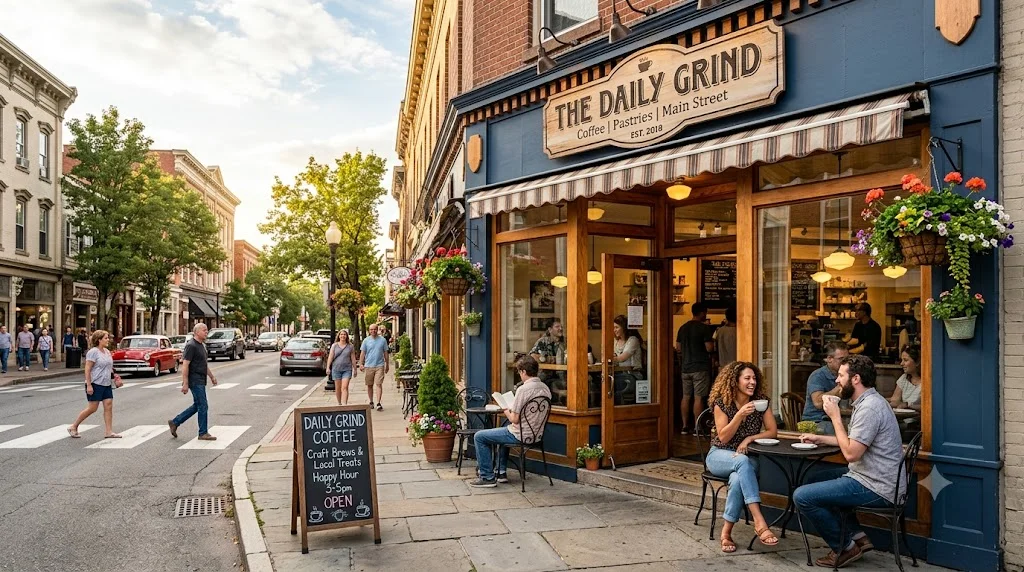
- “The new coffee shop opened on the street where I grew up.”
Real-life example:
- “You’ll find the bookstore on the street right after the traffic light.”
Formal vs. informal: “On the street” is the dominant form in American English across all registers — formal writing, journalism, casual conversation, and business communication.
Similar words: along the street, on the road, on the avenue, on the block.
Opposite context: off the street, away from the street.
Related phrases: “man on the street” (an ordinary person), “word on the street” (rumor or gossip), “street-smart.”
Common collocations: live on the street, work on the street, shop on the street, park on the street.
Synonyms: along the road, on the avenue, on the block, nearby.
When Should You Use “In the Street”?
Correct Usage Rules
Use “in the street” when you mean:
- The physical road surface — where vehicles drive.
- Something happening directly on the pavement/tarmac, especially involving danger, movement, or action.
- British English contexts, where this phrase is used more broadly than in American English.
Quick Tip: If you can replace the phrase with “on the road” and it still makes sense, “in the street” is probably correct.
Example Sentences
- “Don’t leave your bike in the street; someone might hit it.”
- “There was a protest happening in the street outside the office.”
- “A cat darted in the street right in front of my car.”
- “Children in the UK are often told, ‘Don’t play in the street.'”
- “The parade moved slowly in the street, blocking traffic for hours.”
When Should You Use “On the Street”?
Correct Usage Rules
Use “on the street” when you mean:
- A general address or location (“The pizza place is on Elm Street”).
- A neighborhood or area, without focusing on the exact road surface.
- American English contexts, where this is the default and natural choice almost universally.
- Idiomatic expressions like “word on the street” or “man on the street.”
Quick Tip: If you are talking about where something is located (an address, shop, or house), always use “on the street,” never “in the street.”
Example Sentences
- “I parked my car on the street because the garage was full.”
- “She lives on the street next to the old library.”
- “There’s a great taco truck on the street corner.”
- “The word on the street is that the mayor is resigning.”
- “He grew up on a quiet street in the suburbs.”
In the Street vs. On the Street – Side-by-Side Comparison
Key Differences Table
| Feature | In the Street | On the Street |
| Meaning | The road surface itself | A general location or address |
| Region | More common in British English | Standard in American English |
| Grammar function | Preposition of containment | Preposition of surface/location |
| Typical use | Physical danger, action, movement | Location, address, idioms |
| Example | “A ball rolled in the street.” | “The shop is on Main Street.” |
| Formality | Neutral to formal | Neutral to formal |
| Common idioms | Rare | “word on the street,” “man on the street” |
Quick Decision Rule
Ask yourself this simple question: “Am I talking about the road surface, or a location/address?”
- Road surface → in the street (especially in British English)
- Location or address → on the street (in both British and American English)
British English vs. American English
This is where most confusion comes from, so let’s be very clear.
British English Usage
In British English, “in the street” is common and completely natural when describing something happening on the road itself. British speakers say:
- “The kids were playing in the street.”
- “There was rubbish in the street after the festival.”
However, British English also uses “on the street” for addresses and general locations, just like American English:
- “The shop is on Oxford Street.”
American English Usage
American English strongly prefers “on the street” in almost every context, including situations where British English would use “in the street.” Americans say:
- “The kids were playing on the street.” (not “in the street”)
- “Don’t leave your bike on the street.”
Quick Tip: If you are writing for a US audience, blog, or business, default to “on the street” unless you specifically need the British phrasing for stylistic or dialectal reasons.
Common Expressions with “Street”
Let’s look at some everyday verb + street combinations, since this is where learners get tripped up most often. These verb pairings are especially useful for ESL learners because native speakers rarely think about the grammar rule consciously — they simply “feel” which preposition sounds right based on years of exposure. Studying these fixed patterns closely is one of the fastest ways to sound more natural.
Playing in the Street vs. Playing on the Street
- British English: “Playing in the street” is the natural, traditional phrase (think of old British sayings and songs).
- American English: “Playing on the street” or simply “playing outside” is more typical.
Example: “We used to play in the street until the sun went down.” (British) Example: “The neighborhood kids were playing on the street all afternoon.” (American)
Walking in the Street vs. Walking on the Street
- “Walking in the street” means walking on the road itself, not the sidewalk — often implying a safety issue.
- “Walking on the street” simply means walking outdoors, in public, generally along the sidewalk or path.
Example: “He was walking in the street because the sidewalk was blocked.” Example: “I saw her walking on the street this morning near the café.”
Dancing in the Street
Fun fact: the classic phrase is always “dancing in the street” (as in the famous Motown song “Dancing in the Street”), never “on the street.” This is a fixed idiomatic expression describing joyful, public celebration.
Example: “After the team won, fans were dancing in the street all night.”
Living in the Street vs. Living on the Street
This distinction matters a lot, so pay close attention:
- “Living on the street” means being homeless.
- “Living in the street” is grammatically unusual and rarely used this way; native speakers almost always say “living on the street” for homelessness.
Example: “Thousands of people are living on the street due to rising rent costs.”
Common mistake: Never say “living in the street” to mean homelessness — it can sound confusing or incorrect.
Standing in the Street vs. Standing on the Street
- “Standing in the street” means standing on the road surface, often blocking traffic or in a risky spot.
- “Standing on the street” simply means standing outside, in a general public area, often near a building or corner.
Example: “He was standing in the street, waving his arms at the oncoming truck.” Example: “She was standing on the street, waiting for her friend.”
Sleeping in the Street vs. Sleeping on the Street
- “Sleeping on the street” is the standard, correct phrase describing homelessness.
- “Sleeping in the street” is grammatically possible but far less common and can sound overly literal (as if sleeping on the actual road surface).
Example: “It breaks my heart to see people sleeping on the street in freezing weather.”
Can “In the Street” and “On the Street” Be Used Interchangeably?
Situations Where Both Are Correct
Sometimes, especially in British English, both phrases work with only a subtle difference in emphasis:
- “There was a crowd in the street.” / “There was a crowd on the street.”
Both are understandable, though “in the street” slightly emphasizes the road surface, while “on the street” emphasizes the general area.
Situations Where Only One Is Correct
In these cases, swapping the preposition creates an error or changes the meaning:
- ✅ “The bakery is on Main Street.” ❌ “The bakery is in Main Street.”
- ✅ “He’s been living on the street for years.” ❌ “He’s been living in the street for years.”
- ✅ “Dancing in the street” (fixed idiom) ❌ “Dancing on the street” (unnatural in this idiom)
Quick Tip: Fixed idioms and addresses do not follow flexible rules — memorize them as whole chunks, not word-by-word translations.
Common Grammar Rules for Using “In” and “On”
Easy Rule to Remember
Think of “in” as describing an enclosed space (in a box, in a room, in the street — as in, “within the road’s boundaries”).
Think of “on” as describing a surface or a flat reference point (on the table, on the map, on the street — as in, “along this specific road”).
Visual Memory Trick
Picture a street as a long, flat ribbon on a map. When you are talking about an address, you are pointing to a spot on that ribbon. But when you imagine someone standing between the two curbs, surrounded by the road itself, that person is in the street — inside its physical boundaries.
Quick Tip: “On” = location along the ribbon. “In” = inside the physical road space.
Common Mistakes to Avoid
Incorrect Examples
- ❌ “The restaurant is in 5th Avenue.”
- ❌ “He has been living in the street since last winter.”
- ❌ “She parked her car in the street corner.”
- ❌ “Kids in America usually play in the street after school.” (unnatural in US English)
Correct Examples
- ✅ “The restaurant is on 5th Avenue.”
- ✅ “He has been living on the street since last winter.”
- ✅ “She parked her car on the street corner.”
- ✅ “Kids in America usually play on the street after school.”
Common Mistake Tip: When naming a specific street (Main Street, Oxford Street, 5th Avenue), always use “on,” never “in,” regardless of dialect.
Real-Life Examples of “In the Street” and “On the Street”
Everyday Conversations
- “Watch out, there’s broken glass in the street.”
- “My cousin lives on the street behind the mall.”
- “We bumped into an old friend on the street yesterday.”
Formal Writing Examples
- “Pedestrians are advised not to walk in the street due to ongoing construction.” (British-style safety notice)
- “The company’s headquarters are located on Wall Street.” (American formal writing)
News and Media Examples
- “Protesters gathered in the street outside Parliament.” (British news style)
- “Residents on the street reported hearing a loud explosion.” (American news style)
Related Preposition Confusions
At the Street vs. On the Street
“At the street” is generally incorrect on its own. We use “at” with specific points, like “at the corner of the street” or “at 5th Street,” not simply “at the street.”
- ✅ “Meet me at the corner of Main Street.”
- ❌ “Meet me at the street.”
In the Road vs. On the Road
- “In the road” (mostly British) means on the physical road surface, similar to “in the street.”
- “On the road” means traveling, often used idiomatically for road trips or careers involving travel (“The band is on the road this summer”).
Example: “There’s a pothole in the road near my house.” Example: “We’ve been on the road for six hours already.”
At School vs. In School
This is a bonus preposition pair that often confuses the same learners:
- “At school” refers to being physically present at the school building.
- “In school” (American English) can mean currently enrolled as a student, even when not physically present.
Example: “She’s at school right now.” (physically there today) Example: “He’s still in school.” (currently a student, general status)
Mini Quiz – Test Your Understanding
Try these five questions. Answers are below.
- “The coffee shop is ___ Baker Street.” (in / on)
- “A stray dog ran ___ the street in front of my car.” (in / on)
- “They have been ___ the street for three winters now.” (living in / living on)
- “We danced ___ the street after the championship win.” (in / on)
- “He parked his motorcycle ___ the street corner.” (in / on)
Answers: 1. on 2. in 3. living on 4. in 5. on
Tips to Remember the Difference
- If you mean an address or general location → use on the street.
- If you mean the physical road surface → use in the street (especially in British English).
- For homelessness, always say living/sleeping on the street.
- For the classic idiom, remember “dancing in the street” — a fixed exception.
- When in doubt as an American English speaker, “on the street” is almost always safe.
Final Thoughts
“In the street” and “on the street” both describe location, but the small difference between them carries real meaning. “In the street” focuses on the road surface itself, common in British English, while “on the street” describes a general address, neighborhood, or location, and dominates American English usage. Some expressions, like “living on the street” or “dancing in the street,” are fixed and should be memorized as whole phrases rather than analyzed word by word.
Once you understand this distinction, you will speak and write with far more confidence and precision. Like most English prepositions, mastery comes from noticing patterns in real conversations, reading, and practice rather than memorizing rigid rules alone.
Frequently Asked Questions
Which is correct: in the street or on the street? Both are correct, but they mean slightly different things. “In the street” usually refers to the road surface (common in British English), while “on the street” refers to a general location or address, and is the standard choice in American English.
Is it walking on the street or along the street? “Walking on the street” is common and correct in everyday American English. “Walking along the street” is also correct and slightly more descriptive, emphasizing movement parallel to the street rather than a fixed location.
What is the difference between in and on the street? “In the street” implies being within the physical road area, often related to danger or action. “On the street” implies a general location, address, or neighborhood, and is used far more broadly, especially in American English.
Is it correct to say “in the street”? Yes, it is correct, especially in British English, when referring to something happening on the actual road surface, like “a ball rolled in the street.”
Which is correct, in the road or on the road? “In the road” describes the physical road surface (similar to “in the street”), while “on the road” is often idiomatic, meaning traveling, such as “The team has been on the road all season.”