
Have you ever typed “unregister” into a form and wondered if it was even a real word? Or maybe you’ve seen “deregister” on a government website and asked yourself why it wasn’t “unregister” instead?
You are not alone. These two words look almost identical, sound similar, and are often used to mean “stop being registered.” But they are not always interchangeable. As an English teacher, I see this confusion constantly — in emails, tech support tickets, legal forms, and even news articles.
In this guide, I’ll break down the meaning, grammar, pronunciation, word origin, and real-world usage of both words. By the end, you will know exactly which word to use, when to use it, and why native speakers pick one over the other.
Quick Answer: Unregister vs Deregister in Simple Words
Here’s the short version before we go deep.
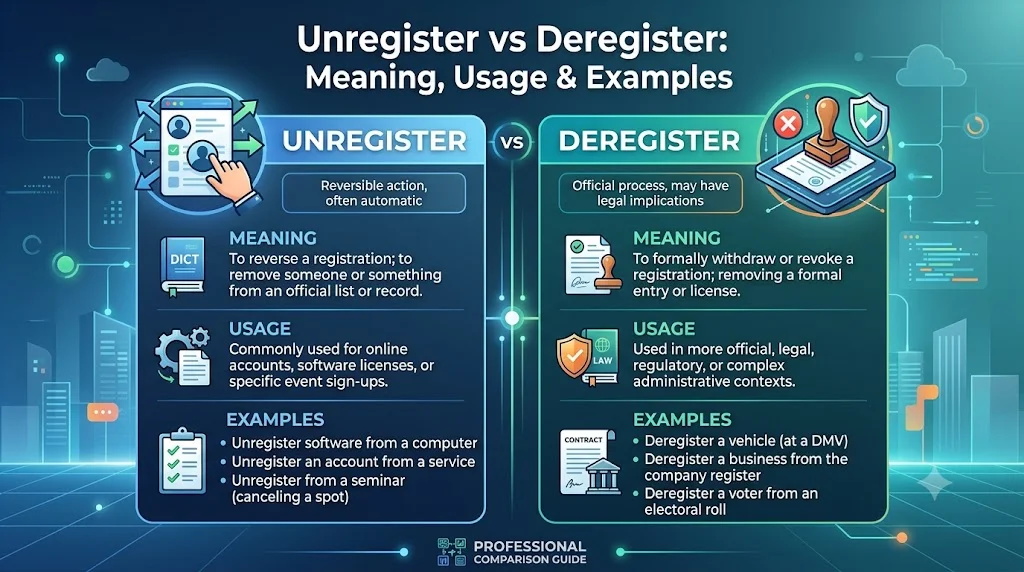
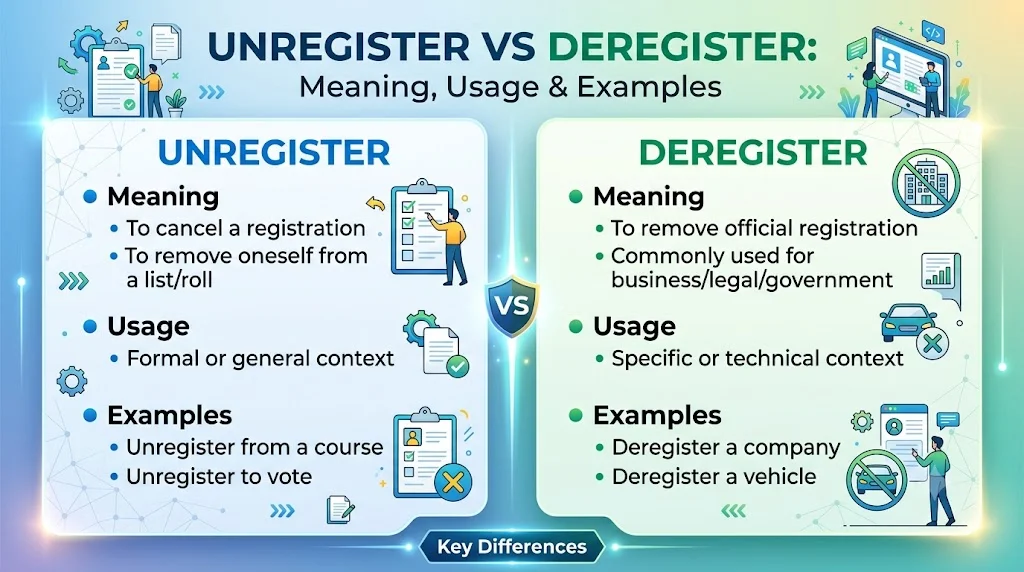
- Unregister = to remove something from a registered state, most often a device, app, account, or software license. It’s common in tech and casual English.
- Deregister = to officially remove something from a formal record, list, or registry — used for vehicles, companies, schools, securities, and government documents.
Both words mean “to cancel a registration,” but deregister carries a more formal, official, and legal tone, while unregister feels more casual and tech-focused.
Quick Tip: If you’re filling out a government form, legal document, or business paperwork, choose deregister. If you’re removing a device or app, unregister works perfectly.
What Does “Unregister” Mean?
Definition
Unregister (verb) means to remove a person, device, account, or item from a list where it was previously registered. It reverses the act of registering.
- Pronunciation: un-REJ-uh-ster (/ʌnˈrɛdʒɪstər/)
- Word Origin: Formed from the prefix un- (meaning “not” or “reverse of”) plus the base verb register, which comes from the Latin word regestrum, meaning “a list” or “record.”
- Part of Speech: Verb (transitive)
- Word Form: Unregister → Unregistered (past tense/adjective) → Unregistering (present participle) → Unregistration (noun, less common)
Grammatically, the prefix un- is added to reverse an action, similar to how “undo” reverses “do” or “unlock” reverses “lock.” This makes unregister feel like a natural, everyday action word.
Common Examples
- I need to unregister my old phone from the app.
- Please unregister this device before selling it.
- She unregistered her account after switching platforms.
- You can unregister from the newsletter anytime.
- He unregistered his Kindle before giving it to his brother.
When You Should Use “Unregister”
Use unregister when talking about:
- Apps and software licenses
- Devices like phones, tablets, or streaming sticks
- Personal online accounts
- Casual or everyday actions that don’t involve legal paperwork
Quick Tip: Think of “unregister” as the informal, tech-friendly cousin of “deregister.” If a five-year-old could technically do the action (like removing a device from an app), “unregister” usually fits.
Grammar Notes for “Unregister”
Because unregister is a transitive verb, it always needs a direct object — the thing being removed. You can’t just say “I unregister”; you need to say what you are unregistering, such as a device, app, or account.
- Correct: “I unregistered my old laptop.”
- Incorrect: “I unregistered yesterday.” (missing object — unclear what was removed)
The past tense simply adds -ed: unregister → unregistered. There is no irregular form to memorize, which makes it easy for English learners.
Formal vs Informal Usage
“Unregister” leans informal. You’ll hear it in everyday tech support chats, help-center articles, and casual conversation. It rarely appears in legal contracts or government paperwork.
- Informal: “Just unregister the tablet and you’re good to go.”
- Semi-formal: “Users may unregister their devices at any time through account settings.”
Common Collocations With “Unregister”
- unregister a device
- unregister an account
- unregister from a service
- unregister a license
- unregister an app
Similar Words to “Unregister”
Words like unlink, disconnect, uninstall, and remove often appear alongside or in place of “unregister,” especially in tech writing. They are not exact synonyms, but they share the idea of undoing a connection or setup.
What Does “Deregister” Mean?
Definition
Deregister (verb) means to formally remove a person, vehicle, business, or item from an official record, government list, or regulatory registry.
- Pronunciation: dee-REJ-uh-ster (/diːˈrɛdʒɪstər/)
- Word Origin: From the prefix de- (meaning “to remove” or “to reverse”) plus register. The prefix de- often appears in formal and legal vocabulary, such as “decommission” or “declassify.”
- Part of Speech: Verb (transitive)
- Word Form: Deregister → Deregistered → Deregistering → Deregistration (noun, commonly used)
The prefix de- gives this word a more official, bureaucratic tone compared to un-. That’s why deregister shows up far more often in legal, financial, and governmental writing.
Common Examples
- The company was deregistered after failing to file annual reports.
- You must deregister your car before moving abroad.
- Students can deregister from a course before the deadline.
- The stock was deregistered from the exchange.
- She had to deregister as a voter in her old district.
When You Should Use “Deregister”
Use deregister when talking about:
- Government records (voter rolls, licenses, permits)
- Businesses and legal entities
- Vehicles and DMV records
- Schools, universities, and formal enrollment
- Financial securities and stock exchanges
Quick Tip: If the action involves an official authority, government body, or legal document, “deregister” is almost always the correct choice.
Grammar Notes for “Deregister”
Like “unregister,” deregister is a transitive verb and requires a direct object. It also follows regular past-tense rules: deregister → deregistered.
- Correct: “The DMV deregistered the vehicle after the sale.”
- Incorrect: “The vehicle deregistered.” (passive-sounding and grammatically awkward without proper passive construction)
For correct passive voice, use: “The vehicle was deregistered by the DMV.”
Formal vs Informal Usage
“Deregister” is almost always formal. It belongs in legal notices, corporate filings, academic policies, and government communications. Using it in casual speech is fine, but it will sound slightly more serious or official than “unregister.”
- Formal: “The corporation must deregister with the Securities and Exchange Commission within 90 days.”
- Semi-casual: “Don’t forget to deregister your car before you move.”
Common Collocations With “Deregister”
- deregister a company
- deregister a vehicle
- deregister a voter
- deregister a student
- deregister a security (finance)
- deregister a professional license
Similar Words to “Deregister”
Words such as revoke, dissolve, withdraw, annul, and cancel often appear near “deregister” in legal and business writing. These words share the sense of officially ending a status, though each has its own specific legal weight.
Unregister vs Deregister: Side-by-Side Comparison
Meaning
Both words describe the act of ending a registration. The core meaning overlaps heavily, but the context and formality separate them.
Purpose
- Unregister — used for personal, technical, or account-based removal.
- Deregister — used for official, legal, or regulatory removal.
Common Use Cases
| Situation | Correct Word |
| Removing an app from your account | Unregister |
| Canceling a business license | Deregister |
| Removing a Kindle device | Unregister |
| Taking a car off DMV records | Deregister |
| Leaving a company mailing list | Unregister |
| Withdrawing from a university course | Deregister |
Which Word Is More Formal?
Deregister is more formal. It’s the word you’ll find in legal contracts, government websites, and financial documents. Unregister is more casual and appears mostly in tech support articles, app instructions, and everyday conversation.
Unregister vs Deregister: Key Differences at a Glance
| Feature | Unregister | Deregister |
| Prefix | un- (reverse) | de- (remove/reverse) |
| Tone | Casual, technical | Formal, official |
| Common Field | Technology, apps, devices | Law, government, business |
| Frequency of Use | Common in tech writing | Common in legal/official writing |
| Noun Form | Unregistration (rare) | Deregistration (common) |
| Example Subject | Device, app, account | Company, vehicle, voter, student |
Where Is “Unregister” Commonly Used?
Software & Technology
In software, unregistering usually refers to removing a license key, deactivating a product ID, or unlinking an app from your account.
Example: “Unregister this software before installing it on a new computer.”
Mobile Apps & Devices
This is one of the most common uses today. When you sell, lose, or replace a phone, you often need to unregister it from cloud services, messaging apps, or security software.
Example: “Don’t forget to unregister your old iPhone from iMessage.”
Websites & Online Accounts
Many websites use “unregister” in their settings menus, especially for newsletters, forums, and community platforms.
Example: “Click here to unregister from future email updates.”
Where Is “Deregister” Commonly Used?
Government Records
Governments use deregister for voter records, licenses, permits, and public registries.
Example: “He was deregistered as a voter after moving to another state.”
Business & Companies
When a company shuts down, merges, or fails to meet compliance requirements, it gets deregistered from official business registries.
Example: “The startup was deregistered by the Companies Registry for non-payment of fees.”
Vehicles
Vehicle owners often need to deregister a car when selling it, exporting it, or scrapping it.
Example: “You must deregister your vehicle before shipping it overseas.”
Schools & Universities
Academic institutions use deregister when a student officially withdraws from a class or program.
Example: “Students who deregister after the deadline may still owe tuition fees.”
Real-Life Examples of Unregister vs Deregister
| Sentence | Correct Word | Why |
| I want to ______ my old tablet from the app. | Unregister | Personal device, casual context |
| The firm was ______ due to inactivity. | Deregistered | Legal/business context |
| Please ______ me from this mailing list. | Unregister | Everyday online action |
| The vehicle was ______ after the accident. | Deregistered | Official government record |
| He ______ his Alexa device before recycling it. | Unregistered | Tech/device context |
| The school ______ the student for non-attendance. | Deregistered | Formal institutional action |
Common Phrases Using “Deregister”
Deregister Amazon Device
This phrase is extremely common in tech support. It means removing a Kindle, Echo, or Fire tablet from your Amazon account.
Example: “You need to deregister your Amazon device before selling it on eBay.”
Deregister Firestick
Similar to the Amazon device example, this refers to unlinking a Fire TV Stick from your account before giving it away or resetting it.
Example: “Deregister your Firestick under Settings > My Account.”
Deregister Vehicle
This is the official, legal process of removing a car from motor vehicle records.
Example: “You can deregister your vehicle online through the DMV portal.”
Deregister Company
This refers to formally closing or removing a business from a corporate registry.
Example: “The company was deregistered after two years of inactivity.”
Deregister From School
This means officially withdrawing from a class, semester, or academic program.
Example: “She decided to deregister from the course before the refund deadline.”
Quick Tip: Notice that even in tech contexts (Amazon devices, Firestick), companies often choose “deregister” instead of “unregister” because it sounds more official and trustworthy — even though “unregister” would technically work too.
Is It “De Register” or “Deregister”?
This is a common spelling mistake. The correct form is always one word: deregister. Writing it as two words (“de register”) is grammatically incorrect in standard English.
Common Mistake: “I need to de register my car.” Correct Version: “I need to deregister my car.”
The same rule applies to unregister — it is always written as a single word, never “un register.”
Synonyms of Unregister and Deregister
| Word | Similar Meaning |
| Cancel | Stop or end registration |
| Withdraw | Remove yourself from a list |
| Remove | Take off a record |
| Delete | Erase from a system (informal) |
| Revoke | Officially cancel (formal, legal) |
| Unsubscribe | Stop receiving updates (email context) |
Opposite Words (Antonyms):
- Register
- Enroll
- Sign up
- Record
US vs UK English Usage
Both unregister and deregister are used in American and British English, but there are subtle preferences:
- US English tends to use “unregister” more often in tech and app contexts.
- UK English leans more toward “deregister,” even in casual tech writing, because it sounds more formal and precise.
Neither word is exclusive to one region, but recognizing this tendency can help you sound more natural depending on your audience.
Common Mistakes to Avoid
- Mistake: Using “unregister” for legal or government processes. Correct: Use “deregister” for anything official (vehicles, companies, voter rolls).
- Mistake: Writing “de-register” with a hyphen. Correct: Write it as one word: “deregister.”
- Mistake: Using “deregister” for simple app removal when “unregister” is more natural. Correct: Either works, but “unregister” sounds more casual and app-friendly.
- Mistake: Confusing “unregister” with “unsubscribe.” Correct: “Unsubscribe” is specifically for emails and content feeds, while “unregister” applies more broadly to accounts, devices, and software.
Easy Trick to Remember the Difference
Here’s a simple memory trick I give my students:
“De” is for Documents. “Un” is for Utilities.”
- Deregister → Department, Democracy, Decree (formal, legal, official)
- Unregister → Unplug, Uninstall, Unlink (everyday tech actions)
If the action involves paperwork, government offices, or legal status, go with deregister. If it involves a gadget, app, or online account, go with unregister.
Which Word Should You Use in Professional Writing?
In professional and business writing, deregister is generally the safer choice because it sounds more formal and precise. It’s widely accepted in legal, financial, and corporate documents.
Unregister is perfectly acceptable in technical documentation, user manuals, app instructions, and customer support content, where a slightly more casual tone is expected.
Quick Tip: When writing for a global business audience, choose “deregister” for anything involving compliance, contracts, or formal record-keeping.
Final Verdict
Both unregister and deregister mean the same basic thing: to remove something from a registered state. The real difference lies in tone and context, not core meaning.
- Choose unregister for personal devices, apps, and casual online accounts.
- Choose deregister for legal, governmental, business, and academic matters.
When in doubt, ask yourself: “Is this official, or is this casual?” That question alone will guide you to the right word almost every time.
Why Does English Have Two Words for the Same Idea?
This is a question I get often from students, and it has a simple answer: English borrows prefixes from different sources, and each prefix developed its own “personality” over time.
The prefix un- is native to English, tracing back to Old English un-, used to reverse simple actions (undo, unlock, untie). Because it’s so old and so common, it feels natural, everyday, and slightly informal.
The prefix de- comes from Latin, often through French, and was historically used in more scholarly, legal, and scientific writing (decompose, deactivate, declassify). Words built with de- tend to sound more technical or official, even when the underlying action is simple.
That’s exactly why deregister feels more “official” than unregister, even though both technically mean the same thing: to undo a registration. This pattern repeats across English — compare “undo” vs “dismantle,” or “unfriend” vs “disassociate.” The un- version usually sounds casual; the de- or dis- version usually sounds formal.
Understanding this pattern doesn’t just help with “unregister vs deregister.” It helps you make smarter word choices across all of your writing, because you’ll start noticing this un- versus de- pattern everywhere.
Related Phrases You Should Know
Beyond “unregister” and “deregister,” a few related phrases show up often in the same context. Knowing them helps you sound more precise and natural.
- Sign off — an informal way to say someone is leaving a system or list, often used in workplace or casual contexts.
- Opt out — commonly used for marketing emails and subscriptions, closely related to “unregister” in tone.
- Terminate registration — a very formal, often legal phrase used interchangeably with “deregister” in contracts.
- Cancel enrollment — typically used in schools and courses, functioning almost identically to “deregister from school.”
- Revoke license — used when an authority forcibly removes someone’s registered status, often carrying a negative or punitive tone that “deregister” alone does not always imply.
Quick Tip: These related phrases aren’t perfect synonyms, but recognizing them will help you understand context clues in official documents, emails, and tech instructions — even when the exact word “unregister” or “deregister” isn’t used.
Practice Exercises: Test Yourself
Try filling in the blanks with either unregister or deregister. Answers are provided below each set.
Set 1
- I want to ______ my old smartwatch from the fitness app.
- The nonprofit was ______ after failing to submit its annual report.
- Please ______ me from the promotional text messages.
- The car was ______ once it was declared a total loss.
Answers: 1. unregister 2. deregistered 3. unregister 4. deregistered
Set 2
- She needs to ______ from her university course before the deadline.
- He forgot to ______ his old router before recycling it.
- The pharmacist’s license was ______ after the investigation.
- You can ______ your streaming device in under a minute.
Answers: 1. deregister 2. unregister 3. deregistered 4. unregister
Why this matters: Practicing with real sentences helps you internalize the tone difference. Notice how the “official” sentences (government, licenses, universities) almost always call for deregister, while device- and app-related sentences call for unregister.
Frequently Asked Questions
Is unregister the same as deregister?
They share the same core meaning — removing something from a registered state — but they differ in tone. Unregister is more casual and common in tech contexts, while deregister is formal and used in legal, business, and government settings.
Can I use unregister instead of deregister?
In casual writing, yes, many people use them interchangeably. However, in formal or legal documents, it’s best to use deregister, since it’s the accepted standard term in official and regulatory language.
What does a deregistered company mean?
A deregistered company is a business that has been officially removed from the corporate registry, usually due to closure, non-compliance, or failure to file required paperwork. It can no longer legally operate under that registered status.
What does a deregistered vehicle mean?
A deregistered vehicle has been formally removed from motor vehicle records, meaning it’s no longer recognized as an active, road-legal vehicle under that registration number. This often happens when selling, scrapping, or exporting a car.
Is “de register” correct English?
No. Writing it as two separate words is incorrect. The correct spelling is deregister, written as a single word without a space or hyphen.
Final Thoughts
Unregister and deregister may look like twins, but they carry different tones. Unregister feels light, technical, and everyday — perfect for apps, devices, and personal accounts. Deregister feels official, formal, and legal — the right choice for government forms, business filings, vehicles, and academic withdrawals.
Understanding this distinction doesn’t just improve your grammar — it makes your writing sound more professional and precise. Whether you’re writing a support article, a legal notice, or a simple email, choosing the right word shows attention to detail. Next time you’re unsure, remember the simple trick: documents call for “deregister,” while devices call for “unregister.”