
If you’ve ever paused mid-sentence, wondering whether to say “when can I start” or “when I can start,” you’re not alone. This is one of the most common word-order mix-ups in English, and it trips up both learners and native speakers.
The short answer: both phrases are correct — but they are not interchangeable. They follow different grammar rules and serve different purposes in a sentence.
In this guide, you’ll learn exactly when to use each phrase, why the word order changes, and how to avoid the mistakes that make sentences sound “off.” We’ll cover the grammar rules in plain English, show you real-life examples from work, school, and everyday conversation, and finish with a quiz so you can test what you’ve learned.
What Is the Difference Between “When Can I” and “When I Can”?
Quick Answer
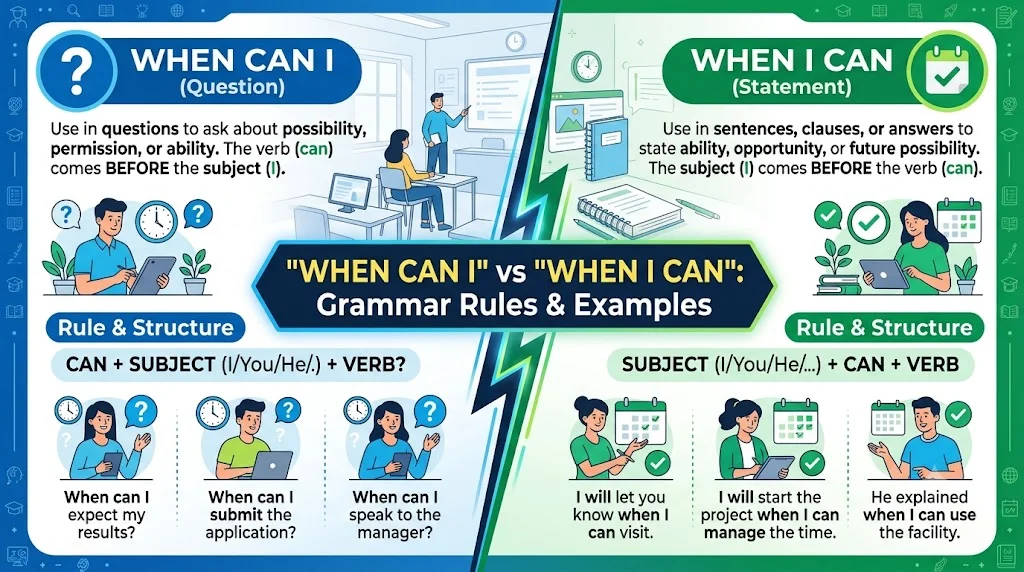
Here’s the rule in one sentence: “When can I” starts a direct question. “When I can” appears inside a sentence, usually as part of an indirect question or a statement.
| Phrase | Type | Example |
| When can I | Direct question | “When can I see the results?” |
| When I can | Embedded clause / indirect question | “Let me know when I can see the results.” |
Notice the word order. In “when can I,” the auxiliary verb can jumps in front of the subject I. In “when I can,” the subject I stays in its normal spot before the verb can. That single difference in order changes the whole grammatical function of the phrase.
Why This Grammar Mistake Is So Common
This mix-up happens for a simple reason: in casual speech, people often drop the inversion out of habit or nerves, especially non-native speakers whose first language doesn’t flip word order to form questions. Languages like Spanish, Korean, and Mandarin don’t always require this kind of subject-verb inversion, so learners sometimes carry their native sentence structure into English.
There’s also a listening trap. Native speakers often say indirect questions (“I wonder when I can leave”) so quickly that learners assume the same rule applies to direct questions. It doesn’t — and that’s exactly where the confusion starts.
Quick Tip: If your sentence is a direct question with a question mark at the end, and it starts the sentence, you almost always need inversion: “When can I…?”
When to Use “When Can I”
Direct Questions Explained
Meaning: “When can I” is used to directly ask someone about timing, permission, or possibility.
Definition: A direct question is a question asked straight to the listener, usually ending in a question mark, and it requires subject-auxiliary inversion.
Grammar explanation: In a direct question, the auxiliary or modal verb (can) moves before the subject (I). This is called subject-auxiliary inversion, and it’s the standard structure for yes/no and wh- questions in English.
- Statement: I can leave.
- Question: Can I leave?
- Wh- question: When can I leave?
Pronunciation: “When can I” is typically said as one smooth phrase — /wɛn kən aɪ/ — with “can” often reduced to a quick “kuhn” sound in fast speech.
Word origin: “When” comes from Old English hwænne, an interrogative adverb of time. “Can” comes from Old English cunnan, meaning “to know” or “to be able to,” which evolved into our modern modal verb of ability and permission.
Common mistakes:
- ❌ When can I leave? (missing inversion)
- ✅ When can I leave?
Correct usage: Use “when can I” whenever you’re directly asking someone a question about timing.
Real-life examples:
- “When can I pick up my package?”
- “When can I schedule a follow-up appointment?”
- “When can I expect a reply from you?”
Formal vs informal usage: “When can I” works in both formal and informal contexts. In formal writing (emails, letters), it’s often softened with polite framing, like “Could you let me know when I can expect a response?” — which shifts it into an indirect question (more on that below).
Similar words/phrases: “What time can I,” “How soon can I,” “Is it possible for me to.”
Related phrases: “When could I,” “When may I,” “When will I be able to.”
Common collocations: “when can I start,” “when can I see you,” “when can I get,” “when can I expect.”
Synonyms (functionally): “At what time can I,” “How soon may I.”
Tips to remember: If the sentence is standing alone and asking something directly, flip it: subject and verb swap places. Think of it as the verb “stepping forward” to greet the question.
Practice examples:
- _____ (when/can/I) collect my certificate?
- _____ (when/can/I) speak with the manager?
(Answers: “When can I collect my certificate?” / “When can I speak with the manager?”)
Real-Life Examples
Here are more direct-question examples across different situations:
- “When can I move into the new apartment?”
- “When can I withdraw money from this account?”
- “When can I see the doctor?”
- “When can I upgrade my plan?”
Spoken English Examples
In natural spoken English, “when can I” often gets softened with fillers or politeness markers:
- “Hey, when can I grab that file from you?”
- “So, when can I actually try this out?”
- “Quick question — when can I check in?”
In casual speech, “can” is frequently reduced, sounding closer to “when c’n I,” but the underlying grammar structure stays the same.
When to Use “When I Can”
Indirect Questions Explained
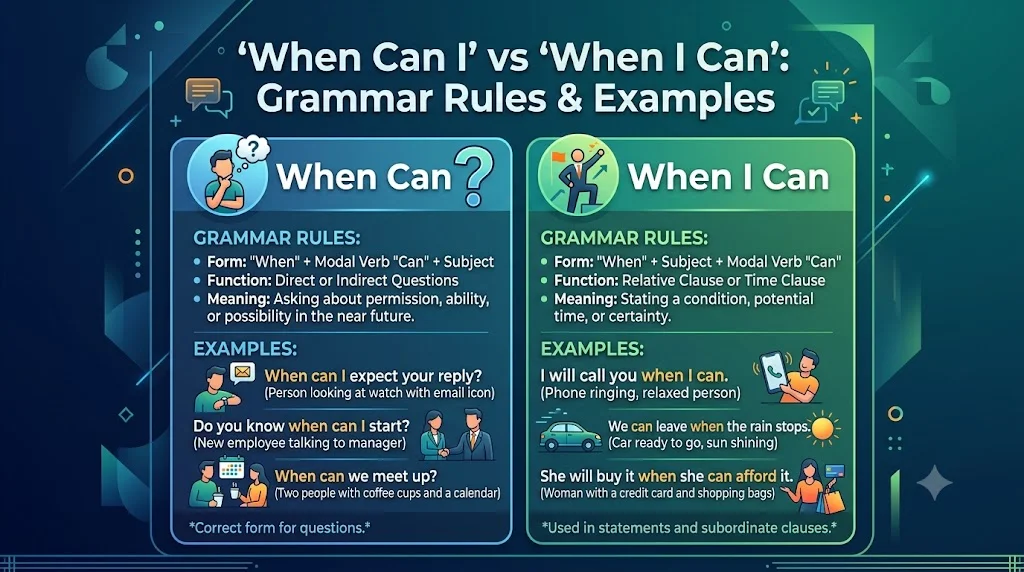
Meaning: “When I can” is used inside a larger sentence — as part of a statement, a promise, or an indirect (embedded) question.
Definition: An indirect question is a question that is embedded within another sentence and does not use inversion. It usually doesn’t end in a question mark either, unless the entire sentence is itself a direct question.
Grammar explanation: Because “when I can” is not standing alone as a direct question, the normal subject-verb order is kept: subject (I) before verb (can).
- Direct: When can I leave?
- Indirect: I don’t know when I can leave.
- Embedded question: Can you tell me when I can leave?
Pronunciation: /wɛn aɪ kən/ — notice “I” now comes right after “when,” flowing naturally into “can.”
Common mistakes:
- ❌ I don’t know when can I leave.
- ✅ I don’t know when I can leave.
Correct usage: Use “when I can” after phrases like “I don’t know,” “let me know,” “tell me,” “I wonder,” “I’m not sure,” or as part of a statement about future ability.
Real-life examples:
- “I’ll call you when I can.”
- “Let me know when I can pick up the keys.”
- “She asked when I can start the project.”
Formal vs informal usage: “When I can” is common in both formal and informal English. In business writing, it appears often in polite requests: “Please advise when I can proceed.”
Similar words/phrases: “As soon as I can,” “once I am able to,” “whenever I’m free.”
Opposite phrase (contextually): “When I can’t” (expressing inability instead of ability or availability).
Related phrases: “When I could,” “when I am able to,” “when I get the chance.”
Common collocations: “let me know when I can,” “I’ll do it when I can,” “tell me when I can.”
Tips to remember: If you could replace “when I can” with “at the time that I am able to” and the sentence still makes sense, you’re using it correctly.
Practice examples:
- Please tell me _____ (when/I/can) submit the form.
- I’ll finish the report _____ (when/I/can).
(Answers: “Please tell me when I can submit the form.” / “I’ll finish the report when I can.”)
Embedded Questions
An embedded question is a question tucked inside a bigger sentence, often introduced by phrases like:
- “Do you know…”
- “Can you tell me…”
- “I wonder…”
- “I’m not sure…”
Example transformation:
- Direct: When can I renew my passport?
- Embedded: Do you know when I can renew my passport?
This is one of the trickiest parts of English grammar for learners, because the embedded question looks like a question (it’s asking for information) but grammatically behaves like a statement — no inversion needed.
Everyday Sentence Examples
- “I’ll text you when I can.”
- “He wasn’t sure when I can join the call.”
- “We’re waiting to hear when I can start training.”
- “I’ll send the invoice when I can confirm the total.”
Grammar Rules Behind “When Can I” vs “When I Can”
Subject–Auxiliary Inversion
Definition: Subject-auxiliary inversion is a grammar rule in English where the auxiliary or modal verb moves before the subject to form a question.
This applies to:
- Yes/no questions: “Can I go?”
- Wh- questions: “When can I go?”
- Negative questions: “Why can’t I go?”
It does not apply to:
- Statements: “I can go.”
- Indirect/embedded questions: “I wonder when I can go.”
Common mistake: Applying inversion inside embedded questions.
- ❌ I wonder when can I go.
- ✅ I wonder when I can go.
Word Order in English Questions
English relies heavily on word order (unlike languages with flexible order supported by case markers). The standard direct-question pattern is:
Wh- word + auxiliary/modal + subject + main verb
| Element | When | Can | I | leave |
| Role | Question word | Modal verb | Subject | Main verb |
Compare that to a statement or embedded clause:
Subject + auxiliary/modal + main verb
| Element | I | can | leave |
| Role | Subject | Modal verb | Main verb |
Modal Verbs and Their Position
Modal verbs (can, could, may, might, will, would, shall, should, must) always follow this same inversion pattern in direct questions.
- When will I know?
- When should I arrive?
- When must I submit this?
And they follow the normal subject-first order in indirect questions:
- I don’t know when I will know.
- Tell me when I should arrive.
- She asked when I must submit this.
Quick Tip: The rule isn’t unique to “can.” It applies to every modal verb in English. Once you understand it with “can,” you can apply it to all the others.
Direct Questions vs Indirect Questions
Side-by-Side Comparison
| Feature | Direct Question | Indirect Question |
| Example | When can I leave? | I wonder when I can leave. |
| Word order | Verb before subject | Subject before verb |
| Punctuation | Ends with “?” | Often ends with “.” |
| Tone | Can sound blunt | Sounds more polite |
| Common use | Casual speech, direct requests | Formal writing, polite requests |
| Introduced by | Nothing (stands alone) | “I wonder,” “Do you know,” “Can you tell me” |
Easy Trick to Remember the Difference
Here’s a simple test: Ask yourself if the sentence could stand completely alone as a question.
- If yes → use inversion → “When can I…?”
- If it’s tucked inside another sentence → don’t invert → “…when I can…”
Quick Tip: Picture “can” and “I” as dance partners. In a direct question, “can” leads and steps in front. In an indirect question, “I” leads, and “can” follows politely behind.
Can vs Could – Which One Should You Use?
When to Use “Can”
Meaning: “Can” expresses present ability, permission, or possibility.
Grammar: “Can” is a modal verb, so it never changes form (no “cans,” no “canned” as a verb) and is always followed by a base verb.
Examples:
- “Can I ask you something?”
- “When can I start?”
- “I can help you tomorrow.”
Formal vs informal: “Can” is generally more casual than “could,” especially in requests.
When to Use “Could”
Meaning: “Could” is the past tense of “can,” but it’s also used to make polite requests or express possibility in the present or future.
Examples:
- “When could I visit?” (polite version of “when can I visit?”)
- “I could help you if you’re free.”
- “She asked when I could start.”
Common mistake: Using “could” and “can” interchangeably without considering politeness or tense.
- Less formal: “When can I get my results?”
- More formal/polite: “When could I get my results?”
Can vs Could Comparison Table
| Feature | Can | Could |
| Tense | Present | Past (or polite present/future) |
| Formality | Neutral to casual | More polite/formal |
| Example (direct) | When can I leave? | When could I leave? |
| Example (indirect) | I wonder when I can leave. | I wonder when I could leave. |
| Use in requests | “Can I have this?” | “Could I have this?” (more polite) |
Quick Tip: When emailing a boss, client, or teacher, “could” often sounds more polished than “can.”
Common Mistakes and How to Fix Them
Mistake #1: Using “When I Can?” as a Question
❌ “When I can start?” ✅ “When can I start?”
Why it’s wrong: This sentence is a direct question, so it needs inversion. Without it, the sentence sounds unnatural to native speakers, even though the meaning is understandable.
Mistake #2: Incorrect Word Order
❌ “I don’t know when can I finish.” ✅ “I don’t know when I can finish.”
Why it’s wrong: This is an embedded question. Once a question is tucked inside another sentence, it follows statement word order — no inversion.
Mistake #3: Mixing Direct and Indirect Questions
❌ “Do you know when can I apply?” ✅ “Do you know when I can apply?”
Why it’s wrong: “Do you know…” already makes this an indirect question. Adding inversion after it is a double mistake — it treats the embedded clause like a stand-alone direct question.
Quick Tip Recap Table:
| Mistake | Correction |
| When I can start? | When can I start? |
| I don’t know when can I finish. | I don’t know when I can finish. |
| Do you know when can I apply? | Do you know when I can apply? |
“When Can I” vs “When I Can” Examples
At Work
- “When can I take my lunch break?” (direct)
- “My manager told me when I can take my lunch break.” (indirect)
- “When can I expect my paycheck?” (direct)
- “HR will confirm when I can expect my paycheck.” (indirect)
At School
- “When can I retake the exam?” (direct)
- “The teacher explained when I can retake the exam.” (indirect)
- “When can I submit my assignment?” (direct)
- “I’m not sure when I can submit my assignment.” (indirect)
In Everyday Conversations
- “When can I come over?” (direct)
- “Text me when I can come over.” (indirect)
- “When can I try your cooking?” (direct)
- “Let me know when I can try your cooking.” (indirect)
In Professional Emails
- Direct: “When can I schedule a call with you?”
- Polite/indirect: “Could you let me know when I can schedule a call with you?”
- Direct: “When can I receive the updated contract?”
- Polite/indirect: “I would appreciate it if you could confirm when I can receive the updated contract.”
Quick Tip: In professional emails, indirect questions (“Could you let me know when I can…”) tend to sound more courteous than blunt direct questions.
Practice Quiz – Test Your Grammar
Choose the Correct Sentence
- A) When I can leave the office? B) When can I leave the office?
- A) I don’t know when can I call you. B) I don’t know when I can call you.
- A) Please tell me when can I start. B) Please tell me when I can start.
- A) When can I see the report? B) When I can see the report?
- A) She asked when I can join. B) She asked when can I join.
Answers and Explanations
- B — This is a direct question, so “can” comes before “I.”
- B — “I don’t know” makes this indirect; no inversion needed.
- B — “Please tell me” introduces an embedded question; keep normal word order.
- A — Standalone question needs inversion.
- A — “She asked” makes this indirect; subject comes before “can.”
Tips to Remember the Difference
- Stand-alone question mark = inversion. If the sentence ends in “?” and starts the sentence, invert: “When can I…?”
- Tucked inside a sentence = no inversion. After phrases like “I wonder,” “tell me,” “let me know,” keep it as “when I can…”
- Say it out loud. Native speakers can often “hear” when word order is wrong, even before they can explain the rule.
- Practice with real sentences from your own life — work emails, texts, or questions you’d ask a doctor or teacher.
- When in doubt, rewrite it as a statement first, then decide if you need to turn it into a direct question.
Final Verdict: When Can I or When I Can?
Neither phrase is “more correct” than the other — they simply do different jobs. “When can I” is for direct questions. “When I can” is for statements and indirect or embedded questions. Once you internalize this one rule, you’ll never second-guess the word order again.
Frequently Asked Questions (FAQs)
Is “When I Can?” grammatically correct?
No. “When I can?” is incorrect as a standalone question because it’s missing subject-auxiliary inversion. The correct direct question is “When can I?” You would only use “when I can” without a question mark inside a larger sentence, such as “I’ll help when I can.”
Why do people confuse “When Can I” and “When I Can”?
This confusion often comes from mixing up direct and indirect question structures, or from a learner’s native language not requiring word-order inversion for questions. Fast, casual speech also makes it harder to notice the difference between the two patterns.
What is subject-auxiliary inversion?
Subject-auxiliary inversion is the English grammar rule where an auxiliary or modal verb (like “can,” “will,” or “is”) moves in front of the subject to form a direct question. For example, “I can go” becomes “Can I go?” This rule applies to most direct yes/no and wh- questions.
Can I use “Could” instead of “Can”?
Yes. “Could” works the same way grammatically but sounds more polite or formal. “When can I visit?” becomes “When could I visit?” in a softer, more courteous tone — useful in emails, interviews, or conversations with people you don’t know well.
Is “When I Can” ever correct?
Yes, absolutely. “When I can” is correct whenever it’s part of a larger sentence, such as an indirect question (“I wonder when I can leave”) or a simple statement about future ability (“I’ll call you when I can”). It’s only incorrect if used alone as a direct question with a question mark.
Does the rule change with other modal verbs like “will” or “should”?
No. The same inversion rule applies to all modal verbs. “When will I know?” and “When should I arrive?” follow the identical pattern as “When can I leave?” — modal before subject in direct questions, subject before modal in indirect ones.
Is this rule the same in British and American English?
Yes. Subject-auxiliary inversion for direct questions is standard across all major English dialects, including American, British, Australian, and Canadian English. The grammar rule itself doesn’t change, though vocabulary and tone preferences may differ slightly.
Can “when I can” start a sentence?
Yes, in certain constructions. For example: “When I can, I’ll send over the files.” Here, “when I can” functions as a subordinate clause meaning “at whatever time I am able to,” and the main clause follows after the comma.
Is it rude to use “When can I” instead of “When could I”?
Not necessarily rude, but “when can I” can sound more direct or casual than “when could I.” In formal settings like job interviews or client emails, “could” often comes across as more polite, though “can” is perfectly acceptable in everyday conversation.
What’s the fastest way to check my own sentence is correct?
Read the sentence and ask: “Is this a complete, stand-alone question?” If yes, put the modal verb before the subject (“When can I…?”). If the question is part of a bigger sentence introduced by phrases like “I wonder” or “let me know,” keep the subject before the modal verb (“…when I can…”).
Final Thoughts
Mastering “when can I” versus “when I can” comes down to one core idea: word order signals sentence function. Direct questions invert the subject and verb; indirect and embedded questions keep the natural subject-first order. This single rule, once understood, applies to nearly every modal verb in English — not just “can.”
The best way to make it automatic is through repetition: notice the pattern in emails you read, conversations you hear, and sentences you write yourself. Over time, choosing the correct order will feel instinctive rather than something you have to consciously calculate. Keep practising with real, everyday examples, and this grammar point will stop being a stumbling block and start becoming second nature.