
If you’ve typed “invision” into a search bar and paused, wondering if you spelled it right, you’re not alone. This mix-up is one of the most common spelling questions in English, and the confusion makes total sense once you understand why it happens.
This guide settles the question for good. You’ll learn the correct spelling, the real meaning of the word, why so many people get it wrong, and exactly how to use it correctly in everyday life, business writing, and creative work.
Is It Invision or Envision? (Quick Answer)
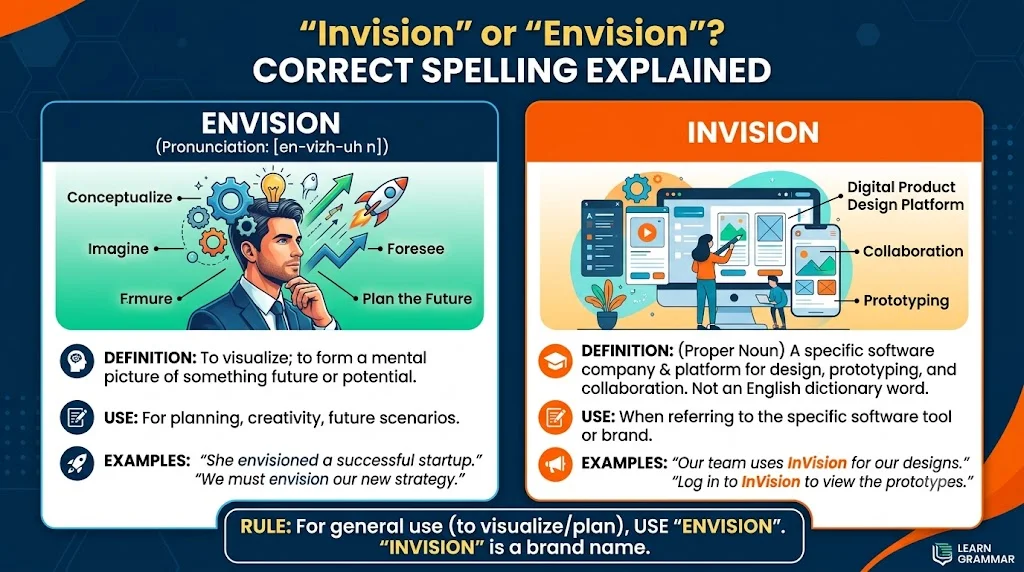
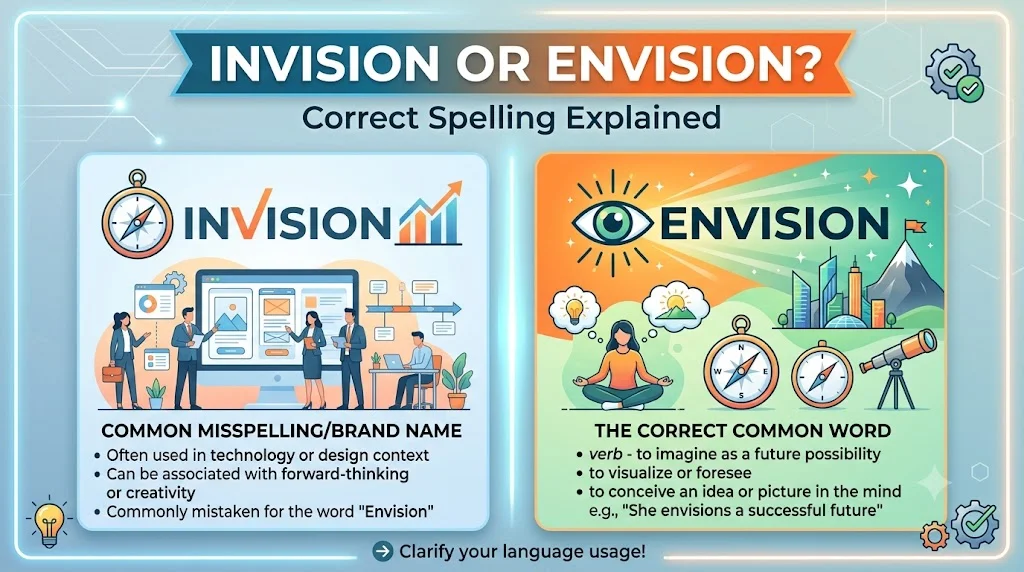
“Envision” is the correct spelling. It is a real, standard English word that means to imagine something as a future possibility, usually something positive.
“Invision” is not a standard English word. It is almost always a misspelling of “envision,” caused by mixing up the prefixes en- and in-. The only time “Invision” is correct is when it refers to a proper noun, such as the design software InVisionApp or a specific brand name.
So, in nearly every sentence you will ever write, the word you want is envision.
| Quick Check | Answer |
| Correct spelling | Envision |
| Is “Invision” a word? | No, except as a brand name |
| Part of speech | Verb |
| Pronunciation | en-VIZH-ən |
| Common confusion | Prefix mix-up (in- vs en-) |
What Does “Envision” Mean?
Definition
Envision (verb): to picture or imagine something in your mind, especially a future event, outcome, or possibility. It often carries a hopeful or forward-looking tone.
In simple terms, when you envision something, you form a clear mental picture of it before it happens.
Pronunciation
Envision is pronounced en-VIZH-ən (three syllables). The stress falls on the second syllable, “VIZH.”
- IPA: /ɪnˈvɪʒ.ən/
- Rhymes with: “revision,” “division,” “provision”
That rhyme is actually a helpful memory tool, and we’ll come back to it later.
Part of Speech
“Envision” is a transitive verb, which means it needs a direct object to complete its meaning. You can’t just say “I envision” and stop; you must envision something.
Example:
- Correct: She envisions a career in medicine.
- Incomplete: She envisions. (missing an object)
Is “Invision” a Real Word?
In standard English, no, “Invision” is not a real word. Dictionaries like Merriam-Webster, Oxford, and Cambridge do not list it as an accepted spelling.
Why It’s Considered a Misspelling
English has two similar-looking prefixes: in- and en-. Both can mean “to put into” or “to make,” which is exactly why they get confused. But only one of them attaches correctly to the root “vision” in this word: en-.
There is no verb “invision” formed from proper etymological rules the way “envision” is. Any appearance of “invision” in casual writing, social media, or business emails is a spelling error.
The Exception: Brand Names
You will see “InVision” written correctly in one context: InVisionApp, a well-known digital design and prototyping platform used by UX and UI designers. Because it’s a registered brand name, it follows its own capitalization and spelling rules, and it is not an example of the English word you’re looking for.
Quick Tip: If you’re writing about the software, “InVision” (capital V) is correct. If you’re writing about imagining the future, “envision” is what you need.
Invision vs Envision – Side-by-Side Comparison
| Feature | Envision | Invision |
| Correct English word? | Yes | No (except as a brand) |
| Meaning | To imagine or picture the future | No standard meaning |
| Part of speech | Verb | Proper noun (brand only) |
| Found in dictionaries? | Yes | No |
| Common use | Everyday, business, academic writing | Referring to the design app |
| Example sentence | “We envision a greener city.” | “Our team uses InVision for prototypes.” |
The takeaway is simple: unless you’re specifically naming the software company, always write envision.
Why Do People Mistype “Invision” Instead of “Envision”?
Understanding the why behind a mistake makes it much easier to stop making it. Here are the four biggest reasons this confusion happens.
1. Prefix Confusion
English borrows heavily from Latin and French, and both in- and en- prefixes came along for the ride. Because they sound almost identical when spoken quickly, writers often guess wrong when spelling the word.
2. Pronunciation Blending
When people speak casually, the first syllable of “envision” can sound like “in” rather than “en,” especially in fast or informal speech. Your ear hears “in-vision,” so your hand types what it hears.
3. Autocorrect and Typing Habits
Some autocorrect tools and typing habits favor the more common prefix pattern “in-” (as in “inside,” “invite,” “insight”), which can nudge writers toward the incorrect spelling without them noticing.
4. Brand Influence
Because InVisionApp is a widely used tool in the design and tech industry, professionals who use it daily sometimes carry that spelling into unrelated contexts, without realizing the brand name and the English word are spelled differently.
Common Mistake Alert:
- ❌ “I can’t invision how this will work.”
- ✅ “I can’t envision how this will work.”
Origin and History of the Word “Envision”
Etymology
“Envision” comes from the prefix en- (meaning “to put into” or “to cause to be”) combined with vision, from the Latin word visio, meaning “sight” or “act of seeing.” Put together, the word literally means “to put into sight,” or more naturally, “to see in the mind.”
This same en- prefix pattern shows up in other familiar English words:
- enable (en- + able)
- encourage (en- + courage)
- enlighten (en- + light)
Recognizing this pattern helps confirm why “en-” belongs with “vision,” not “in-.”
First Known Use
Language historians trace “envision” to the early 20th century, evolving from the older, related verb “envisage,” which has a similar meaning and entered English from French in the 1800s. Over time, “envision” became the more commonly used form in American English.
How to Use “Envision” Correctly
In Everyday Conversation
In casual speech, “envision” adds a slightly thoughtful or hopeful tone. It works well when talking about plans, dreams, or hopes.
Examples:
- I envision us traveling together someday.
- Can you envision living in another country?
In Business Writing
“Envision” is extremely common in professional settings, especially around goals, leadership, and strategy. It sounds confident and forward-thinking, which is exactly why it appears so often in mission statements.
Examples:
- Our leadership team envisions expanding into three new markets by 2027.
- The company envisions a workplace built on trust and innovation.
In Academic Writing
In academic or formal writing, “envision” is used to describe hypothesized outcomes, theoretical models, or proposed future research directions.
Examples:
- Researchers envision a future where renewable energy meets global demand.
- The study envisions a framework for reducing urban traffic congestion.
In Creative Writing
Writers use “envision” to build imagery and emotional depth, especially when describing a character’s dreams, fears, or imagination.
Examples:
- She closed her eyes and envisioned the life she once wanted.
- He could envision the storm long before the clouds arrived.
20 Envision Sentence Examples
- I envision a future where every child has access to education.
- Can you envision what this room will look like after renovation?
- The architect envisioned a building shaped like a wave.
- We envision stronger partnerships between the two companies.
- She envisions herself running her own bakery one day.
- It’s hard to envision life without smartphones now.
- The coach envisions a championship season for the team.
- He envisioned a quiet life away from the city.
- Investors envision massive growth in renewable energy.
- The teacher asked students to envision their dream careers.
- I can easily envision how this app will help small businesses.
- The city council envisions a car-free downtown by 2030.
- Artists often envision their final piece before they begin painting.
- She envisioned a wedding filled with close friends and family.
- Scientists envision a cure within the next decade.
- The startup founder envisioned solving a problem no one else noticed.
- Try to envision the best possible outcome of this decision.
- He envisioned success long before he achieved it.
- The designer envisions a logo that feels modern yet timeless.
- We must envision a world with cleaner oceans.
Common Phrases With “Envision”
These collocations appear frequently in both spoken and written English:
- envision the future – to picture what’s coming ahead
- envision success – to imagine achieving a goal
- envision a better world – often used in idealistic or motivational contexts
- envision yourself – picturing your own future role or situation
- envision possibilities – imagining potential outcomes or opportunities
Example in context: “Take a moment to envision yourself succeeding before the big presentation.”
Envision Synonyms and Similar Words
| Synonym | Nuance |
| Imagine | General mental picturing, not always future-focused |
| Foresee | Predicting something will happen, often based on evidence |
| Picture | Casual, visual mental image |
| Visualize | Strong, detailed mental image, often used in goal-setting |
| Anticipate | Expecting something, with less emphasis on imagery |
| Conceptualize | Forming an abstract idea or plan, often intellectual |
Opposite words (antonyms): disregard, overlook, ignore, forget
Envision vs Imagine vs Visualize
These three words overlap, but each has a slightly different flavor.
| Word | Focus | Typical Use |
| Envision | Future-oriented, often hopeful or strategic | Goals, plans, leadership |
| Imagine | Broad, creative, not always future-based | Storytelling, hypotheticals |
| Visualize | Detailed, sensory mental image | Meditation, performance, sports |
Example comparison:
- “I imagine a dragon flying over the castle.” (pure creativity)
- “I visualize myself crossing the finish line.” (detailed mental rehearsal)
- “I envision our company leading the industry.” (strategic future goal)
What Are the Adjective and Noun Forms of “Envision”?
| Word | Part of Speech | Meaning |
| envisioned | Past tense / adjective | Something already imagined |
| envisioning | Present participle / gerund | The ongoing act of imagining |
| vision | Noun | A mental image or sense of purpose |
| visionary | Noun / adjective | A person with original, forward-thinking ideas |
Examples:
- The envisioned plan finally became reality.
- She spent the afternoon envisioning next year’s marketing strategy.
- His vision for the company inspired the entire team.
- Steve Jobs is often described as a visionary leader.
Common Grammar Mistakes With “Envision”
1. Wrong Spelling
- ❌ invision, envison, envison
- ✅ envision
2. Wrong Prepositions
“Envision” typically does not take the preposition “for” or “about” before its object. It’s used as a direct transitive verb.
- ❌ I envision for a better future.
- ✅ I envision a better future.
3. Wrong Verb Forms
- ❌ She envision the results.
- ✅ She envisions the results. (third-person singular needs “-s”)
- ❌ They have envision the outcome.
- ✅ They have envisioned the outcome. (past participle needed after “have”)
Quick Tips to Remember the Correct Spelling
- Rhyme trick: “Envision” rhymes with “revision” and “division,” both spelled with en- patterns nearby — think “vision needs an E.”
- Prefix trick: Remember other en- words like “enable” and “encourage.” “Envision” follows the same family.
- Brand trick: Only capitalize and spell it “InVision” when you’re talking about the design app. Everywhere else, it’s “envision.”
Formal vs Informal Usage
“Envision” works comfortably in both formal and informal English, which makes it a flexible word to know well.
- Formal: “The board envisions sustainable growth over the next fiscal year.”
- Informal: “Honestly, I can’t even envision moving to a new city right now.”
Practice Examples
Try completing these sentences with the correct form of “envision”:
- She ______ a world with less pollution. (present tense)
- We have already ______ the next steps. (past participle)
- He ______ himself as a future CEO. (present tense)
- They were ______ new ways to help the community. (present participle)
Answers: 1. envisions 2. envisioned 3. envisions 4. envisioning
Final Thoughts
The correct word is always envision, not “invision,” unless you’re specifically naming the InVision design software. This mix-up happens because in- and en- prefixes sound alike and both feel grammatically familiar in English. Once you remember that “envision” shares its pattern with words like “enable” and “encourage,” the spelling becomes much easier to recall.
Whether you’re writing a business plan, a personal goal, or a creative story, “envision” adds a confident, forward-looking tone to your sentence. Keep this guide handy, and you’ll never second-guess this spelling again.
Frequently Asked Questions
1. Is “invision” ever correct in English? No, “invision” is not a standard English word. The only correct use of that spelling is the brand name InVisionApp, a design and prototyping tool. In every other context, “envision” is the correct spelling.
2. What does “envision” mean in simple terms? “Envision” means to picture something in your mind, usually about the future. It’s often used when talking about goals, dreams, or plans that haven’t happened yet but feel possible.
3. How do you pronounce “envision”? It’s pronounced en-VIZH-ən, with three syllables and stress on the second one. It rhymes with words like “revision” and “division.”
4. Is “envision” formal or informal? “Envision” works well in both formal and informal English. It’s common in business reports, academic writing, everyday conversation, and creative storytelling.
5. What’s the difference between “envision” and “imagine”? “Imagine” is broader and can apply to anything creative, real or fictional. “Envision” usually focuses on future possibilities, often tied to goals or plans.