
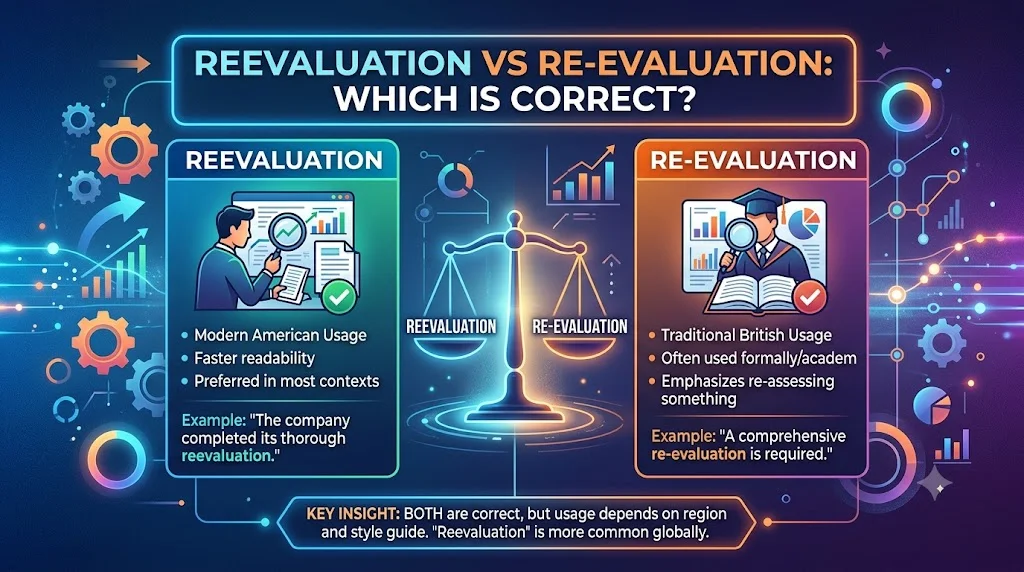
If you’ve typed this word and then stared at it wondering whether it needs a hyphen, you’re not alone. “Reevaluation vs re-evaluation” is one of the most common spelling questions in English, and the honest answer is: both spellings are correct, but they belong to different style traditions.
This guide breaks down exactly when to use each form, why the confusion exists, and how to sound confident every time you write the word — in emails, essays, medical reports, or legal documents.
Reevaluation vs Re-evaluation: Quick Comparison
Before we go deep into grammar rules, here’s the short answer in table form.
| Feature | Reevaluation | Re-evaluation |
| Style | Modern, closed (no hyphen) | Traditional, hyphenated |
| Preferred by | Merriam-Webster, AP Style, most US publications | Older dictionaries, some British/formal writing |
| Common region | American English | Sometimes British/Commonwealth English |
| Formality | Works in both formal and informal writing | Slightly more traditional/formal tone |
| Best use case | General, everyday, business, digital content | Legal, academic, or clarity-focused writing |
| Pronunciation | ree-ih-val-yoo-AY-shun | ree-ih-val-yoo-AY-shun (same) |
Quick takeaway: In modern American English, “reevaluation” (no hyphen) is the standard and recommended spelling. “Re-evaluation” is not wrong — it’s simply the older, more conservative version of the same word.
Is “Reevaluation” or “Re-evaluation” Correct?
Both are grammatically correct. Neither spelling is a “mistake” in the strict sense. The real issue is consistency and style preference, not right versus wrong.
Here’s the simplest way to think about it:
- “Reevaluation” is the closed-form spelling. It’s what you’ll find in Merriam-Webster and most modern American style guides.
- “Re-evaluation” is the hyphenated form. It’s older, and it’s still accepted, especially outside the US or in more formal, traditional writing.
Think of it the same way you think about “email” versus “e-mail.” Both existed at the same time, but language evolved toward the simpler, closed form as the word became more common in everyday use. “Reevaluation” is following that same natural path.
Quick Tip
If you’re writing for a US audience, a website, a resume, or a business document, default to “reevaluation.” If you’re writing in a very formal, legal, or British-influenced context, “re-evaluation” is a safe and accepted choice.
What Does Reevaluation Mean?
Meaning and Definition
Reevaluation (noun) means the act of assessing or judging something again, especially after new information becomes available or after some time has passed.
Definition: A fresh, repeated assessment of a situation, decision, product, condition, or value.
Pronunciation
- IPA: /ˌriː.ɪˌvæl.juˈeɪ.ʃən/
- Sounds like: ree-ih-val-yoo-AY-shun
- Stress falls on the fourth syllable: re-e-val-u-A-tion
Word Origin
The word comes from the prefix “re-“ (meaning “again”) attached to “evaluation,” which comes from the French “évaluer” and ultimately the Latin “valere,” meaning “to be strong” or “to have worth.” So at its root, “reevaluation” literally means “to judge the worth of something again.”
Grammar Explanation
“Reevaluation” is a noun. It’s formed by adding the prefix “re-” directly to the noun “evaluation” without a hyphen, following the modern closed-compound trend in English.
- Part of speech: Noun
- Related verb: reevaluate (to evaluate again)
- Related adjective: none standard; use “reevaluated” as a past participle adjective
Correct Usage
“The committee requested a full reevaluation of the proposal.”
“After the reevaluation, the team changed its strategy.”
Common Mistakes
- ❌ “Re evaluation” (missing hyphen or closed spelling — looks like two separate words)
- ❌ “Reavaluation” (misspelling — extra or wrong vowel)
- ❌ “Re-Evaluation” (unnecessary capitalization mid-sentence)
Formal vs Informal Usage
“Reevaluation” works comfortably in both formal and informal writing. It’s neutral enough for a business email, a school report, or a casual conversation about reconsidering a decision.
Similar Words
Reassessment, reappraisal, review, reconsideration, revision
Opposite Words
Confirmation, affirmation, validation (in the sense of “sticking with the original judgment”)
Related Phrases
- “undergo a reevaluation”
- “request a reevaluation”
- “pending reevaluation”
- “subject to reevaluation”
Common Collocations
- annual reevaluation
- formal reevaluation
- medical reevaluation
- policy reevaluation
- performance reevaluation
Synonyms
Reassessment, review, reappraisal, reconsideration, re-examination
Practice Example
Fill in the blank: “The doctor scheduled a ______ for next month.” (Answer: reevaluation)
What Does Re-evaluation Mean?
Meaning and Definition
Re-evaluation carries the exact same meaning as “reevaluation” — the act of evaluating something again. The only difference is the hyphen.
Definition: A repeated or renewed assessment of something, written with a hyphen between “re” and “evaluation.”
Pronunciation
Identical to “reevaluation”: ree-ih-val-yoo-AY-shun. The hyphen does not change how the word sounds.
Word Origin
Same Latin and French roots as “reevaluation.” The hyphenated form reflects an older English convention of separating a prefix from a root word that starts with a vowel, to avoid visual confusion (like “re-elect” or “re-enter”).
Grammar Explanation
Grammatically, “re-evaluation” is also a noun, functioning identically to “reevaluation” in a sentence. The hyphen is a stylistic choice, not a grammatical requirement in modern English, though it was more standard decades ago.
Correct Usage
“The board called for a re-evaluation of company policy.”
“A re-evaluation of the risk factors is now underway.”
Common Mistakes
- ❌ “Re -evaluation” (space before hyphen)
- ❌ “Re- evaluation” (space after hyphen)
- ❌ “Reevalution” (missing letter when trying to remove the hyphen)
Formal vs Informal Usage
“Re-evaluation” leans slightly more formal or traditional. You’ll see it more often in legal documents, older textbooks, and British English publications.
Similar Words
Reassessment, review, reappraisal, reconsideration
Opposite Words
Confirmation, endorsement, validation
Related Phrases
- “in need of re-evaluation”
- “a re-evaluation process”
- “trigger a re-evaluation”
Common Collocations
- legal re-evaluation
- academic re-evaluation
- risk re-evaluation
- clinical re-evaluation
Synonyms
Reappraisal, reassessment, second review, renewed assessment
Practice Example
Fill in the blank: “The lawyer asked for a ______ of the contract terms.” (Answer: re-evaluation)
What Is the Difference Between Reevaluation and Re-evaluation?
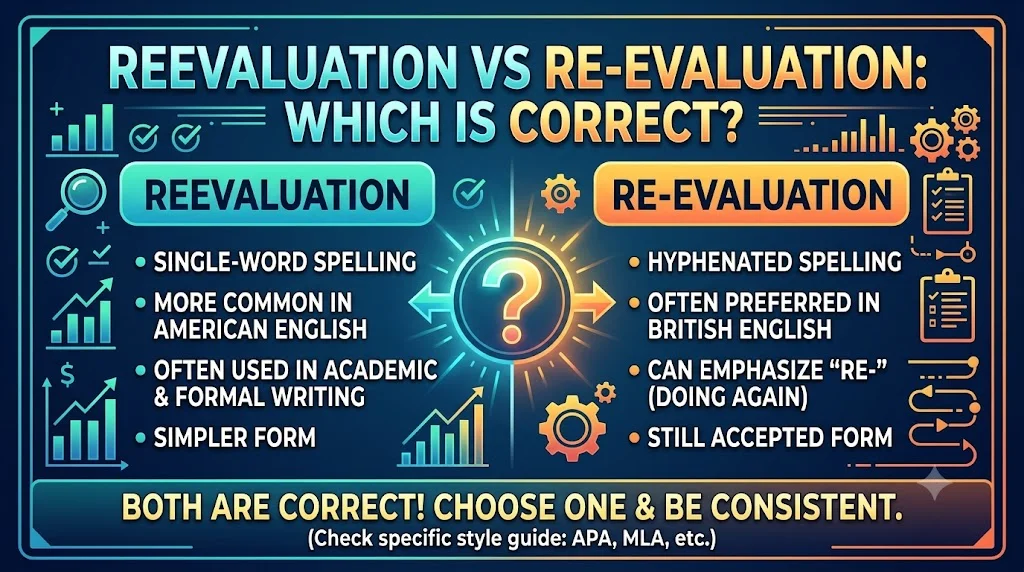
There is no difference in meaning, pronunciation, or grammar function between these two words. The only difference is the hyphen, which is a matter of spelling style, not linguistic rule.
| Aspect | Reevaluation | Re-evaluation |
| Meaning | Same | Same |
| Pronunciation | Same | Same |
| Grammar role | Noun | Noun |
| Hyphen | No | Yes |
| Style guide preference | AP, Merriam-Webster | Chicago (in some editions), older dictionaries |
| Best fit | Modern, general writing | Traditional, formal, legal writing |
Think of them as two outfits for the same person — same identity, different presentation.
Why Do Some Writers Use a Hyphen?
There are a few real reasons writers still hyphenate this word:
- Avoiding double vowels. Words like “re-enter,” “re-elect,” and “re-examine” traditionally kept the hyphen to prevent two vowels from bumping into each other awkwardly (“reenter” can look strange without one).
- Habit and training. Writers who learned grammar rules decades ago, or who work in legal and academic fields, were often taught to hyphenate prefixes before vowel-starting root words.
- Clarity in specific contexts. In rare cases, a hyphen prevents misreading, though “reevaluation” doesn’t really suffer from this problem the way a word like “re-cover” (meaning to cover again) does versus “recover” (to get better).
- Regional preference. British and Commonwealth English is generally more comfortable keeping hyphens in prefixed words compared to American English.
Quick Tip
If a word feels hard to read without a hyphen, style guides traditionally allowed one. But “reevaluation” has become common enough that most readers no longer need that visual break.
The Grammar Rule Behind “Reevaluation” vs “Re-evaluation”
The Re- Prefix Rule Explained
The prefix “re-“ means “again” or “back.” In English, whether you hyphenate a word using “re-” generally depends on these patterns:
- No hyphen when the word is common and widely recognized: redo, rewrite, reopen, reevaluate.
- Hyphen used when the root word starts with “e” and the combination could look confusing, or when the word is less common: re-elect, re-enter, re-emerge.
- Hyphen used to distinguish meaning from a different existing word: re-cover (cover again) vs. recover (get well); re-sign (sign again) vs. resign (quit).
“Evaluation” doesn’t have a conflicting twin word, so there’s no real ambiguity risk — which is exactly why modern dictionaries have comfortably dropped the hyphen.
American English vs British English Usage
- American English has moved firmly toward the closed form: reevaluation. This mirrors a broader American trend of simplifying compound words over time (like “email,” “cooperate,” and “coordinate,” which all used to be hyphenated).
- British English is more flexible and sometimes retains the hyphen, especially in formal, academic, or legal writing: re-evaluation.
Neither is “wrong” — it’s a regional and stylistic distinction, much like “color” versus “colour.”
AP Style, Chicago Style, and Dictionary Preferences
| Style Guide / Dictionary | Preferred Form |
| Merriam-Webster | reevaluation |
| AP Stylebook | reevaluation |
| Chicago Manual of Style | Generally accepts closed form for common “re-” words |
| Oxford Dictionary (UK) | re-evaluation (hyphen often retained) |
| Cambridge Dictionary | Accepts both, leans toward re-evaluation |
Bottom line: If you write for American publications, blogs, or business documents, “reevaluation” is the safer, more modern default. If your audience or organization follows British or more traditional conventions, “re-evaluation” is perfectly acceptable.
When to Use Reevaluation (Without Hyphen)
Use the closed form “reevaluation” when:
- You’re writing for a US-based audience, website, or publication
- You’re following AP Style or Merriam-Webster as your reference
- You want a clean, modern, professional tone
- You’re writing marketing copy, blog content, business reports, or resumes
Example: “Our team completed a full reevaluation of the marketing budget.”
When to Use Re-evaluation (With Hyphen)
Use the hyphenated form “re-evaluation” when:
- You’re writing for a British, Australian, or Commonwealth audience
- You’re working within legal, academic, or government documents that favor traditional hyphenation
- Your organization’s official style guide specifically requires it
- You want to match the formatting of a document that already uses hyphenated “re-” words
Example: “The tribunal ordered a re-evaluation of the original ruling.”
When NOT to Use Either Form
There are situations where neither “reevaluation” nor “re-evaluation” is the right word choice at all:
- When you mean a first-time assessment, use “evaluation” alone (no “re-” needed).
- When you mean a quick, informal check, consider “review” or “check-in” instead — “reevaluation” can sound overly formal for small tasks.
- When referring to a legal appeal process specifically, terms like “reconsideration” or “appeal” might be more precise than “reevaluation.”
- Avoid using it as a verb directly — “reevaluation” is a noun. The verb form is “reevaluate” (e.g., “We need to reevaluate the plan,” not “We need to reevaluation the plan”).
Reevaluation vs Re-evaluation: Real Sentence Examples
Correct Examples
- “The manager requested a reevaluation of the sales targets.” ✅
- “A re-evaluation of the patient’s condition is scheduled for Friday.” ✅
- “After the reevaluation, the score was adjusted.” ✅
- “The court demanded a re-evaluation of the evidence.” ✅
Incorrect Examples
- “The manager requested a re evaluation of the sales targets.” ❌ (missing hyphen or closed spelling)
- “A Re-Evaluation of the patient’s condition is scheduled.” ❌ (unnecessary mid-sentence capitalization)
- “We need to reevaluation the plan.” ❌ (used incorrectly as a verb)
Formal Writing Examples
- “The board of directors has authorized a comprehensive reevaluation of the merger terms.”
- “Pursuant to company policy, a re-evaluation of the employee’s performance record will occur annually.”
Academic Writing Examples
- “This study calls for a reevaluation of existing climate models.”
- “Further re-evaluation of the historical data is necessary to confirm these findings.”
Business Writing Examples
- “Following customer feedback, we initiated a reevaluation of our pricing strategy.”
- “The quarterly re-evaluation process helps us stay aligned with market conditions.”
Reevaluation in Different Professional Contexts
The word shows up constantly across industries. Here’s how it’s used in each field, along with which spelling tends to dominate.
Medical Reevaluation
In healthcare, a “reevaluation” refers to a follow-up assessment of a patient’s condition, treatment progress, or diagnosis.
“The physical therapist scheduled a reevaluation after four weeks of treatment to measure progress.”
Medical documentation in the US typically favors the closed form, “reevaluation,” following AP and AMA style conventions.
Educational Reevaluation
In schools, “reevaluation” often refers to reassessing a student’s academic performance, learning plan, or special education needs (as in an IEP reevaluation).
“The school psychologist will conduct a reevaluation every three years, as required by federal law.”
Business Reevaluation
In business, this word describes reassessing strategy, budgets, staffing, or company direction.
“The CEO called for a full reevaluation of the company’s five-year plan.”
Legal Reevaluation
In legal writing, “re-evaluation” (often hyphenated) refers to reassessing evidence, contracts, rulings, or claims.
“The insurance company initiated a re-evaluation of the claim after new evidence emerged.”
Financial Reevaluation
In finance, this term describes reassessing asset values, investment risk, or budget allocations.
“Analysts recommended a reevaluation of the stock’s valuation following the earnings report.”
Reevaluation vs Similar Words: Reassessment, Reappraisal, and Review
English gives us several words that overlap with “reevaluation” in meaning, but each carries a slightly different shade of tone or context. Understanding these differences helps you pick the sharpest word for any situation.
| Word | Nuance | Typical Context |
| Reevaluation | Neutral, thorough, formal-leaning | Business, medical, academic |
| Reassessment | Slightly softer, often used for people or performance | HR, education, personal growth |
| Reappraisal | Often tied to value or worth, common in real estate/finance | Property, assets, investments |
| Review | Casual, broad, can be quick or informal | Everyday use, workplaces, media |
| Reconsideration | Focused on decisions or judgments, not conditions | Legal appeals, policy decisions |
Example comparison:
- “The house needs a reappraisal before we can refinance.” (value-focused)
- “Her manager scheduled a reassessment of her goals.” (people-focused)
- “The board requested a reevaluation of the entire budget.” (broad, formal)
- “Let’s do a quick review of last week’s numbers.” (casual, fast)
Quick Tip
If money or property value is involved, “reappraisal” often fits better. If you’re discussing a formal, structured process, “reevaluation” is usually the stronger choice.
Common Mistakes People Make
- Mixing spellings within the same document. Pick one form and stay consistent throughout your writing.
- Adding a space instead of a hyphen or closing it up: “re evaluation” is never correct.
- Capitalizing mid-sentence without reason: “Re-Evaluation” should only be capitalized in a title or heading.
- Using it as a verb. Remember: “reevaluation” is a noun. The verb is “reevaluate.”
- Overusing the hyphenated form in casual American writing, where it can look outdated.
- Misspelling the root word, such as “reevaluetion” or “reevalution.”
Quick Tip
When in doubt, search how your target dictionary or style guide spells it, and stick with that choice consistently across your entire document.
Easy Trick to Remember the Correct Spelling
Here’s a simple memory trick: think of “reevaluation” like “reopen.”
You wouldn’t write “re-open” in modern American English — you’d write “reopen.” Apply the same logic to “reevaluation,” and you’ll naturally lean toward the closed, hyphen-free spelling in everyday US writing.
If you’re writing formally or for a British audience, imagine the word “re-enter” instead — since that word often keeps its hyphen, “re-evaluation” can follow the same pattern.
Reevaluation vs Re-evaluation: Decision Guide
Ask yourself these three questions:
- Who is my audience? American → reevaluation. British/international → re-evaluation is also fine.
- What style guide am I following? AP or Merriam-Webster → reevaluation. Traditional/legal/Oxford → re-evaluation.
- Does my document already use hyphenated “re-” words? If yes, stay consistent with re-evaluation.
If you’re still unsure, “reevaluation” is the safer default for most modern writing.
Practice Quiz (Fill in the Blanks)
Try filling in the blanks with either “reevaluation” or “re-evaluation,” based on the context clues.
- The US-based marketing team requested a ______ of the campaign results.
- The British tribunal ordered a formal ______ of the case.
- After six months, the therapist recommended a ______ of the treatment plan.
- The academic journal called for a ______ of outdated research methods.
- Following new evidence, the legal team pushed for a ______ of the verdict.
Quiz Answers
- reevaluation (American business context)
- re-evaluation (British legal context)
- reevaluation (general American usage)
- reevaluation (or re-evaluation, both accepted in academic writing)
- re-evaluation (legal formality)
Final Verdict: Reevaluation or Re-evaluation?
Both spellings are correct, and neither will get you marked wrong by a careful reader. But if you want one clear rule to follow: use “reevaluation” for modern American writing, and reserve “re-evaluation” for formal, legal, or British-style contexts.
Consistency matters more than which one you pick. Choose a spelling, stick with it throughout your document, and you’ll always sound polished and professional.
Frequently Asked Questions
Is reevaluation one word or two?
“Reevaluation” is one single word, written without a space or hyphen. It’s formed by attaching the prefix “re-” directly to “evaluation.” Writing it as two separate words (“re evaluation”) is always incorrect, regardless of which style guide you follow.
Is re-evaluation grammatically correct?
Yes, “re-evaluation” is grammatically correct. It’s simply the hyphenated version of the same word, more common in British English and traditional or legal writing. Grammatically, it functions exactly like “reevaluation” — both are nouns with identical meanings.
Which spelling is preferred in American English?
American English strongly prefers “reevaluation” without a hyphen. This matches guidance from Merriam-Webster and the AP Stylebook, both of which favor closed compounds for common “re-” prefixed words in modern usage.
Which spelling do dictionaries recommend?
Merriam-Webster lists “reevaluation” as the primary American spelling. Oxford and Cambridge dictionaries, which reflect British usage, often show “re-evaluation” with a hyphen as the standard or equally accepted form.
Can I use both spellings interchangeably?
Technically yes, since they mean the same thing, but it’s best practice to pick one spelling and use it consistently throughout a single document. Mixing both forms in the same piece of writing looks inconsistent and unpolished to careful readers.
Final Thoughts
“Reevaluation” and “re-evaluation” are two spellings of the exact same word, separated only by a hyphen and a bit of regional style preference. Neither is wrong, but “reevaluation” has become the modern standard in American English, favored by Merriam-Webster and AP Style, while “re-evaluation” remains common in British English and formal or legal writing.
The real key isn’t memorizing a strict rule — it’s choosing one spelling that fits your audience and style guide, then staying consistent throughout your writing. Once you understand the “re-” prefix pattern, you’ll never hesitate over this word again, and you’ll be able to write with the same confidence a professional editor brings to every sentence.