
If you have ever paused mid-sentence wondering whether you “heard” something or a “herd” of something, you are not alone. These three words — heard, herd, and hurd — sound almost identical when spoken out loud, but they mean completely different things.
This confusion is extremely common among English learners and even native speakers. The good news is that once you understand the roots of each word, you will never mix them up again.
In this guide, you will learn the exact meaning, grammar, pronunciation, and real-world usage of heard, herd, and hurd — explained the way a language teacher would explain it in a classroom, with practical examples you can use immediately.
Quick Summary: Heard vs Herd vs Hurd
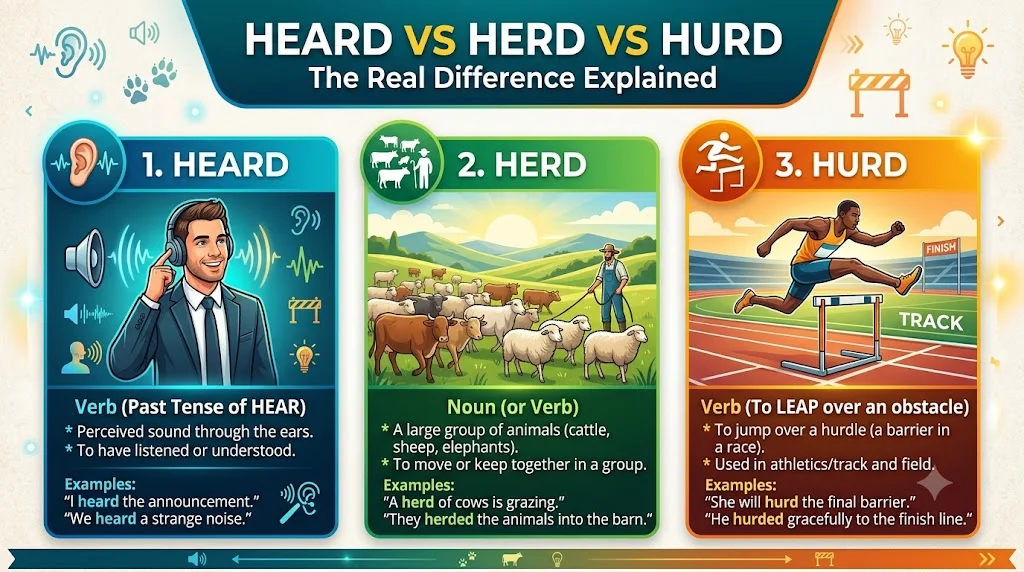
- Heard is the past tense and past participle of the verb “hear,” meaning to perceive sound with your ears.
- Herd refers to a group of animals (as a noun) or the act of gathering animals or people together (as a verb).
- Hurd is not a standard dictionary word in modern English. It mostly appears as a surname or, in older/technical usage, as a term for coarse fibers separated from flax or hemp.
If you remember nothing else from this article, remember this: heard relates to hearing, herd relates to animals or groups, and hurd is almost always a name, not a common word.
Comparison Table: Heard vs Herd vs Hurd
| Word | Part of Speech | Meaning | Pronunciation (IPA) | Example Sentence |
| Heard | Verb (past tense/participle of “hear”) | Perceived sound | /hɜːrd/ | I heard the doorbell ring. |
| Herd | Noun / Verb | A group of animals / to gather animals or people | /hɜːrd/ | The herd of cattle crossed the field. |
| Hurd | Proper noun (surname) / rare technical noun | A person’s last name / coarse plant fiber | /hɜːrd/ | Douglas Hurd was a British politician. |
All three words are pronounced the same way in most English accents, which is exactly why they get confused so often. This type of word group is called a set of homophones — words that sound alike but have different meanings and spellings.
Why Do Heard, Herd, and Hurd Cause Confusion?
English has hundreds of homophones, and this particular trio is tricky for three reasons.
First, all three words share the same vowel sound, so listening alone will not tell you which one someone means — context does the work.
Second, “heard” and “herd” are both extremely common in everyday writing, so a small typo can completely change the meaning of a sentence.
Third, “hurd” looks like it could be a regular English word because it follows the same spelling pattern, even though it is rarely used outside of names or specialized vocabulary.
Understanding the grammar and meaning behind each word — not just the sound — is the key to using them correctly.
What Does “Heard” Mean?
Definition and Part of Speech
Heard is a verb. Specifically, it is the past tense and past participle of the irregular verb “hear,” which means to become aware of sound through your ears.
- Base form: hear
- Past tense: heard
- Past participle: heard
- Present participle: hearing
Because “hear” is an irregular verb, it does not follow the normal “-ed” pattern like “walked” or “talked.” Instead, the spelling changes from hear to heard.
How “Heard” Is Used in Everyday English
“Heard” is used whenever you are talking about something that happened in the past involving your sense of hearing, or when you are forming a perfect tense.
- Simple past: I heard a strange noise last night.
- Present perfect: I have heard that song before.
- Past perfect: She had heard the news before anyone told her.
- Passive voice: The announcement was heard by everyone in the building.
Real-Life Sentence Examples
- I heard my phone buzzing in the other room.
- Have you heard the latest news about the merger?
- We heard a loud crash coming from the kitchen.
- He said he had never heard of that restaurant before.
- Her voice could be heard from the back of the auditorium.
Common Expressions with “Heard”
English has several fixed expressions built around “heard” that are worth memorizing:
- “I’ve heard of it” – meaning you know something exists, even if you don’t know details.
- “Never heard of it” – meaning something is completely unknown to you.
- “Heard it through the grapevine” – meaning you learned something through informal gossip or rumor.
- “Make yourself heard” – meaning to speak up so others notice your opinion.
- “Heard it all before” – meaning something is not new or surprising to you.
Heard vs Listened
Learners often confuse heard with listened, but there is an important difference in meaning.
- Heard means sound reached your ears, often without effort or attention.
- Listened means you paid active, intentional attention to a sound.
Example: I heard the music playing in the background, but I wasn’t really listening to the lyrics.
Quick Tip: If the action was passive, use “heard.” If it involved focus and attention, use “listened.”
What Does “Herd” Mean?
Herd as a Noun
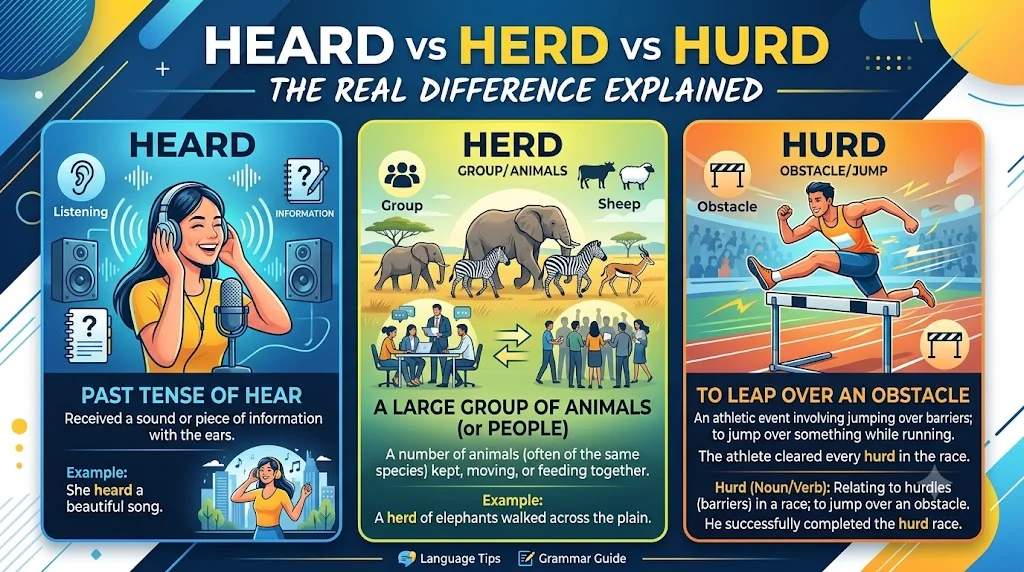
As a noun, herd refers to a large group of animals — usually mammals like cattle, deer, elephants, or goats — that live, feed, or move together.
Example: A herd of wild horses galloped across the plains.
The word can also be used, often informally, to describe a large group of people, though this usage sometimes carries a slightly negative or dismissive tone.
Example: He didn’t want to just follow the herd; he wanted to think for himself.
Herd as a Verb
As a verb, herd means to gather, guide, or move animals (or people) together as a group.
- Base form: herd
- Past tense: herded
- Past participle: herded
- Present participle: herding
Example: The farmer herded the sheep into the barn before the storm.
Example: Security guards herded the crowd toward the exit.
Real-Life Examples of Herd
- The herd of elephants moved slowly toward the watering hole.
- Ranchers spent all morning herding the cattle into the pen.
- A herd mentality can make people follow decisions they wouldn’t normally make alone.
- The nature documentary followed a herd of bison across the plains.
- Teachers sometimes joke about “herding cats” when managing a group of energetic children.
Idioms and Expressions with Herd
- “Herd mentality” – the tendency of people to think and act like the group around them instead of independently.
- “Herd instinct” – a natural tendency in animals (and sometimes people) to stay together for safety.
- “Like herding cats” – an idiom describing an impossible or very difficult task to organize.
- “Break away from the herd” – to stop following the crowd and act independently.
Figurative Meaning: Herd Mentality
In psychology and social science, herd mentality describes how individuals in a group often make decisions based on what others are doing rather than on independent analysis. This concept is widely used in finance, marketing, and behavioral psychology to explain trends, panic buying, and market bubbles.
Example: Investors sometimes buy stocks simply because everyone else is buying — a classic example of herd mentality.
The History and Importance of Herding
Herding is one of the oldest human practices, dating back thousands of years to when early societies domesticated animals like sheep, goats, and cattle for food, wool, and labor. Herding cultures developed specialized skills, tools, and even trained animals like sheepdogs to manage large groups efficiently. Today, the word still carries this agricultural root, even when used metaphorically to describe groups of people.
Is “Hurd” a Real Word?
Who Is Hurd?
In modern English, Hurd is almost exclusively used as a proper noun, most commonly as a surname. You may recognize it from names such as:
- Douglas Hurd — a former British Foreign Secretary.
- Mark Hurd — a former co-CEO of Oracle and CEO of Hewlett-Packard.
Because it is a name, “Hurd” is always capitalized and does not have a general dictionary meaning the way “heard” and “herd” do.
Why People Mistake Hurd for a Dictionary Word
Many learners assume “hurd” must be a regular word because it fits the same spelling and sound pattern as “heard” and “herd.” However, “hurd” is not used in standard everyday speech or writing except as a name.
Interestingly, there is one rare technical meaning: in textile and agricultural contexts, hurds (usually plural) refer to the coarse, woody fibers separated from flax or hemp during processing. This usage is extremely uncommon in modern conversation and mostly appears in historical or specialized industrial texts.
Common Typing and Spelling Errors
The most frequent mistake involving “hurd” happens when someone means to type “heard” or “herd” but makes a typo, since all three letters (e, r, u) are close together conceptually in spelling. Autocorrect tools sometimes fail to catch this because “Hurd” is a recognized proper noun in most dictionaries and spell-checkers.
Quick Tip: Unless you are referring to a person’s last name, you almost never need to use “hurd” in your writing.
Pronunciation Guide: Heard vs Herd vs Hurd
IPA Pronunciation
All three words share the same standard American pronunciation:
- Heard: /hɜːrd/
- Herd: /hɜːrd/
- Hurd: /hɜːrd/
The vowel sound in all three is the “er” sound found in words like “bird,” “word,” and “third.”
Why Heard and Herd Sound the Same
“Heard” and “herd” are true homophones in nearly every English dialect. This happens because English spelling does not always match pronunciation — a result of centuries of language change, borrowed spellings, and inconsistent vowel shifts in the history of the language.
US vs UK Pronunciation
In both American and British English, “heard,” “herd,” and “hurd” are pronounced identically. There is no meaningful regional difference that would help you distinguish them by sound alone — which is exactly why spelling and context matter so much.
Heard vs Herd vs Hurd: Side-by-Side Differences
| Feature | Heard | Herd | Hurd |
| Word type | Verb | Noun/Verb | Proper noun (name) |
| Root word | Hear | — | — |
| Common usage | Very common | Common | Rare (mainly a surname) |
| Capitalized? | No | No | Yes (as a name) |
| Related to sound | Yes | No | No |
| Related to animals/groups | No | Yes | No |
| Everyday use in sentences | Frequent | Frequent | Very rare |
Common Mistakes and How to Avoid Them
Most Common Grammar Errors
- Using “herd” instead of “heard” when describing something you perceived with your ears.
- Using “heard” instead of “herd” when talking about a group of animals.
- Typing “hurd” by accident due to autocorrect or muscle memory, when “heard” or “herd” was intended.
- Forgetting that “heard” is irregular and mistakenly writing “heared.”
Incorrect vs Correct Examples
| Incorrect | Correct |
| I herd a strange noise last night. | I heard a strange noise last night. |
| A heard of cows crossed the road. | A herd of cows crossed the road. |
| She hurd the news yesterday. | She heard the news yesterday. |
| The farmer heard his sheep into the barn. | The farmer herded his sheep into the barn. |
| I have never heared that word before. | I have never heard that word before. |
Memory Tricks to Remember the Difference
HEAR → Heard
Notice that “heard” contains the word “hear” inside it. If the sentence is about your ears or sound, use heard.
Trick: Hear + D = Heard (something you perceived with your ears).
HERD → Animals
Think of the letters H-E-R-D as standing for a group — picture a herd of animals moving together in a field.
Trick: Herd rhymes with “bird,” and a herd is often watched over like a flock of birds — a group moving together.
HURD → Surname
Since “hurd” is almost always a person’s last name, picture it capitalized, like on a business card: Mr. Hurd. If you’re not naming a person, you probably don’t need this word.
Trick: If it starts with a capital H and refers to a person, it’s Hurd. Otherwise, it’s not the word you want.
Real Examples from Books, News, and Daily Conversations
- News headline style: “Residents say they heard a loud explosion before the power outage.”
- Everyday conversation: “Have you heard from Sarah about the weekend plans?”
- Nature writing: “The herd moved north as the seasons changed, following ancient migration paths.”
- Business news: “Mark Hurd served as CEO of two major technology companies during his career.”
- Casual texting: “Did you hear that?? I heard it too!”
Practice Quiz: Test Your Understanding
Quiz Questions
- I ______ a knock at the door around midnight.
- The ______ of elephants walked slowly across the savanna.
- ______ Hurd is a well-known name in the tech industry.
- She said she had never ______ that story before.
- The cowboys spent the whole day ______ the cattle across the ranch.
- Investors often follow ______ mentality when the stock market changes quickly.
- I think I just ______ my name being called.
- A ______ of goats blocked the mountain road.
Answer Key with Explanations
- heard — past tense of “hear,” relating to sound.
- herd — a group of animals.
- Mark (or another first name) + Hurd — a surname, capitalized.
- heard — past participle after “had never.”
- herding — verb form describing the action of gathering cattle.
- herd — figurative use describing group behavior.
- heard — perception of sound.
- herd — group of goats.
Why Correct Homophones Matter in Professional Writing
Using the wrong homophone might seem like a small mistake, but in professional or academic writing, it can undermine your credibility. Readers, editors, and employers often associate spelling accuracy with attention to detail and overall communication skill.
In resumes, emails, reports, and published content, mixing up “heard” and “herd” can distract readers from your message and make your writing appear careless, even if the rest of your content is strong. Taking a few extra seconds to proofread homophones like these is a simple habit that noticeably improves the quality of your writing.
Frequently Asked Questions
1. What is the main difference between heard and herd? “Heard” is the past tense of the verb “hear,” used when talking about perceiving sound. “Herd” is a noun or verb related to groups of animals or, informally, groups of people. They sound identical but are used in completely different contexts.
2. Is hurd an actual English word? “Hurd” is mainly used as a surname and is not a common dictionary word in everyday English. It has a rare technical meaning referring to coarse plant fibers, but this usage is uncommon outside specialized or historical texts.
3. Why do heard and herd sound exactly the same? Both words share the same pronunciation, /hɜːrd/, because of how English vowel sounds developed historically. This makes them true homophones, and only context or spelling can tell you which word is intended.
4. How can I remember when to use heard instead of herd? Remember that “heard” contains the word “hear” inside it. If your sentence involves listening or sound, choose “heard.” If it involves animals or groups, choose “herd.”
5. Can herd be used to describe people, not just animals? Yes. “Herd” can informally describe a large group of people, often to suggest they are following others without independent thinking, as in the phrase “herd mentality.”
Final Thoughts
Heard, herd, and hurd may sound identical, but their meanings could not be more different. “Heard” connects to your sense of hearing, “herd” connects to groups of animals or people, and “hurd” is almost always a person’s surname. Once you understand these roots, choosing the correct word becomes automatic rather than confusing.
The best way to master these homophones is through consistent practice: read examples, write your own sentences, and proofread carefully before submitting any professional document. With a little attention, you will never confuse these three words again — and your writing will look sharper and more polished as a result.