
People use the words cartel and mafia as if they mean the same thing. They don’t. If you are learning English, writing for a class, or just curious about how these words work in real sentences, this guide will teach you the meaning, grammar, and cultural background of both terms — and then break down how the organizations themselves actually differ.
Think of this as two lessons in one: an English vocabulary lesson and a topic explainer. By the end, you will know how to use these words correctly and how to explain the difference between them with confidence.
Cartel vs Mafia at a Glance (Quick Comparison Table)
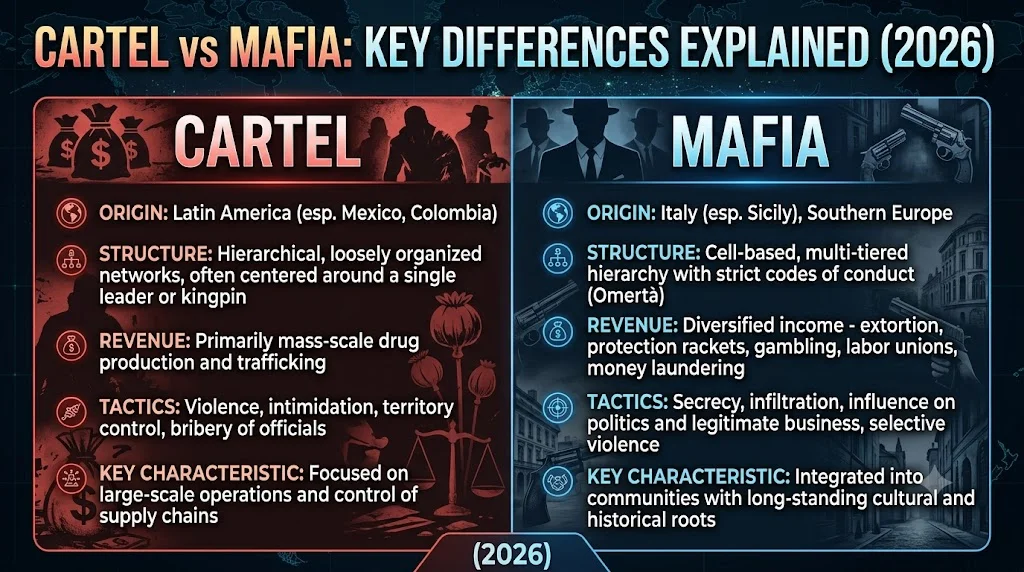
| Feature | Cartel | Mafia |
| Word origin | Spanish/Italian, from Latin charta (paper/document) | Sicilian, possibly from Arabic mahyas (aggressive boasting) |
| Pronunciation | /kɑːrˈtɛl/ (car-TELL) | /ˈmɑːfiə/ (MAH-fee-uh) |
| Core meaning | A group of businesses or people who agree to control prices or a market | A secretive, hierarchical criminal organization built on family or tribal loyalty |
| Structure | Loosely connected, often independent groups working toward a shared goal | Tight, ranked structure (boss, underboss, capos, soldiers) |
| Main activity | Often drug trafficking (in criminal use), but the word itself just means “alliance” | Broad criminal enterprise: extortion, gambling, smuggling, drugs, murder |
| Best known examples | Sinaloa Cartel, Medellín Cartel | Sicilian Mafia (Cosa Nostra), American Mafia |
| Grammar note | Can be countable (“a cartel,” “cartels”) and used in economics without crime | Almost always refers to organized crime; capitalized “Mafia” often means the Italian original |
Understanding the Word “Cartel”: Meaning, Grammar, and Usage
Definition
A cartel (noun) is a group of independent businesses, producers, or criminal groups that agree — openly or secretly — to work together instead of competing. The goal is usually to control prices, supply, or territory.
- Part of speech: Noun
- Pronunciation: /kɑːrˈtɛl/ — stress on the second syllable
- Plural form: cartels
- Word origin: From French cartel, from Italian cartello (“placard, written agreement”), from Latin charta (“paper”). Originally, a cartel was simply a written agreement between parties, even between rival armies discussing prisoner exchanges.
Common Mistakes
- ❌ “The cartel is a person who sells drugs.” (A cartel is a group, not one person.)
- ✅ “The cartel controls most of the cocaine trade in the region.”
- ❌ Writing it as “cartell” or “kartel” — the correct spelling has one L and no K.
- ✅ Cartel, cartels, cartel-related (hyphenated as an adjective).
Formal vs Informal Usage
- Formal (business/economics): “OPEC operates similarly to a cartel by coordinating oil production.”
- Informal (everyday speech): “That gang is basically a drug cartel now.”
Synonyms
Syndicate, ring, alliance, coalition, bloc, trust (in economics), consortium
Related Words and Antonyms
- Antonym (opposite idea): competition, free market, rivalry
- Related noun: cartelization (the process of forming a cartel)
- Related adjective: cartel-like
Common Collocations
- “drug cartel”
- “oil cartel”
- “form a cartel”
- “break up a cartel”
- “cartel leader”
- “cartel violence”
Real-Life Example Sentences
- “Economists study how a cartel can raise prices by limiting supply.”
- “The Sinaloa Cartel is one of the most powerful criminal organizations in North America.”
- “Several airlines were fined for acting like a price-fixing cartel.”
Quick Tip to Remember It
Think of the “chart” hiding inside car-tel. A cartel started as a written agreement (a chart, a paper) — that’s the root idea. Even today, a cartel is a group bound by an agreement, not necessarily by blood or family.
Understanding the Word “Mafia”: Meaning, Grammar, and Usage
Definition
A mafia (noun) is a secretive, organized criminal group, traditionally structured around family loyalty, strict codes of honor, and a strong hierarchy. When capitalized as “Mafia,” it usually refers specifically to the Sicilian or Italian-American organization.
- Part of speech: Noun
- Pronunciation: /ˈmɑːfiə/ — MAH-fee-uh
- Plural form: mafias (lowercase, general use) or “Mafia families” (specific groups)
- Word origin: Sicilian dialect, 19th century. Several theories exist: some link it to Arabic mahyas (bragging, aggression), others to a Sicilian word for “beauty” or “boldness.” No single origin is proven, and Claude does not claim certainty here — linguists still debate it.
Common Mistakes
- ❌ “Mafia” used as a verb (“He mafia’d the business”) — incorrect; mafia is a noun only.
- ✅ “Organized crime groups sometimes operate like a mafia.”
- ❌ Confusing “Mafia” (capital M, the Italian original) with “mafia” (lowercase, general criminal network) — many writers use them interchangeably, but strict style guides keep the distinction.
Formal vs Informal Usage
- Formal: “The Sicilian Mafia is formally known as Cosa Nostra.”
- Informal: “Don’t mess with him — his uncle’s basically in the mafia.”
Synonyms
Syndicate, crime family, organized crime, secret society, gang (less precise), underworld network
Related Words
- Adjective: mafia-style, mafioso (a member of the Mafia, Italian term)
- Related phrase: “code of silence” (omertà)
- Antonym (opposite idea): law-abiding organization, legitimate business
Common Collocations
- “Mafia boss”
- “Mafia family”
- “join the mafia”
- “Mafia-style hit”
- “Mafia don”
- “crack down on the mafia”
Real-Life Example Sentences
- “The Italian Mafia has operated for more than a century.”
- “Police believe the killing had mafia connections.”
- “He grew up in a mafia family in Sicily.”
Quick Tip to Remember It
Picture a family dinner table. The Mafia’s whole structure is built on family-like loyalty — even members who aren’t blood relatives are treated as “family.” That mental image helps you recall that mafia = tight family structure, while cartel = business agreement.
Key Differences Between Cartel and Mafia
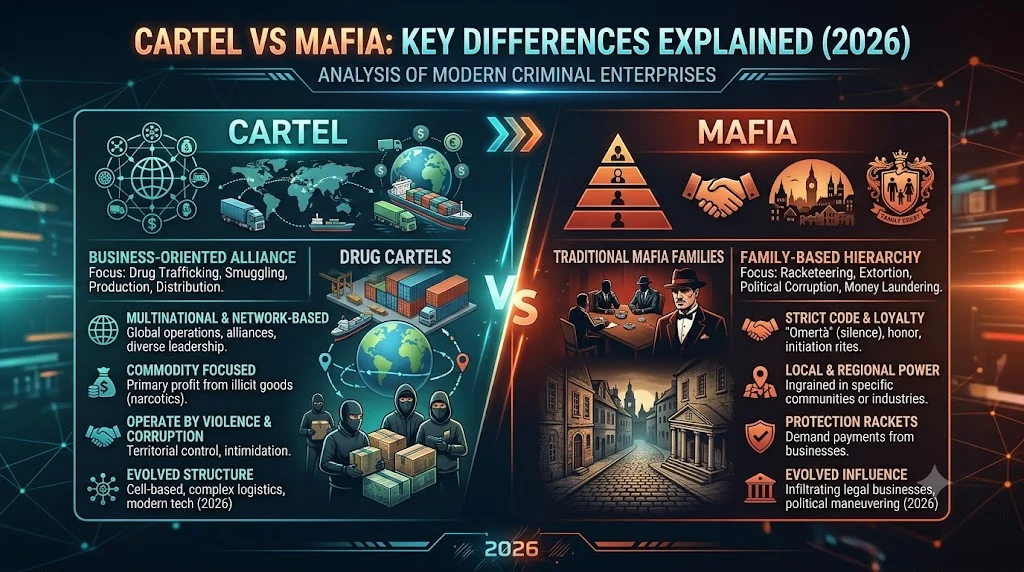
Now that you understand the words themselves, let’s compare the organizations they usually describe.
| Difference | Cartel | Mafia |
| Foundation | Business alliance or criminal partnership | Family or clan-based loyalty |
| Origin region | Often Latin America (in criminal context) | Traditionally Italy, especially Sicily |
| Leadership style | Can be decentralized, with cells operating semi-independently | Strict top-down chain of command |
| Primary goal | Control a market (often drugs) | Control territory and multiple criminal enterprises |
| Membership basis | Recruited for skill or loyalty to the operation | Often born or married into the family, or formally “inducted” |
| Public image | Associated heavily with drug trafficking | Associated with a wider criminal “lifestyle” and honor code |
Grammar note for writers: When comparing two nouns like this, remember to keep your sentence structure parallel. Write “A cartel focuses on trade; a mafia focuses on territory” — not “A cartel focuses on trade while mafia is territory,” which breaks parallel structure.
Is Every Cartel a Drug Cartel?
No. This is a common misunderstanding.
The word “cartel” simply describes an agreement between independent groups to limit competition. This concept exists in:
- Economics: Oil cartels (like OPEC) coordinate production levels.
- Business law: Price-fixing cartels are illegal in most countries, even without any violence involved.
- Organized crime: Drug cartels are the most famous criminal example, but weapons cartels and human trafficking networks also use cartel-style structures.
Common Mistake: Assuming “cartel” always means drugs. Correct Usage: “The airline cartel was fined for fixing ticket prices” — no drugs involved, still correctly called a cartel.
Are All Mafias Italian?
No, and this is another point competitors often get wrong.
“Mafia” originally referred to the Sicilian organization, but the word has become a general term for any tightly organized, hierarchical criminal group with strong internal loyalty codes. You will hear phrases like:
- Russian mafia
- Japanese mafia (though the correct term is Yakuza)
- Albanian mafia
- Chinese mafia (though Triads is more accurate)
Grammar tip: When the word refers to the specific historical Italian organization, capitalize it: “the Mafia.” When used generally for any similar group, lowercase is standard: “a Russian mafia network.”
How Cartels and Mafias Make Money
Both organizations are, at their core, illegal businesses. Their revenue streams often overlap but differ in emphasis.
Cartels typically earn through:
- Drug production and trafficking
- Extortion of local businesses
- Fuel theft (notable in Mexico)
- Kidnapping for ransom
- Human smuggling
Mafias typically earn through:
- Extortion (“protection money”)
- Gambling and loan-sharking
- Infiltrating legitimate businesses (construction, waste management, unions)
- Corruption of public officials
- Smuggling and counterfeit goods
Semantic keyword note: Words like extortion, racketeering, money laundering, and trafficking are closely related vocabulary you’ll often see paired with both terms.
Which Is More Powerful: Cartel or Mafia?
This depends entirely on the era and region you’re comparing.
- Modern context: Mexican drug cartels currently control vast territory, have access to military-grade weapons, and generate billions of dollars annually. Many analysts consider them more powerful today than most traditional mafia families.
- Historical context: In the 20th century, the American and Sicilian Mafia held enormous political and economic influence, especially in cities like New York and Palermo.
There is no single correct answer — power depends on wealth, territory, political corruption, and weaponry, and these shift over decades.
Which Is More Dangerous?
Again, context matters, but here’s a useful distinction:
- Cartels are generally associated with higher levels of public violence — armed clashes, mass casualties, and open conflict with government forces.
- Mafias traditionally favor discretion — targeted killings, quiet corruption, and avoiding public attention whenever possible, though this is not a strict rule.
Quick Tip: If a news article uses the word “cartel,” expect stories involving direct violence or trafficking. If it uses “mafia,” expect stories involving corruption, extortion, or infiltration of legal businesses.
How They Expand Across Countries
Cartels expand by establishing trafficking routes and partnering with local criminal networks in new countries. This often includes:
- Setting up distribution cells abroad
- Partnering with local gangs for logistics
- Using legitimate shipping and trade routes to move product
Mafias historically expanded through immigration and diaspora communities, which is exactly how the Sicilian Mafia established a strong presence in the United States during the early 20th century. Modern mafias also expand through:
- Real estate investment
- Legitimate business fronts
- Political lobbying and bribery
Recruitment: Who Joins These Criminal Organizations?
Cartel recruitment often targets:
- Young men in poverty-stricken regions
- Former or current members of the military or police
- People with existing debts to the organization
Mafia recruitment traditionally relies on:
- Blood relatives and in-laws
- Childhood friends from the same neighborhood
- A formal induction ceremony in some Mafia traditions
Grammar note: When writing about recruitment, avoid vague phrasing like “people join for money.” Be specific: “Recruits are often drawn in by promises of income, protection, or status” — specific, active language reads more professionally.
Codes of Silence, Loyalty, and Betrayal
The Sicilian Mafia’s code of silence is called omertà — a rule that forbids cooperating with police or authorities, even as a victim.
Cartels have a similar unwritten rule, sometimes referred to informally as “la ley del silencio” (the law of silence), though it is less formally codified than omertà.
Vocabulary spotlight — “omertà”:
- Pronunciation: /oʊmɛərˈtɑː/
- Origin: Sicilian dialect, likely connected to the Italian word umiltà (humility)
- Usage: “He refused to testify, honoring the code of omertà.”
Betrayal in both worlds is treated with extreme severity, often resulting in violent retaliation — a shared theme despite the different structures.
How Money Laundering Works
Both cartels and mafias must “clean” illegal profits before spending them openly. Common methods include:
- Shell companies: fake businesses that appear to generate legitimate income
- Real estate purchases: buying property with cash, then reselling
- Cash-intensive businesses: restaurants, car washes, and laundromats (ironically, the literal origin of the term “money laundering”)
- Cryptocurrency transfers: increasingly common for both organizations in the last decade
Word origin note: The term “money laundering” is believed to come from the use of laundromats by organized crime figures in the early 20th century to disguise illegal cash as business revenue — a nice real-world example of how criminal activity has shaped everyday English vocabulary.
How Cartels and Mafias Use Technology
Modern organized crime has adapted quickly to digital tools:
- Encrypted messaging apps for secure communication among members
- Cryptocurrency for faster, harder-to-trace transactions
- Darknet marketplaces for distributing drugs and weapons
- Social media for recruitment, intimidation, and even public branding (some cartel members openly post on social platforms)
- Drones used by cartels for surveillance and, increasingly, for smuggling small packages across borders
Mafias have been slower to embrace public technology use, generally preferring discretion, but they use similar encrypted communication and financial technology behind the scenes.
Famous Cartels vs Famous Mafia Families
| Cartels | Mafia Families |
| Sinaloa Cartel | Corleonesi (fictionalized, inspired by real clans) |
| Medellín Cartel (led by Pablo Escobar) | Gambino Family (New York) |
| Jalisco New Generation Cartel (CJNG) | Genovese Family (New York) |
| Gulf Cartel | Cosa Nostra (Sicily) |
| Tijuana Cartel | ‘Ndrangheta (Calabria) |
Note: ‘Ndrangheta and Camorra are separate Italian organized crime groups, distinct from the Sicilian Mafia, though English speakers often lump all Italian organized crime under the general word “mafia.”
Biggest Myths About Cartels and Mafias
- Myth: All cartel members are violent killers. Reality: Most cartel employees work in logistics, finance, or low-level distribution — violence is carried out by a smaller enforcement branch.
- Myth: The Mafia is extinct. Reality: The Sicilian Mafia and Italian-American families still exist, though with reduced power compared to their mid-20th-century peak.
- Myth: Cartels only exist in Mexico. Reality: Cartel-style organizations operate in Colombia, Central America, parts of Europe, and Asia.
- Myth: Joining is always voluntary. Reality: Coercion, debt, and threats to family members are common recruitment tools in both cartels and mafias.
Cartel vs Mafia in Movies vs Reality
Hollywood has shaped how most English speakers understand these words.
- “The Godfather” popularized the romanticized image of Mafia loyalty and honor — a version that softens the real-world violence and exploitation.
- “Narcos” and similar shows dramatize cartel operations, often exaggerating individual leaders’ power while simplifying the larger trafficking networks.
Language lesson: Media exposure is exactly why so many English learners already “know” these words before ever studying them formally — but movie dialogue often uses slang and regional accents that don’t reflect standard grammar. Use films for listening practice, not grammar reference.
Can Someone Leave a Cartel or Mafia?
Technically, yes — but it is extremely dangerous in both cases.
- Leaving a cartel often requires relocating, entering witness protection, or cooperating with authorities in exchange for reduced sentencing.
- Leaving the Mafia historically required either death, a “made man” retiring quietly with permission (rare), or full cooperation with law enforcement under witness protection.
Both organizations treat departure as a potential security risk, since former members often know sensitive information.
How Governments Fight Organized Crime Today
- RICO Act (USA): Allows prosecutors to charge entire organizations, not just individuals, for a pattern of criminal activity — historically very effective against the Mafia.
- Extradition treaties: Allow cartel leaders to be tried in countries with stricter sentencing.
- Asset seizure laws: Target the financial backbone of these organizations by confiscating laundered money and property.
- International cooperation: Agencies like INTERPOL and Europol coordinate cross-border investigations.
Why Organized Crime Still Exists
Despite decades of law enforcement pressure, both cartels and mafias persist because of:
- Ongoing demand for illegal drugs and services
- Government corruption in certain regions
- Economic inequality that makes recruitment easier
- The adaptability of these organizations to new markets and technology
Understanding this helps explain why the words “cartel” and “mafia” remain common in news reporting decades after either concept began.
Cartel vs Mafia: Side-by-Side Comparison Table
| Category | Cartel | Mafia |
| Definition | Alliance to control a market | Hierarchical crime family |
| Structure | Loosely networked cells | Strict chain of command |
| Loyalty basis | Business interest | Blood/family ties |
| Common crimes | Drug trafficking, extortion | Extortion, racketeering, corruption |
| Code of conduct | Informal silence rules | Formal omertà |
| Global presence | Latin America, expanding globally | Italy, USA, and other diaspora regions |
| Public visibility | Often violent and visible | Traditionally discreet |
Final Verdict: Cartel vs Mafia Explained Simply
If you remember only one thing from this guide, remember this: a cartel is built on agreement, and a mafia is built on family.
Cartels form when independent groups decide it’s more profitable to cooperate than compete — this concept applies to oil companies just as much as drug traffickers. Mafias form around loyalty, tradition, and a rigid code of honor, most famously associated with Sicilian and Italian-American crime families.
Neither word is interchangeable with “gang,” “syndicate,” or “crime ring” in strict usage, though English speakers often blur these lines in casual conversation. Knowing the precise meaning — and the grammar rules around capitalization and usage — will make your writing, speaking, and reading noticeably more accurate.
Final Thoughts
Learning the difference between “cartel” and “mafia” is really a lesson in precision. English is full of words that seem like synonyms but carry very different histories, structures, and connotations. A cartel is fundamentally an agreement between groups — it can even apply to legal businesses.
A mafia is fundamentally a family-based hierarchy built on loyalty and tradition. Once you understand these roots, you’ll never confuse the two again, whether you’re writing an essay, reading the news, or simply having a conversation about true crime documentaries.
Frequently Asked Questions
1. Is the Mafia legal anywhere in the world? No. The Mafia is not a legal organization anywhere. However, in Italy, simply being a documented member of a mafia-type association (under Article 416-bis) is itself a punishable crime, even without proof of a specific violent act.
2. Is a cartel always involved in drugs? No. “Cartel” is a general economic term for any group that agrees to limit competition. It’s used in legal contexts like oil production and illegally in drug trafficking, but the word itself doesn’t require illegal activity.
3. Which organization earns more money? Modern drug cartels, especially in Mexico and Colombia, are generally estimated to generate more annual revenue than most current Mafia families, largely due to the scale of the global drug trade.
4. Can cartels and mafias work together? Yes. There is documented cooperation between Mexican cartels and Italian mafia groups, particularly the ‘Ndrangheta, for distributing cocaine across Europe.
5. What is the oldest mafia organization? The Sicilian Mafia (Cosa Nostra) is widely considered the oldest and most well-documented mafia organization, with roots tracing back to 19th-century Sicily.
6. Is “cartel” always capitalized? No. “Cartel” is only capitalized when it’s part of a proper name, like “the Sinaloa Cartel.” As a general noun, it stays lowercase.
7. What’s the plural of mafia? “Mafias” is correct when referring to multiple distinct groups, such as “the Russian and Sicilian mafias operate differently.”
8. Is “mafioso” an English word? It’s a borrowed Italian word now commonly used in English to describe a Mafia member, especially in journalism and film. Plural: mafiosi.
9. Do cartels have a formal induction ceremony like the Mafia? Generally, no. Most cartels recruit informally, while some traditional Mafia families historically used formal induction rituals to mark new “made” members.
10. Is it wrong to use “mafia” for non-Italian groups? It’s grammatically acceptable in modern English, though purists argue the term should be reserved for the Sicilian/Italian original, with words like “syndicate” or “cartel” used for other regions.