
If you have ever paused mid-sentence wondering whether to say “my father and I went fishing” or “my father and me went fishing,” you are not alone. This tiny pronoun choice trips up native speakers, ESL learners, and even professional writers. The good news is that the rule behind it is simple once you see it clearly.
In this guide, you will learn exactly when to use “my father and I” and when to use “my father and me,” why the confusion happens in the first place, and how to fix the mistake permanently using a one-second trick called the Drop Test.
Why “My Father and I” vs “My Father and Me” Confuses So Many People
The confusion happens because English pronouns change form depending on their job in a sentence. “I” and “me” refer to the same person — the speaker — but they are not interchangeable.
Meaning: “I” and “me” are both first-person singular pronouns. They point to the person speaking or writing.
Definition:
- I — a subject pronoun, used when the speaker performs the action.
- Me — an object pronoun, used when the speaker receives the action.
Why people get it wrong: Many of us were corrected as children for saying “me and my father went to the store.” Teachers told us to say “my father and I” instead. That correction was right in that specific sentence, but it stuck in our heads as a blanket rule — “always say ‘I,’ never ‘me,’ when talking about yourself and someone else.” That overcorrection is called hypercorrection, and it is the number one reason people misuse “I” in phrases like “between you and I” (which is actually wrong — it should be “between you and me”).
Quick Tip: The rule is not about politeness or formality. It is about grammar function — subject or object.
The Basic Grammar Rule: “I” as a Subject and “Me” as an Object
Grammar explanation:
| Pronoun Type | Job in the Sentence | Example |
| Subject pronoun | Performs the action | I called my father. |
| Object pronoun | Receives the action | My father called me. |
Rule in plain English:
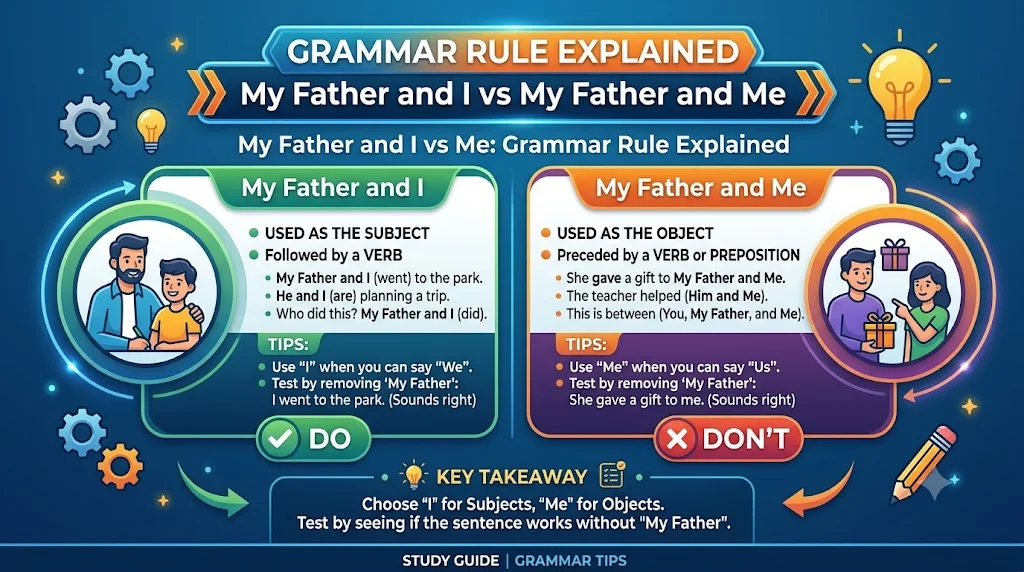
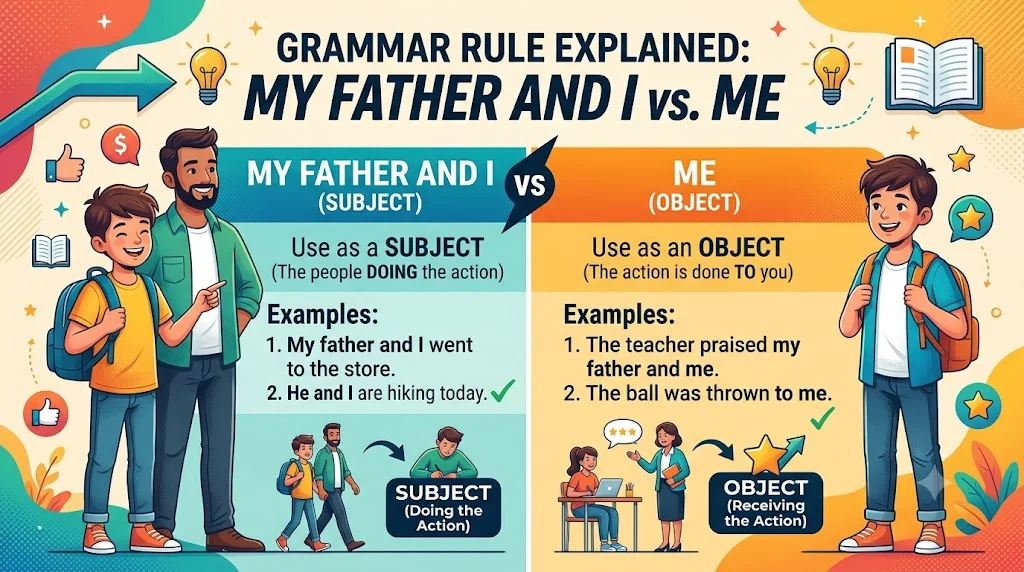
- Use “my father and I” when the pair is doing the action (subject).
- Use “my father and me” when the pair is receiving the action, or following a preposition (object).
Common mistake: Saying “my father and me went to the game” — this is wrong because “went” needs a subject pronoun, and “me” cannot be a subject.
Correct usage: “My father and I went to the game.”
Real-life example pair:
- ✅ My father and I cooked dinner. (subject)
- ✅ The teacher praised my father and me. (object)
Similar pairs that follow the same rule: he/him, she/her, they/them, we/us.
Understanding Subject and Object Pronouns With Simple Examples
Definition: A subject pronoun replaces the noun doing the action. An object pronoun replaces the noun receiving the action.
Subject pronouns: I, you, he, she, it, we, they Object pronouns: me, you, him, her, it, us, them
Pronunciation notes:
- “I” is pronounced /aɪ/ (rhymes with “eye”).
- “Me” is pronounced /miː/ (rhymes with “see”).
Word origin: “I” comes from Old English ic, and “me” comes from Old English mē — both are ancient, core parts of the language, which is part of why their rules feel so deeply “wired in” for native speakers, even when we misapply them.
Simple examples:
- Subject: She plays the piano.
- Object: The music surprised her.
- Subject: My father and I fixed the car.
- Object: The mechanic thanked my father and me.
Tip to remember: Subjects go before the verb and do the action. Objects go after the verb (or after a preposition) and receive the action.
Practice examples:
- ___ and I / ___ and me love pizza. → My father and I love pizza.
- The waiter served ___. → my father and me.
- ___ walked the dog. → My father and I walked the dog.
The Drop Test: The Easiest Way to Choose Between “I” and “Me”
If you remember only one trick from this article, make it this one.
How the Drop Test Works
Definition: The Drop Test means temporarily removing “my father and” from the sentence and checking whether “I” or “me” sounds correct on its own.
Steps:
- Take the full sentence.
- Cross out “my father and.”
- Read the sentence with just “I” or “me.”
- Whichever sounds natural is the correct pronoun to use in the full sentence.
Grammar logic: Since “my father” doesn’t change form, the correct pronoun for the whole phrase is whatever pronoun would work alone in that same sentence slot.
Examples of Using the Drop Test Correctly
| Full Sentence | After Dropping “My Father and” | Correct Form |
| My father and I went hiking. | I went hiking. ✅ | My father and I |
| My father and me went hiking. | Me went hiking. ❌ | My father and I |
| The coach picked my father and me. | The coach picked me. ✅ | my father and me |
| The coach picked my father and I. | The coach picked I. ❌ | my father and me |
Common mistake: Skipping the test and guessing based on which one “sounds fancier.” “I” often sounds more formal to people, but formality has nothing to do with correctness here.
Quick Tip: If “me” sounds wrong alone, don’t use it in the pair. If “I” sounds wrong alone, don’t use it in the pair.
When to Use “My Father and I” Correctly
Using “My Father and I” as the Subject of a Sentence
Meaning: Use this phrase when “my father” and “I” are together performing the main action of the sentence.
Grammar rule: Compound subjects that include the speaker use the subject pronoun “I,” never “me.”
Correct usage pattern: [My father and I] + [verb] + (rest of sentence)
Common Sentence Examples With “My Father and I”
- My father and I are planning a road trip.
- My father and I built this treehouse together.
- Every summer, my father and I visit the lake house.
- My father and I disagree about politics sometimes.
- My father and I will attend the ceremony.
Formal example: “My father and I are pleased to announce the opening of our new office.”
Informal example: “My father and I binge-watched the whole series last night.”
Common mistake: Writing “Me and my father are planning a trip.” This reverses word order and uses the wrong case. The correct, more polite order is “My father and I.”
When to Use “My Father and Me” Correctly
Using “My Father and Me” as an Object
Meaning: Use this phrase when “my father” and “you” (or the speaker) are receiving the action rather than doing it.
Grammar rule: Compound objects use the object pronoun “me.”
Correct usage pattern: [Subject] + [verb] + [my father and me]
Examples:
- The manager congratulated my father and me.
- She invited my father and me to the wedding.
- The photographer took a picture of my father and me.
- Grandma gave my father and me matching sweaters.
Why Prepositions Always Take “Me”
Definition: A preposition is a word that shows a relationship between a noun/pronoun and another part of the sentence — words like to, for, with, between, from, of, at.
Grammar rule: Every pronoun that follows a preposition must be an object pronoun. This is called the object of a preposition.
Examples:
- Come with my father and me. (not “with my father and I”)
- This gift is for my father and me.
- There’s no secret between my father and me.
- She sat between my father and me at dinner.
Common mistake: “Between you and I” — this is incorrect. Since “between” is a preposition, it must be followed by “me”: between you and me.
Quick Tip: After any preposition, always default to the object pronoun “me,” never “I.”
“My Father and I” vs “My Father and Me”: Real-Life Examples
Everyday Conversation Examples
- My father and I are going grocery shopping. (subject)
- Mom cooked dinner for my father and me. (object)
- My father and I watched the sunset together. (subject)
- The neighbor waved at my father and me. (object)
Professional and Formal Writing Examples
- My father and I co-founded this company in 2015. (subject)
- The board of directors recognized my father and me for our contributions. (object)
- My father and I look forward to discussing this proposal further. (subject)
- Please direct all correspondence to my father and me. (object)
Academic Writing Examples
- My father and I conducted the research over three semesters. (subject)
- The professor assigned my father and me to the same project group. (object)
- My father and I presented our findings at the conference. (subject)
Social Media and Informal Usage Examples
- My father and I just crushed a 10-mile hike! 🏔️ (subject)
- Tag my father and me in that photo! (object)
- My father and I are obsessed with this new show. (subject)
Formal vs informal usage note: The grammar rule never changes between formal and informal writing. What changes is tone, vocabulary, and sentence length — not pronoun case.
Common Mistakes People Make With “My Father and I” and “My Father and Me”
Using “I” to Sound More Formal
The mistake: Many people assume “I” always sounds more educated, so they use it even as an object: “The gift is from my father and I.” This is incorrect. “From” is a preposition, so it needs “me.”
Correction: The gift is from my father and me.
Using “Me” as the Subject of a Sentence
The mistake: “Me and my father are going camping.”
Why it’s wrong: “Me” cannot perform an action as a subject.
Correction: My father and I are going camping.
Confusing Compound Subjects and Objects
The mistake: Not recognizing whether the phrase is doing the action or receiving it.
Fix: Always run the Drop Test before finalizing your sentence.
Using “My Father and Myself” Incorrectly
Definition of “myself”: A reflexive or intensive pronoun, used when the subject and object are the same person, or to add emphasis.
Correct usage: “I hurt myself.” “I myself will handle it.”
Incorrect usage: “Please contact my father and myself.” This is a common corporate-email mistake. “Myself” cannot substitute for “me” as a simple object.
Correction: Please contact my father and me.
Common collocations with “myself”: by myself, to myself, for myself, I myself, myself included.
How to Avoid Pronoun Mistakes in Compound Sentences
Remove the Other Person and Test the Sentence
This is the Drop Test again, applied as a general life-long habit. Whenever you write a sentence with “[Someone] and I/me,” delete “[Someone] and” and read the sentence alone.
Check Whether the Pronoun Performs or Receives the Action
Ask yourself two questions:
- Is this pronoun doing something (subject)? → Use “I.”
- Is this pronoun having something done to it, or following a preposition (object)? → Use “me.”
Practice examples:
- ___ and I / me should leave now. → My father and I should leave now. (subject)
- Please wait for ___ and I / me. → Please wait for my father and me. (object)
- ___ and I / me are twins. → My father and I are twins. (subject — though logically odd, grammatically illustrative)
- The invitation was addressed to ___ and I / me. → my father and me. (object)
Formal vs Informal Usage: Does Context Change the Rule?
Grammar Rules Stay the Same in All Situations
Key point: Whether you are texting a friend, writing a wedding speech, or submitting a business report, the subject/object rule for “I” and “me” does not change. Grammar rules are constant; only style and word choice shift with tone.
Differences Between Spoken and Written English
In casual speech, native speakers sometimes say “me and my father” out of habit (placing “me” first), which is considered informal and slightly less polished, even though many people say it. In writing — especially professional or academic writing — always use the grammatically correct and more conventionally polite order: “my father and I” or “my father and me,” depending on function.
Tip to remember: Spoken English tolerates more relaxed patterns; written English, especially formal writing, rewards precision.
American vs British English: Is There Any Difference?
Same Pronoun Rules in Both Varieties
Good news: American English and British English follow the exact same subject/object pronoun rule. “My father and I” as a subject and “my father and me” as an object are correct in both dialects.
Regional Speech Patterns and Common Variations
Some regional or dialectal speech patterns (in both the US and UK) use “me” more broadly in casual speech, such as “me and him went down the pub” in some British regional dialects, or similar patterns in American colloquial speech. These are recognized as non-standard in formal grammar, even though they are common in everyday spoken dialects.
Quick Tip: For school, work, and professional writing, always follow standard grammar rules regardless of region.
Advanced Grammar Tips for Fluent English Speakers
Compound Subjects and Compound Objects Explained
Definition: A compound subject or object contains two or more nouns/pronouns joined by “and” or “or,” functioning together as one grammatical unit.
Example compound subject: My father and I (both doing the action) Example compound object: my father and me (both receiving the action)
Similar structures: “my sister and I,” “you and he,” “the manager and I,” “my colleagues and I.”
Pronoun Order and Politeness Rules
Etiquette rule: In traditional English etiquette, it is considered more polite to mention the other person first: “my father and I,” not “I and my father.” This is a style convention, not a hard grammar law, but it is widely taught and expected in formal writing.
Avoiding Hidden Pronoun Errors
Watch for pronoun errors hiding in longer or more complex sentences, such as:
- “Between my father and I, we managed to fix the sink.” ❌ → “Between my father and me…” ✅
- “He gave the keys to my father and I.” ❌ → “…to my father and me.” ✅
- “My father and myself completed the project.” ❌ → “My father and I completed the project.” ✅
Quick Comparison Table: “My Father and I” vs “My Father and Me”
| Feature | My Father and I | My Father and Me |
| Grammatical role | Subject | Object |
| Comes before or after the verb | Before | After (or after a preposition) |
| Drop Test result | “I” sounds correct alone | “Me” sounds correct alone |
| Example | My father and I love hiking. | The trail challenged my father and me. |
| Used after prepositions? | No | Yes |
| Formality level | Same rule in formal and informal contexts | Same rule in formal and informal contexts |
Easy Sentence Templates You Can Remember
Examples Using “My Father and I”
- My father and I + [verb] + …
- My father and I are excited about the trip.
- My father and I have decided to renovate the kitchen.
- My father and I always watch the news together.
Examples Using “My Father and Me”
- [Someone] + [verb] + my father and me
- [Preposition] + my father and me
- The coach chose my father and me for the team.
- There is a strong bond between my father and me.
Practice Quiz: Test Your Understanding
Choose the correct pronoun for each sentence.
- ___ and I / me are going to the concert tonight.
- The teacher spoke with my father and ___ (I/me) after class.
- ___ and I / me built this treehouse last summer.
- She gave the tickets to my father and ___ (I/me).
- My father and ___ (I/me) will be there at noon.
- This decision affects my father and ___ (I/me) equally.
- ___ and I / me love spicy food.
- Nobody told my father and ___ (I/me) about the change in plans.
Answers and Explanations
- My father and I — subject of “are going.”
- me — object of the preposition “with.”
- My father and I — subject of “built.”
- me — object of “gave… to.”
- I — subject of “will be.”
- me — object of “affects.”
- My father and I — subject of “love.”
- me — object of “told.”
Frequently Asked Questions About “My Father and I” vs “My Father and Me”
1. Is it ever okay to say “my father and me” as the subject of a sentence? No. In standard English grammar, “me” can never be the subject. Even in casual speech, “my father and me went to the store” is considered grammatically incorrect, though it is common in relaxed conversation.
2. Why does “my father and I” sound more correct even when it’s wrong? Because many people were taught as children to avoid “me and my father,” they overapply “I” everywhere, including after prepositions where “me” is actually correct.
3. Is “between you and I” correct? No. “Between” is a preposition, so the correct phrase is “between you and me.”
4. Does word order matter, like “my father and I” vs “I and my father”? Grammatically, order doesn’t change correctness, but “my father and I” is considered more polite and standard in English etiquette.
5. Is this rule different in British English? No. American and British English follow the same subject/object pronoun rule, though casual regional dialects may vary informally.
Final Thoughts:
The difference between “my father and I” and “my father and me” comes down to one simple question: is the pronoun doing the action, or receiving it? Use “I” for subjects and “me” for objects, including after every preposition. The Drop Test — removing “my father and” and checking which pronoun sounds right alone — will guide you correctly every time, in formal writing, casual conversation, emails, or exams.
Once this rule clicks, you’ll never second-guess yourself again, and your writing will sound both natural and grammatically confident.