
Business writers argue about this word more than almost any other compound term in office English. Some style guides hyphenate it. Some dictionaries merge it into one word. Some companies just pick a version and hope nobody notices the inconsistency in the same newsletter.
This guide settles it for good. You’ll learn the correct spelling, the grammar rule behind it, when the alternate spelling is acceptable, and how to use the term correctly in HR policies, emails, reports, and marketing copy — with 25 real examples and a quiz to test yourself.
Quick Answer (TL;DR)
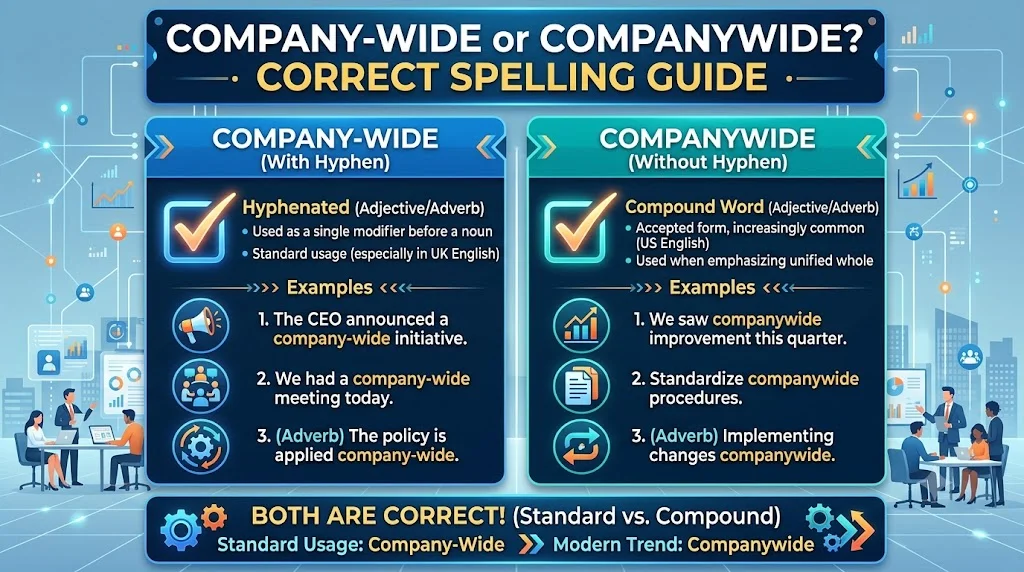
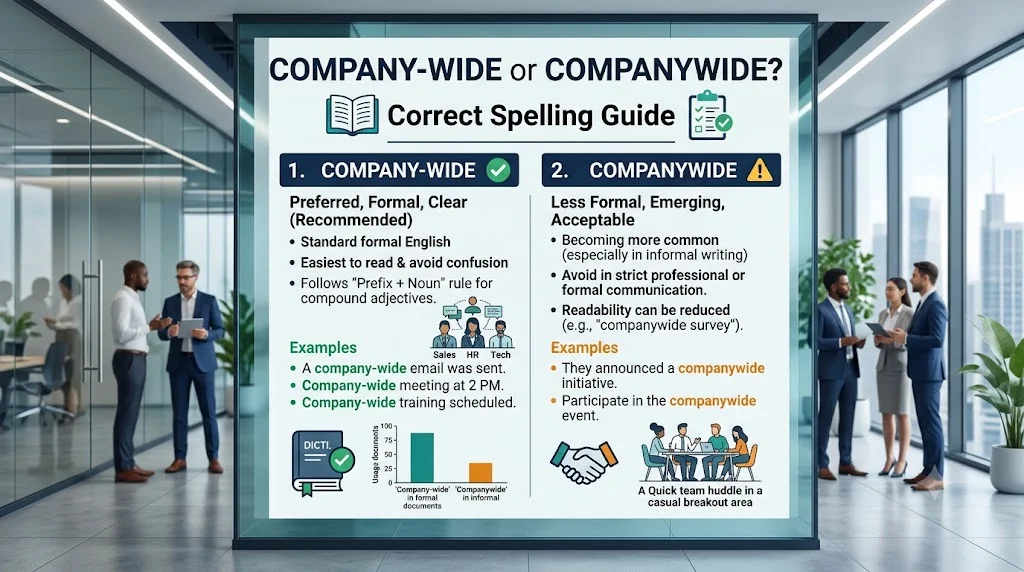
“Company-wide” (hyphenated) is the standard, most widely accepted spelling in American English. It is correct in nearly every context — as an adjective before a noun (“a company-wide policy”) and as an adverb (“the update rolled out company-wide”).
“Companywide” (one word, no hyphen) is a valid variant recognized by Merriam-Webster and used by some organizations, but it’s less common in professional and journalistic writing.
- Use “company-wide” for formal writing, HR documents, journalism, and anywhere AP Style or Chicago Manual of Style applies.
- “Companywide” is acceptable if your company style guide specifically prefers it, but stay consistent once you choose.
There is no such thing as “company wide” written as two separate words with a space and no hyphen — that version is always incorrect.
Company-Wide vs Companywide: Which Spelling Is Correct?
The Short Answer
Both spellings exist in modern American English, but they are not equally common or equally “correct” in every style guide.
| Spelling | Status |
| Company-wide | Standard, most widely used, AP-style friendly |
| Companywide | Acceptable variant, dictionary-recognized |
| Company wide | Incorrect (never write it as two unhyphenated words) |
Think of it this way: “company-wide” is the safe, professional default. “Companywide” is a stylistic choice, not an error — but it’s the less common road.
The One Rule to Remember
Here’s the simple version a grammar teacher would give you:
When “company” combines with “wide” to describe something that applies across an entire organization, it functions as a single descriptive unit — and English usually joins those units with a hyphen until they become common enough to merge into one word.
That’s exactly what’s happening here. “Company-wide” is in a transition zone: hyphenated by tradition, but increasingly written solid (one word) in casual and digital writing. This is a completely normal pattern in English word formation — think of “email” (once “e-mail”) or “online” (once “on-line”).
Quick Tip: When in doubt, hyphenate. A hyphen is never “wrong” here, even in contexts where the solid spelling is accepted. The reverse isn’t always true.
What Does “Company-Wide” Mean?
Definition and Meaning
Company-wide (adjective/adverb): affecting, involving, or applying to every part of a company; extending across the entire organization, including all departments, teams, and employees.
In simple terms: if something is company-wide, it touches everyone in the business — not just one team or one office.
Pronunciation
Company-wide is pronounced: KUHM-puh-nee-WYDE
- Stress falls on the first syllable of “company” and the second word “wide.”
- Four syllables total: com-pa-ny-wide.
Word Origin and Word Formation
“Company-wide” is a compound word formed by combining:
- Company — from Old French compagnie, meaning “society, friendship, body of soldiers,” ultimately from Latin roots meaning “one who shares bread” (com- “together” + panis “bread”).
- Wide — from Old English wīd, meaning “vast, spacious, extending far.”
When “wide” attaches to a noun like “company,” “nation,” “world,” or “industry,” it creates a compound meaning “extending across the whole of X.” This is a productive pattern in English — you’ll recognize it from words like nationwide, worldwide, and statewide.
Everyday Examples
- The CEO sent a company-wide email about the new vacation policy.
- Productivity software was rolled out company-wide last quarter.
- The layoffs affected staff company-wide, not just one department.
- Management announced a company-wide hiring freeze.
Quick Tip: If you can replace “company-wide” with “across the whole company” and the sentence still makes sense, you’re using it correctly.
Why Is “Company-Wide” Hyphenated? The Grammar Explained
Compound Modifier Rule
This is the heart of the grammar lesson, so let’s slow down.
A compound modifier is two or more words that work together as a single adjective before a noun. English style guides (including AP and Chicago) generally require a hyphen when two words jointly modify a noun that follows them.
Rule: Hyphenate a compound modifier when it comes before the noun it describes.
Examples of the same pattern:
- a well-known author
- a five-year-old child
- a company-wide initiative
In each case, the hyphen tells the reader: “treat these words as one unit describing what comes next.” Without the hyphen, a reader might briefly misread the phrase or process it more slowly.
When the Hyphen Is Required
The hyphen is required (or strongly preferred) when “company-wide” functions as an adjective directly before a noun.
Correct:
- a company-wide meeting
- company-wide training
- a company-wide shutdown
Here, “company-wide” is modifying “meeting,” “training,” and “shutdown.” It sits before the noun, so the hyphen keeps the phrase clear.
When the Hyphen Can Be Omitted
Style flexibility opens up when “company-wide” is used as an adverb (describing a verb, often placed after it) rather than as an adjective before a noun.
Both acceptable:
- The update rolled out company-wide.
- The update rolled out companywide.
Because there’s no noun directly following the word in this position, some style guides relax the hyphenation rule — though “company-wide” with the hyphen remains the safer, more traditional choice even here.
Quick Tip: Before a noun = hyphen is essentially mandatory. After a verb = hyphen is still recommended but slightly more flexible.
Is “Companywide” Ever Correct?
Dictionary Acceptance
Yes — “companywide” (solid, one word) is a legitimate spelling. Major dictionaries, including Merriam-Webster, recognize “companywide” as an adjective meaning “involving or extending throughout an entire company.” It is not slang, and it is not a typo.
However, dictionary recognition doesn’t mean equal popularity. In edited American publications, business journalism, and style-guide-driven writing (AP, Chicago), the hyphenated form remains far more common.
Why Some Companies Prefer It
Some organizations adopt “companywide” as their internal style choice for a few practical reasons:
- Visual simplicity — one word can look cleaner in headlines and slide decks.
- Digital-first writing habits — solid compounds are increasingly common online (similar to “website,” “email,” “login”).
- Brand style guides — some corporate communications teams standardize on it to match other solid compounds like “nationwide” already used in their materials.
If your company’s internal style guide says “companywide,” follow it — internal consistency matters more than which version is technically more common externally.
Company-Wide vs Companywide: What’s the Difference?
The core meaning is identical. There is no difference in what the word communicates. The only difference is spelling convention and register (formality).
- Company-wide — traditional, widely accepted, safest for formal and external-facing writing (press releases, HR policy documents, news articles).
- Companywide — modern, accepted variant, common in internal communications and some corporate style guides.
Neither spelling changes pronunciation, meaning, or grammatical function. Choosing between them is a style decision, not a grammatical one — but consistency within a single document is essential.
Company-Wide vs Companywide Comparison Table
| Feature | Company-Wide | Companywide |
| Spelling | Hyphenated | Solid (one word) |
| Meaning | Identical | Identical |
| Dictionary status | Widely listed | Listed, less dominant |
| AP Style fit | Preferred | Used, but less traditional |
| Chicago Manual fit | Preferred | Acceptable |
| Common in | News, HR docs, formal reports | Internal memos, casual business writing |
| Before a noun | Hyphen strongly required | Less standard |
| After a verb | Hyphen recommended | Acceptable |
| Best for | Formal / external writing | Internal / brand-style writing |
| Risk of being marked “incorrect” | Very low | Slightly higher in formal editing |
What Do AP Style, Chicago, and Merriam-Webster Recommend?
- AP Stylebook: Follows the general compound-modifier rule — hyphenate compound adjectives before a noun. AP writing overwhelmingly favors company-wide, consistent with how it treats similar business compounds.
- Chicago Manual of Style: Chicago’s hyphenation guidance is based on function and clarity. Since “company-wide” modifies a noun in most business contexts, Chicago also leans toward the hyphenated form, especially before a noun.
- Merriam-Webster: Lists “companywide” as a recognized solid-word entry, meaning it has enough established use to be dictionary-worthy — but this doesn’t override editorial style preferences in professional writing.
Bottom line: If you must follow a specific published style guide, hyphenate. If you’re writing for an internal audience with its own brand guide, follow that guide’s stated preference.
When Should You Use Company-Wide?
Use the hyphenated form in nearly all professional and external-facing writing. Here’s where it matters most:
HR Policies
HR documents are formal, often legally referenced, and read closely. Use the traditional, safest spelling.
- The company-wide remote work policy takes effect January 1.
- All employees must complete the company-wide compliance training by Friday.
Business Emails
Internal or external, professional emails benefit from the standard spelling.
- We’re excited to announce a company-wide wellness program.
- Please review the attached company-wide holiday schedule.
Company Announcements
Announcements are often quoted, archived, or reused in press releases — consistency with journalistic style helps.
- The CEO addressed company-wide concerns about the merger.
- A company-wide town hall is scheduled for next Tuesday.
Marketing Campaigns
Marketing copy is read by external audiences, so hyphenation supports clarity and professionalism.
- Our company-wide commitment to sustainability drives every decision.
- Join our company-wide celebration of ten years in business.
Corporate Reports
Reports are formal documents, often reviewed by investors, auditors, or the board.
- The annual report highlights company-wide revenue growth of 12 percent.
- A company-wide audit revealed opportunities for cost savings.
When Should You Use Companywide?
Use “companywide” only when:
- Your organization’s internal style guide explicitly specifies it.
- You’re writing brief, informal internal content (a Slack message, quick memo, or internal slide) where brand style already favors solid compounds.
- You need to match existing published content that already uses the solid form, for consistency within that piece.
Example (acceptable in an internal-style context):
- The new intranet is live companywide starting Monday.
- Employee feedback is being collected companywide this quarter.
Quick Tip: If you’re unsure which your company prefers, check the employee handbook or brand style guide first — and once you find the answer, use it consistently across every document.
Synonyms, Similar Words, and Related Phrases
Synonyms of “company-wide”:
- organization-wide
- firm-wide
- business-wide
- across the organization
- throughout the company
- across all departments
- enterprise-wide (for larger organizations)
Opposite (antonym) concepts:
- department-specific
- team-only
- localized (affecting one office or branch only)
- individual-level
Related collocations (words that commonly appear with it):
- company-wide policy
- company-wide announcement
- company-wide initiative
- company-wide rollout
- company-wide meeting
- company-wide survey
- company-wide shutdown
- company-wide training
Related phrases:
- “across the board” (similar meaning, more general — not limited to companies)
- “organization-wide” (used interchangeably in nonprofit or institutional contexts)
- “top to bottom” (informal way of expressing the same idea)
25 Real Sentence Examples
Correct Examples
- The company-wide memo clarified the new dress code.
- IT is performing a company-wide system update tonight.
- Employees praised the company-wide bonus announcement.
- The companywide intranet launch went smoothly.
- Sales targets were shared company-wide during the town hall.
- A company-wide hiring freeze was announced in March.
- The survey results reflect company-wide satisfaction levels.
- Our company-wide diversity initiative launched this spring.
- The outage affected services companywide for two hours.
- HR issued a company-wide reminder about the benefits deadline.
- The merger triggered company-wide restructuring.
- A company-wide email outlined the updated travel policy.
- Leadership held a company-wide Q&A session on Zoom.
- The new software was adopted companywide within a month.
- Company-wide layoffs were confirmed in the press release.
- The safety protocol applies company-wide, without exception.
- A company-wide celebration marked the firm’s 20th anniversary.
- Feedback was collected companywide through an anonymous survey.
- The company-wide budget review begins next week.
- Training modules are now mandatory company-wide.
Incorrect Examples
- ❌ The memo was sent company wide yesterday. (missing hyphen, written as two words — incorrect)
- ❌ We need a Company-Wide Meeting on Monday. (unnecessary capitalization mid-sentence)
- ❌ The policy applies companywide- to every branch. (stray hyphen after a solid compound)
- ❌ It’s a company- wide initiative. (incorrect spacing around the hyphen)
- ❌ The update rolled out company Wide last night. (inconsistent capitalization)
Common Grammar Mistakes to Avoid
- Writing it as two separate words with no hyphen (“company wide”) — this is never correct in any style.
- Adding extra hyphens or spaces — “company- wide” or “company -wide” are formatting errors.
- Mixing spellings in the same document — pick one version and stay consistent.
- Capitalizing mid-sentence — “Company-Wide” should only be capitalized in a title or heading, not in regular prose.
- Using it as a noun — “company-wide” is an adjective/adverb, not a noun. Avoid phrases like “we need a company-wide” without a following noun or clear verb context.
Quick Tip: Run a “find and replace” check before publishing any long document to make sure you haven’t accidentally switched between “company-wide” and “companywide.”
Company-Wide vs Organization-Wide vs Business-Wide
These three terms are close synonyms, but they carry slightly different connotations based on the type of entity being described.
| Term | Best Used For |
| Company-wide | For-profit businesses, corporations, private firms |
| Organization-wide | Nonprofits, government bodies, associations, mixed-structure entities |
| Business-wide | General business contexts, sometimes used interchangeably with “company-wide” |
Examples:
- The nonprofit issued an organization-wide statement on new funding priorities.
- The retailer’s company-wide sale begins Friday.
- Analysts expect a business-wide shift toward automation.
Tip to remember: Match the term to the entity type. Use “organization-wide” for nonprofits, agencies, or institutions that aren’t strictly “companies.”
Similar Hyphenated Business Compound Words
The “-wide” suffix pattern is extremely common in business English. Here are the closest relatives:
Company-wide
Meaning: across the entire company. Example: The policy is company-wide.
Office-wide
Meaning: across a single office location, not necessarily the whole company. Example: An office-wide potluck is planned for Friday.
Team-wide
Meaning: affecting an entire team, but not necessarily other teams. Example: We’re making a team-wide switch to a new project tool.
Department-wide
Meaning: applies to one department across all its staff. Example: A department-wide review is scheduled for next month.
Enterprise-wide
Meaning: applies across a large organization, often one with multiple companies, divisions, or subsidiaries — broader in scope than “company-wide.” Example: The enterprise-wide rollout includes all subsidiaries.
Quick Tip: Scope matters. “Team-wide” is smaller than “department-wide,” which is smaller than “company-wide,” which is smaller than “enterprise-wide.” Choose the term that accurately reflects who is affected.
American English vs British English
There isn’t a major transatlantic split for this specific word — both American and British English generally hyphenate compound modifiers like “company-wide” following the same “before a noun, use a hyphen” logic.
That said:
- American English shows more tolerance for solid compounds over time (“companywide” is more likely to appear in US business writing).
- British English tends to retain hyphens slightly longer in formal and journalistic writing, so “company-wide” is the near-universal choice in UK business publications.
If you’re writing for a British or international audience, hyphenate. It’s the safer, more universally accepted choice.
Formal vs Informal Usage
| Context | Recommended Spelling |
| Legal or HR documents | Company-wide |
| Press releases | Company-wide |
| News articles | Company-wide |
| Academic or business reports | Company-wide |
| Internal Slack/Teams messages | Either (companywide acceptable) |
| Casual internal memos | Either, based on brand style |
| Marketing to external audiences | Company-wide |
| Social media captions | Either (shorter, informal contexts allow flexibility) |
Why Hyphenation Matters in Professional Writing
Hyphens aren’t just decoration — they’re a readability tool. In fast-scanned professional writing (emails, reports, headlines), a missing or misplaced hyphen can:
- Slow down comprehension.
- Make writing look careless or unedited.
- Undermine credibility in formal documents like contracts or investor reports.
- Create brief ambiguity (does “company wide policy” mean a “wide policy” belonging to the company, or a policy that is “company-wide”? The hyphen removes that doubt instantly).
Professional writers, editors, and HR teams treat correct hyphenation as a small but meaningful signal of attention to detail — which is exactly why this distinction matters more than it might seem at first glance.
Expert Tips to Remember the Rule Forever
- Before a noun, hyphenate. “A company-wide policy” — hyphen required.
- After a verb, hyphenate anyway (safest choice). “It applies company-wide” — hyphen still recommended.
- Never use a space instead of a hyphen. “Company wide” is always wrong.
- Match your organization’s style guide. If unsure, default to the hyphenated form — it’s accepted everywhere.
- Compare it to “nationwide” and “worldwide.” Those are now solid because they’ve been common for over a century. “Company-wide” hasn’t reached that stage yet in most style guides, so keep the hyphen.
- Read it aloud. If it sounds like one smooth descriptive phrase before a noun, it needs the hyphen to look as smooth on the page as it sounds.
Practice Quiz: Test Yourself
Choose the correct version for each sentence.
- The CEO announced a ______ hiring freeze. (company-wide / company wide)
- The new system rolled out ______ last week. (companywide / company- wide)
- We need a ______ policy on remote work. (Company-Wide / company-wide)
- The training is mandatory ______. (company wide / company-wide)
- A ______ survey will be sent to all staff. (company-wide / companywide-)
Answers:
- company-wide
- companywide
- company-wide
- company-wide
- company-wide (or companywide, if your style guide prefers the solid form)
Frequently Asked Questions
Is companywide one word?
Yes, “companywide” can be written as one word, and it is recognized by major dictionaries like Merriam-Webster. However, the hyphenated form “company-wide” remains more common in formal and journalistic writing. Both spellings share the same meaning: something that applies across an entire company.
Is company-wide grammatically correct?
Yes, “company-wide” is grammatically correct and is the standard, widely accepted spelling. It follows the compound-modifier hyphenation rule, which requires a hyphen when two words jointly describe a noun that follows them, such as in “a company-wide announcement.”
Which spelling is better for formal writing?
“Company-wide” is better for formal writing, including HR policies, legal documents, press releases, and corporate reports. It aligns with AP Style and Chicago Manual of Style conventions and is the safer, more universally accepted option across both American and British English audiences.
Does AP Style use company-wide?
AP Style generally favors the hyphenated form because it follows the standard rule of hyphenating compound modifiers before a noun. While AP doesn’t always list “company-wide” as its own entry, the same logic used for similar compounds points clearly to the hyphenated spelling.
Can I use companywide in emails?
Yes, “companywide” is acceptable in internal emails, especially if your organization’s style guide prefers it. For external or formal emails, though, “company-wide” is the safer and more traditional choice, particularly if the recipient is outside your organization.
Which spelling should businesses use consistently?
Businesses should choose one spelling — ideally “company-wide” for its broader acceptance — and apply it consistently across all documents, emails, and marketing materials. Consistency matters more than which specific spelling is chosen, since mixing both looks unpolished and unprofessional.
Final Verdict
“Company-wide” is the correct, standard, and safest spelling for nearly every professional context — HR policies, business emails, press releases, and corporate reports. “Companywide” is a legitimate, dictionary-recognized variant, but it’s less common and best reserved for internal writing or organizations with a specific brand style preference.
The grammar rule behind the hyphen is simple: compound modifiers that come before a noun need a hyphen for clarity, and “company-wide” almost always fits that pattern. When in doubt, hyphenate — it’s accepted everywhere, while the solid spelling isn’t always. Pick one version, apply it consistently across your organization’s writing, and you’ll never have to second-guess this word again.