
If you’ve ever paused mid-sentence wondering whether to write “envolved” or “involved,” you’re not alone. This is one of the most common spelling mix-ups in English, and it trips up native speakers and English learners alike. As an English teacher, I see this exact question in student essays, work emails, and social media posts every week.
Quick Answer: Is It “Envolved” or “Involved”?
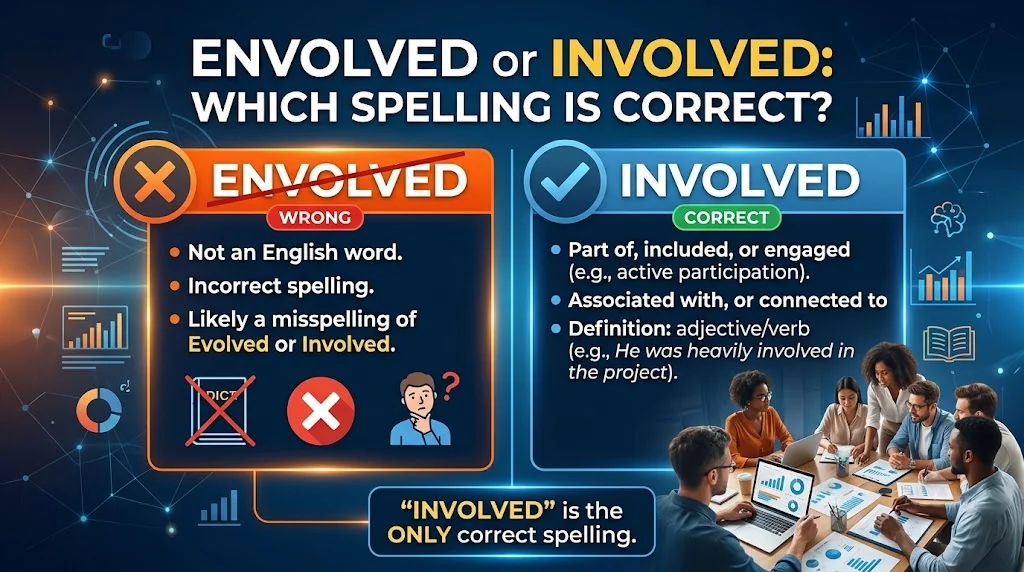
“Involved” is the correct spelling. “Envolved” is not a real word in standard English — it does not appear in any recognized dictionary, and it has no accepted grammatical use.
The confusion happens because the word sounds like it might start with “en-,” similar to words like enclosed, encoded, or envelope. But “involved” is built from the prefix in-, not en-. Keep that one detail in mind, and the spelling mistake disappears for good.
| Spelling | Correct? | Notes |
| Involved | ✅ Yes | Standard English word, found in all dictionaries |
| Envolved | ❌ No | Misspelling, not a recognized word |
What Does “Involved” Mean?
Definition and Meaning
“Involved” is the past tense and past participle of the verb “involve.” It’s also frequently used as an adjective. It generally means:
- Taking part in something, or being connected to a situation, activity, or relationship.
- Being complicated, complex, or detailed (when describing a situation, process, or explanation).
For example:
- She is involved in the school’s charity project. (taking part)
- The tax filing process is quite involved this year. (complicated)
Pronunciation of Involved
“Involved” is pronounced: in-VOLVD (/ɪnˈvɒlvd/ in British English, /ɪnˈvɑːlvd/ in American English).
- Stress falls on the second syllable: volved.
- The ending sounds like “volved,” rhyming with “solved” or “resolved.”
Quick Tip: If you can say “solved” and “resolved” correctly, you already know how to pronounce the end of “involved.”
Word Origin (Etymology)
Understanding where a word comes from often makes spelling much easier to remember.
“Involved” comes from the Latin verb involvere, meaning “to roll into, envelop, or entangle.” It’s built from:
- in- (meaning “into” or “in”)
- volvere (meaning “to roll”)
The word entered English through Old French and Latin roots in the 14th century, originally meaning “to wrap up” or “to entangle,” before evolving into its modern sense of “to take part in” or “to be connected with.”
Because the root is in-volvere, not en-volvere, there is no historical or linguistic basis for spelling it with “en-.” This etymology is the strongest proof that “envolved” has never been correct.
Parts of Speech
“Involved” functions in more than one grammatical role, which is part of why students sometimes get confused about how to use it.
| Form | Part of Speech | Example |
| Involve | Base verb | Many jobs involve travel. |
| Involves | Present tense (3rd person singular) | This recipe involves several steps. |
| Involved | Past tense verb | He involved his whole team in the decision. |
| Involved | Past participle (used with “have/has/had”) | She has involved her lawyer in the dispute. |
| Involved | Adjective | He is deeply involved in local politics. |
| Involving | Present participle / gerund | A case involving fraud was reported. |
Grammar Note: As an adjective, “involved” can appear before or after the noun it describes:
- An involved process (before the noun)
- He is involved (after the linking verb “is”)
Is “Envolved” a Real Word?
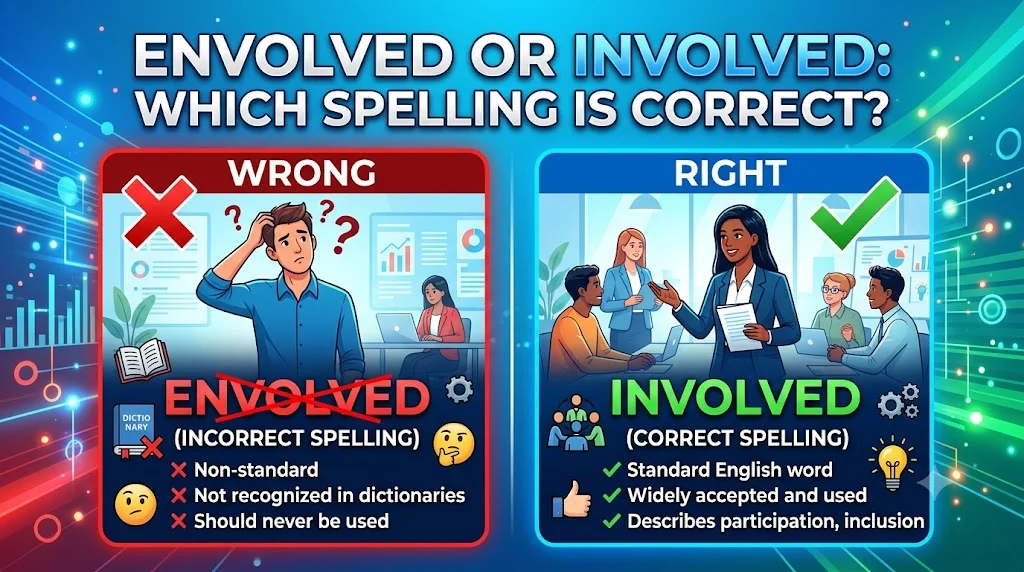
No. “Envolved” is not listed in Merriam-Webster, Oxford English Dictionary, Cambridge Dictionary, or any other major reference. It’s simply a common misspelling of “involved.”
You may occasionally see “envolved” used informally online, in casual texts, or in non-native English writing, but this doesn’t make it correct. It’s similar to writing “recieve” instead of “receive” — a frequent typo, not an alternate spelling.
Important distinction: In Spanish, the verb envolver means “to wrap” or “to involve,” and this may be part of why Spanish speakers learning English sometimes write “envolved.” But English simply does not use “en-” here.
Envolved vs Involved: Key Differences
| Feature | Involved | Envolved |
| Correct spelling | Yes | No |
| Found in dictionaries | Yes | No |
| Grammatically valid | Yes | No |
| Prefix used | in- | en- (incorrect) |
| Root word | involve | none (not a real root) |
| Used in formal writing | Yes | Never |
| Common in | All English writing | Typos, non-native writing, autocorrect errors |
Bottom line: There is no context — formal, informal, academic, or casual — where “envolved” is the right choice.
Why Do People Misspell “Involved” as “Envolved”?
Understanding why a mistake happens makes it much easier to stop making it. Here are the main reasons:
- Prefix confusion. English has many words that start with “en-” (enclose, enable, endure, enjoy), so the brain sometimes defaults to that pattern.
- Pronunciation blending. In fast speech, “in” and “en” can sound almost identical, especially in casual conversation.
- Cross-language interference. Speakers of Spanish, Portuguese, French, and Italian have similar-sounding words that use an “en-” pattern (like Spanish envolver), which carries over into English writing.
- Autocorrect and typing speed. Quick typing on phones sometimes swaps letters, and if autocorrect doesn’t catch it, the error goes unnoticed.
- Visual memory errors. Some learners simply memorize the word incorrectly the first time they see it and never get corrected.
Quick Tip: Remember the phrase “IN, not EN — involved begins like ‘invite.’” Both words share the same “in-” opening, and this small trick sticks in memory very well.
How to Use “Involved” Correctly
In Everyday Conversation
In daily speech, “involved” is used casually to describe participation, relationships, or complications.
- I don’t want to get involved in their argument.
- Are you still involved with that volunteer group?
- It’s a long story — a lot was involved.
Formal vs Informal: In casual conversation, people often shorten explanations with phrases like “it’s complicated” instead of “it’s quite involved,” which sounds slightly more formal.
In Professional Writing
In workplace communication, “involved” is common in describing responsibilities, collaboration, and project scope.
- All department heads were involved in the budget review.
- Please keep me involved in future client discussions.
- The onboarding process is more involved than expected.
Quick Tip: In emails and reports, “involved” often pairs naturally with words like stakeholders, team, process, and decision-making — all common business collocations.
In Academic Writing
Academic writing tends to use “involved” in a more precise, analytical way, often describing variables, participants, or complexity.
- The study involved 200 participants over six months.
- Several cognitive processes are involved in language acquisition.
- The methodology involved a mixed-methods approach.
Grammar Tip: In academic writing, “involved” is frequently used in the passive voice (“was involved,” “were involved”) to keep the tone objective and formal.
Correct and Incorrect Sentence Examples
Correct Examples
- She got involved in the community garden project.
- He was directly involved in planning the event.
- The negotiation process was long and involved.
- Many stakeholders are involved in this decision.
- Thank you for keeping me involved.
Incorrect Examples
- ❌ She got envolved in the community garden project.
- ❌ He was directly envolved in planning the event.
- ❌ The process was long and envolved.
- ❌ Many stakeholders are envolved in this decision.
Common Mistake Alert: Even one letter swap (“en-” instead of “in-“) makes the sentence grammatically incorrect and unprofessional in written English, especially in resumes, emails, and reports.
Involved vs Evolved: What’s the Difference?
This is another pair that gets mixed up — not because of spelling this time, but because the words look similar and are sometimes used in related contexts.
| Word | Meaning | Example |
| Involved | To take part in, or to be complex | She is involved in the project. |
| Evolved | To develop or change gradually over time | The company has evolved over the years. |
Key Difference: “Involved” is about participation or complexity, while “evolved” is about change, growth, or development over time. They are unrelated in meaning, even though they share several letters.
Example comparing both:
- The strategy has evolved significantly, and more team members are now involved in shaping it.
Common Grammar and Spelling Mistakes
Here are frequent errors learners make with “involved,” beyond the “envolved” issue:
- ❌ He is involve in the club. → ✅ He is involved in the club. (missing -d ending)
- ❌ They was involved. → ✅ They were involved. (subject-verb agreement)
- ❌ She involved with the case. → ✅ She is involved with the case / She was involved in the case. (missing linking verb, and correct preposition use)
- ❌ involved of → ✅ involved in or involved with (wrong preposition)
Grammar Tip: “Involved” is usually followed by “in” or “with”, never “of”.
- Involved in a project ✅
- Involved with a person or organization ✅
- Involved of ❌ (never correct)
Common Collocations with “Involved”
Native speakers naturally pair “involved” with certain words. Learning these collocations helps your English sound more fluent and natural.
- Get involved – I want to get involved in local politics.
- Stay involved – She stayed involved even after retiring.
- deeply involved – He is deeply involved in the negotiations.
- directly involved – Were you directly involved in the decision?
- actively involved – They remain actively involved in the community.
- involved parties – All involved parties must sign the agreement.
- Those involved – Thanks to everyone involved.
Synonyms of “Involved”
Depending on the meaning you intend, different synonyms work best.
When “involved” means participating:
- Engaged
- Participating
- Included
- Concerned
- Associated
- Connected
When “involved” means complicated:
- Complex
- Intricate
- Elaborate
- Complicated
- Convoluted
Example: The plot was so involved (complicated) that even engaged (participating) readers got confused.
Antonyms of “Involved”
| Meaning | Antonyms |
| Participating | Uninvolved, detached, unconnected, excluded |
| Complicated | Simple, straightforward, basic, clear |
Example: Unlike her uninvolved colleagues, she stayed engaged throughout the entire project.
Tips to Remember the Correct Spelling of “Involved”
- Think “IN,” not “EN.” Both “involve” and “invite” start the same way.
- Break it down: IN + VOLVE + D.
- Link it to “revolve.” Both words come from the Latin root volvere (“to roll”), and neither uses “en-.”
- Use a memory sentence: “If you’re IN it, you’re INvolved.”
- Say it slowly when writing: in-volved, emphasizing the “in” sound to reinforce spelling.
Frequently Confused Words
Involve vs Involved
“Involve” is the base verb (present tense), while “involved” is the past tense, past participle, or adjective form.
- This job involves teamwork. (present tense)
- She was involved in teamwork. (past/adjective)
Involved vs Included
“Included” means something is part of a group or list, without necessarily suggesting active participation. “Involved” often implies active participation or connection.
- The tax is included in the price. (part of something, passive)
- She is involved in tax planning. (active participation)
Involved vs Engaged
“Engaged” often implies active commitment, attention, or even a romantic commitment (engaged to be married). “Involved” is broader and doesn’t carry the romantic meaning.
- He is engaged in the discussion. (actively participating, attentive)
- He is involved in the discussion. (participating, more neutral)
- They are engaged. (to be married — “involved” cannot replace this meaning)
Involved vs Concerned
“Concerned” can mean either “worried” or “connected to a matter.” “Involved” only means connected or participating, never worried.
- She is concerned about the results. (worried)
- She is involved in the results. (participating in producing them)
Quick Practice Exercise
Test yourself. Choose the correct word: involved or envolved.
- He got _______ in the school play. (Answer: involved)
- The plan is more _______ than we expected. (Answer: involved)
- She has _______ her entire team. (Answer: involved)
- All parties _______ must agree. (Answer: involved)
- It’s a long, _______ explanation. (Answer: involved)
If you answered “involved” every time, congratulations — you’ve mastered the spelling.
Final Verdict: Envolved or Involved?
“Involved” is the only correct spelling. “Envolved” is a common misspelling with no dictionary support, no grammatical validity, and no acceptable use in formal, professional, or academic English. The confusion mostly comes from prefix mix-ups and cross-language influence, but once you remember that “involved” starts with “in-,” just like “invite” and “inside,” the mistake becomes easy to avoid permanently.
Final Thoughts
Spelling mistakes like “envolved” versus “involved” are common, but they’re also easy to fix once you understand the word’s structure and origin. “Involved” comes from the Latin in-volvere, meaning “to roll into,” and every correct use of the word keeps that “in-” prefix intact.
Whether you’re writing a casual text, a professional email, or an academic paper, using “involved” correctly signals attention to detail and strengthens your credibility as a writer. With the tips, examples, and practice exercises in this guide, you now have everything you need to use “involved” confidently and correctly, every single time.
Frequently Asked Questions (FAQs)
1. Is “envolved” ever correct in any dialect of English? No. “Envolved” is not recognized in American, British, Australian, or any other standard English dialect. It’s simply a misspelling of “involved,” with no accepted regional or historical variation supporting its use.
2. Why do people confuse “involved” with “envolved”? The confusion usually comes from similar-sounding prefixes (“in-” vs “en-“), fast speech pronunciation, and interference from other languages like Spanish, where a similar-sounding word uses “en-.” Autocorrect errors also contribute to the mistake.
3. What is the correct past tense of “involve”? The correct past tense and past participle of “involve” is “involved.” For example: She involved her manager in the discussion and He has involved his lawyer in the case.
4. Can “involved” be used as an adjective? Yes. “Involved” often functions as an adjective describing participation or complexity, such as an involved process or she is involved in charity work. It can appear before or after the noun it modifies.
5. What preposition goes with “involved”? “Involved” is typically followed by “in” or “with,” such as involved in a project or involved with a group. It is never followed by “of,” which is a common grammar mistake.