
Introduction
Have you ever wanted to describe an action that started in the past and is still continuing in the present? The present perfect continuous tense helps us express these situations clearly. It is commonly used to describe ongoing activities, the duration of actions, and recently stopped activities with visible results. Understanding its rules, sentence structures, and time expressions can help you communicate more naturally and improve your English grammar skills.
What Is the Present Perfect Continuous Tense?
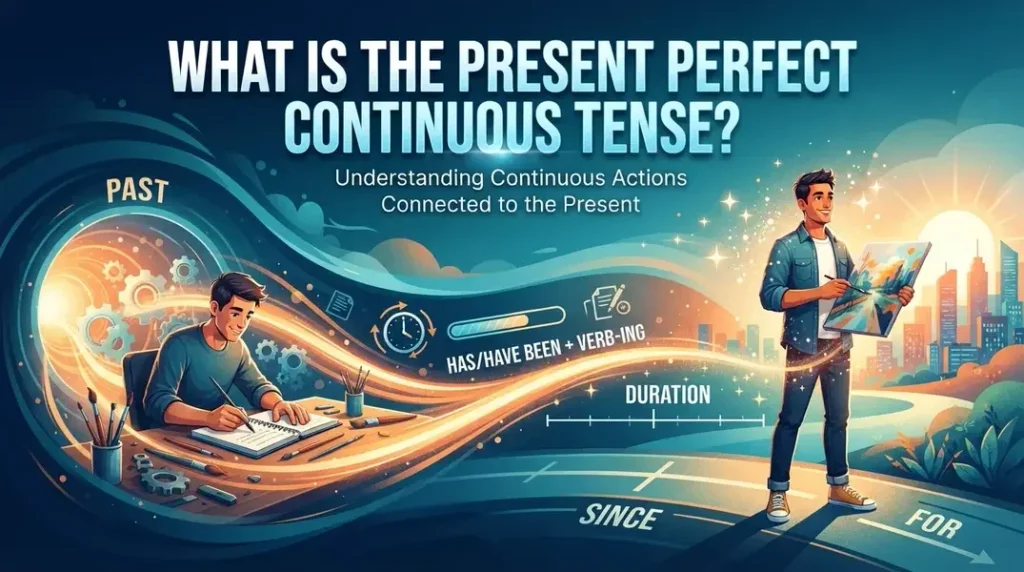
A grammatical tense used to describe an action that started in the past and is still continuing in the present or has recently stopped but has a connection to the present is called present perfect continuous tense. It emphasizes the duration or continuous nature of an activity rather than simply focusing on its completion.
It is formed by combining has/have + been + present participle (verb + ing).
Examples:
- She has been studying for three hours.
- I have been working since morning.
- They have been playing football.
- He has been learning English for two years.
- We have been waiting for the bus.
In these examples, the actions started in the past and continue into the present or have a present result.
Present Perfect Continuous Tense Structure
The present perfect continuous tense follows specific sentence structures depending on whether the sentence is affirmative, negative, interrogative, or interrogative.
1. Affirmative Sentences
Structure:
Subject + has/have + been + verb-ing + object.
Use has with he, she, it, and singular nouns. Use have with I, we, you, they, and plural nouns.
Examples:
- She has been reading a book.
- I have been learning English.
- They have been playing cricket.
- He has been working in this office.
- We have been preparing for the examination.
- My brother has been studying mathematics.
2. Negative Sentences
Structure:
Subject + has/have + not + been + verb-ing + object.
Use has not or have not to make negative sentences. Their contractions are hasn’t and haven’t.
Examples:
- She has not been sleeping well.
- I have not been watching television.
- They have not been attending classes.
- He hasn’t been working recently.
- We haven’t been practicing English.
- My sister has not been feeling well.
- The students haven’t been completing their assignments.
3. Interrogative Sentences
Structure:
Has/Have + subject + been + verb-ing + object +?
To form questions, place has or have before the subject.
Examples:
- Have you been studying English?
- Has she been working today?
- Have they been playing football?
- Has he been waiting for me?
- Have we been making progress?
- Has your brother been learning French?
4. Negative Interrogative Sentences
Structure:
Has/Have + subject + not + been + verb-ing + object +?
These sentences are used to express surprise, expectations, or confirmation.
Examples:
- Haven’t you been studying?
- Hasn’t she been working today?
- Haven’t they been waiting for us?
- Hasn’t he been practicing regularly?
- Haven’t we been discussing this issue?
- Hasn’t your brother been attending classes?
Uses of the Present Perfect Continuous Tense
The present perfect continuous tense has several important uses in everyday English. It helps explain how long an action has continued and why a present situation exists.
1. To Describe Actions That Started in the Past and Continue in the Present
Use this tense when an activity began in the past and is still happening now.
Examples:
- I have been studying English for three years.
- She has been working at this company since 2022.
- They have been living in this apartment for six months.
- He has been learning computer programming.
- We have been waiting for the teacher.
2. To Emphasize the Duration of an Action
Use the present perfect continuous tense when you want to emphasize how long an activity has been happening.
Examples:
- I have been reading this book for two hours.
- She has been teaching English for ten years.
- They have been playing cricket since afternoon.
- He has been working on this project for a week.
- We have been practicing grammar for several months.
3. To Describe Recently Stopped Actions With Present Results
Use this tense for activities that have recently stopped but whose effects or results are still noticeable.
Examples:
- She is tired because she has been running.
- His clothes are wet because he has been washing the car.
- The ground is muddy because it has been raining.
- I am exhausted because I have been working all day.
- Your eyes are red because you have been crying.
4. To Describe Repeated Activities Over a Period of Time
Use this tense to describe repeated activities that have been happening regularly or frequently during a period leading up to the present.
Examples:
- She has been calling me every evening.
- They have been practicing regularly this month.
- I have been visiting the library frequently.
- He has been asking the same question repeatedly.
- We have been attending extra classes recently.
5. To Explain the Cause of a Present Situation
Use this tense when an ongoing or recently completed activity explains a condition or situation in the present.
Examples:
- You look tired because you have been working hard.
- She is sweating because she has been exercising.
- The children are dirty because they have been playing outside.
- He is hungry because he has been working without a break.
- The kitchen smells wonderful because my mother has been cooking.
How to Use Has, Have, and Been in the Present Perfect Continuous Tense
The helping verbs has, have, and been are essential parts of the present perfect continuous tense.
- Use has with he, she, it, and singular nouns.
- Use have with I, we, you, they, and plural nouns.
- Use been after has or have.
- Use the -ing form of the main verb after been.
| Subject | Helping Verbs | Example |
| I | Have been | I have been studying. |
| You | Have been | You have been working. |
| We | Have been | We have been waiting. |
| They | Have been | They have been playing. |
| He | Has been | He has been reading. |
| She | Has been | She has been cooking. |
| It | Has been | It has been raining. |
| Ali | Has been | Ali has been learning English. |
Important Rule: Never omit been when forming the present perfect continuous tense. The correct structure is has/have + been + verb-ing.
How to Use the -ing Form of Verbs
The main verb in the present perfect continuous tense always appears in its present participle form, which generally ends in -ing.
However, some verbs require spelling changes before adding -ing.
1. Verbs That Simply Take -ing
For most verbs, add -ing directly to the base form.
| BaseVerb | PresentParticiple |
| Work | Working |
| Play | Playing |
| Read | Reading |
| Watch | Watching |
| Clean | Cleaning |
| Help | Helping |
Examples:
- She has been working hard.
- They have been playing outside.
- I have been reading a novel.
2. Verbs Ending in Silent -e
Remove the final silent -e before adding -ing.
| Base Verb | Present Participle |
| Write | Writing |
| Make | Making |
| Dance | Dancing |
| Drive | Driving |
| Take | Taking |
| Come | Coming |
Examples:
- He has been writing an article.
- She has been making dinner.
- They have been driving for hours.
3. Verbs With a Doubled Final Consonant
Some short verbs double their final consonant before adding -ing.
| Base Verb | Present Participle |
| Run | Running |
| Sit | Sitting |
| Swim | Swimming |
| Stop | Stopping |
| Plan | Planning |
| Get | Getting |
Examples:
- He has been running every morning.
- They have been swimming for an hour.
- I have been sitting here since noon.
4. Verbs Ending in -ie
Change -ie to -y before adding -ing.
| Base Verb | Present Participle |
| Lie | Lying |
| Die | Dying |
| Tie | Tying |
Examples:
- The child has been lying on the sofa.
- The patient has been dying slowly.
How to Use Since and For in the Present Perfect Continuous Tense
Since and for are commonly used with the present perfect continuous tense to describe the starting point and duration of an ongoing activity.
1. Use of Since
Use since to identify the specific starting point of an action.
It answers the question: When did the action start?
Examples:
- I have been studying since morning.
- She has been working here since 2021.
- They have been playing football since 4 p.m.
- He has been learning English since January.
- We have been waiting since noon.
2. Use of For
Use for to describe the length or duration of an activity.
It answers the question: How long has the action continued?
Examples:
- I have been studying for three hours.
- She has been working here for five years.
- They have been playing football for two hours.
- He has been learning English for six months.
- We have been waiting for thirty minutes.
Quick Comparison:
| Since | For |
| Starting point | Duration |
| Since 2020 | For six years |
| Since Monday | For several days |
| Since morning | For a few hours |
| Since childhood | For many years |
| Since 8 a.m. | For three hours |
Common Time Expressions Used With the Present Perfect Continuous Tense
Certain time expressions are frequently used with the present perfect continuous tense. They help explain the duration, frequency, or recent nature of an activity.
| Time Expression | Usage | Example |
| Since | Starting point | I have been working since morning. |
| For | Duration | She has been studying for two hours. |
| All day | Entire day | They have been playing all day. |
| All morning | Entire morning | He has been working all morning. |
| Recently | Recent activity | I have been exercising recently. |
| Lately | During the recent period | She has been feeling tired lately. |
| How long | Asking about duration | How long have you been waiting? |
| The whole week | Entire week | We have been preparing the whole week. |
Present Perfect Continuous Tense vs. Present Perfect Tense
The present perfect and present perfect continuous tenses both connect past actions with the present. However, they emphasize different aspects of an action.
The present perfect generally focuses on completion, results, or experiences, while the present perfect continuous emphasizes the duration or ongoing nature of an activity.
| Present Perfect Tense | Present Perfect Continuous Tense |
| I have read this book. | I have been reading this book for two hours. |
| She has written five articles. | She has been writing articles all morning. |
| They have played three matches. | They have been playing for three hours. |
| He has cleaned the room. | He has been cleaning the room since morning. |
| We have learned ten lessons. | We have been learning English for six months. |
Important Difference:
- Present Perfect: Focuses on the result or completion.
- Present Perfect Continuous: Focuses on the duration or continuation of an activity.
Present Perfect Continuous Tense vs. Present Continuous Tense
These two tenses both describe ongoing activities, but they refer to different time relationships.
The present continuous describes an action happening now, while the present perfect continuous describes an action that started in the past and continues into the present or has recently stopped.
| Present Continuous Tense | Present Perfect Continuous Tense |
| I am studying English. | I have been studying English for two hours. |
| She is cooking dinner. | She has been cooking dinner since 5 p.m. |
| They are playing football. | They have been playing football all afternoon. |
| He is working in the office. | He has been working in the office since morning. |
| We are waiting for the bus. | We have been waiting for the bus for thirty minutes. |
When Not to Use the Present Perfect Continuous Tense
Although the present perfect continuous tense is useful in many situations, it is not suitable for every verb or context.
1. With Many Stative Verbs
Stative verbs describe conditions, feelings, possession, or mental states rather than continuous physical activities. They are generally not used in continuous forms.
Incorrect: I have been knowing her for five years.
Correct: I have known her for five years.
Other examples:
- Incorrect: She has been owning this house for ten years.
- Correct: She has owned this house for ten years.
- Incorrect: He has been believing in this idea.
- Correct: He has believed in this idea.
2. When the Focus Is on a Completed Result
Use the present perfect tense when you want to emphasize the completed result rather than the duration of an activity.
Example:
- I have completed my homework. (The result is important.)
- I have been doing my homework for two hours. (The duration is important.)
3. With Specific Completed Past-Time Expressions
Do not normally use the present perfect continuous to describe an activity that happened entirely at a definite time in the past.
Incorrect: I have been working yesterday.
Correct: I worked yesterday.
4. With Actions That Are Not Naturally Continuous
Some activities are momentary and do not usually fit the continuous form when their completion is the main point.
Incorrect: She has been finding her keys.
Correct: She has found her keys.
Common Grammar Mistakes When Using the Present Perfect Continuous Tense
English learners sometimes make mistakes when choosing helping verbs, using been, adding -ing, and selecting time expressions.
Here are ten common mistakes with their corrections.
| Incorrect Sentence | Correct Sentence |
| She have been studying. | She has been studying. |
| He has been work here. | He has been working here. |
| I has been learning English. | I have been learning English. |
| They have been play football. | They have been playing football. |
| She has studying for two hours. | She has been studying for two hours. |
| I am working here since 2020. | I have been working here since 2020. |
| He has been knowing me for years. | He has known me for years. |
| Have she been waiting? | Has she been waiting? |
| They has been living here. | They have been living here. |
| I have been worked all day. | I have been working all day. |
Remember: The correct formula is subject + has/have + been + verb-ing. Always follow this structure when forming the present perfect continuous tense.
20 Examples of Present Perfect Continuous Tense in Everyday Sentences
Here are 20 practical examples that demonstrate how the present perfect continuous tense is used in everyday communication.
- I have been studying English for three hours.
- She has been preparing dinner since 6 p.m.
- They have been playing cricket all afternoon.
- He has been working on his new project.
- We have been learning English grammar for several months.
- My brother has been practicing the piano every day.
- The teacher has been explaining the lesson for an hour.
- I have been waiting for your response since morning.
- She has been writing articles for her website.
- They have been building a new shopping center.
- He has been exercising regularly this year.
- We have been discussing this problem for a long time.
- My parents have been traveling around Europe.
- The company has been developing a new application.
- It has been raining since last night.
- The children have been watching television for two hours.
- I have been improving my writing skills recently.
- She has been working from home since Monday.
- Our team has been preparing for the competition.
- You have been making excellent progress in English.
Quick Rules of the Present Perfect Continuous Tense
Remember these important rules when using the present perfect continuous tense:
- Use has with he, she, it, and singular nouns.
- Use have with I, we, you, they, and plural nouns.
- Always use been after has or have.
- Use the present participle (verb + ing) after been.
- Use has/have + not to form negative sentences.
- Place has or have before the subject to form questions.
- Use since to describe a starting point.
- Use for to describe the duration of an activity.
- Use this tense for actions that started in the past and continue in the present.
- Use it for recently stopped activities with noticeable present results.
- Avoid using continuous forms with most stative verbs.
- Use the present perfect when the completed result is more important than the duration.
Present Perfect Continuous Tense Practice Exercises
Test your understanding by completing the following exercises.
Exercise 1: Fill in the Blanks
Choose the correct form of the verb given in brackets.
- She ______ English for two years. (study)
- They ______ football since morning. (play)
- I ______ for my examination all week. (prepare)
- He ______ in this company since 2021. (work)
- We ______ for the bus for thirty minutes. (wait)
- My mother ______ dinner for an hour. (cook)
- The children ______ outside all afternoon. (play)
- It ______ since last night. (rain)
- You ______ your writing skills recently. (improve)
- He ______ regularly for the competition. (practice)
Exercise 2: Correct the Mistakes
Rewrite these sentences using the correct present perfect continuous structure.
- She have been working all day.
- He has been play cricket.
- I has been studying since morning.
- They have been wait for us.
- Has she studying for two hours?
Exercise Answers
Exercise 1: Fill in the Blanks
- has been studying
- have been playing
- have been preparing
- has been working
- have been waiting
- has been cooking
- have been playing
- has been raining
- have been improving
- has been practicing
Exercise 2: Correct the Mistakes
- She has been working all day.
- He has been playing cricket.
- I have been studying since morning.
- They have been waiting for us.
- Has she been studying for two hours?
Conclusion:
The present perfect continuous tense is an important part of English grammar because it helps describe ongoing activities, their duration, and recently completed actions with present results. By understanding its sentence structures, helping verbs, present participles, and time expressions, you can use this tense more accurately in everyday communication. Remember to follow the correct formula of has or have + been + verb-ing and use since and for appropriately. Regular practice with meaningful examples and exercises will help strengthen your English grammar skills and improve your communication.
FAQs:
1. What is the present perfect continuous tense?
The present perfect continuous tense describes an action that started in the past and continues in the present or has recently stopped with a present result.
Example: She has been studying for three hours.
2. What is the formula of the present perfect continuous tense?
The basic formula is:
Subject + has/have + been + verb-ing + object.
Example: They have been playing football.
3. When do we use the present perfect continuous tense?
We use this tense to describe ongoing actions, emphasize the duration of activities, explain repeated actions, and describe recently stopped activities with present results.
Example: I have been working since morning.
4. What is the difference between present perfect and present perfect continuous?
The present perfect focuses mainly on results, completion, or experiences, while the present perfect continuous emphasizes the duration or ongoing nature of an action.
Examples:
- I have written three articles.
- I have been writing articles for three hours.
5. What is the difference between since and for?
Since refers to the starting point of an action, whereas for describes how long an action has continued.
Examples:
- She has been working since Monday.
- She has been working for three days.
6. Can we use the present perfect continuous tense with stative verbs?
Generally, no. Stative verbs such as know, believe, own, and understand are usually not used in continuous forms.
Incorrect: I have been knowing him for years.
Correct: I have known him for years.
7. Can the present perfect continuous tense describe an action that has stopped?
Yes. It can describe a recently stopped action when its effects or results are still noticeable in the present.
Example: She is tired because she has been running.
