
Introduction
Have you ever wondered how to describe an action that happened in the past but still has a connection to the present? This is where the present perfect tense becomes important. It helps us talk about past experiences, completed actions, recent events, and situations that started in the past and continue today. Understanding its rules, sentence structures, and uses can help you communicate more naturally and accurately in English.
What Is the Present Perfect Tense?
The present perfect tense is a grammatical tense used to describe actions or situations that happened in the past but have a connection to the present. It can also express life experiences, recently completed activities, and actions that began in the past and continue up to now.
It is formed by combining has or have with the past participle (third form) of the main verb.
Examples:
- She has completed her homework.
- They have visited London.
- I have learned several new words.
- He has worked here for five years.
In these examples, the actions are connected to the present in different ways.
Present Perfect Tense Structure
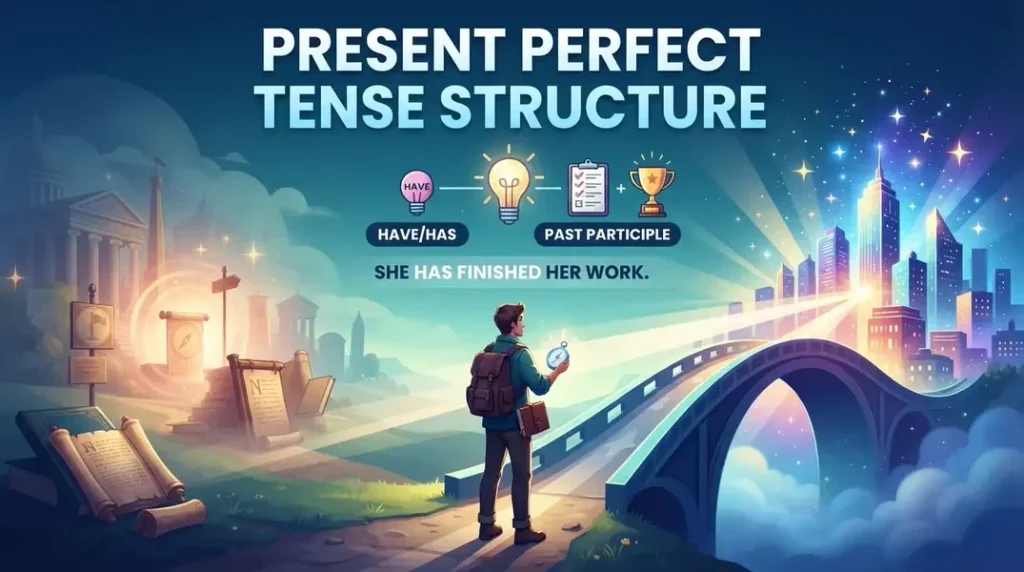
The present perfect tense follows a specific structure depending on whether the sentence is affirmative, negative, or interrogative.
1. Affirmative Sentences
Structure:
Subject + has/have + past participle (V3) + object.
Use has with he, she, it, and singular nouns. Use have with I, we, you, they, and plural nouns.
Examples:
- She has finished her assignment.
- I have completed my project.
- They have purchased a new house.
- He has written a letter.
- We have watched this movie.
2. Negative Sentences
Structure:
Subject + has/have + not + past participle (V3) + object.
Use has not or have not to make negative sentences. Their contractions are hasn’t and haven’t.
Examples:
- She has not finished her homework.
- I have not visited that place.
- They have not received the invitation.
- He hasn’t completed his work.
- We haven’t seen that movie.
3. Interrogative Sentences
Structure:
Has/Have + subject + past participle (V3) + object + ?
To form questions, place has or have before the subject.
Examples:
- Have you completed your assignment?
- Has she arrived at the office?
- Have they visited the museum?
- Has he finished his lunch?
- Have we made the right decision?
4. Negative Interrogative Sentences
Structure:
Has/Have + subject + not + past participle (V3) + object + ?
These questions are used to express surprise, expectations, or confirmation.
Examples:
- Haven’t you finished your homework?
- Hasn’t she called you?
- Haven’t they arrived yet?
- Hasn’t he submitted the report?
- Haven’t we met before?
Uses of the Present Perfect Tense
It has several important uses in everyday English. Understanding these situations will help you choose the correct tense.
1. To Describe Life Experiences
Use the present perfect tense to talk about experiences that have happened at some point in your life without mentioning a specific completed time.
Examples:
- I have visited Paris twice.
- She has never traveled by airplane.
- Have you ever eaten Japanese food?
- They have participated in several competitions.
- He has met many famous writers.
2. To Describe Recently Completed Actions
Use the present perfect tense for actions that have recently finished, especially when their results are important in the present.
Examples:
- I have just finished my breakfast.
- She has already submitted the application.
- They have recently moved to another city.
- He has just repaired the computer.
- We have completed the meeting.
3. To Describe Actions That Started in the Past and Continue in the Present
Use the present perfect tense for situations that began in the past and are still continuing.
Examples:
- I have lived here for ten years.
- She has worked at this company since 2020.
- They have known each other for a long time.
- He has studied English since childhood.
- We have been friends for many years.
4. To Describe Actions That Have Happened More Than Once
Use It when an action has occurred repeatedly before now.
Examples:
- I have watched this movie three times.
- She has visited her grandparents several times.
- They have called me twice today.
- He has read this book many times.
- We have discussed this topic before.
5. To Describe Unfinished Time Periods
Use the present perfect tense when an action happens during a time period that is not yet finished.
Examples:
- I have received five emails today.
- She has completed three lessons this week.
- They have played two matches this month.
- He has written several articles this year.
- We have had many meetings this morning.
How to Use Has and Have in the Present Perfect Tense
The helping verbs has and have are essential parts of the present perfect tense. Their selection depends on the subject of the sentence.
| Subject | Helping Verb | Example |
| I | Have | I have finished my work. |
| You | Have | You have done well. |
| We | Have | We have arrived. |
| They | Have | They have left. |
| He | Has | He has eaten lunch. |
| She | Has | She has called me. |
| It | Has | It has stopped raining. |
| Ali (singular noun) | Has | Ali has passed the exam. |
Important Rule: Never use has or have according to the main verb. Always select the helping verb according to the subject.
How to Use the Past Participle (V3)
The past participle is the third form of a verb. It is used with has or have to form the present perfect tense.
English verbs are generally divided into regular and irregular verbs.
1. Regular Verbs
Regular verbs usually form their past participle by adding -ed or -d to the base verb.
| Base Verb (V1) | Past (V2) | Past Participle (V3) |
| Work | Worked | Worked |
| Play | Played | Played |
| Clean | Cleaned | Cleaned |
| Visit | Visited | Visited |
| Open | Opened | Opened |
| Finish | Finished | Finished |
Examples:
- She has cleaned her room.
- I have visited my uncle.
- They have finished their assignments.
2. Irregular Verbs
Irregular verbs do not follow one fixed spelling rule. Their past participle forms must be learned individually.
| Base Verb (V1) | Past (V2) | Past Participle (V3) |
| Go | Went | Gone |
| Eat | Ate | Eaten |
| Write | Wrote | Written |
| See | Saw | Seen |
| Do | Did | Done |
| Take | Took | Taken |
| Break | Broke | Broken |
| Speak | Spoke | Spoken |
| Give | Gave | Given |
| Choose | Chose | Chosen |
Examples:
- He has written a story.
- They have eaten dinner.
- I have seen that film.
How to Use Since and For in the Present Perfect Tense
Since and for are commonly used with the present perfect tense to describe actions or situations that started in the past and continue up to the present.
1. Use of Since
Use since to identify the starting point of an action or situation.
It tells us when something began.
Examples:
- I have lived here since 2018.
- She has worked here since Monday.
- They have known each other since childhood.
- He has studied English since January.
- We have been friends since school.
2. Use of For
Use for to describe the duration of an action or situation.
It tells us how long something has continued.
Examples:
- I have lived here for eight years.
- She has worked here for six months.
- They have known each other for a long time.
- He has studied English for three years.
- We have been friends for ten years.
Quick Difference:
| Since | For |
| Starting point | Duration |
| Since 2020 | For six years |
| Since Monday | For three days |
| Since morning | For several hours |
| Since childhood | For many years |
Common Time Expressions Used with the Present Perfect Tense
Certain time expressions frequently appear with the present perfect tense. They help explain when an action happened or how it relates to the present.
| Time Expression | Usage | Example |
| Already | Something happened earlier than expected | She has already left. |
| Yet | Expected action, mainly in questions and negatives | Have you finished yet? |
| Just | A recently completed action | I have just arrived. |
| Ever | At any time in your life | Have you ever traveled abroad? |
| Never | Not at any time | I have never seen snow. |
| Recently | Not long ago | He has recently changed jobs. |
| Lately | During the recent period | I haven’t slept well lately. |
| So far | Up to this point | We have completed five lessons so far. |
| Before | At an earlier time | I have seen this movie before. |
Present Perfect Tense vs. Simple Past Tense
The present perfect tense and simple past tense both describe past actions, but they are used differently.
The present perfect connects a past action to the present, while the simple past describes an action completed at a definite time in the past.
| Present Perfect Tense | Simple Past Tense |
| I have visited London. | I visited London last year. |
| She has completed her work. | She completed her work yesterday. |
| They have eaten lunch. | They ate lunch at noon. |
| He has written a book. | He wrote a book in 2020. |
| We have watched this movie. | We watched this movie last night. |
Important Rule: Do not normally use the present perfect with a definite, completed past-time expression such as yesterday, last week, or in 2020.
Difference Between Been and Gone in the Present Perfect Tense
The words been and gone are both past participles of the verb go, but they have different meanings when used in the present perfect tense.
Been
Use been when someone has visited a place and returned.
Examples:
- I have been to London.
- She has been to the library.
- They have been to Paris twice.
Gone
Use gone when someone has gone somewhere and has not yet returned.
Examples:
- He has gone to the office.
- She has gone to the market.
- They have gone to the airport.
Quick Comparison:
- I have been to the bank. (I visited and returned.)
- I have gone to the bank. (I went there and have not returned yet.)
When Not to Use the Present Perfect Tense
Although the present perfect is useful in many situations, it is not appropriate in every context.
1. With Definite Finished Past-Time Expressions
Do not use the present perfect with a specific completed time in the past.
Incorrect: I have visited London yesterday.
Correct: I visited London yesterday.
2. For Actions Happening Right Now
Use the present continuous tense for an action happening at the moment of speaking.
Incorrect: She has cooking dinner now.
Correct: She is cooking dinner now.
3. For Regular Habits and Routines
Use the simple present tense for regular habits and repeated routines.
Incorrect: He has drinks coffee every morning.
Correct: He drinks coffee every morning.
4. With Past Events That Have No Present Connection
When simply narrating a completed past event, use the simple past tense.
Incorrect: Shakespeare has written Hamlet.
Correct: Shakespeare wrote Hamlet.
Common Grammar Mistakes When Using the Present Perfect Tense
English learners often make mistakes when choosing helping verbs, past participles, and time expressions.
Here are ten common mistakes with their corrections.
| Incorrect Sentence | Correct Sentence |
| She have finished her work. | She has finished her work. |
| I has completed my task. | I have completed my task. |
| He has went home. | He has gone home. |
| They have ate dinner. | They have eaten dinner. |
| I have seen him yesterday. | I saw him yesterday. |
| She has not went there. | She has not gone there. |
| Have she finished her work? | Has she finished her work? |
| I am living here since 2020. | I have lived here since 2020. |
| He has finish his homework. | He has finished his homework. |
| Did you have completed it? | Have you completed it? |
Remember: Always use has or have with the third form of the main verb when forming the present perfect tense.
20 Examples of Present Perfect Tense in Everyday Sentences
Here are 20 practical examples to help you understand how the present perfect tense is used in different situations.
- I have completed my English grammar course.
- She has prepared dinner for her family.
- They have moved to a new apartment.
- He has purchased a brand-new laptop.
- We have learned many useful grammar rules.
- My brother has passed his driving test.
- The teacher has explained the lesson clearly.
- I have received your email.
- She has improved her writing skills.
- They have built a beautiful house.
- He has forgotten his password.
- We have visited several historical places.
- My parents have traveled to Canada.
- The company has launched a new product.
- I have never tried Italian food.
- She has already completed her assignment.
- The students have submitted their projects.
- Someone has taken my notebook.
- Our team has won three matches this season.
- Have you ever written an English article?
Present Perfect Tense Practice Exercises
Test your understanding by completing the following exercises.
Exercise 1: Fill in the Blanks
Choose the correct form of the verb given in brackets.
- She ______ her homework. (complete)
- They ______ to London twice. (go)
- I ______ my breakfast. (eat)
- He ______ a new car. (buy)
- We ______ this movie before. (see)
- My father ______ his office. (leave)
- You ______ a beautiful story. (write)
- The students ______ their assignments. (submit)
- She ______ here since 2022. (work)
- I ______ never ______ sushi. (try)
Exercise 2: Correct the Mistakes
Rewrite these sentences using the correct present perfect structure.
- She have finished her work.
- He has went to school.
- I has seen this movie.
- They have ate their lunch.
- Have she completed the project?
Exercise Answers
Exercise 1: Fill in the Blanks
- has completed
- have been
- have eaten
- has bought
- have seen
- has left
- have written
- have submitted
- has worked
- have never tried
Exercise 2: Correct the Mistakes
- She has finished her work.
- He has gone to school.
- I have seen this movie.
- They have eaten their lunch.
- Has she completed the project?
Conclusion:
The present perfect tense is an essential part of English grammar because it connects past actions and experiences with the present. By understanding its sentence structures, helping verbs, past participles, and time expressions, you can use it more accurately in everyday communication. Remember to use has or have with the third form of the main verb and distinguish between the present perfect and simple past. Regular practice with meaningful examples will help you strengthen your grammar skills and communicate more effectively in English.
FAQ:
1. What is the present perfect tense?
The present perfect tense describes past actions or situations connected to the present. It is formed using has or have with the past participle of the main verb.
Example: She has completed her homework.
2. What is the formula of the present perfect tense?
The basic formula is:
Subject + has/have + past participle (V3) + object.
Example: They have finished their work.
3. When do we use has and have in the present perfect tense?
Use has with he, she, it, and singular nouns. Use have with I, we, you, they, and plural nouns.
Examples:
- He has arrived.
- They have arrived.
4. What is the difference between since and for?
Since identifies the starting point of an action, while for describes its duration.
Examples:
- I have lived here since 2020.
- I have lived here for six years.
5. Can we use yesterday with the present perfect tense?
No. We generally use the simple past tense with yesterday because it refers to a specific, completed time in the past.
Incorrect: I have visited him yesterday.
Correct: I visited him yesterday.
6. What is the difference between been and gone?
Been indicates that someone visited a place and returned, while gone indicates that someone went somewhere and has not yet returned.
Examples:
- She has been to London.
- She has gone to London.
7. What is the past participle of irregular verbs?
The past participle is the third form of a verb. Irregular verbs have different forms that do not always follow the regular -ed pattern.
Examples:
- Go – Went – Gone
- Eat – Ate – Eaten
- Write – Wrote – Written

I am passionate about the English language, grammar, vocabulary, and effective communication. Through Grammar Hub Pro, I aim to help students, professionals, teachers, and English learners improve their language skills. I enjoy exploring English grammar rules, discovering useful words, explaining idioms and phrases, and sharing practical writing tips. My goal is to make learning English simple, clear, and enjoyable for everyone. I create helpful, easy-to-understand content with practical examples so readers can use English more confidently in everyday conversations, academic studies, and professional communication. I believe learning English should be accessible to everyone.