
The word “the” is known as the definite article in English grammar. It is used before a noun when referring to a specific or identifiable person, place, object, or idea. Unlike a and an, which introduce nonspecific nouns, the helps readers and listeners understand exactly what someone is talking about. For example, in the sentence “Please close the door,” the word the indicates a particular door that the listener can identify. Do not use the when talking about things in general, such as languages, meals, sports, and most personal names.
Unlike a and an, which generally introduce a nonspecific singular countable noun, the points to something particular or identifiable.
For example:
- I saw a dog in the street. (Any dog; it is not yet identified.)
- The dog was barking loudly. (A particular dog already mentioned.)
In the first sentence, a introduces the dog for the first time. In the second sentence, the refers to the same dog, so the reader knows which animal is being discussed.
Why Is “The” Important in English Grammar?
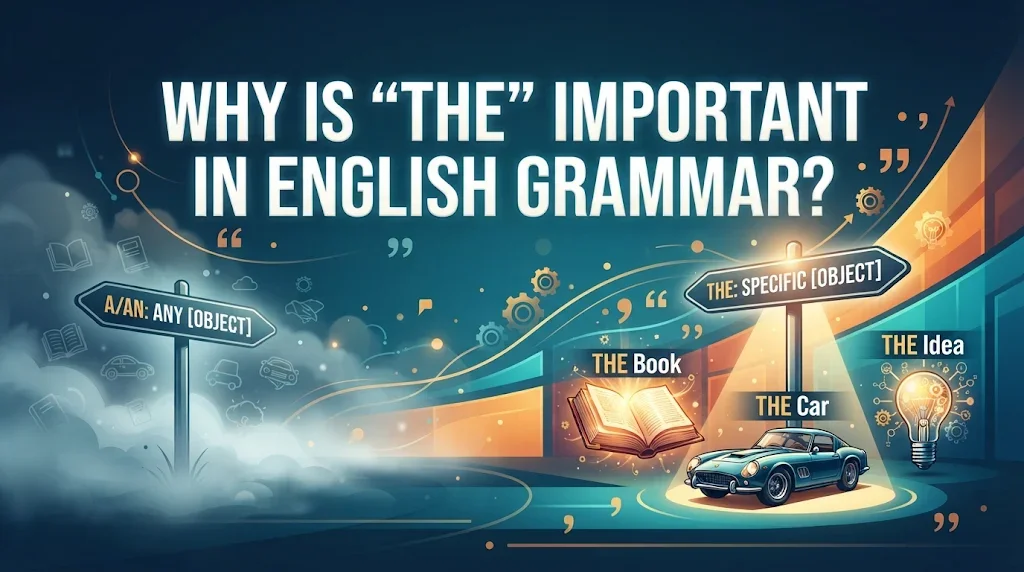
The definite article helps readers and listeners understand exactly which noun someone is talking about. Without it, sentences may sound incomplete, unnatural, or confusing.
Consider these examples:
- She closed the door.
- He is the manager of this company.
- We visited the museum yesterday.
In each sentence, the identifies a particular noun rather than referring to something in general.
Quick Grammar Rules for Using “The”
Here is a simple summary of the most important rules to remember.
- Use the when referring to a specific or identifiable noun.
- Use the when mentioning a noun for the second time.
- Use the with unique things, such as the sun and the moon.
- Use the before superlative adjectives, such as the best and the tallest.
- Use the with ordinal numbers when identifying a position in a sequence.
- Use the with rivers, oceans, seas, deserts, and mountain ranges.
- Use the with certain country names, such as the United States and the United Kingdom.
- Use the before adjectives that represent groups of people, such as the rich and the elderly.
What Is the Difference Between “The,” “A,” and “An”?
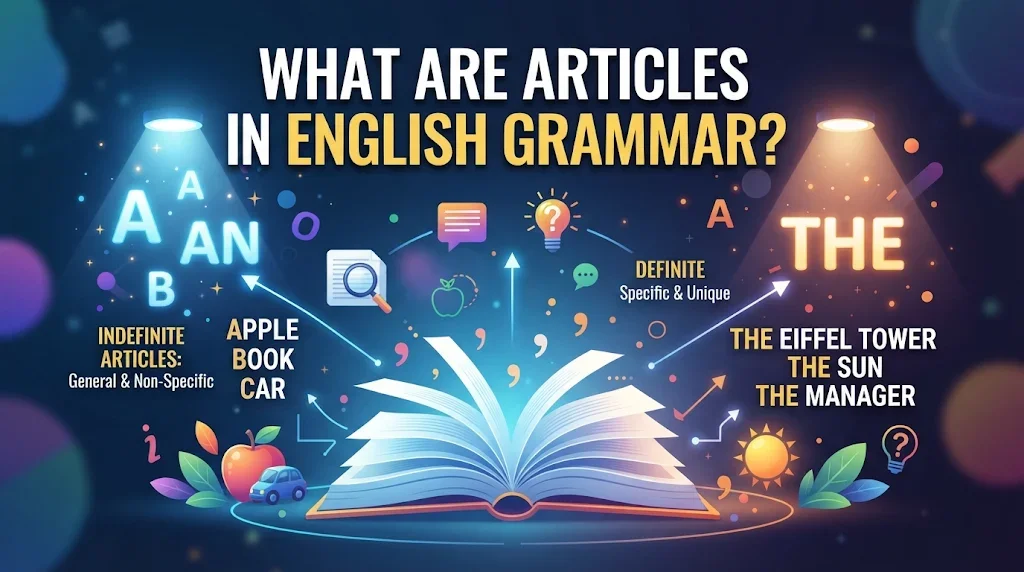
English has three main articles: a, an, and the. They are divided into two categories: definite and indefinite articles.
- The: A definite article used for a specific or identifiable noun.
- A: An indefinite article used before a singular countable noun beginning with a consonant sound.
- An: An indefinite article used before a singular countable noun beginning with a vowel sound.
The main difference is whether the noun is specific or nonspecific.
| Article | Type | Main Usage | Example |
| The | Definite | A particular noun | The teacher is here. |
| A | Indefinite | A nonspecific noun | I need a pen. |
| An | Indefinite | A nonspecific noun | She ate an apple. |
Remember: Use the when the reader or listener can identify which person or thing you mean. Use a or an when introducing a nonspecific singular countable noun.
When to Use “The” in English
There are several situations in which the definite article the is necessary. Understanding these rules will help you recognize when a noun refers to something specific.
1. To Refer to Something Mentioned Before
Use the definite article when referring to a noun that has already been introduced.
- I bought a book. The book is interesting.
- She saw a dog. The dog was black.
2. To Refer to Unique Things
Use the before nouns that refer to something unique or commonly understood as one of a kind.
- The sun rises in the east.
- The moon looks beautiful tonight.
- The Earth revolves around the sun.
3. To Refer to Specific People, Places, or Things
Use the when the person, place, or object is clearly identifiable.
- Please close the door.
- Where is the teacher?
- Put the keys on the table.
4. With Superlative Adjectives
Use the before superlative adjectives such as best, tallest, biggest, and most beautiful.
- She is the best student in the class.
- He is the tallest boy in the group.
- This is the most beautiful place.
5. With Ordinal Numbers
Use the ordinal numbers before when identifying a particular position or order.
- He won the first prize.
- This is the second chapter.
- She lives on the third floor.
6. With Names of Rivers, Seas, and Oceans
Use the before the names of most rivers, seas, and oceans.
- The Nile is a famous river.
- The Pacific Ocean is the largest ocean.
- The Arabian Sea is near India.
7. With Names of Mountain Ranges
Use the before the names of mountain ranges.
- The Himalayas are very beautiful.
- The Alps are located in Europe.
- The Rocky Mountains extend across North America.
8. With Certain Country Names
Use the with certain country names, particularly those containing words such as states, kingdom, or republic.
- The United States
- The United Kingdom
- The United Arab Emirates
- The Netherlands
9. With Musical Instruments
Use the when talking about playing musical instruments as a general skill or activity.
- She plays the piano.
- He plays the guitar.
- My brother plays the violin.
10. With Adjectives Referring to Groups of People
Use the before certain adjectives to refer to entire groups of people.
You stoppedResume
Think
To pick up a draggable item, press the space bar. While dragging, use the arrow keys to move the item. Press space again to drop the item in its new position, or press escape to cancel.
Quick Comparison: When Not to Use “The”
| Situation | Incorrect | Correct |
| General plural nouns | The dogs are loyal. | Dogs are loyal. |
| General uncountable nouns | The water is important. | Water is important. |
| Personal names | The John is here. | John is here. |
| Languages | She speaks the English. | She speaks English. |
| Academic subjects | The mathematics is interesting. | Mathematics is interesting. |
| Meals | I had the breakfast. | I had breakfast. |
| Country names | The Pakistan is beautiful. | Pakistan is beautiful. |
| City names | The London is beautiful. | London is beautiful. |
| Continents | The Asia is large. | Asia is large. |
| Individual mountains | The Mount Everest is high. | Mount Everest is high. |
Special Rules and Tricky Situations When Using “The”
Some grammatical situations can confuse even experienced English learners. The following rules explain important exceptions and special cases.
1. Use “The” Before an Adjective When It Describes a Specific Noun
When an adjective comes before a specific noun, the article is generally placed before the adjective.
Examples:
- The beautiful house belongs to my uncle.
- She bought the red dress.
- He repaired the broken window.
- I visited the old library.
Incorrect: She bought red dress.
Correct: She bought the red dress. (If a particular dress is intended.)
Remember that adjectives do not change the basic article rule. The article comes before the adjective and its noun.
2. Use “The” Before Certain Abbreviations and Acronyms
The use of the with abbreviations depends on the full name, established convention, and context.
Examples:
- The USA is a large country.
- The UK has a long history.
- The BBC broadcasts news worldwide.
- The UN promotes international cooperation.
However, not every abbreviation requires the. For example:
- NASA conducts space research.
- UNESCO promotes education and culture.
- NATO is an international alliance.
3. Pronunciation of “The” Before Vowel and Consonant Sounds
The pronunciation of the changes depending on the sound that follows it.
There are two common pronunciations:
| Pronunciation | When to Use | Example |
| /ðə/ (thuh) | Before a consonant sound | The book, the car |
| /ðiː/ (thee) | Before a vowel sound | The apple, the orange |
Important: The rule depends on the sound, not simply the written letter.
Examples:
- The university (/ðə/): University begins with a consonant /j/ sound.
- The hour (/ðiː/): The h is silent, so the word begins with a vowel sound.
- The European country (/ðə/): European begins with a consonant /j/ sound.
- The honest person (/ðiː/): Honest begins with a vowel sound because its h is silent.
When emphasizing a word, speakers may also pronounce the as /ðiː/ before a consonant sound.
4. Use “The” with Some Fixed Expressions
Certain expressions traditionally include the definite article.
Examples:
- Tell the truth.
- Play the role of a teacher.
- Take the risk.
- Make the most of your time.
- On the other hand.
- In the future.
- By the way.
These expressions are best learned as common grammatical patterns.
Common Grammar Mistakes When Using “The”
English learners often make mistakes when deciding whether to include or omit the definite article. Here are 10 common errors, along with their corrections and explanations.
| No. | Incorrect Sentence | Correct Sentence | Explanation |
| 1 | The life is beautiful. | Life is beautiful. | Use no article when discussing life in general. |
| 2 | She speaks the English. | She speaks English. | Language names generally do not take articles. |
| 3 | The Mount Everest is very high. | Mount Everest is very high. | Individual mountain names usually take no article. |
| 4 | I go to the school every day. | I go to school every day. | School without an article refers to attending school as a student. |
| 5 | The my father is kind. | My father is kind. | Do not combine the with a possessive determiner. |
| 6 | He plays piano well. | He plays the piano well. | The definite article is commonly used with musical instruments. |
| 7 | The dogs are loyal animals. | Dogs are loyal animals. | Use no article for dogs in general. |
| 8 | She is best student in class. | She is the best student in the class. | Superlatives generally require the. |
| 9 | I had the breakfast at 8. | I had breakfast at 8. | Meal names generally take no article when used generally. |
| 10 | The United States are a country. | The United States is a country. | The country name takes the and is treated as singular. |
20 Practical Examples of “The” in Sentences
Here are 20 original examples showing how the definite article is used in everyday conversations, education, professional communication, and general writing.
Everyday English Examples
- Please leave the keys beside the front door.
- My mother is cleaning the kitchen before the guests arrive.
- We enjoyed the sunset from our hotel balcony.
- Could you pass me the salt on your left?
- I forgot to lock the gate before leaving home.
Academic and Educational Examples
- The research presented in this paper supports the main argument.
- Students must submit their assignments before the deadline.
- The teacher explained the difficult concept using simple examples.
- We discussed the causes of climate change during the lecture.
- Please review the final chapter before taking the examination.
Professional and Workplace Examples
- The director will announce the company’s new strategy tomorrow.
- Please send the updated report to the finance department.
- We discussed the proposal during yesterday’s meeting.
- The customer requested additional information about the product.
- Our team successfully completed the project ahead of schedule.
General English Writing Examples
- The quality of a product often influences customer satisfaction.
- The development of technology has transformed modern communication.
- The environment requires protection from pollution.
- The decision was based on careful consideration.
- The opportunity allowed her to develop new professional skills.
Practice Exercise: 10 Questions on the Definite Article “The”
Choose the correct answers.
1. ___ sun rises in the east.
A
An
The
No article
2. I usually have ___ breakfast at 8 a.m.
A
An
The
No article
3. She is ___ best student in the class.
A
An
The
No article
4. ___ Mount Everest is the highest mountain above sea level.
A
An
The
No article
5. He plays ___ guitar very well.
A
An
The
No article
6. ___ water in this glass is cold.
A
An
The
No article
7. ___ children need love and care.
A
An
The
No article
8. We visited ___ United States last year.
A
An
The
No article
9. She speaks ___ English fluently.
A
An
The
No article
10. Please close ___ door.
A
An
The
No article
Explanation of Answers
- The sun – We use “the” because there is only one sun in our solar system.
- Breakfast – We generally do not use an article before the names of meals.
- The best student – We use “the” before superlative adjectives.
- Mount Everest – We do not normally use “the” before the names of individual mountains.
- The guitar – We use “the” when talking about musical instruments in a general sense.
- The water – We use “the” when referring to specific water.
- Children – We do not use “the” when talking about children in general.
- The United States – We use “the” with this country’s name.
- English – We generally do not use “the” before the names of languages.
- The door – We use “the” when referring to a specific door.
Conclusion:
Understanding the uses of the in English is essential for developing accurate grammar and effective communication. The definite article identifies specific, previously mentioned, or easily recognized nouns. It is commonly used with unique things, superlatives, ordinal numbers, geographical names, and particular groups of people. However, it is generally omitted when discussing plural and uncountable nouns in a general sense, languages, meals, and most personal names. By learning these rules, recognizing exceptions, and practicing with everyday sentences, you can use the definite article the more naturally and confidently in both speaking and writing.
FAQs:
1. What Is the Definite Article “The” in English Grammar?
The definite article the is used before a noun when referring to a particular or identifiable person, place, object, or idea. It helps readers understand exactly which noun is being discussed.
Example: The girl standing near the entrance is my sister.
Here, the identifies a particular girl.
2. When Should We Use “The” in a Sentence?
Use the when a noun is specific, already mentioned, unique, or clearly understood from the context. It is also commonly used with superlatives, ordinal numbers, rivers, oceans, and certain geographical names.
Example: She bought a dress yesterday. The dress is blue.
3. What Is the Difference Between “The” and “A”?
The main difference is that the identifies a specific noun, while a generally introduces a nonspecific singular countable noun.
Examples:
- I saw a bird. (Any bird.)
- The bird was beautiful. (A particular bird.)
4. Can We Use “The” with Plural Nouns?
Yes. We use the with plural nouns when referring to a particular or identifiable group. However, we usually omit it when discussing plural nouns in general.
Examples:
- The players in our team are talented.
- Players need regular practice.
5. Can We Use “The” with Uncountable Nouns?
Yes. The definite article can be used with uncountable nouns when they refer to something specific. However, it is generally omitted when discussing them in a general sense.
Examples:
- Water is necessary for survival.
- The water in this glass is fresh.
6. Why Do We Say “The Sun” but Not “The Nature”?
We use the sun because it refers to the unique star at the center of our solar system. However, nature is generally used without an article when referring to the natural world as a whole.
Examples:
- The sun rises in the east.
- Nature provides essential resources for life.
We can also say the nature of something when discussing its particular character or qualities.
7. How Do We Pronounce “The” Correctly?
The word the has two common pronunciations:
- /ðə/ (thuh): Usually before a consonant sound, as in the book.
- /ðiː/ (thee): Usually before a vowel sound, as in the apple.
Remember that pronunciation depends on the first sound of the following word rather than its first written letter.

I am passionate about the English language, grammar, vocabulary, and effective communication. Through Grammar Hub Pro, I aim to help students, professionals, teachers, and English learners improve their language skills. I enjoy exploring English grammar rules, discovering useful words, explaining idioms and phrases, and sharing practical writing tips. My goal is to make learning English simple, clear, and enjoyable for everyone. I create helpful, easy-to-understand content with practical examples so readers can use English more confidently in everyday conversations, academic studies, and professional communication. I believe learning English should be accessible to everyone.