
One of the most commonly used tenses in English grammar is the simple present tense, also known as the present indefinite tense. It describes daily routines, habits, general truths, repeated actions, and permanent situations. For example, “She goes to school every day” and “The sun rises in the east” are sentences in the simple present tense. Learning its rules, sentence structures, and uses helps you communicate clearly and construct grammatically correct sentences. It is a verb tense used to describe habits, routines, repeated actions, general facts, universal truths, and situations that are generally true in the present.
Examples of the Simple Present Tense:
- I drink coffee every morning.
- She teaches English at a school.
- They play football on Sundays.
- Water boils at 100°C at standard atmospheric pressure.
- He lives in London.
When Do We Use the Simple Present Tense?
There are several situations in which we use the simple present tense.
1. Daily Routines and Habits
To talk about activities that happen regularly or repeatedly , we use the simple present.
Examples:
- I wake up at 6 a.m. every day.
- She brushes her teeth twice a day.
- My father reads the newspaper every morning.
2. General Facts and Universal Truths
To express facts and things that are generally accepted as true.
Examples:
- The Earth revolves around the Sun.
- Birds have wings.
- Ice melts when it gets warm.
3. Permanent Situations
We use this tense to describe situations that are relatively permanent or continue for a long time.
Examples:
- My brother works in a bank.
- She lives in New York.
- They own a small business.
4. Timetables and Schedules
It is also used for fixed schedules and officially arranged events, especially in transportation and public programs.
Examples:
- The train leaves at 8:30 a.m.
- The school opens at 9 a.m.
- The flight arrives at midnight.
5. Likes, Dislikes, and Feelings
We use the simple present to describe emotions, preferences, opinions, and mental states.
Examples:
- I love chocolate.
- She likes classical music.
- He believes in hard work.
How to Form the Simple Present (Structure)
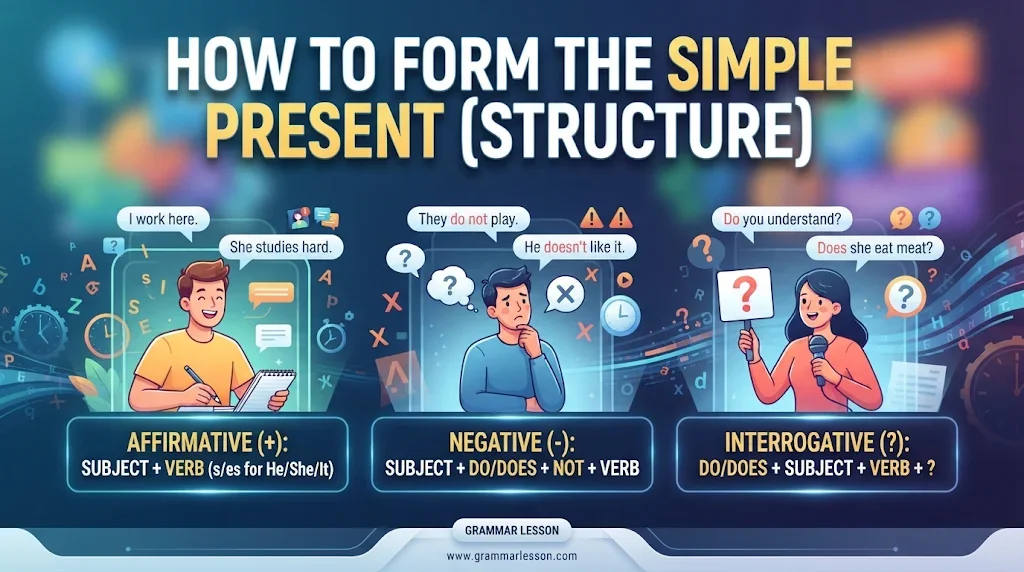
The structure of the simple present tense depends on the subject and the type of sentence. For most verbs, we use the base form of the verb with I, you, we, and they. With he, she, and it, we generally add -s or -es to the verb.
The basic structures are:
| Sentence Type | Structure | Example |
| Affirmative | Subject + V1 + Object | I play cricket. |
| Negative | Subject + do/does + not + V1 + Object | She does not play cricket. |
| Interrogative | Do/Does + Subject + V1 + Object? | Do you play cricket? |
1. Affirmative Formula
Subject + V1 (s/es) + Object.
- I play cricket.
- She reads books.
- He goes to school.
2. Negative Formula
Subject + do/does + not + V1 + Object.
- I do not play cricket.
- She does not read books.
- He does not go to school.
3. Interrogative Formula
Do/Does + Subject + V1 + Object?
- Do you play cricket?
- Does she read books?
- Does he go to school?
4. Negative Interrogative Formula
Do/Does + Subject + not + V1 + Object?
- Do you not play cricket?
- Does she not read books?
- Does he not go to school?
First-Person in Simple Present
First-person pronouns include I and we. When using these subjects, we use the base form of the main verb without adding -s or -es.
Structure:
Subject (I/We) + Base Form of Verb + Object.
Examples:
- I study English every day.
- I work in an office.
- We play football after school.
- We visit our grandparents on weekends.
- I write articles for my website.
Notice that the verb remains in its original form with both I and we.
Second-Person in Simple Present
The second-person pronoun is you. It can refer to one person or multiple people. We always use the base form of the verb with you.
Structure:
Subject (You) + Base Form of Verb + Object.
Examples:
- You speak English fluently.
- You work very hard.
- You understand the lesson.
- You drink enough water.
- You help your friends.
Even when you refer to a single person, the main verb does not take -s or -es.
Third-Person in Simple Present
Third-person singular pronouns include he, she, and it. We also use this rule with singular nouns and names.
Unlike first-person and second-person subjects, third-person singular subjects require an -s or -es ending on most main verbs in affirmative sentences.
Structure:
Subject (He/She/It) + Verb (s/es) + Object.
Examples:
- He plays football every evening.
- She teaches English.
- It rains heavily in July.
- John works in a hospital.
- My mother cooks delicious food.
Rules for Adding -s and -es
- Add -s to most verbs: play → plays, read → reads.
- Add -es to verbs ending in -sh, -ch, -ss, -x, and -z: wash → washes, watch → watches, fix → fixes.
- For verbs ending in a consonant + y, change y to -ies: study → studies, carry → carries.
- For verbs ending in a vowel + y, simply add -s: enjoy → enjoys, play → plays.
- Some verbs are irregular: have → has, do → does, go → goes.
These spelling rules help you form grammatically correct third-person singular sentences.
How to Ask a Question in the Simple Present
To make questions in the simple present tense, place do or does before the subject. The main verb remains in its base form.
Use do with I, you, we, and they. Use does with he, she, and it.
Structure:
Do/Does + Subject + Base Form of Verb + Object + ?
Examples:
- Do you speak English?
- Do they live in Canada?
- Do we need more time?
- Does he play cricket?
- Does she work here?
- Does your brother drive a car?
WH-Questions in the Simple Present
We can also use question words such as what, where, when, why, who, and how to ask more specific questions.
Structure:
WH-Word + Do/Does + Subject + Base Form of Verb + ?
Examples:
- Where do you live?
- What does she do?
- When do they arrive?
- Why does he study English?
- How do you prepare breakfast?
These questions help us ask about routines, preferences, facts, and everyday activities.
Common Verbs in the Simple Present
Many common English verbs are regularly used in the simple present tense to describe daily activities, habits, feelings, and general situations.
Here are some frequently used verbs with their third-person singular forms and example sentences.
| Base Verb | Third-Person Form | Example |
| Go | Goes | She goes to school. |
| Do | Does | He does his homework. |
| Have | Has | She has a new phone. |
| Watch | Watches | He watches television. |
| Study | Studies | My brother studies English. |
| Play | Plays | John plays football. |
| Read | Reads | She reads books. |
| Write | Writes | He writes stories. |
| Teach | Teaches | My father teaches mathematics. |
| Work | Works | She works in a hospital. |
| Wash | Washes | He washes his car. |
| Try | Tries | She tries her best. |
Learning these common verbs and their third-person forms can help you improve your sentence construction and avoid frequent grammatical mistakes.
The Verb To Be in the Simple Present
The verb to be is an important part of English grammar. In the simple present tense, it has three forms: am, is, and are.
Unlike ordinary action verbs, the verb to be does not use do or does to form negatives and questions.
Use am with I:
- I am a student.
- I am happy.
- I am interested in English.
Use is with he, she, it, and singular nouns:
- He is a teacher.
- She is very intelligent.
- It is a beautiful day.
- Sarah is my friend.
Use are with you, we, they, and plural nouns:
- You are a good student.
- We are ready.
- They are my classmates.
- The children are happy.
Negative Sentences with Am, Is, and Are
To make negative sentences, add not after the correct form of the verb to be.
Examples:
- I am not tired.
- She is not at home.
- He is not a doctor.
- We are not busy.
- They are not ready.
Questions with Am, Is, and Are
To make questions, place am, is, or are before the subject.
Examples:
- Am I late?
- Is she your sister?
- Is he at school?
- Are you ready?
- Are they students?
Remember that we do not use do or does with the verb to be in these sentence structures.
Simple Present Tense Practice Exercises
Now that you understand the rules and examples, test your knowledge with these exercises. Complete the following questions to check how well you can use the simple present tense.
Exercise 1: Fill in the Blanks
Complete each sentence using the correct form of the verb given in brackets.
- She _____ (go) to school every morning.
- They _____ (play) football on Sundays.
- He _____ (watch) television after dinner.
- I _____ (drink) coffee every day.
- My mother _____ (cook) delicious meals.
- We _____ (study) English together.
- The baby _____ (cry) at night.
- John _____ (work) in a bank.
- You _____ (speak) English very well.
- The sun _____ (rise) in the east.
Exercise 2: Change into Negative Sentences
Rewrite the following sentences in the negative form.
- She likes tea.
- He plays cricket.
- They visit the park.
- I eat meat.
- We watch movies.
- Sarah speaks French.
- My brother drives a car.
- You understand the lesson.
- The dog barks loudly.
- He studies mathematics.
Exercise 3: Change into Questions
Rewrite the following statements as questions.
- She works in a hospital.
- They play tennis.
- He likes chocolate.
- You speak English.
- John lives in London.
- We need more time.
- Your father drives a car.
- They study together.
- She teaches mathematics.
- He goes to school.
Exercise 4: Choose the Correct Answer
Select the grammatically correct option.
1. She _____ English every day.
- A) study
- B) studies
- C) studying
2. They _____ football on weekends.
- A) plays
- B) playing
- C) play
3. He _____ like coffee.
- A) don’t
- B) doesn’t
- C) isn’t
4. _____ you work here?
- A) Does
- B) Do
- C) Are
5. My brother _____ a new car.
- A) have
- B) having
- C) has
Exercise Answers
Exercise 1: Fill in the Blanks
- goes
- play
- watches
- drink
- cooks
- study
- cries
- works
- speak
- rises
Exercise 2: Negative Sentences
- She does not like tea.
- He does not play cricket.
- They do not visit the park.
- I do not eat meat.
- We do not watch movies.
- Sarah does not speak French.
- My brother does not drive a car.
- You do not understand the lesson.
- The dog does not bark loudly.
- He does not study mathematics.
Exercise 3: Questions
- Does she work in a hospital?
- Do they play tennis?
- Does he like chocolate?
- Do you speak English?
- Does John live in London?
- Do we need more time?
- Does your father drive a car?
- Do they study together?
- Does she teach mathematics?
- Does he go to school?
Exercise 4: Correct Answers
- B) studies
- C) play
- B) doesn’t
- B) Do
- C) has
Conclusion:
The tense that is used to describe actions happening now or regularly is the simple present tense, also called the present indefinite tense, it plays an important role in everyday English communication. It helps us describe daily routines, habits, general truths, permanent situations, and scheduled events. Understanding the simple present tense rules, including affirmative, negative, and interrogative sentence structures, makes it easier to construct grammatically correct sentences. Remember to add -s or -es with third-person singular subjects and use do or does correctly when forming questions and negative sentences. Regular practice with examples and exercises will help you improve your grammar and use English more naturally.
FAQs:
How do you form a negative in the simple present tense?
To form a negative sentence, use do not (don’t) or does not (doesn’t) before the base form of the verb. Use don’t with I, you, we, and they, and doesn’t with he, she, and it.
Example: She doesn’t like coffee.
How do you ask questions in the simple present tense?
Place do or does before the subject, followed by the base form of the main verb.
Examples:
- Do you play football?
- Does she speak English?
What’s an example of an irregular verb in the simple present?
The verb have is an irregular verb in the simple present when used with third-person singular subjects. Its form changes to has.
Example: She has a beautiful house.
Other examples include go → goes and do → does.
What’s the difference between the simple present and the present continuous?
The simple present describes habits, routines, and general facts, while the present continuous describes actions happening at the moment of speaking or around the present time.
Examples:
- Simple present: She reads books every evening.
- Present continuous: She is reading a book right now.
The first sentence describes a regular habit, while the second describes an ongoing action.

I am passionate about the English language, grammar, vocabulary, and effective communication. Through Grammar Hub Pro, I aim to help students, professionals, teachers, and English learners improve their language skills. I enjoy exploring English grammar rules, discovering useful words, explaining idioms and phrases, and sharing practical writing tips. My goal is to make learning English simple, clear, and enjoyable for everyone. I create helpful, easy-to-understand content with practical examples so readers can use English more confidently in everyday conversations, academic studies, and professional communication. I believe learning English should be accessible to everyone.