
If you have ever paused mid-sentence wondering whether to write “the introduction to the book” or “the introduction of the book,” you are not alone. This is one of the most common preposition mix-ups in English, and it trips up native speakers just as often as learners.
The good news? Once you understand the logic behind these two phrases, you will never guess again. In this guide, I will walk you through the meaning, grammar, and real-life use of “introduction to” and “introduction of,” the way I would explain it to a student in my own classroom.
By the end, you will know exactly which phrase fits your sentence, why it fits, and how to avoid the mistakes that even confident writers make.
What Does “Introduction” Really Mean?
Meaning: An introduction is the act of bringing something or someone into a situation for the first time, or an opening section of a written or spoken work.
Definition: As a noun, “introduction” refers to (1) the action of introducing a person, idea, or thing, or (2) a preliminary part of a book, speech, or presentation that prepares the audience for what follows.
Pronunciation: in-truh-DUHK-shuhn (four syllables, stress on the third syllable).
Word origin: “Introduction” comes from the Latin word introductio, built from intro- (meaning “inward” or “into”) and ducere (meaning “to lead”). Literally, it means “a leading in.” This root explains why the word almost always involves movement — bringing something in, or leading someone toward something new.
Grammar note: “Introduction” is a countable noun in most uses (“an introduction,” “two introductions”), though it can function as an uncountable concept when discussing the general idea of introducing something (“Introduction of new policies takes time”).
Quick Tip
Think of the Latin root ducere (to lead) every time you see “introduction.” It is always about leading something or someone somewhere — that mental picture will help you choose the right preposition later in this guide.
“Introduction To”: Meaning and Use
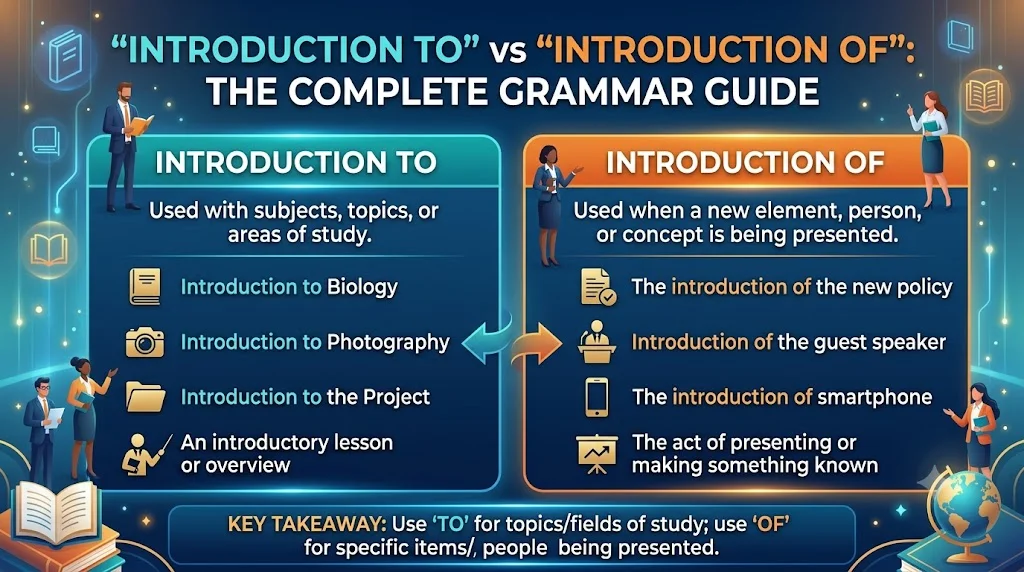
Meaning: “Introduction to” means a beginning point, an entry into a subject, or the act of presenting one person to another.
Grammar explanation: “To” is a preposition that shows direction or destination. When you write “introduction to,” you are pointing toward a subject, a person, or a body of knowledge. The phrase answers the question: introduction toward what?
Common structure:
- Introduction + to + [subject/topic/person]
Real-life examples:
- This textbook is an excellent introduction to organic chemistry.
- Her introduction to the new manager was brief but friendly.
- The course offers a gentle introduction to programming for beginners.
Formal usage: “Introduction to” appears constantly in academic titles, course names, and formal writing.
- Introduction to Psychology (textbook title)
- Introduction to Financial Accounting (university course)
Informal usage: In casual speech, it often shortens naturally in context.
- “That party was my introduction to the local food scene.”
Common collocations:
- brief introduction to
- gentle introduction to
- formal introduction to
- comprehensive introduction to
- basic introduction to
Synonyms for “introduction to”: primer on, overview of, entry point into, foundation in, grounding in.
Common mistakes:
- ❌ This book is a good introduction of computers.
- ✅ This book is a good introduction to computers.
The subject being explored (“computers”) needs “to,” not “of,” because the book is leading the reader toward that subject.
Tip to remember: If you can replace the phrase with “a starting point for” or “a first step toward,” use “to.”
Practice Examples
- The seminar gave students an early ______ (introduction) ______ contract law. (Answer: to)
- My ______ (introduction) ______ Spanish culture happened during a semester abroad. (Answer: to)
“Introduction Of”: Meaning and Use
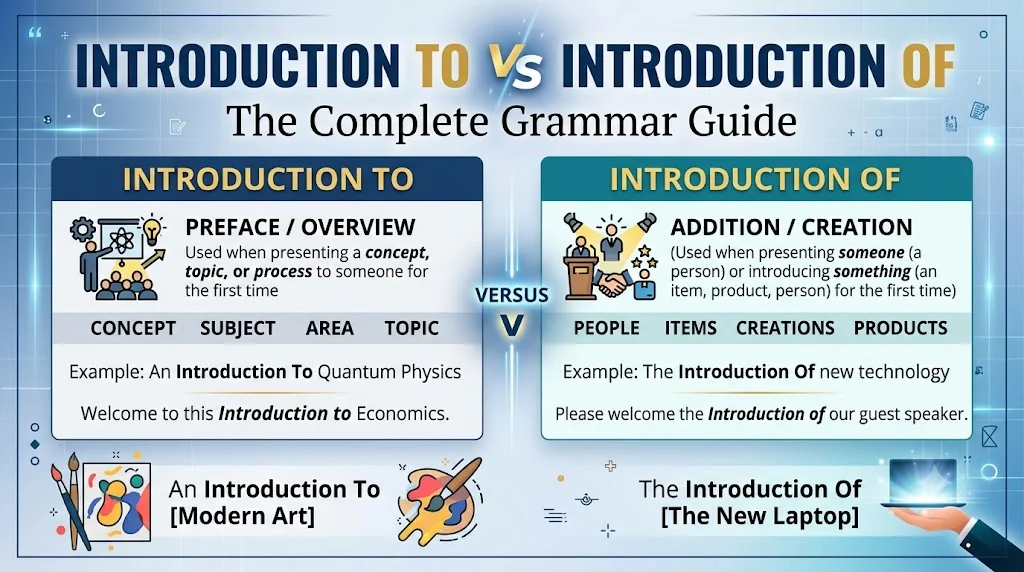
Meaning: “Introduction of” refers to the act of bringing something into existence, use, or a particular place — often for the first time.
Grammar explanation: “Of” is a preposition showing possession, origin, or the object of an action. “Introduction of” describes what is being introduced, not what it is introducing you to. The phrase answers the question: the introduction of what thing?
Common structure:
- Introduction + of + [object/item/policy/species]
Real-life examples:
- The introduction of electric cars has changed the automotive industry.
- Farmers welcomed the introduction of new irrigation technology.
- The introduction of the euro simplified trade across Europe.
Formal usage: This structure dominates news reports, legal documents, scientific writing, and policy discussions.
- The introduction of stricter emissions standards took effect in January.
- Parliament debated the introduction of the new tax bill.
Informal usage: Less common in casual chat, but still natural in everyday storytelling.
- “The introduction of Wi-Fi on that flight was a game changer.”
Common collocations:
- gradual introduction of
- recent introduction of
- planned introduction of
- widespread introduction of
- successful introduction of
Synonyms for “introduction of”: launch of, rollout of, arrival of, adoption of, implementation of.
Common mistakes:
- ❌ The introduction to the smartphone changed communication forever.
- ✅ The introduction of the smartphone changed communication forever.
Here, the smartphone is the thing being introduced, so “of” is correct. “To” would incorrectly suggest the smartphone is a subject you are being guided toward, like a course.
Tip to remember: If you can replace the phrase with “the arrival of” or “the launch of,” use “of.”
Practice Examples
- The ______ (introduction) ______ a new grading system upset many students. (Answer: of)
- Historians study the ______ (introduction) ______ the printing press in Europe. (Answer: of)
“Introduction To” vs “Introduction Of”: Key Differences
| Feature | “Introduction To” | “Introduction Of” |
| Function | Points toward a subject, topic, or person | Names the thing being brought in |
| Question it answers | Introduction toward what? | Introduction of what? |
| Typical use | Books, courses, meeting people | New products, laws, species, technology |
| Preposition type | Direction/destination | Possession/object |
| Example | Introduction to Biology | Introduction of vaccines |
| Common field | Education, social contexts | Business, science, law, history |
Quick Rule
Ask yourself: Am I leading someone toward a subject, or am I naming a new thing being brought in?
- Leading toward a subject or person → use “to”
- Naming what is being brought in → use “of”
If you can mentally swap in “guide to” for your sentence and it still makes sense, “to” is correct. If “arrival of” fits better, “of” is correct.
Context Matters: Choosing the Right Preposition
Context is everything with these two phrases. The same word — “introduction” — completely changes meaning depending on the preposition that follows it.
Consider this pair of sentences:
- The professor’s introduction to the topic was clear and engaging. (She is guiding students toward understanding.)
- The professor’s introduction of the topic was rushed. (She is presenting or unveiling the topic itself, almost like announcing it.)
Both are grammatically correct, but they carry different shades of meaning. “Introduction to” focuses on the learning journey. “Introduction of” focuses on the act of presenting or bringing something forward.
Quick Tip: When in doubt, identify the noun right after the preposition. If that noun is a field of study or a person, lean toward “to.” If it is a product, policy, species, law, or innovation, lean toward “of.”
Historical and Modern Usage
The distinction between “introduction to” and “introduction of” is not new. Both patterns trace back to how English absorbed Latin-based vocabulary during the medieval and early modern periods, when formal writing borrowed heavily from Latin grammar structures.
In older academic texts, “introduction to” was already standard for naming primers and textbooks, much like today’s Introduction to Statistics. Meanwhile, “introduction of” appeared frequently in historical and legal records describing the arrival of new customs, goods, or laws — for example, “the introduction of gunpowder to Europe” in centuries-old historical writing.
Modern usage has stayed remarkably consistent. Search any major academic catalog today, and you will still see “Introduction to [Subject]” as the standard course-naming convention. Meanwhile, news articles about new products, regulations, or discoveries almost always use “introduction of.”
Semantic note: This consistency across centuries is one reason English teachers consider this rule fairly stable — it has not shifted much, unlike some other preposition pairs in English.
Real-Life Applications
Understanding where each phrase naturally belongs makes it much easier to use correctly. Let’s look at three common settings.
Academic Settings
Academic writing relies heavily on “introduction to” for course titles, textbook names, and lecture topics.
Examples:
- Introduction to Sociology is a required course for first-year students.
- The lecture served as a broad introduction to quantum mechanics.
- Her thesis includes a strong introduction to the research methodology.
Academic papers also use “introduction of” when discussing historical developments or new findings.
Examples:
- The paper examines the introduction of standardized testing in the 1900s.
- Researchers highlighted the introduction of a new variable in the study.
Professional Settings
In business and workplace communication, both phrases show up often, but “introduction of” tends to dominate discussions about products, systems, and policies.
Examples:
- The introduction of a four-day workweek boosted employee morale.
- Our team led the introduction of the updated CRM software.
- Her introduction to the client was smooth and professional. (This one uses “to” because it involves a person.)
Everyday Contexts
In daily conversation, “introduction to” often relates to meeting people or trying something new for the first time.
Examples:
- That road trip was my introduction to Southern cooking.
- My introduction to yoga happened almost by accident.
- The introduction of solar panels on our street sparked a neighborhood conversation.
Common Mistakes and How to Avoid Them
Even skilled writers slip up here. Below are the most frequent errors I see as a teacher, along with corrections.
| Mistake | Correction | Why |
| This is a good introduction of the topic for beginners. | This is a good introduction to the topic for beginners. | You are guiding readers toward a topic, not naming a new object. |
| The introduction to the new law caused controversy. | The introduction of the new law caused controversy. | The law is the thing being introduced. |
| Her introduction of the guest speaker was to the audience. | Her introduction of the guest speaker to the audience was warm. | Both prepositions can appear together correctly — “introduction of [person] to [audience].” |
| The book gives an introduction of grammar rules. | The book gives an introduction to grammar rules. | The subject (grammar) needs “to.” |
Common Mistake Pattern: Many learners default to “of” because it feels more formal. Resist that instinct — formality does not decide the preposition. Meaning does.
Quick Tip: Read your sentence aloud and ask, “Am I naming a subject to explore, or a thing being unveiled?” That single question solves 90 percent of the confusion.
Special Cases
Some situations combine both prepositions in a single sentence, which can look confusing at first but is completely correct.
Example: The host handled the introduction of the new employee to the entire team beautifully.
Here:
- “introduction of the new employee” — the employee is the person being introduced (object).
- “to the entire team” — the team is the destination.
This double-preposition structure is common in social and workplace introductions, where someone (or something) is being presented to an audience.
Another special case involves abstract nouns like “introduction of doubt” or “introduction of change,” where “of” pairs with a concept rather than a physical object.
Example: The introduction of doubt into the negotiations slowed everything down.
Here, “of” still marks the thing being brought in — in this case, an abstract idea rather than a physical product.
Tip to remember: When two prepositions appear together, identify two separate elements: the thing being introduced (paired with “of”) and the destination or audience (paired with “to”).
Formal vs Informal Usage at a Glance
Both phrases shift slightly in tone depending on the setting. Here is a side-by-side look at how formality changes the way each phrase is used.
| Setting | “Introduction To” Example | “Introduction Of” Example |
| Formal/Academic | This paper offers an introduction to behavioral economics. | The committee approved the introduction of new safety standards. |
| Business/Professional | Please join me for an introduction to our new department head. | We announced the introduction of a flexible work policy. |
| Informal/Everyday | That trip was my introduction to street food. | The introduction of the new app was pretty exciting. |
| Legal/Government | The manual serves as an introduction to tax law. | Lawmakers debated the introduction of the new bill. |
Quick Tip: Notice that “introduction of” appears constantly in formal, official contexts — laws, policies, technology rollouts — simply because these are the kinds of things that get “introduced” into a system. It is not that “of” is more formal by nature; it is that formal topics often need “of.”
Word Family and Related Forms
Understanding related word forms makes it easier to use “introduction” correctly across different parts of speech.
- Introduce (verb): The teacher introduced the new topic carefully.
- Introduction (noun): Her introduction to the class was memorable.
- Introductory (adjective): This is an introductory chapter, not the full analysis.
- Introducer (noun, less common): The introducer welcomed the keynote speaker.
Grammar note: The verb “introduce” also pairs with “to” and “into,” following the same logic as the noun form.
- Introduce someone to a group → direction toward people.
- Introduce a new rule into the system → bringing something into a structure.
Practice example: Fill in the blank: The manager plans to introduce the new software ______ the whole department next month. (Answer: to)
Beyond “To” and “Of”: Other Prepositions With “Introduction”
While “to” and “of” are the most common pairings, “introduction” also appears with a few other prepositions in specific contexts.
- Introduction by — refers to who performs the introduction. The book includes an introduction by a well-known historian.
- Introduction into — similar to “introduction of,” but emphasizes entry into a new environment or system. The introduction into the market was carefully timed.
- Introduction at — refers to the location or event. Their introduction at the conference led to a long friendship.
Similar words: preface, foreword, prologue, preamble, prelude (for the “opening section” sense); presentation, debut, launch, unveiling (for the “bringing something new” sense).
Opposite words: conclusion, closing, epilogue, afterword (for the “opening section” sense); withdrawal, removal, discontinuation (for the “bringing something new” sense).
Related phrases:
- to introduce someone to someone
- to introduce something into a system
- a brief/formal/proper introduction
- letters of introduction
Synonyms and Related Words for “Introduction”
Building your vocabulary around “introduction” helps you write with more variety and precision.
| Context | Suitable Synonym |
| Opening section of a book | preface, foreword, prologue |
| Presenting a person | acquaintance, presentation |
| Bringing something new | launch, debut, rollout, adoption |
| Formal event | inauguration, unveiling |
| Academic overview | primer, overview, orientation |
Quick Tip: Swapping in these synonyms during editing can help you confirm whether “to” or “of” fits. If “primer” fits naturally, you likely need “to.” If “launch” fits naturally, you likely need “of.”
Practice Exercises
Try filling in the blank with “to” or “of” before checking the answers below.
- The museum’s new exhibit marks the introduction ______ ancient Egyptian artifacts to the public.
- Our teacher gave a helpful introduction ______ essay writing before the assignment.
- The introduction ______ recycling bins reduced waste across campus.
- His introduction ______ the CEO was formal and respectful.
- This chapter is only a brief introduction ______ the topic.
Answers: 1. of, 2. to, 3. of, 4. to, 5. to
Bonus challenge: Write two of your own sentences — one using “introduction to” and one using “introduction of” — and check them against the Quick Rule above. This kind of active practice cements the pattern far better than reading alone.
Semantic and SEO Notes: Related Search Terms
If you are researching this topic online, you may also come across related questions and phrases, such as:
- “introduction to vs introduction of grammar”
- “preposition after introduction”
- “introduction to the topic or introduction of the topic”
- “difference between to and of in English”
- “introduction to book title grammar rule”
All of these searches point back to the same core idea covered in this guide: prepositions after “introduction” change meaning based on direction versus object. Recognizing these related phrases can also help you catch the pattern in other similar English structures, such as “reference to” versus “reference of,” or “access to” versus “access of” (note that “access of” is actually incorrect in standard English — only “access to” is correct, which shows why understanding preposition logic matters beyond just this one word pair).
Final Thoughts
Choosing between “introduction to” and “introduction of” comes down to one simple question: are you pointing toward a subject or person, or are you naming something being brought in? “To” leads you somewhere new — a course, a topic, a person. “Of” names the thing itself — a product, a law, an idea entering the picture.
Once this distinction clicks, you will notice it everywhere, from course catalogs to news headlines. With the examples, tables, and practice exercises in this guide, you now have a clear, reliable system for choosing the right preposition every time you write.
FAQs
1. What is the difference between “introduction to” and “introduction of”? “Introduction to” points toward a subject, topic, or person you are being guided toward, like a textbook or a new acquaintance. “Introduction of” names the thing being brought into existence or use, such as a product, law, or policy.
2. Which is correct: “introduction to the topic” or “introduction of the topic”? “Introduction to the topic” is correct when describing an overview or starting point for learning about that topic. Use “introduction of” only if the topic itself is a new item being unveiled or presented for the first time.
3. Can “introduction of” and “introduction to” appear in the same sentence? Yes. For example, “The introduction of the new manager to the team went smoothly.” Here, “of” marks the person being introduced, and “to” marks the audience or destination.
4. Is “Introduction to” always used in book and course titles? Almost always, yes. Titles like Introduction to Physics or Introduction to Marketing follow a long-standing academic convention because they guide readers toward a subject.
5. Why do people confuse “introduction to” and “introduction of”? Both phrases sound formal and similar, and many learners assume the prepositions are interchangeable. In reality, they serve different grammatical roles: one shows direction, the other shows the object being introduced.
6. Is “introduction of” more formal than “introduction to”? Neither phrase is inherently more formal. Formality depends on context, not the preposition. “Introduction of” appears often in formal writing simply because it commonly describes laws, products, and policies, which are typical formal-writing subjects.
7. What preposition follows “introduction” when introducing people? Use “to” when introducing a person to another person or group, as in “Let me give you an introduction to my colleague” or “Her introduction to the team was warm.”
8. Does “introduction into” mean the same as “introduction of”? They are related but not identical. “Introduction of” names the thing being introduced, while “introduction into” emphasizes entry into a new system, market, or environment, such as “the introduction into the European market.”
9. What is a simple trick to remember the difference? Ask if you are leading someone toward a subject (use “to”) or naming a new thing being brought in (use “of”). Testing the sentence with “guide to” versus “arrival of” often reveals the correct choice instantly.
10. Are there other prepositions used with “introduction”? Yes. “Introduction by” identifies who performs the introduction, “introduction at” refers to a location or event, and “introduction into” emphasizes entering a new environment or system.