
Every Easter, churches, greeting cards, and social media posts fill up with one short but powerful sentence. Some people write “He is risen.” Others write “He has risen.” Both sound similar, but they are not built the same way, and they do not carry the exact same shade of meaning.
If you have ever paused before typing this phrase, wondering which version is “grammatically correct,” you are not alone. This guide breaks down the grammar, history, theology, and everyday usage of both phrases in plain, simple English — the way a patient English teacher would explain it to a curious student.
By the end, you will know exactly which phrase to use, why the King James Bible chose the wording it did, and how modern English speakers actually use these words today.
Quick Answer: Which Phrase Is Correct?
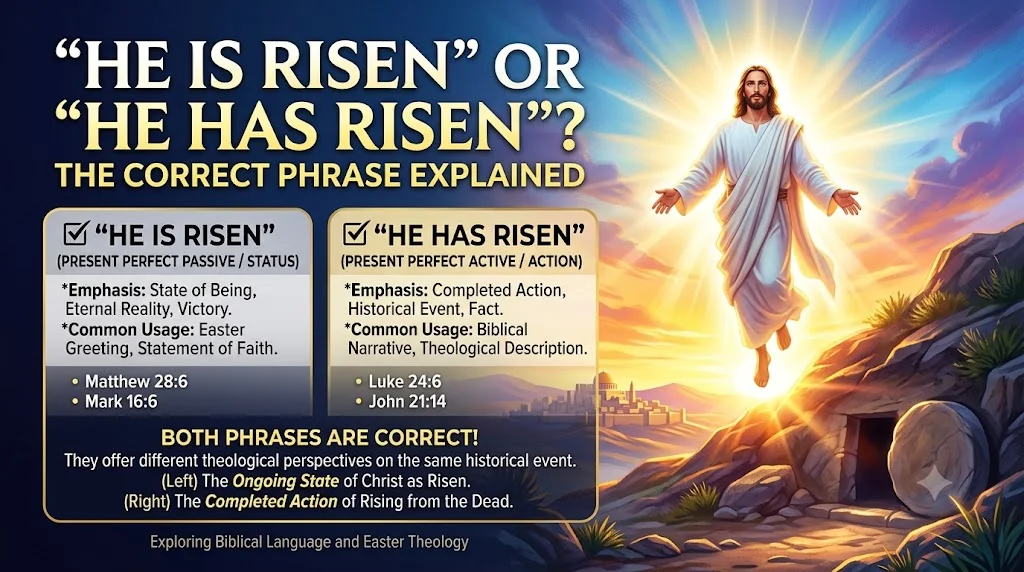
Both phrases are grammatically correct English. They are just built with different grammatical structures.
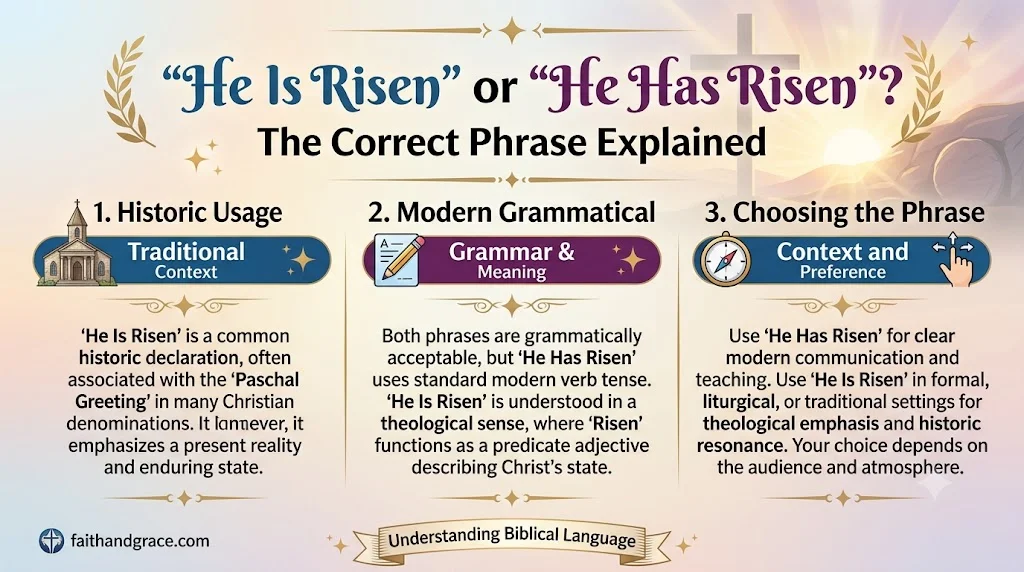
- “He is risen” uses “risen” as a predicate adjective (a descriptive word after a linking verb). It describes a state — Christ is in a risen condition.
- “He has risen” uses “risen” as part of the present perfect tense (“has” + past participle). It describes a completed action with a present result.
Neither one is “wrong.” “He is risen” is an older, more traditional, and more formal construction, closely tied to the King James Bible and traditional liturgy. “He has risen” is the modern, everyday grammatical form most English speakers would naturally produce today.
Quick Tip: If you are writing for a traditional Easter card, hymn, or church banner, “He is risen” fits the tone. If you are writing a modern sermon, blog post, or casual message, “He has risen” sounds more natural to contemporary ears.
Historical Background of the Phrase
The phrase comes from the New Testament accounts of the resurrection of Jesus Christ. In the Gospel of Matthew, an angel tells the women at the tomb, “He is not here, for he is risen, as he said” (Matthew 28:6, King James Version).
This wording reflects a grammar pattern that was common in Early Modern English, the form of English used in the late 1500s and early 1600s, when the King James Bible (KJV) was translated in 1611.
At that time, English verbs of motion or change of state — such as rise, come, go, become — were often paired with “to be” instead of “to have” in perfect-tense-like constructions. This is called the “be”-perfect construction. You can still see traces of it in phrases like:
- “Christ is risen.”
- “The sun is set.”
- “Winter is come” (an older, poetic form).
Modern English almost entirely replaced this pattern with the “have”-perfect: “has risen,” “has set,” “has come.” That shift is exactly why “He is risen” now sounds old-fashioned, ceremonial, and biblical, while “He has risen” sounds like ordinary modern speech.
Word Origin: The word risen comes from the Old English verb rīsan, meaning “to get up” or “to ascend.” Its past participle form, risen, has stayed largely the same in shape for over a thousand years, even as the grammar surrounding it changed.
Understanding “He Is Risen”
Meaning and Definition
“He is risen” means that Christ is currently in a resurrected, living state. The focus is on His present condition — He is alive, not dead. This phrase is a declaration of a fact that exists right now, not simply a report of something that happened in the past.
Grammatical Construction
Grammatically, “He is risen” is built from:
- He — subject pronoun
- is — linking verb (a form of “to be”)
- risen — used here as an adjective (technically, a participial adjective) describing the subject’s state
This structure is called a predicate adjective construction. It works the same way as sentences like:
- “The door is open.”
- “The cake is baked.”
- “He is risen.”
In each case, the word after “is” describes a condition or result, not an ongoing action.
Pronunciation
- Risen: /ˈrɪz.ən/ (RIZ-en) — two syllables, stress on the first syllable. The “s” sounds like a “z.”
- Full phrase: /hiː ɪz ˈrɪz.ən/ — “hee iz RIZ-en.”
Significance
Because “He is risen” describes a permanent, present state rather than a one-time past event, many theologians and pastors favor this phrasing for its emphasis. It says: Christ’s resurrection is not just history — it is an ongoing reality. He is alive now.
This is why “He is risen” is the version most often printed on Easter banners, sung in hymns, and recited in liturgical call-and-response traditions (“He is risen!” / “He is risen indeed!”).
Formal vs. Informal: “He is risen” is formal, ceremonial, and closely associated with religious ritual and traditional texts. You would rarely hear someone use this exact grammar pattern outside of an Easter or biblical context.
Real-Life Examples:
- The pastor declared, “He is risen!” and the congregation responded, “He is risen indeed!”
- The Easter card read simply: He is risen. Alleluia.
- In the sunrise service, the choir sang an old hymn that began, “He is risen, He is risen, tell it out with joyful voice.”
Understanding “He Has Risen”
Meaning and Definition
“He has risen” reports an action that was completed — Christ rose from the dead — and connects that past action to the present moment. It highlights what happened and implies that its effects continue today.
Grammatical Construction
“He has risen” is built using the present perfect tense:
- He — subject
- has — auxiliary (helping) verb, present tense of “to have”
- risen — past participle of the verb “to rise”
The present perfect tense generally connects a past action to present relevance. Compare it with other present perfect sentences:
- “She has finished her homework.” (completed action, relevant now)
- “They have arrived.” (action done, they are here now)
- “He has risen.” (the rising happened, and He is alive as a result)
Why Use “He Has Risen”?
Modern English speakers naturally default to “have” + past participle for perfect tenses. “He is risen” is grammatically unusual today because English largely dropped the “be”-perfect pattern centuries ago. “He has risen” is the version that matches how English actually works in the 21st century.
Many modern Bible translations — including the New International Version (NIV), the English Standard Version (ESV), and the New Living Translation (NLT) — use “He has risen” precisely because it reflects current, standard English grammar and is easier for contemporary readers to process without a grammar lesson.
Formal vs. Informal: “He has risen” works in both formal and informal writing. It is common in modern sermons, devotionals, Sunday school lessons, and everyday conversation about Easter.
Real-Life Examples:
- The Bible study leader explained, “Christ has risen, and because He has risen, we have hope.”
- The children’s Easter book read: “The tomb was empty. He has risen, just like He promised.”
- In her sermon, the pastor said, “He has risen from the dead, defeating sin and death forever.”
“He Is Risen” vs. “He Has Risen”: Key Differences at a Glance
| Feature | “He Is Risen” | “He Has Risen” |
| Grammar structure | Predicate adjective (“is” + adjective) | Present perfect tense (“has” + past participle) |
| Focus | Present state or condition | Completed action with present relevance |
| Era of English | Early Modern English (1600s) | Modern Standard English |
| Common source | King James Version (KJV) | NIV, ESV, NLT, and most modern translations |
| Tone | Formal, poetic, liturgical | Natural, conversational, modern |
| Typical use | Hymns, banners, traditional liturgy | Sermons, devotionals, everyday speech and writing |
| Grammatically correct today? | Yes, but archaic pattern | Yes, and standard modern usage |
Scriptural Evidence Across Translations
Different English Bible translations render the angel’s announcement at the empty tomb in slightly different ways. Here is a comparison based on Matthew 28:6 and Mark 16:6:
| Translation | Wording Used |
| King James Version (KJV) | “He is not here: for he is risen, as he said.” |
| New King James Version (NKJV) | “He is not here; for He is risen, as He said.” |
| New International Version (NIV) | “He is not here; he has risen, just as he said.” |
| English Standard Version (ESV) | “He is not here, for he has risen, as he said.” |
| New Living Translation (NLT) | “He isn’t here! He is risen from the dead, just as he said would happen.” |
| Christian Standard Bible (CSB) | “He is not here, for he has risen, just as he said.” |
Observation: Translations that aim to preserve traditional, formal, liturgical English (KJV, NKJV) tend to keep “He is risen.” Translations focused on modern readability (NIV, ESV, CSB) generally shift to “He has risen.” The NLT is a notable middle case, choosing “He is risen” even though it is a modern translation, likely to preserve the phrase’s traditional emotional impact.
This tells us something important: the choice is stylistic, not doctrinal. No major Bible translation treats this as a matter of correct versus incorrect theology — it’s a matter of how each translation team balances tradition, poetic rhythm, and grammatical accuracy for modern readers.
Theological Implications of Each Phrase
Although the grammar difference is small, some readers find meaningful theological nuance in each version.
- “He is risen” emphasizes ongoing reality. Christ is not merely someone who performed a resurrection in the past — He exists, right now, in a risen and glorified state. This fits well with New Testament teaching that Christ’s resurrection is a present, living fact, not a closed historical footnote.
- “He has risen” emphasizes the completed, historical event and its lasting consequences. It answers the question “What happened?” while still pointing to today’s implications — because He rose, believers today have hope, forgiveness, and the promise of resurrection themselves.
Most theologians agree these are two complementary angles on the same truth, not competing doctrines. Neither phrase denies or contradicts the other; they simply highlight different grammatical aspects of one resurrection event.
Tip to Remember: Think of “He is risen” as a snapshot of Christ’s current state, and “He has risen” as a summary of the completed action that produced that state.
Modern English Grammar Rules: Present Perfect vs. Predicate Adjective
To fully understand this phrase pair, it helps to step back and look at general English grammar rules.
The Present Perfect Tense (used in “has risen”)
Formed with: has/have + past participle
Used for:
- Actions completed at an unspecified time in the past
- Past actions with results that matter now
- Life experiences
Examples:
- I have visited Paris twice.
- She has finished her degree.
- He has risen early every day this week.
The Predicate Adjective Pattern (used in “is risen”)
Formed with: is/am/are + adjective (or participial adjective)
Used for:
- Describing a current state or condition
- Linking the subject to a descriptive word, not an action
Examples:
- The milk is spoiled.
- The window is broken.
- He is risen.
Why This Confuses English Learners
Many English learners assume “risen” must always follow “has/have” because it is a past participle. But English allows past participles to double as adjectives after linking verbs — this is common with words describing a resulting state, such as broken, finished, done, gone, and risen.
Common Mistake: Saying “He is arisen” or “He has risen up” — both are redundant or nonstandard. “Risen” already implies upward movement; adding “up” is unnecessary in formal writing.
Correct Usage Checklist:
- ✅ He is risen. (predicate adjective, traditional)
- ✅ He has risen. (present perfect, modern)
- ❌ He has risen. (redundant “up”)
- ❌ He has arisen. (nonstandard modern usage; “arisen” isn’t idiomatic here)
- ❌ He has risen. (missing auxiliary/linking verb — always needs “is” or “has”)
Cultural and Liturgical Significance
“He is risen” holds a special place in Christian worship traditions, especially in liturgical call-and-response, most famously:
Leader: “Christ is risen!” Congregation: “He is risen indeed!”
This exchange, sometimes called the Paschal greeting, is used across many denominations — Anglican, Catholic, Orthodox, and various Protestant traditions — especially during Easter Sunday services and the Easter season (sometimes called Eastertide).
The phrase also appears widely in:
- Easter hymns (“Christ the Lord Is Risen Today,” “He Is Risen, He Is Risen”)
- Church bulletins, banners, and Easter cards
- Devotionals and sermon titles
“He has risen,” by contrast, appears more often in:
- Modern sermon manuscripts and Bible commentaries
- Contemporary worship songs
- Everyday conversation, blog posts, and social media captions
Formal vs. Informal Table
| Setting | Preferred Phrase |
| Traditional liturgy / call-and-response | “He is risen” / “He is risen indeed” |
| Hymn lyrics | “He is risen” |
| Modern Bible translation reading (NIV, ESV) | “He has risen” |
| Casual Easter greeting texts | Either — both are widely understood |
| Academic or grammar-focused writing | “He has risen” (standard modern grammar) |
Common Mistakes and Misunderstandings
Even confident English speakers slip up with this phrase. Here are the most frequent errors and how to fix them.
Mistake 1: Thinking one phrase is “wrong.” Both are correct English; they simply reflect different grammatical eras and stylistic choices. Neither is a typo or an error.
Mistake 2: Mixing the two forms. ❌ “He has risen indeed” as a direct swap for the traditional response can sound slightly off in liturgical contexts, since “He is risen indeed” is the fixed traditional response. In casual writing, either works, but liturgical call-and-response usually keeps the traditional form.
Mistake 3: Adding unnecessary words. ❌ “He is risen up from the dead again.” The word “again” is misleading (Christ’s resurrection is a one-time event, not repeated), and “up” is redundant with “risen.”
Mistake 4: Confusing “risen” with “raised.” “Risen” is intransitive (He rose on His own, or by God’s power described without an object). “Raised” is often used in a passive sense: “He was raised from the dead” (by God). Both are theologically accurate, but grammatically distinct.
- ✅ He is risen. / He has risen. (intransitive: he rose)
- ✅ He was raised from the dead. (passive: God raised him)
- ❌ He has raised. (“raised” needs an object or passive structure; this sentence is incomplete)
Mistake 5: Using “rose” interchangeably without checking tense fit. “Rose” is the simple past tense: “He rose from the dead on the third day.” This is different from “He is risen” (state) and “He has risen” (perfect tense), though all three describe the same event from different grammatical angles.
| Form | Tense/Type | Example |
| rose | Simple past | He rose on the third day. |
| has risen | Present perfect | He has risen, and death has lost its power. |
| is risen | Predicate adjective (state) | He is risen; He is alive. |
Similar Phrases, Synonyms, and Related Expressions
Similar Words to “Risen”
- Arisen (less common, slightly more formal/poetic)
- Resurrected
- Raised (up)
- Ascended (technically different — refers to Christ’s ascension into heaven, a separate event from the resurrection)
Synonyms for the Concept of “Rising from the Dead”
- Resurrection (noun)
- Coming back to life
- Overcoming death
- Conquering the grave
Opposite Concepts
- Remained dead
- Stayed in the tomb
- Perished permanently
Related Phrases and Collocations
- “Christ is risen” / “Christ has risen”
- “He is risen indeed”
- “Risen from the dead”
- “Risen Lord” / “Risen Savior”
- “The empty tomb”
- “Resurrection Sunday”
- “He lives!”
Common Collocations with “Risen”
- Risen Christ
- Risen Lord
- Risen Savior
- Risen from the dead
- Newly risen sun (unrelated, everyday usage — note “risen” also describes sunrise: “The sun has risen.”)
Tip to Remember: “Risen” is not exclusively religious vocabulary. It is the standard past participle of “rise” and appears in everyday English too — “The bread has risen,” “The sun is risen” (poetic), “Prices have risen sharply.”
Making the Right Choice: Practical Tips
Use this simple decision guide when deciding which phrase fits your writing:
- Writing a traditional Easter card, hymn, or church banner? Choose “He is risen” — it matches centuries of tradition and liturgical rhythm.
- Writing a modern sermon, blog, devotional, or social caption? Choose “He has risen” — it reads naturally to today’s audience.
- Quoting Scripture directly? Match the exact wording of your chosen Bible translation. Check KJV/NKJV for “is risen,” or NIV/ESV/CSB for “has risen.”
- Responding in a call-and-response liturgy? Stick with the traditional “He is risen indeed” — changing it may feel jarring to a congregation.
- Teaching English grammar? Use “He has risen” as the standard present perfect example, and “He is risen” as a useful case study in how English grammar has evolved.
Quick Tips Summary Box:
- Both phrases are correct — choose based on tone, audience, and context.
- “He is risen” = formal, traditional, describes a state.
- “He has risen” = modern, standard, describes a completed action.
- Never say “He has risen up” or “He is arisen” in formal writing.
- Match Bible quotations to their specific translation’s exact wording.
Practice Examples
Try identifying which grammatical structure is used in each sentence below.
- “He is risen, just as the Scriptures foretold.” (predicate adjective)
- “The pastor reminded us that Christ has risen and defeated death.” (present perfect)
- “The sun is fully risen over the hills.” (predicate adjective, everyday usage)
- “Bread dough has risen after an hour of resting.” (present perfect, everyday usage)
- “He is risen indeed, alleluia!” (predicate adjective, liturgical)
Practice Tip: If you can naturally insert “already” before the verb phrase and it still sounds smooth (“He has already risen”), you’re likely using the present perfect. If the sentence describes a fixed state rather than an event, you’re likely using the predicate adjective pattern.
Final Thoughts
“He is risen” and “He has risen” are both correct, meaningful, and deeply rooted in Christian tradition and the English language. The difference comes down to grammar and tone, not truth or accuracy. “He is risen” reflects Early Modern English and carries a formal, timeless, liturgical weight, especially in the King James Version and traditional hymns.
“He has risen” reflects standard modern grammar and fits naturally into everyday speech, contemporary sermons, and modern Bible translations. Understanding this distinction not only sharpens your English grammar skills but also deepens your appreciation for how language, faith, and history intertwine in one of Christianity’s most celebrated declarations.
FAQs
1. Is “He is risen” grammatically correct? Yes. “He is risen” uses “risen” as a predicate adjective after the linking verb “is,” describing Christ’s current state. This was a standard construction in Early Modern English and remains grammatically valid, especially in traditional and liturgical contexts.
2. Is “He has risen” more modern than “He is risen”? Yes. “He has risen” uses the present perfect tense (“has” + past participle), which matches how modern English typically expresses completed past actions with present relevance, making it the more contemporary phrasing.
3. Which phrase does the King James Bible use? The King James Version uses “He is risen,” found in Matthew 28:6: “He is not here: for he is risen, as he said.”
4. Which phrase do modern Bible translations use? Most modern translations, including the NIV, ESV, and CSB, use “He has risen” to reflect current, standard English grammar for easier reader comprehension.
5. Is one phrase more theologically correct than the other? No. Both phrases describe the same resurrection event from slightly different grammatical angles — one emphasizes a present state, the other a completed action. Neither changes the theological meaning.