
Have you ever paused mid-sentence and wondered, “Wait, is it it’s called or it called?” You are not alone. This is one of the most common mix-ups in everyday English, and it trips up native speakers and English learners alike. The good news is that the rule behind it is simple once you see it clearly.
In this guide, I’ll break down the grammar, meaning, and real-world usage of both phrases like a patient English teacher sitting right next to you. By the end, you will never second-guess this again.
Quick Answer: Is It “It’s Called” or “It Called”?
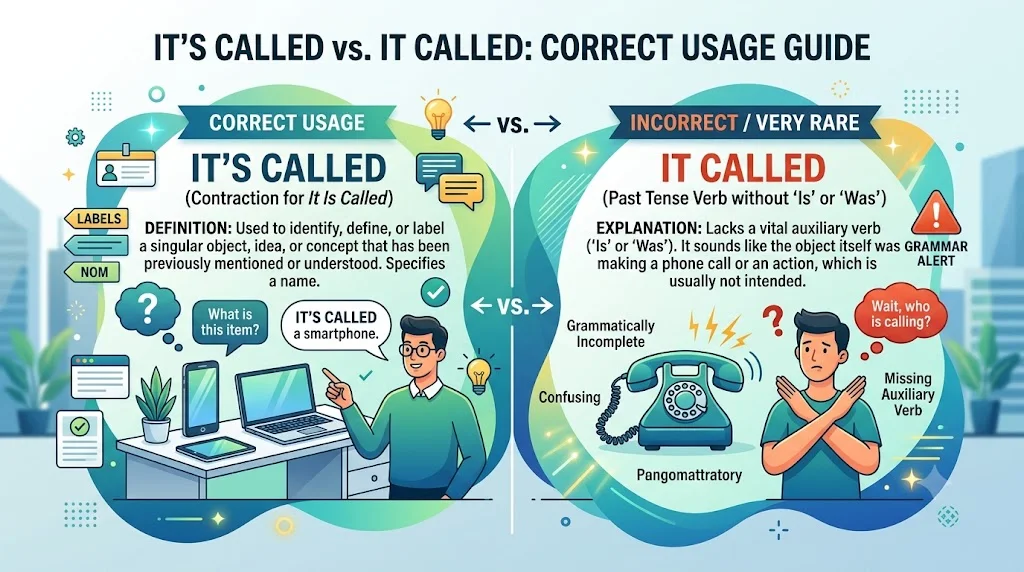
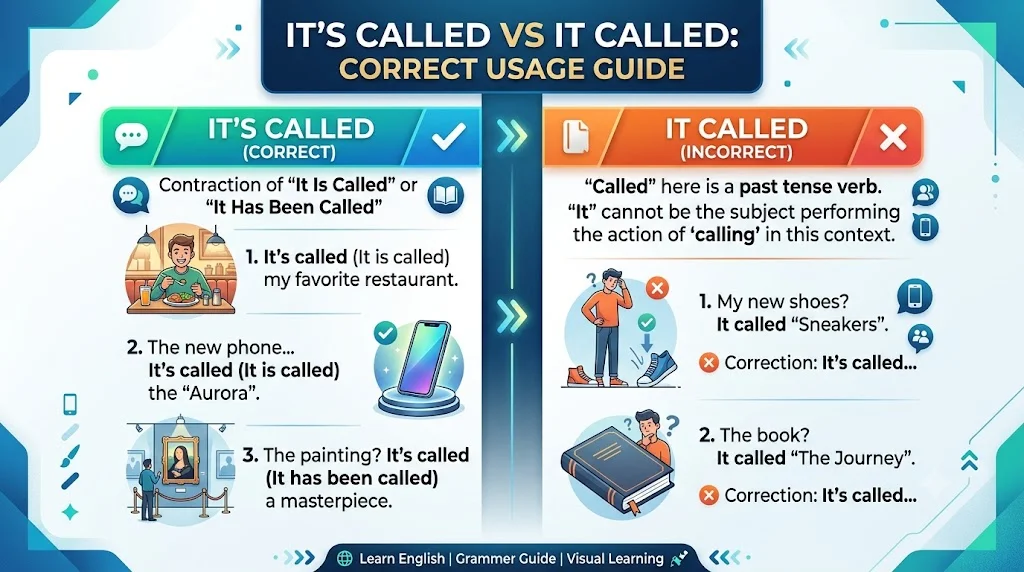
“It’s called” is almost always the correct phrase when you want to say what something is named. “It’s” is a contraction of “it is,” so “it’s called” means “it is called” — a present-tense passive construction used to identify a name. “It called” is grammatically valid only as a simple past-tense sentence meaning something (like an animal, a phone, or a person) made a call in the past.
What Does “It’s Called” Mean?
Meaning and Definition
“It’s called” is a short way of saying “it is called.” It is used to introduce or explain the name of something — an object, a place, a concept, a food, a tool, or even a feeling. Think of it as the go-to phrase whenever you want to tell someone what a thing is named.
Definition: It’s called (phrase) — used to state the name or label of something in the present tense.
Grammar Explanation: Why “It’s Called” Is Correct
Let’s break this down piece by piece, the way I would on a whiteboard:
- It’s = It + is (a contraction)
- is = the helping verb (auxiliary verb)
- called = the past participle of the verb “to call,” used here in passive voice
So the full sentence structure is:
Subject (It) + helping verb (is) + past participle (called) + name
This is a classic example of the present passive voice. In passive voice, the subject receives the action instead of performing it. Nobody is actively “calling” the object in this moment — the object simply has that name, given to it at some point by someone else.
Example: “It’s called a boomerang.” → The object didn’t call itself anything; someone named it that, and the name stays true today.
Pronunciation
“It’s called” is pronounced /ɪts kɔːld/ (rhymes with “bits bold”). Native speakers usually blend “it’s” and “called” smoothly in casual speech, almost sounding like “itskawld.”
Word Origin
“Call” comes from the Old English word ceallian and Old Norse kalla, both meaning “to cry out” or “to summon.” Over centuries, “call” expanded to mean “to name” or “to label,” which is the sense we use in “it’s called.”
Common Sentence Examples
- It’s called a smartphone because it does much more than make calls.
- This dish is delicious — it’s called paella.
- In grammar, this rule is called the passive voice.
- That instrument is called a ukulele.
- This neighborhood is called Little Italy.
Formal vs Informal Usage
“It’s called” works comfortably in both formal and informal English.
- Formal: “This phenomenon is called the placebo effect.”
- Informal: “Oh yeah, it’s called a fidget spinner. My kid has three of them.”
In highly formal academic writing, some writers prefer the full form “it is called” instead of the contraction, but both are grammatically correct.
Common Mistakes
Learners often forget the apostrophe or skip the helping verb entirely, writing “it called” instead of “it’s called” when introducing a name. Another frequent slip is confusing “it’s” with the possessive “its,” which changes the meaning of the whole sentence.
Synonyms and Related Phrases
While “it’s called” doesn’t have an exact one-word synonym, several phrases carry a similar naming function:
- It is known as
- It goes by the name of
- People refer to it as
- It’s known as
- It’s referred to as
- It’s termed
- It’s labeled
- It’s dubbed (informal, often used for nicknames)
Example: “This condition is known as insomnia” is a more formal alternative to “It’s called insomnia.”
Common Collocations
“It’s called” frequently pairs with nouns describing categories, techniques, tools, or phenomena:
- It’s called a technique
- It’s called a syndrome
- It’s called a strategy
- It’s called a tradition
- It’s called a method
- It’s called a loophole
Opposite Expressions
There isn’t a true grammatical opposite of “it’s called,” but a functional opposite would be a phrase that removes or denies a name, such as “it has no name” or “it’s unnamed.”
Example: “This new species is still unnamed — scientists haven’t decided what it’s called yet.”
Quick Tips
- If you can replace it with “it is,” you need the apostrophe: it’s called.
- If you’re naming or defining something, “it’s called” is almost always the right choice.
- Say the sentence slowly and insert “is” mentally — if it still makes sense, the apostrophe belongs there.
What Does “It Called” Mean?
Meaning and Definition
“It called” is the simple past tense of the verb “to call,” used when a non-human subject (an animal, a machine, a phone, a company, or even weather) performed the action of calling in the past.
Definition: It called (verb phrase) — the subject (referred to as “it”) made a call or cried out at some point in the past.
Is “It Called” Ever Correct?
Yes — but only in a specific context. “It called” is correct when “it” is the subject doing the action, not receiving a name. This is active voice, not passive voice.
Example: “The phone rang. It called my number by mistake.”
Here, “it” (the phone) actively performed the calling.
Rare Situations Where It Works
- Animals or nature: “The owl called through the night.” (Often “it” replaces the noun: “It called again.”)
- Machines or systems: “The alarm system malfunctioned — it called emergency services on its own.”
- Software/coding context: “The function ran successfully; it called the next method in the sequence.”
- Weather personification (rare, literary): “The wind howled — it called out across the valley.”
Examples in Complete Sentences
- The unknown number called twice; it called again an hour later.
- The app crashed after it called an invalid function.
- The bird called from the treetop before it called once more.
- My computer froze right after it called the update server.
Formal vs Informal Usage
“It called” is rarely used in casual conversation about naming things, but it appears often in technical, scientific, or narrative writing, especially in programming (“the script called the API”) and storytelling.
Common Mistakes
The biggest mistake is using “it called” when you actually mean to name something. Writers sometimes drop the apostrophe from “it’s” without realizing they’ve switched the entire meaning of the sentence from a naming statement to a past-tense action.
Incorrect: “This vegetable it called a zucchini.” Correct: “This vegetable is called a zucchini.”
Synonyms and Related Phrases
When “it called” means a past action, similar phrases include:
- It rang
- It dialed
- It contacted
- It reached out to
- It phoned
- It summoned (more formal/literary)
Example: “The system dialed the wrong extension” works as a synonym for “It called the wrong extension.”
Common Collocations
“It called” often pairs with nouns related to communication or systems:
- It called the office
- It called an emergency number
- It called a function (in programming)
- It called out (literary, meaning to shout)
- It called for backup
Opposite Expressions
The opposite of “it called” (as an action) would be “it did not call,” “it stayed silent,” or “it never rang.”
Example: “We waited all day, but it never called.”
It’s Called vs It Called: Key Differences
Side-by-Side Comparison Table
| Feature | It’s Called | It Called |
| Full form | It is called | It (subject) called (verb) |
| Voice | Passive voice | Active voice |
| Tense | Present tense | Simple past tense |
| Function | Names or identifies something | Describes a past action |
| Common use | Everyday, academic, business | Narrative, technical, coding |
| Example | It’s called a stapler. | It called the office twice. |
Grammar Comparison
“It’s called” always contains a helping verb (is) plus a past participle (called). “It called” is a standalone past-tense verb with no helping verb needed, because simple past tense doesn’t require one in affirmative sentences.
Meaning Comparison
“It’s called” answers the question “What is it named?” “It called” answers the question “What did it do?”
Usage Comparison
Use “it’s called” when introducing vocabulary, defining terms, or naming objects. Use “it called” only when narrating a completed action performed by a non-human subject.
Why Do People Confuse “It’s Called” and “It Called”?
Missing Helping Verb
Many learners drop the helping verb “is” out of habit, especially if their native language doesn’t require one in similar sentences. This turns “it’s called” into the incorrect “it called” when naming something.
Incorrect: “It called a laptop.” Correct: “It’s called a laptop.”
Confusing Contractions
The apostrophe in “it’s” is small and easy to miss, especially in fast typing or texting. This leads writers to accidentally drop it, creating confusion with the unrelated verb form “it called.”
Direct Translation Errors
Speakers translating directly from languages that don’t use passive voice the same way often skip the “is,” producing sentences like “It called a market” instead of “It’s called a market.”
When Should You Use “It’s Called”?
Everyday Conversations
“It’s called” is extremely common in casual talk when explaining or introducing something new to a listener.
Example: “Try this drink — it’s called a matcha latte.”
Academic Writing
In essays, research papers, and textbooks, “it’s called” (or the full form “it is called”) is used to define terms clearly and formally.
Example: “This process is called photosynthesis.”
Business and Professional Writing
Professionals use “it’s called” to introduce products, strategies, or systems.
Example: “Our new pricing model — it’s called Value Tier — launches next quarter.”
Technology and Software
Tech writers frequently use “it’s called” to introduce new tools, apps, or features.
Example: “There’s a new feature in the update — it’s called Focus Mode.”
Social Media and Pop Culture
Influencers and content creators use “it’s called” constantly when introducing trends, products, or slang.
Example: “It’s called ‘quiet quitting,’ and everyone’s talking about it.”
When Should You Use “It Called”?
Narrative Writing
Fiction and storytelling sometimes personify objects, animals, or machines, giving them the active role of “calling.”
Example: “The wolf howled at the moon. It called out again, louder this time.”
Past-Tense Action Examples
- The taxi company said it called our house at 9 p.m.
- The router failed after it called an outdated server.
- My phone buzzed — it called an unknown number by itself.
Common Grammar Mistakes to Avoid
Incorrect Sentence Examples
- ❌ “It called a violin.”
- ❌ “This dessert it called tiramisu.”
- ❌ “It called my best friend since childhood.” (meaning: naming a friend)
Corrected Versions
- ✅ “It’s called a violin.”
- ✅ “This dessert is called tiramisu.”
- ✅ “She’s called my best friend since childhood.”
Why the Mistakes Happen
These errors usually come from skipping the helping verb “is” or confusing “called” (naming) with “called” (the action of calling someone). Reading sentences aloud often helps catch the missing word.
Real-Life Examples of “It’s Called” vs “It Called”
| Situation | Correct Sentence |
| Naming a food | It’s called ramen. |
| Naming a place | It’s called Central Park. |
| Naming a tool | It’s called a wrench. |
| Past action (phone) | It called three times last night. |
| Past action (software) | The program crashed after it called an error function. |
| Naming a feeling | It’s called nostalgia. |
How to Remember the Difference
Simple Memory Trick
Ask yourself: “Am I naming something, or describing an action that already happened?”
- Naming → It’s called (present, passive)
- Action → It called (past, active)
Quick Checklist
- Can you replace it with “it is”? Use it’s called.
- Is a machine, animal, or system doing something in the past? Use it called.
- Are you introducing a name, term, or label? Use it’s called.
Grammar Rules Explained
Understanding Contractions
A contraction combines two words into one shorter word using an apostrophe to replace missing letters. “It’s” always means “it is” or “it has” — never the possessive “its” (no apostrophe), which shows ownership.
Example: “The dog wagged its tail.” (possession) vs. “It’s a golden retriever.” (it is)
Passive Voice Explained
Passive voice happens when the subject receives the action instead of performing it. “It’s called” is passive because “it” is not doing the calling — someone else named it in the past, and the name still applies now.
Active vs Passive Voice
| Voice | Structure | Example |
| Active | Subject + verb + object | The teacher called the students. |
| Passive | Subject + be verb + past participle | The students were called by the teacher. |
Understanding Helping Verbs
Helping verbs (also called auxiliary verbs) support the main verb to show tense, voice, or mood. In “it’s called,” the helping verb is signals present tense and passive voice.
How Native Speakers Actually Use This in Speech
If you listen closely to native English speakers, you’ll notice “it’s called” shows up constantly in daily conversation — often without anyone thinking twice about the grammar behind it. It’s one of those phrases that feels automatic, almost like a verbal habit.
Common spoken patterns:
- “You know what it’s called? It’s called burnout.”
- “So this thing — it’s called a French press — makes really strong coffee.”
- “It’s called karma, honestly.”
Notice how speakers often pause slightly before “it’s called” for emphasis, especially when introducing slang or a surprising term. This rhythm is part of natural spoken English and is worth imitating if you want to sound fluent.
On the other hand, “it called” in speech almost always refers to a phone, alarm, or device.
- “My phone buzzed — it called mom by accident.”
- “The smoke detector went off, and it called the fire department automatically.”
Listening Tip
In fast speech, “it’s called” can sound almost identical to “it called” because the “s” sound softens. Context is your best clue: if the sentence introduces a name, it’s “it’s called.” If it describes an action, it’s “it called.”
Regional and Stylistic Notes
English learners sometimes ask whether British English and American English treat “it’s called” differently. They don’t — the rule is identical on both sides of the Atlantic. However, style guides differ slightly on contractions.
- Academic style guides (APA, MLA, Chicago) generally allow contractions like “it’s called” in less formal sections but recommend the full form “it is called” in highly formal research papers.
- Journalism style (AP Style) freely uses “it’s called” since news writing favors a natural, conversational tone.
- Business writing often mixes both, using the full form in formal reports and the contraction in emails or presentations.
More Real-World Examples
To really lock in the difference, here are additional examples pulled from everyday contexts:
- Cooking: “This spice blend — it’s called garam masala — comes from South Asian cuisine.”
- Travel: “The old town area is called Trastevere, and it’s known for its cobblestone streets.”
- Fitness: “This workout style is called HIIT, short for high-intensity interval training.”
- Finance: “It’s called compound interest, and it can work for or against you.”
- Relationships: “It’s called attachment style, and it shapes how we connect with others.”
- Technology (past action): “The server crashed right after it called an outdated API endpoint.”
- Nature (past action): “The wolf paused, and it called out one more time before the forest went silent.”
These examples show how flexible “it’s called” is across topics — food, travel, fitness, finance, and psychology — while “it called” stays limited to describing a completed action.
A Note on Clarity in Writing
Good writers use “it’s called” to smoothly introduce new vocabulary without sounding like a dictionary entry. Instead of writing “The definition of this term is X,” you can simply say, “It’s called X,” which feels more natural and reader-friendly. This small shift makes technical or unfamiliar topics feel more approachable, which is exactly why the phrase appears so often in blogs, tutorials, and explainer content.
Similar Grammar Confusions
Its vs It’s
- Its = possessive (shows ownership) — “The cat licked its paw.”
- It’s = contraction of “it is” or “it has” — “It’s raining outside.”
Called vs Named
Both words can describe naming something, but “named” often implies a formal or intentional act of naming, while “called” is more casual and everyday.
Example: “The baby was named Sophia.” vs. “Everyone calls her Sophie.”
Is Called vs Was Called
- Is called = present tense, current name — “It is called a tablet.”
- Was called = past tense, name used before (may have changed) — “It was called a Walkman in the 1980s.”
Practice Quiz
Multiple Choice Questions
- This fruit ___ a dragon fruit. a) it called b) it’s called c) its called
- After the alarm went off, ___ the security company. a) it’s called b) it called c) its call
- That tool ___ a chisel. a) it called b) it’s called c) it call
Fill in the Blank
- This dance move ______ the moonwalk.
- The system crashed right after ______ the wrong server.
- In science, this reaction ______ oxidation.
True or False
- “It’s called” always uses passive voice. (True/False)
- “It called” can describe naming a person. (True/False)
- “Its” and “it’s” mean the same thing. (True/False)
Answer Key
Multiple Choice: 1-b, 2-b, 3-b Fill in the Blank: 1. is called, 2. it called, 3. is called True or False: 1. True, 2. False, 3. False
Final Verdict
In almost every situation where you’re naming or defining something, “it’s called” is the correct choice. It uses the present passive voice to introduce a term, object, or concept clearly and naturally. “It called,” on the other hand, is a simple past-tense action, correctly used only when something non-human — like a phone, animal, or system — performed the act of calling in the past.
When in doubt, ask yourself if you’re naming something or describing a completed action. That one question will guide you to the right phrase every time.
Frequently Asked Questions
1. Is “it’s called” grammatically correct? Yes. “It’s called” is grammatically correct because “it’s” means “it is,” and “called” functions as a past participle in the passive voice. Together, they correctly introduce the name of something in present tense, such as “It’s called a violin.”
2. Can I say “it called” instead of “it’s called”? No, not when naming something. “It called” is simple past tense and means an action happened, like a phone calling a number. Use “it’s called” whenever you’re identifying a name or label.
3. What’s the difference between “its” and “it’s”? “Its” shows possession, as in “The bird flapped its wings.” “It’s” is a contraction of “it is” or “it has,” as in “It’s called a sparrow.” Mixing these up is one of the most common English writing mistakes.
4. Why do people drop the apostrophe in “it’s called”? Many writers drop it by habit, autocorrect issues, or confusion with the possessive “its.” Reading the sentence aloud as “it is called” helps confirm whether the apostrophe is needed.
5. Is “it called” ever used in professional writing? Yes, especially in technical or narrative contexts, such as software documentation: “The script failed after it called an undefined variable.” It’s uncommon in casual naming contexts, though.