
If you’ve ever paused mid-sentence wondering whether to write “extensible” or “extendible,” you’re not alone. These two words look almost identical, sound similar, and both relate to the idea of “extending” something. Yet native speakers, software developers, and even professional editors mix them up constantly.
As an English teacher, I see this confusion all the time in technical writing, business emails, and product documentation. The good news? Once you understand the small grammatical root behind each word, you’ll never confuse them again.
This guide breaks down the meaning, pronunciation, grammar, word origin, and real-world usage of both words — with practice examples so you can test yourself at the end.
Understanding this pair matters more than most people realize. Get it wrong in a resume, a technical spec, or a client proposal, and it can quietly signal a lack of polish — even if your reader can’t name exactly what feels off. Get it right, and your writing reads as precise, professional, and well-informed. That’s the goal of this guide: not just to answer “which word is correct,” but to help you understand why, so the right choice becomes automatic.
Quick Answer: Extensible vs. Extendible
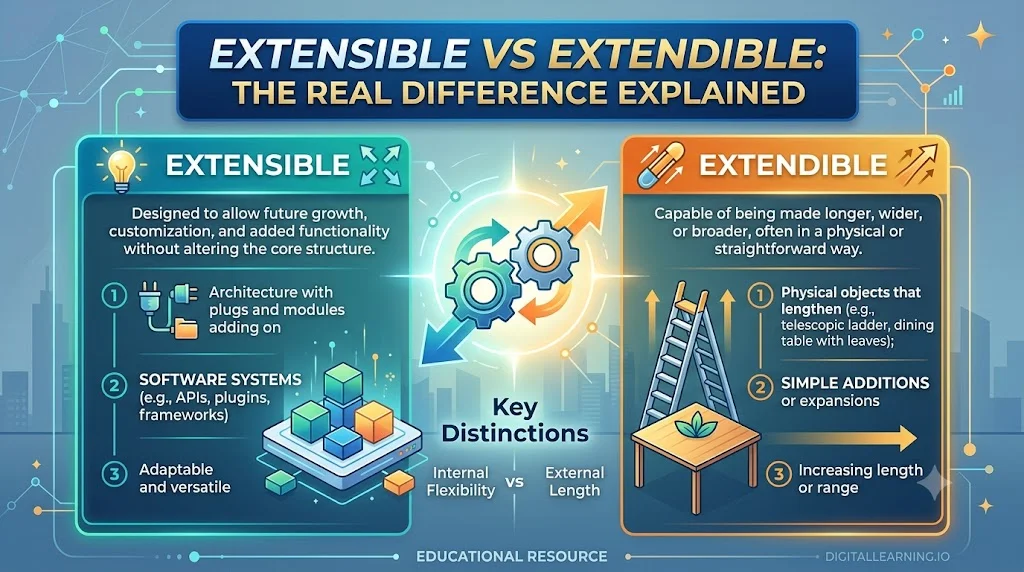
Extensible means “capable of being extended,” and it’s the word used almost everywhere today — especially in software, technology, and business writing. Extendible is an older, less common variant with the exact same meaning, occasionally still used in formal or engineering contexts.
The Difference in One Sentence
Both words mean “able to be extended,” but extensible is the modern, standard, and far more frequently used form, while extendible is a rarer variant that has mostly fallen out of everyday use.
Which Word Should You Use?
In almost every situation — software, technology, business systems, or general writing — use extensible. Reserve extendible only if you’re quoting older texts, writing in a specific legal or engineering style guide that prefers it, or matching an established house style that already uses it.
Quick Tip: If you’re ever unsure, default to “extensible.” It’s correct in 95% of real-world contexts and is the version recognized by every major dictionary and style guide.
What Does “Extensible” Mean?
Definition
Extensible (adjective): capable of being extended, stretched, or enlarged in scope, size, or function. In modern usage, it most often describes systems, software, or frameworks that can be expanded with new features without being redesigned from scratch.
Word origin: “Extensible” comes from the Latin verb extendere (to stretch out), combined with the Latin-derived suffix -ible, which attaches to verbs ending in certain patterns (often from the third conjugation or those ending in -t or -s in their past participle). This is why “extend” pairs more naturally with -ible through its Latin root extensus.
Pronunciation
Extensible is pronounced: ik-STEN-suh-buhl (/ɪkˈstɛn.sɪ.bəl/)
- Stress falls on the second syllable: ex-TEN-si-ble
- The “x” sounds like “ks”
- The ending rhymes with “sensible” and “responsible”
Quick Tip: If you can pronounce “sensible” correctly, you already know how to say the ending of “extensible.”
Common Synonyms
- Expandable
- Scalable
- Adaptable
- Flexible (in a structural sense)
- Modular (in software contexts)
Opposite Words
- Fixed
- Rigid
- Non-expandable
- Inflexible
- Closed (in software architecture, meaning it cannot be modified or extended)
Common Collocations
- Extensible framework
- Extensible architecture
- Extensible design
- Extensible markup language (this is where XML gets its name)
- Extensible software
- Extensible system
Related Phrases
- “Built to be extensible”
- “An extensible plugin system”
- “Designed with extensibility in mind”
Formal vs. Informal Usage
“Extensible” is a formal, technical word. You’ll rarely hear it in casual conversation, but it’s extremely common in:
- Software documentation
- Technical specifications
- Business proposals
- Academic and engineering papers
In casual speech, most people would simply say “expandable” or “flexible” instead.
Example Sentences
- The company built an extensible platform so new features could be added without rewriting the core code.
- Our new API was designed to be extensible, allowing third-party developers to build custom plugins.
- A good content management system should be extensible enough to support future integrations.
- The architecture firm designed an extensible floor plan, allowing rooms to be added later.
Common Mistakes with “Extensible”
- ❌ “The dining table is extensible.” (Sounds overly technical for furniture; “extendable” is more natural here.)
- ✅ “The software architecture is extensible.”
- ❌ Confusing “extensible” with “extensive” (which means “large in size or scope,” not “able to be extended”).
Quick Tip: “Extensive” describes something already large. “Extensible” describes something that can become larger.
What Does “Extendible” Mean?
Definition
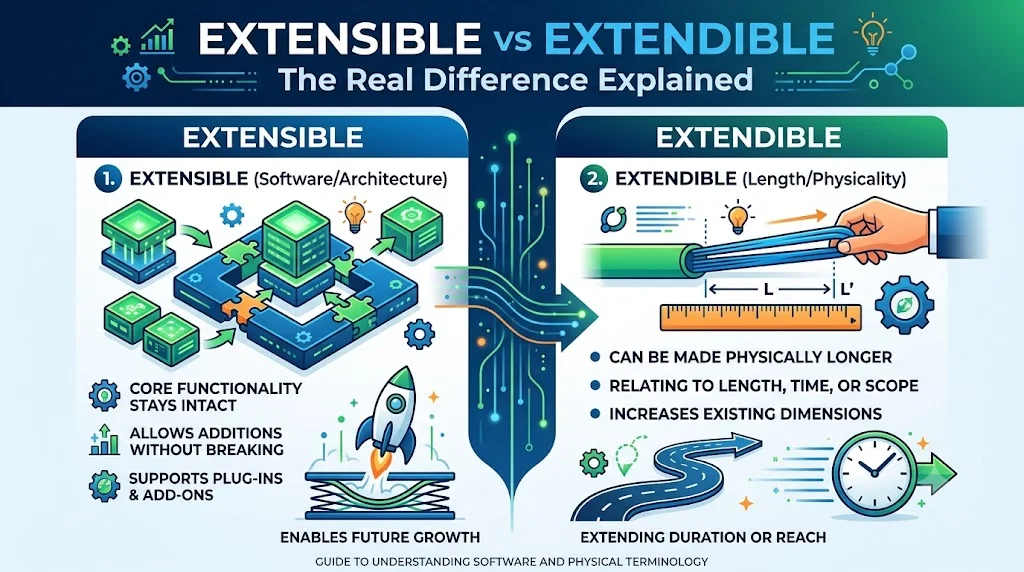
Extendible (adjective): capable of being extended; stretched out or made longer. It carries the exact same core meaning as “extensible” but is grammatically formed differently and used far less frequently in modern English.
Word origin: “Extendible” is built directly from the verb “extend” plus the suffix -ible. This is a more direct, transparent formation compared to “extensible,” which routes through the Latin past participle extensus.
Pronunciation
Extendible is pronounced: ik-STEN-duh-buhl (/ɪkˈstɛn.dɪ.bəl/)
- Stress on the second syllable: ex-TEN-di-ble
- Notice the “d” sound before “ible,” compared to the “s” sound in “extensible”
Quick Tip: The spelling and pronunciation follow the base verb “extend” almost exactly — just add “-ible.”
Common Synonyms
- Extensible (they are near-perfect synonyms)
- Expandable
- Stretchable
- Prolongable (rare, formal)
Opposite Words
- Fixed
- Unextendable
- Rigid
- Final (as in “a final, non-extendible deadline”)
Common Collocations
- Extendible hashing (a real computer science term used in database indexing)
- Extendible array
- Extendible deadline
- Extendible structure
Related Phrases
- “An extendible warranty period”
- “A legally extendible contract term”
Formal vs. Informal Usage
“Extendible” is rarely used in casual speech at all. Even in formal writing, it’s less common than “extensible.” However, it survives in a few specific technical niches — most notably extendible hashing, a well-known term in computer science and database design.
Example Sentences
- The lease includes an extendible clause, allowing tenants to renew for another year.
- Extendible hashing is a technique used to manage growing datasets efficiently.
- The warranty is extendible for an additional two years upon request.
- Engineers designed an extendible ladder mechanism for the fire truck.
Common Mistakes with “Extendible”
- ❌ Using “extendible” in general software writing when “extensible” is the industry standard.
- ❌ Assuming “extendible” is a misspelling — it isn’t. It’s a valid, dictionary-recognized word.
- ✅ “The database uses extendible hashing” (correct, specific technical term).
Quick Tip: Outside of “extendible hashing” and a few legal/engineering contexts, most style guides recommend “extensible” instead.
Extensible vs. Extendible: Comparison Table
| Feature | Extensible | Extendible |
| Meaning | Capable of being extended | Capable of being extended |
| Root word | Latin extensus (past participle of extendere) | English verb “extend” + suffix |
| Pronunciation | ik-STEN-suh-buhl | ik-STEN-duh-buhl |
| Common use | Software, technology, systems | Legal terms, engineering, older texts |
| Frequency | Very common | Rare |
| Industry preference | Preferred in tech/IT | Used in niche technical fields |
| Dictionary status | Standard, widely listed | Valid but less common |
| Example term | Extensible Markup Language (XML) | Extendible hashing |
Side-by-Side Differences
Meaning
Both words mean the same thing at their core: something that can be made bigger, longer, or broader. There is no meaningful difference in definition — only in form and frequency.
Usage
“Extensible” dominates technology, software engineering, and business writing. “Extendible” survives mostly in specific technical fields (like database hashing) and older or formal documents.
Industry Preference
Ask any software engineer, and they’ll almost always write “extensible architecture,” never “extendible architecture.” The tech industry standardized on “extensible” decades ago, partly because of terms like Extensible Markup Language (XML) and Extensible Firmware Interface (EFI).
This preference shows up across job postings, too. Search any major job board for “extensible design” or “extensible architecture,” and you’ll find thousands of listings in software engineering, DevOps, and systems architecture. Search for “extendible design,” and results are sparse, often limited to academic papers or older documentation. That gap alone tells you which word has become the industry default.
Style guides used by major tech companies — including internal writing standards at large software firms — typically list “extensible” as the preferred spelling and flag “extendible” as non-standard or discouraged. If you’re writing documentation, marketing copy, or technical specs for a tech audience, “extensible” is the safer, more professional choice nearly every time.
Grammar Difference
This is the part most articles skip, so let’s slow down here, teacher-style.
Both “-ible” and “-able” suffixes attach to verbs to mean “capable of being [verb]-ed.” The choice between them usually depends on the verb’s Latin root:
- If the verb comes from a Latin root ending in a hard consonant pattern (like -t or -s in the past participle), English often uses -ible: extend → extensus → extensible.
- If the verb is a native English or fully anglicized form, English often uses -able: extend → extendable.
- “Extendible” is a rarer hybrid: the base English verb “extend” plus “-ible” instead of the more common “-able.”
In short: “extensible” follows the Latin-derived pattern, “extendable” follows the standard English pattern, and “extendible” is a less common blend of the two.
When Should You Use “Extensible”?
Software Development
In coding and software architecture, “extensible” describes systems built so new features, modules, or functions can be added later without breaking existing code.
Example: “We refactored the codebase to make it more extensible before adding new payment methods.”
Technology
Operating systems, firmware, and hardware standards frequently use “extensible” in their official names, such as the Extensible Firmware Interface (EFI).
Example: “The device firmware uses an extensible interface to support future hardware updates.”
Business Systems
Business tools, CRMs, and enterprise software are often marketed as “extensible” to signal long-term flexibility for growing companies.
Example: “Our enterprise platform is extensible, so it grows alongside your business needs.”
APIs & Plugins
Developers describe APIs as extensible when third parties can build plugins, integrations, or add-ons on top of the core product.
Example: “The API was designed to be extensible, giving developers the freedom to build custom integrations.”
When Should You Use “Extendible”?
Physical Objects
While “extendable” is more common for physical items, “extendible” occasionally appears in formal descriptions of mechanical or structural objects.
Example: “The crane featured an extendible arm for reaching greater heights.”
Engineering
Engineering and computer science both retain niche uses of “extendible,” most notably extendible hashing, a data structure technique for managing expanding storage needs.
Example: “Extendible hashing allows the database to grow without a full reorganization.”
Everyday English
In casual, everyday English, native speakers rarely reach for “extendible” at all. If it appears, it’s usually in legal contracts or older formal writing.
Example: “The agreement is extendible by mutual consent of both parties.”
Why Is “Extensible” More Common Than “Extendible”?
There are three real reasons “extensible” has become the dominant form:
- Technology adoption: Major standards like XML (Extensible Markup Language) and EFI cemented “extensible” as the default term in computing.
- Publishing frequency: Dictionaries, style guides, and technical writing courses consistently favor “extensible,” reinforcing it further.
- Ease of recognition: Because “extensible” appears constantly in tech contexts, readers recognize and trust it more, while “extendible” can look like a typo even though it’s a legitimate word.
Quick Tip: When in doubt, remember that search engines, spell-checkers, and industry style guides overwhelmingly favor “extensible.” Choosing it keeps your writing consistent with what readers expect.
Extensible vs. Extendable vs. Extendible
Are They the Same?
Yes — semantically, all three words mean “capable of being extended.” The difference lies entirely in spelling convention and frequency of use, not in meaning.
Which One Is Preferred?
- Extensible — preferred in software, technology, and business contexts.
- Extendable — preferred for physical objects (extendable dining tables, extendable ladders) and general everyday English.
- Extendible — rare; appears mostly in legal, engineering, or specialized technical writing.
Grammar Experts’ Opinion
Most usage guides and dictionaries list “extensible” and “extendable” as the two standard spellings, with “extendible” noted as a valid but uncommon variant. Style guides generally recommend picking one form and using it consistently throughout a document rather than mixing all three.
Quick Tip: If your document already uses “extendable” for physical objects, don’t suddenly switch to “extendible” — consistency matters more than which variant you pick.
Real-Life Examples
Software Example
“Our team chose a microservices architecture specifically because it’s extensible — we can add new services without touching the core system.”
Furniture Example
“We bought an extendable dining table so it can seat twelve people during the holidays.” (Note: “extendable,” not “extensible,” is the natural choice here.)
Business Example
“The consulting firm recommended an extensible CRM platform that could scale as the client’s customer base grew.”
Daily Conversation Example
“Can we get an extension on the deadline? I know it’s usually fixed, but is it extendable this time?”
Common Mistakes People Make
Using “Extensible” for Physical Objects
Many writers incorrectly apply “extensible” to furniture, ladders, or physical tools. While technically understandable, native speakers overwhelmingly prefer “extendable” for physical, tangible items.
- ❌ “We need an extensible power cord.”
- ✅ “We need an extendable power cord.”
Using “Extendible” in Software
Some writers use “extendible” when describing software architecture, which can look outdated or inconsistent with industry standards.
- ❌ “This framework is extendible for future plugins.”
- ✅ “This framework is extensible for future plugins.”
Confusing “Extendable” with “Extendible”
Because these two words differ by only one letter, many writers use them interchangeably without realizing “extendable” is the more common, everyday form, while “extendible” is a rarer technical variant.
Quick Tip: If you’re writing about anything physical, choose “extendable.” If you’re writing about anything digital or systemic, choose “extensible.” Save “extendible” only for specific fixed terms like “extendible hashing.”
Easy Trick to Remember the Difference
Here’s a simple memory trick I give my students:
“Extensible” = Extension + Systems. Think of software systems, and remember the “s” sound in “extensible” matches the “s” in “systems.”
“Extendable” = Extend + Able. This is the most literal, easy-to-spell form — perfect for everyday physical objects.
“Extendible” is the rare cousin — reserve it for specific technical terms you’ve seen used that way before, like “extendible hashing.”
If you remember just one rule: when it comes to software or technology, always choose “extensible.”
Frequently Asked Questions
Is “Extendible” a Real Word?
Yes. “Extendible” is a legitimate, dictionary-recognized adjective meaning “capable of being extended.” It’s simply far less common than “extensible” or “extendable,” and it survives mostly in niche technical and legal contexts today.
Is “Extensible” Correct in Programming?
Absolutely. “Extensible” is the industry-standard term in programming and software architecture. It’s used in official technology names like Extensible Markup Language (XML) and appears constantly in technical documentation, API guides, and system design discussions.
Can I Use “Extendable” Instead?
Yes, in many cases. “Extendable” is a widely accepted synonym and is often the more natural choice for physical objects, like furniture or tools. For software and technical systems, however, “extensible” remains the stronger, industry-preferred choice.
Which Word Is More Common?
“Extensible” is significantly more common than “extendible” in both formal and technical writing. “Extendable” is more common than both in everyday, non-technical English, especially when describing physical items.
What Does “Extensibility” Mean?
“Extensibility” is the noun form describing the quality or capacity of something to be extended. In software, it refers to how easily a system can be expanded with new features without major redesign. Example: “Good extensibility reduces long-term development costs.”
Is “Extensible” the Same as “Scalable”?
Not exactly. “Extensible” means new features can be added, while “scalable” means a system can handle increased load or size. A system can be extensible without being scalable, and vice versa.
Does “Extensible” Apply Only to Software?
No. While software is its most common context, “extensible” also appears in business strategy, architecture, and organizational design whenever something is built to accommodate future growth or added functionality.
Why Do Style Guides Prefer “Extensible” Over “Extendible”?
Because “extensible” is more widely recognized, appears in major technical standards, and avoids the risk of readers mistaking it for a spelling error. Consistency and reader familiarity matter in professional writing.
Can “Extendible” and “Extendable” Be Used Interchangeably?
Generally, yes, since they share the same meaning. However, “extendable” is far more common in modern English, so using it will feel more natural to most readers, while “extendible” may look unfamiliar or old-fashioned.
What’s the Best Way to Choose Between These Words?
Ask yourself: Is this about software, systems, or technology? Use “extensible.” Is this about a physical object or general topic? Use “extendable.” Are you quoting a specific technical term like “extendible hashing”? Use “extendible.”
Practice Examples
Try choosing the correct word for each sentence before checking the answers below.
- The new plugin system makes our app much more ______ (extensible/extendable).
- We bought an ______ (extensible/extendable) ladder for the garage.
- The database relies on ______ (extendible/extensible) hashing to manage growth.
- Her contract includes an ______ (extendable/extendible) clause for renewal.
- The API was built to be ______ (extensible/extendable) so third parties can add features.
Answers: 1. extensible 2. extendable 3. extendible (fixed technical term) 4. either works, though “extendable” is more common 5. extensible
A Brief History: How “Extensible” Overtook “Extendible”
Language historians who track word frequency over time (using tools like Google’s Ngram Viewer, which scans millions of published books) have found a clear pattern: “extensible” and “extendible” were used at roughly similar, low rates through most of the 19th and early 20th centuries. Both were rare, technical words used mostly in engineering and legal writing.
That changed dramatically in the late 20th century with the rise of computing. As software engineering became a mainstream profession, writers needed a word to describe systems that could grow without being rebuilt. “Extensible” was already established in formal English, and it got adopted — and then popularized — by the tech industry.
The real turning point came with the naming of Extensible Markup Language (XML) in the late 1990s. Once XML became a foundational web technology, “extensible” was printed in millions of technical documents, textbooks, and job descriptions. “Extendible” never received a similar boost and largely stayed confined to its older, narrower niches — particularly extendible hashing, a term coined in computer science literature decades earlier and still used today in database theory.
This history explains why, even though both words are equally “correct” from a dictionary standpoint, one feels modern and common while the other feels dated and unfamiliar to most readers.
How Native Speakers Actually Choose Between Them
If you asked ten native English speakers to write a sentence about a system that “can be extended,” it’s likely that eight or nine would write “extensible” if the topic is technology, and “extendable” if the topic is anything physical — a table, a deadline, a ladder. Almost none would spontaneously choose “extendible” unless they work specifically in a field like database engineering or law.
This is a useful real-world test you can apply yourself. When you’re unsure which word fits, ask:
- Is this about code, software, or a digital system? → Extensible
- Is this about a physical object, everyday deadline, or general topic? → Extendable
- Am I quoting or referencing a specific fixed technical term, like “extendible hashing”? → Extendible
This simple three-question test resolves nearly every real-world case you’ll encounter.
Final Thoughts
“Extensible” and “extendible” both mean “capable of being extended,” but they’ve traveled very different paths in modern English. “Extensible” has become the standard in software, technology, and business writing, largely thanks to its presence in major technical standards like XML. “Extendible” survives mostly in specialized fields, such as extendible hashing in computer science, and in some formal or legal writing.
For everyday physical objects, “extendable” is usually your safest and most natural choice. For anything digital, systemic, or architectural, reach for “extensible.” And unless you’re referencing a specific technical term, you can safely leave “extendible” out of your everyday vocabulary altogether.