

Have you ever typed a sentence, stared at it, and thought, “Wait… is it to fast or too fast?” You are not alone. This is one of the most common mix-ups in English, and even confident writers pause on it sometimes.
The good news is that once you understand the small but important difference between “to” and “too,” you will never confuse them again. In this guide, I will explain everything like a grammar teacher standing right next to you — meanings, pronunciation, word origins, common mistakes, real examples, and even a quick quiz at the end.
Let’s fix this confusion for good.
The Quick Answer
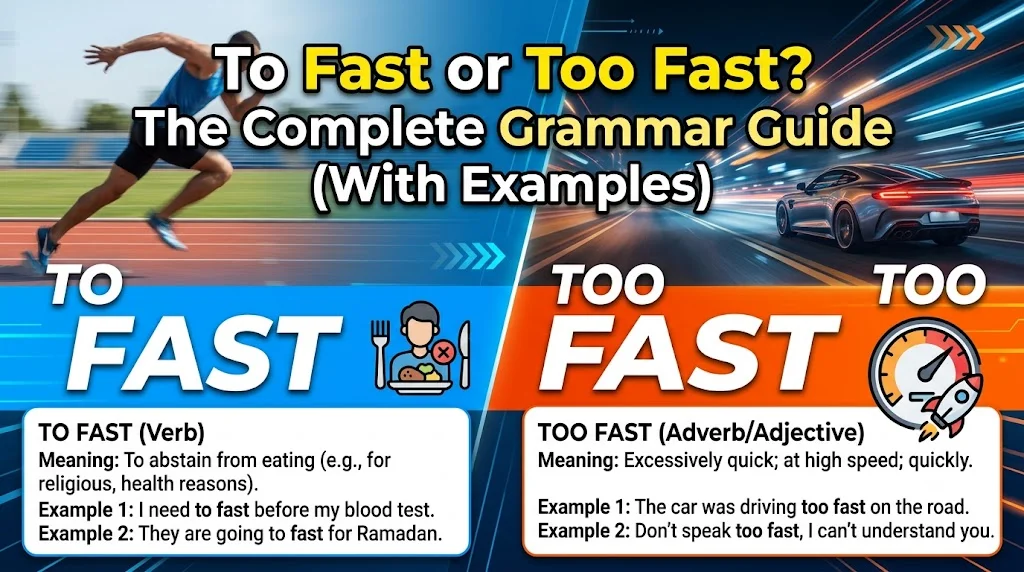
Both “to fast” and “too fast” are correct — but they mean completely different things.
- “Too fast” means “at a speed that is too high” or “excessively quick.” Example: You are driving too fast.
- “To fast” means “to not eat food,” usually for religious, health, or medical reasons. Example: Muslims fast during Ramadan.
The difference comes down to one letter — but that single letter changes the entire meaning of your sentence. Let’s break down why.
Why This Mix-Up Happens
“To” and “too” are called homophones — words that sound alike but have different spellings and meanings. English has hundreds of these tricky pairs (think “their/there/they’re” or “your/you’re”), and “to/too” is one of the most frequently confused because the words are short, common, and used constantly in everyday speech.
Since spoken English does not show spelling, your ear cannot tell you which one to use. Only grammar can. That is exactly what we are going to fix.
Understanding “To”: Meaning, Grammar, and Usage
Definition of “To”
“To” is a short function word in English. It usually works in one of two ways:
- As a preposition showing direction, destination, or relationship.
- As part of the infinitive form of a verb (to + base verb).
Pronunciation: “To” is pronounced /tuː/ or, in fast casual speech, often softened to /tə/ (like “I want tuh go”).
Word origin: “To” comes from Old English tō, which had a similar directional meaning, related to Old High German zuo. It has been part of English for over a thousand years, making it one of the oldest and most essential words in the language.
“To” as a Preposition
When “to” works as a preposition, it shows movement, direction, or connection between two things.
Examples:
- She walked to the store.
- We are driving to Chicago tomorrow.
- Give this letter to your manager.
Common collocations with “to” (preposition):
- go to, come to, belong to, listen to, talk to, adapt to, respond to
“To” as an Infinitive Marker
The second job of “to” is forming the infinitive — the base form of a verb used to express purpose, intention, or a general action.
Examples:
- I need to sleep.
- She wants to fast for religious reasons.
- They plan to travel next month.
Notice the second example: to fast. Here, “fast” is a verb, not an adjective, and “to” is simply introducing that verb in its infinitive form — exactly the same job “to” does in “to sleep” or “to travel.”
Quick Tip: If you can replace “fast” with another action verb (like “eat,” “run,” or “sleep”) and the sentence still makes sense, you are using the infinitive form, and “to” is correct.
Understanding “Too”: Meaning, Grammar, and Usage
Definition of “Too”
“Too” is an adverb with two main meanings:
- Excess — meaning “more than necessary” or “more than acceptable.”
- Addition — meaning “also” or “as well.”
Pronunciation: “Too” is pronounced /tuː/ — identical to “to” in careful speech, which is exactly why people confuse them in writing.
Word origin: “Too” is also from Old English, originally a stressed variant of “to.” Over centuries, English speakers began spelling the emphatic, adverbial meaning with a double “o” to visually separate it from the preposition/infinitive “to.” This spelling distinction became standardized by the 1600s.
“Too” Indicating Excess
This is the meaning we care about most for our keyword. When “too” means excess, it appears directly before an adjective or adverb and signals that something has gone beyond a normal, acceptable, or safe limit.
Examples:
- This coffee is too hot to drink.
- He was driving too fast on the highway.
- The test was too difficult for beginners.
Here, “fast” is functioning as an adverb describing how someone drives, and “too” is modifying “fast” to show excess speed.
“Too” Indicating Addition
Examples:
- I would like to come too.
- She ordered pizza, and I did too.
This meaning is not related to our main keyword, but it is worth knowing so you fully understand every use of “too.”
Too vs To: Side-by-Side Comparison
| Feature | To | Too |
| Part of speech | Preposition / infinitive marker | Adverb |
| Meaning | Direction, destination, or “in order to” | Excess (“more than needed”) or “also” |
| Followed by | A noun or base verb | An adjective or adverb |
| Example | I want to fast | You’re driving too fast |
| Number of O’s | One “o” | Two “o’s” |
| Sounds like | Identical pronunciation to “too” | Identical pronunciation to “to” |
Memory Tip: “Too” has an extra “o,” just like it expresses an extra or excessive amount. One simple trick: “Too” has TOO MANY O’s, just like it means TOO MUCH.”
What Does “Fast” Mean in Grammar?
To fully understand this word pair, you need to know that “fast” itself has two completely different grammatical roles, and that is the real root of the confusion.
- Fast as an adjective/adverb — meaning quick or rapid, or done at high speed.
- He is a fast runner. (adjective)
- She ran fast. (adverb)
- Fast as a verb — meaning to go without food or drink, usually voluntarily.
- He decided to fast for 24 hours.
- Fast as a noun — referring to the act or period of not eating.
- The fast lasted three days.
This is why “to fast” and “too fast” both exist as grammatically correct phrases — they simply use “fast” in two different roles.
When “To Fast” Is Correct
“To fast” is correct when “fast” is used as a verb meaning to abstain from eating, and “to” is functioning as the infinitive marker before it.
Correct Examples
- Many people choose to fast during Ramadan.
- The doctor advised him to fast before the blood test.
- She wanted to fast for spiritual clarity.
- It can be healthy to fast occasionally, according to some nutritionists.
- He promised to fast from sunrise to sunset.
Case Study: Intermittent Fasting
Intermittent fasting has become extremely popular in health and wellness content, and it is a perfect real-world example of “to fast” used correctly.
Example: “Many people decide to fast for 16 hours a day as part of an intermittent fasting routine.”
Here, “fast” is clearly a verb (an action you do), and “to” introduces it in infinitive form — the same pattern as “to eat,” “to sleep,” or “to exercise.”
Related terms: fasting, faster (someone who fasts), unfasten (unrelated, different root), break a fast, breakfast (literally “break-fast,” the meal that ends the overnight fast).
When “Too Fast” Is Correct
“Too fast” is correct when “fast” is used as an adjective or adverb meaning quick or rapid, and “too” modifies it to show excess.
Examples
- You are driving too fast — slow down.
- The download finished too fast to be accurate.
- He speaks too fast for me to understand.
- The car accelerated too fast and skidded.
- Don’t eat too fast, or you’ll get a stomachache.
Real-Life Applications
In traffic laws:
- “Going too fast in a school zone can result in a heavy fine.”
In sports:
- “The runner started too fast and had nothing left for the final lap.”
In everyday life:
- “Time moves too fast when you’re having fun.”
- “Don’t grow up too fast.”
Common collocations with “too fast”: drive too fast, talk too fast, move too fast, eat too fast, grow too fast, run too fast, spread too fast (as in news or disease).
Common Mistakes and Why They Happen
Typical Errors
- ❌ I want to loose weight, so I’m going to to fast. (missing second “to”)
- ❌ He was driving to fast. (should be “too fast”)
- ❌ She decided too fast for the competition. (should be “to fast”)
- ❌ That’s to easy. (should be “too easy”)
Why These Mistakes Happen
- Identical pronunciation — “to” and “too” sound exactly the same in speech, so writers rely on habit rather than grammar rules.
- Autocorrect and typing speed — many errors happen simply from typing quickly and not proofreading.
- Lack of grammar review — many English learners were never taught the preposition/adverb distinction clearly.
- Visual similarity — the words look almost identical, differing by only one letter.
Quick Fixes
- Test 1: Try replacing the word with “also.” If the sentence still makes sense, use “too.” (I want to come, too.)
- Test 2: Ask if the next word is an adjective or adverb (like “fast,” “hot,” “big”). If yes, and it means “excessively,” use “too.”
- Test 3: Ask if the next word is a verb (like “eat,” “run,” “fast”). If yes, use “to.”
Quick Reference Table
| Sentence Type | Correct Word | Example |
| Before a verb (infinitive) | to | I want to fast. |
| Before an adjective/adverb showing excess | too | You’re driving too fast. |
| Showing direction/destination | to | Walk to the door. |
| Meaning “also” | too | Me too! |
| Fast = not eating | to fast | He plans to fast on Friday. |
| Fast = quick speed | too fast | That car is too fast. |
Advanced Usage: When Both Appear in the Same Sentence
Sometimes both words appear together, which can feel tricky at first, but the rule stays the same — just apply it twice.
Example: “It’s too risky to fast for more than three days without medical advice.”
Let’s break this down:
- too risky → “too” + adjective (excess)
- to fast → “to” + verb (infinitive)
Another example: “Don’t try to fast too quickly without easing into it — start with shorter periods.”
Quick Tip: Read the sentence slowly and identify each word’s job separately. Grammar rules don’t change just because two tricky words appear close together.
Formal vs Informal Usage
| Context | Preferred Style | Example |
| Academic writing | Full, precise phrasing | “Participants were instructed to fast for twelve hours prior to testing.” |
| Business writing | Clear and direct | “Please do not drive too fast in the company parking lot.” |
| Casual conversation | Contractions and shorter phrasing common | “Don’t drive too fast, okay?” |
| Religious/cultural texts | Formal infinitive structure | “Believers are called to fast during this holy period.” |
Both “to fast” and “too fast” are appropriate in formal and informal English — there is no version that is more “correct” for tone. What matters is grammatical accuracy, not formality.
Similar and Related Word Pairs
English has several other homophone pairs that confuse writers in the same way. Learning the pattern for “to/too” actually helps you master these too.
| Pair | Difference | Example |
| Your / You’re | Possession vs. contraction of “you are” | Your dog is cute. / You’re funny. |
| There / Their / They’re | Place / possession / contraction | There it is. / Their house. / They’re late. |
| Its / It’s | Possession vs. contraction of “it is” | The dog wagged its tail. / It’s raining. |
| Then / Than | Time vs. comparison | First this, then that. / Better than before. |
| Affect / Effect | Verb vs. noun (usually) | It will affect the results. / The effect was clear. |
Tip: Whenever two words sound identical, always check their grammatical role in the sentence — that’s the trick that solves almost every homophone confusion in English.
Synonyms and Opposites
Synonyms for “too” (excess meaning): excessively, overly, unduly, extremely (informal usage)
Synonyms for “fast” (speed meaning): quick, rapid, speedy, swift, brisk
Synonyms for “fast” (not eating meaning): abstain, go without food, do a cleanse (informal)
Opposite of “too fast”: too slow, at a proper pace, appropriately fast
Opposite of “to fast”: to eat, to feast, to indulge
Mini Quiz: Test Your Understanding
Choose the correct word for each sentence. Answers are below.
- He was driving ___ fast when the accident happened.
- Many athletes choose ___ fast before a weigh-in.
- This soup is ___ hot to eat right now.
- She wants ___ come with us ___.
- It’s not healthy ___ fast for more than a few days without guidance.
Answers: 1) too, 2) to, 3) too, 4) to / too, 5) to
If you got four or five correct, you have already mastered this rule better than most native speakers.
Extra Practice Examples
Reading rules is helpful, but practice is what makes the grammar stick. Try covering the answers and testing yourself on each sentence below.
Fill in the blank with “to” or “too”:
- I think you’re driving ___ fast for this weather.
- He plans ___ fast for two days before his surgery.
- This bag is ___ heavy for me to carry.
- She wants ___ visit her grandmother this weekend.
- My brother is coming ___, so save him a seat.
- It’s not safe ___ fast without checking with a doctor first.
- The internet connection was ___ slow to stream the video.
- They decided ___ fast together as a family during the holiday.
Answers: 1) too, 2) to, 3) too, 4) to, 5) too, 6) to, 7) too, 8) to
Sentence-building practice:
Try writing your own sentences using each phrase correctly:
- Write one sentence using “to fast” as a verb.
- Write one sentence using “too fast” as excessive speed.
- Write one sentence using “too” to mean “also.”
- Write one sentence using “to” as a preposition of direction.
This kind of active practice trains your brain to recognize grammatical patterns instead of relying on memory alone, which is exactly how professional English teachers recommend building lasting fluency.
Pronunciation Practice Tips
Since “to” and “too” sound identical, your ear will never catch the mistake — only your understanding of grammar will. Still, it helps to practice saying both words in context so you associate meaning with sound.
- Say aloud: “I want to go” (soft, quick /tə/ sound, unstressed).
- Say aloud: “That’s too much” (slightly longer, more stressed /tuː/ sound).
Native speakers often stress “too” slightly more than “to” in natural speech, especially when emphasizing excess (“That’s TOO expensive!”). This subtle stress pattern won’t help you in writing, but it’s a useful listening clue when you’re trying to understand spoken English.
How Search Intent Shapes This Question
Most people searching for “to fast or too fast” fall into one of three groups:
- Grammar learners who want a clear, simple rule they can apply immediately.
- Writers and editors proofreading content and double-checking correct usage.
- Health and fitness readers researching intermittent fasting and wanting to confirm the correct spelling before publishing or sharing content.
This guide is built to serve all three groups by combining a clear grammar explanation with real, practical examples from everyday writing, health content, and casual conversation — not just abstract rules.
Why Getting This Right Matters
Small grammar mistakes like “to” versus “too” might seem minor, but they can affect how your writing is perceived. In professional emails, resumes, articles, and even text messages, mixing up homophones can distract readers from your message and, in formal settings, may come across as careless. Learning this rule once means you never have to worry about it again — in job applications, blog posts, school essays, or everyday texting.
A Note on Regional and Dialect Differences
The grammar rule for “to” versus “too” does not change across English dialects — American, British, Australian, and Canadian English all follow the same distinction. However, a few small stylistic differences are worth knowing:
- American English tends to favor shorter, more direct sentences: “Don’t drive too fast.”
- British English sometimes uses slightly more formal phrasing in writing: “One ought not to drive too fast in poor conditions.”
- Religious and cultural contexts (such as discussions of Ramadan, Lent, or Yom Kippur) frequently use “to fast” in formal, respectful language: “Observers are asked to fast from dawn until dusk.”
No matter the dialect, the underlying grammar rule stays identical: check whether “fast” is functioning as a verb (use “to”) or as an adjective/adverb of speed (use “too”).
Recap: The Core Rule in One Sentence
If you remember nothing else from this guide, remember this: use “to fast” when “fast” means to stop eating, and use “too fast” when “fast” means excessive speed. Everything else in this article — the examples, the tables, the quiz — exists to help that one rule become automatic in your writing.
Expert Insight: What Linguists Say
Grammar authorities agree that homophone confusion, especially between “to” and “too,” is one of the most common written English errors — not because the rule is complicated, but because pronunciation gives no visual clue. Professional editors recommend reading your sentence aloud and mentally testing whether the word means “also/excessively” (too) or “toward/infinitive” (to) before finalizing any written content.
Final Thoughts
“To fast” and “too fast” are both correct English phrases, but they serve very different purposes. “To fast” uses “fast” as a verb meaning to skip food, introduced by the infinitive marker “to.” “Too fast” uses “fast” as an adjective or adverb describing excessive speed, modified by the adverb “too.”
The easiest way to remember the difference is to check what comes next: a verb needs “to,” while an adjective or adverb showing excess needs “too.” Once you internalize this simple test, you will never second-guess this pair again, whether you’re writing an email, a school essay, or a work report.
Frequently Asked Questions
1. Is it “to fast” or “too fast” when talking about driving? When talking about driving speed, always use “too fast.” Example: “He was driving too fast on the icy road.” “Fast” here is an adverb describing speed, so it needs “too” to show excess, not “to.”
2. Is it “to fast” or “too fast” for Ramadan? It is “to fast” for Ramadan, since “fast” means to abstain from food, functioning as a verb. Example: “Muslims choose to fast from dawn until sunset during Ramadan.”
3. Why do “to” and “too” sound the same? Both words descend from the same Old English root and share identical pronunciation, /tuː/. English later added the double “o” spelling to “too” to visually distinguish its adverbial meaning from the preposition/infinitive “to.”
4. What’s an easy trick to remember the difference? Replace the word with “also.” If the sentence still makes sense, use “too.” If not, and a verb follows, use “to.” This simple test works in almost every situation you’ll encounter.
5. Can “too fast” and “to fast” appear in the same sentence? Yes. Example: “It’s too risky to fast for a full week without medical supervision.” Each word keeps its own separate grammar rule even when they appear close together.