
If you’ve ever stopped mid-sentence wondering whether to write “passerbys,” “passersby,” or “passerbyers,” you’re not alone. This is one of the most commonly mistyped plural nouns in English, and even confident writers second-guess themselves here.
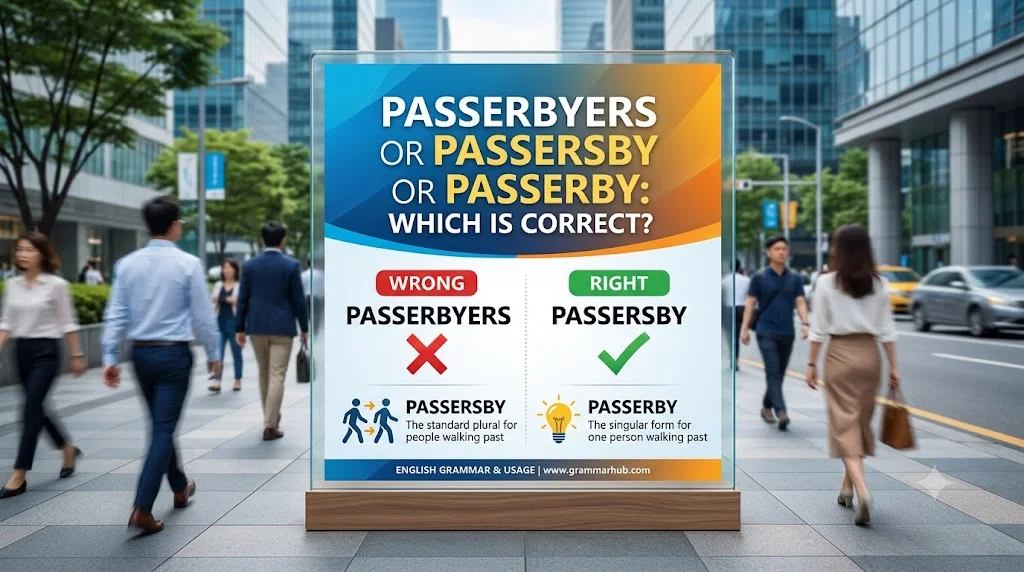
The short answer: “passersby” is the correct plural of “passerby.” Both “passerbys” and “passerbyers” are incorrect. But knowing the right answer isn’t enough — understanding why it’s correct will help you get similar words right for the rest of your writing life.
In this guide, we’ll break down the meaning, grammar, history, and correct usage of “passerby” and “passersby” like a language teacher walking you through a lesson, step by step, with real examples along the way.
What Does “Passerby” Mean?
Definition of Passerby
A passerby (singular noun) is a person who is walking past a place or event, usually by chance, without stopping or being directly involved in it.
Pronunciation: PASS-er-by (/ˈpæs.ərˌbaɪ/)
Part of speech: Noun (singular)
Simple meaning: Someone who happens to walk by.
Example sentences:
- A passerby called 911 after seeing the accident.
- The lost dog was found by a kind passerby.
- No one noticed the sign except one curious passerby.
Notice that “passerby” refers to one person. This matters a lot once we get into plural forms, because most of the confusion around this word comes from people forgetting it’s actually a compound word in disguise.
Origin and History of the Word
“Passerby” comes from combining three familiar English words:
- Passer — one who passes
- By — near or alongside
Historically, the word was written as two separate words, “passer by,” and later hyphenated as “passer-by.” Over time, especially in American English, it became common to write it as one solid word: “passerby.” This evolution is typical in English — many compound words go through the same journey (think “email,” which was once “e-mail”).
Understanding this origin is the key to everything else in this article, because “passer” is the actual noun being pluralized, not “by.”
Why Is “Passerby” So Confusing?
English speakers usually pluralize nouns by adding “-s” or “-es” to the end of the word. That’s the rule most of us learned in school: dog → dogs, box → boxes, city → cities.
So naturally, people assume “passerby” becomes “passerbys.” It looks like a normal noun ending in “-by,” so adding an “-s” feels logical.
But “passerby” isn’t a normal single-unit noun. It’s a compound noun made from two parts: “passer” (the noun) and “by” (a preposition). And compound nouns don’t always follow the standard pluralization rule — especially when the core noun isn’t at the end of the word.
This is the exact same reason people mix up:
- Mother-in-law → mothers-in-law (not “mother-in-laws”)
- Attorney general → attorneys general (not “attorney generals”)
Once you see “passerby” as “passer” + “by,” the confusion clears up fast.
Is “Passerby” a Compound Noun? Understanding the Grammar Rule
Yes — “passerby” is a compound noun, specifically one formed from a noun (“passer”) and a preposition (“by”).
Grammar rule: When a compound noun is made of a noun followed by a preposition or modifier, you pluralize the main noun, not the word at the end.
Here’s the breakdown:
| Part | Word | Role |
| First part | Passer | Main noun (the person) |
| Second part | By | Preposition (describes location/direction) |
Because “passer” is the actual noun, that’s the part that becomes plural: “passer” → “passers.” The preposition “by” stays fixed. Combine them, and you get passersby.
Quick Tip: Ask yourself, “Who or what is doing the action?” In “passerby,” it’s the passer who is doing the passing. So the “-s” belongs on “passer.”
Passerby vs Passersby vs Passerbys vs Passerbyers
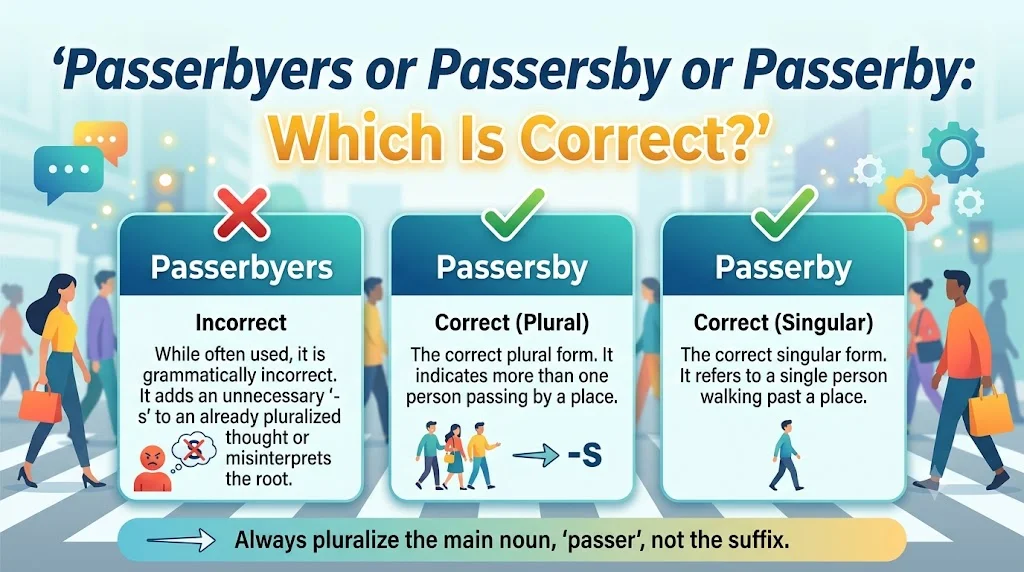
Let’s compare all four versions side by side so you can see exactly what’s right and what’s wrong.
| Word | Correct? | Explanation |
| Passerby | ✅ Correct | Singular form — one person walking by |
| Passersby | ✅ Correct | Plural form — multiple people walking by |
| Passerbys | ❌ Incorrect | Misapplies the standard “-s” rule to the wrong part of the word |
| Passerbyers | ❌ Incorrect | Not a real word; incorrectly adds “-er” and “-s” |
Only two of these four forms are real, dictionary-approved English words: passerby and passersby. The other two are common misspellings that appear in casual writing, social media, and even some published content — but they are not grammatically correct.
Which Is the Correct Plural of Passerby?
The correct plural is passersby.
Why Passersby Is Correct
As explained above, “passerby” is built from “passer” (noun) + “by” (preposition). Standard English grammar pluralizes the head noun in this kind of compound structure, giving us “passers” + “by” = passersby.
Example sentences using “passersby”:
- Several passersby stopped to help after the fall.
- The street performer drew a crowd of amused passersby.
- Witnesses said the passersby scattered when the alarm sounded.
Why Passerbys Is Incorrect
“Passerbys” wrongly treats the whole word as a single, indivisible noun and slaps an “-s” on the end, the same way you’d pluralize “sky” to “skies” or “toy” to “toys.” But since “by” is a preposition, not the core noun, this construction breaks the compound noun rule. You will not find “passerbys” in any major dictionary.
Why Passerbyers Is Incorrect
“Passerbyers” is not a recognized English word at all. It appears to combine “passerby” with the agent suffix “-er” (as in “worker” or “teacher”), then adds a plural “-s.” But “passerby” already contains its own built-in “agent” meaning inside “passer” (someone who passes). Adding another “-er” is redundant and grammatically unsupported. No dictionary — Oxford, Cambridge, or Merriam-Webster — lists “passerbyers” as a word.
Common Mistake: Writing “passerbyers” usually happens when someone mishears the plural “passersby” and tries to reconstruct it phonetically without knowing the correct spelling.
How to Use “Passersby” Correctly in Sentences
Here are practical, real-world examples showing “passersby” in different contexts:
- News reporting: “Passersby captured the incident on their phones.”
- Everyday conversation: “A few passersby stopped to admire the street art.”
- Formal writing: “The report notes that several passersby provided witness statements to police.”
- Descriptive writing: “Passersby paused briefly, then continued on their way, unaware of the drama unfolding just inside the café.”
Grammar note: “Passersby” is always used as a plural noun, so it takes a plural verb.
- ✅ Passersby were watching the parade.
- ❌ Passersby was watching the parade.
Practice Examples: Try filling in the blank with “passerby” or “passersby”:
- A single ______ noticed the smoke first.
- Dozens of ______ gathered outside the courthouse.
- The artist thanked every ______ who stopped to look.
(Answers: 1. passerby, 2. passersby, 3. passerby)
Passer-by vs Passerby: What’s the Difference?
You may have seen the hyphenated form “passer-by” in older texts or British English writing. Is it different from “passerby”?
Meaning-wise, no difference. Both refer to the same thing — someone walking past. The difference is purely about spelling style, which has shifted over time.
| Form | Common Usage | Style Notes |
| Passer-by | Older, more traditional, sometimes British | Hyphenated compound |
| Passerby | Modern, common in American English | Solid (closed) compound |
Modern dictionaries, including Merriam-Webster, primarily list “passerby” as the standard American English spelling. “Passer-by” still appears in British publications and older texts but is becoming less common.
Quick Tip: When in doubt, use “passerby” (no hyphen) for American audiences and “passer-by” only if you’re specifically writing in a British or historical style guide context.
Synonyms, Related Words, and Collocations for “Passerby”
A good writer doesn’t just memorize a word — they understand its neighborhood of meaning. Here’s how “passerby” relates to other English words.
Synonyms for “passerby”:
- Bystander
- Onlooker
- Spectator
- Witness
- Pedestrian (in some contexts)
Important distinction: These words are close in meaning but not identical.
- A bystander is someone present at an event who does not participate — this word carries a slightly more “witness to something happening” tone than “passerby.”
- An onlooker emphasizes watching, often out of curiosity.
- A pedestrian simply means someone walking, with no implication of witnessing anything.
- A passerby specifically implies someone moving past a location, often only briefly present.
Opposite words (antonyms):
- Resident
- Local
- Participant
- Insider
While “passerby” suggests someone temporary and uninvolved, its opposites suggest permanence or direct involvement.
Common collocations (words that naturally pair with “passerby” and “passersby”):
- “A curious passerby”
- “An innocent passerby”
- “Random passersby”
- “Concerned passersby”
- “Passersby stopped to help”
- “Passersby gathered around”
- “Caught the attention of passersby”
Related phrases:
- “In passing” (as in, mentioned quickly, similar spirit to someone walking past)
- “Pass by” (the verb form behind the noun)
- “Walk past”
- “Chance encounter”
Formal vs. informal usage:
| Context | Preferred Word |
| Legal or police reports | Witness, bystander |
| News journalism | Passerby / passersby |
| Everyday conversation | Passerby / passersby |
| Academic writing | Passerby, pedestrian (context-dependent) |
Quick Tip: In formal legal writing, “witness” or “bystander” often sounds more precise than “passerby,” since “passerby” emphasizes movement rather than legal relevance. But in journalism and everyday storytelling, “passerby” and “passersby” remain the natural, most commonly used choice.
Possessive Forms: Passerby’s vs Passersby’s
Possessives trip people up almost as much as plurals do, so let’s clear this up too.
Singular possessive: Add an apostrophe + “s” to “passerby.”
- The passerby’s umbrella blew away in the wind.
Plural possessive: Since “passersby” already ends in “y” (not “s”), you simply add an apostrophe + “s” as well.
- The passersby’s reactions ranged from shock to laughter.
Common Mistake: Writers sometimes try to add the apostrophe before the final “s” in “passersby,” writing “passersby’s” incorrectly as “passerby’s” when referring to a group. Remember: if you mean more than one person, pluralize first (“passersby”), then add the possessive apostrophe + “s” at the very end.
| Form | Example |
| Singular possessive | The passerby’s phone rang. |
| Plural possessive | The passersby’s opinions varied. |
Extra Practice: Test Yourself
Try completing these sentences using “passerby” or “passersby” correctly. Answers are provided below.
- Only one ______ witnessed the theft.
- The mural attracted dozens of ______ throughout the day.
- A kind ______ offered to call a taxi for the stranded traveler.
- Reporters interviewed several ______ near the scene.
- The child waved at every ______ who walked by the window.
Answers: 1. passerby — 2. passersby — 3. passerby — 4. passersby — 5. passerby
Quick Tip: If your sentence uses “a,” “one,” “every,” or “each,” you almost always need the singular “passerby.” If it uses “several,” “many,” “dozens of,” or “some,” you need the plural “passersby.”
“Passerby” in Literature, Media, and Idiomatic Expressions
Beyond grammar textbooks, “passerby” and “passersby” show up often in storytelling, journalism, and everyday idioms, which is part of why getting the spelling right matters so much.
In literature and film: Writers frequently use “a passerby” as a narrative device — an unnamed, minor character who briefly interacts with the main story. Think of the classic scene where “a passerby” hears a cry for help, or “passersby” freeze to watch something unusual happen on the street. This word choice signals someone outside the main plot, present only for a moment.
- Example: “It was a passerby, not a friend, who finally called for help.”
- Example: “The magician performed his trick for a small crowd of amused passersby.”
In journalism: News writing relies heavily on “passersby” because reporters often need a neutral, general term for people who witnessed an event without being formally interviewed as named sources.
- Example: “Passersby described hearing a loud crash before the building’s alarm went off.”
Idiomatic and figurative uses: While “passerby” is mostly literal, it sometimes appears in reflective or poetic writing to represent life’s fleeting, temporary connections.
- Example: “We are all just passersby in each other’s lives, some staying longer than others.”
This figurative use treats “passerby” almost like a metaphor for impermanence — useful in essays, speeches, or creative writing when you want to express the idea of brief, meaningful encounters.
Quick Tip: When writing creatively, “passerby” (singular) often works well as a symbolic figure — a stranger who changes the course of a story in a small way. “Passersby” (plural), on the other hand, is more useful for setting a scene, showing a crowd’s reaction, or grounding a moment in a busy, public place.
Common Grammar Mistakes and How to Avoid Them
Let’s look at the most frequent errors people make with this word family, and how to fix them.
Mistake 1: Adding “-s” to the end of the whole word
- ❌ Passerbys
- ✅ Passersby
Mistake 2: Adding “-er” to form a false agent noun
- ❌ Passerbyer / Passerbyers
- ✅ Passerby / Passersby
Mistake 3: Using “passerby” as a plural
- ❌ Three passerby saw the crash.
- ✅ Three passersby saw the crash.
Mistake 4: Using “passersby” as a singular
- ❌ A passersby helped me find my keys.
- ✅ A passerby helped me find my keys.
Mistake 5: Confusing the possessive form
- ✅ The passerby’s phone rang. (singular possessive)
- ✅ The passersby’s reactions varied. (plural possessive)
Quick Tip to Avoid All These Mistakes: Mentally replace “passer” with a normal noun like “runner.” Just as “runner” becomes “runners,” “passer” becomes “passers.” Then simply add “by” back on: “passers” + “by” = “passersby.”
Examples of Passersby in Everyday English
Daily Conversations
- “I asked a passerby for directions to the train station.”
- “A group of passersby stopped to take photos of the sunset.”
News Articles
- “Several passersby rushed to assist the injured cyclist before paramedics arrived.”
- “Authorities are asking passersby who witnessed the incident to come forward.”
Formal Writing
- “The study relied on interviews with passersby near the city center to gauge public opinion.”
- “Security footage shows the suspect interacting briefly with a passerby before fleeing the scene.”
These examples show that “passerby” and “passersby” appear naturally across casual speech, journalism, and academic or legal writing — making it an important word to get right in nearly any writing context.
Similar Compound Nouns That Follow the Same Rule
“Passerby” isn’t alone. Many English compound nouns pluralize the first part rather than the last. Recognizing this pattern helps you avoid similar mistakes elsewhere.
| Singular | Correct Plural | Incorrect Plural |
| Passerby | Passersby | Passerbys |
| Mother-in-law | Mothers-in-law | Mother-in-laws |
| Attorney general | Attorneys general | Attorney generals |
| Court-martial | Courts-martial | Court-martials |
| Runner-up | Runners-up | Runner-ups |
| Editor-in-chief | Editors-in-chief | Editor-in-chiefs |
Tip to Remember: In all of these examples, the most important noun (the “who” or “what”) comes first, and that’s the part that gets pluralized. The word that follows — “in-law,” “general,” “martial,” “up,” “in-chief,” or “by” — acts as a modifier and stays fixed.
Passersby in American vs British English
Both American and British English accept “passersby” as the correct plural. The main difference lies in the singular spelling style:
| Region | Preferred Singular | Preferred Plural |
| American English | Passerby | Passersby |
| British English | Passer-by (sometimes) | Passers-by |
Notice that British English sometimes hyphenates the plural too: “passers-by.” This is stylistic and not a grammar error — both “passersby” and “passers-by” are widely accepted, though “passersby” (no hyphen) is now more common globally, especially in digital and American publications.
What Do Major Dictionaries Say?
Let’s check what the most trusted English dictionaries confirm about this word.
Oxford Dictionary
Oxford lists “passer-by” (hyphenated) as the standard entry, with the plural form “passers-by.” It defines the word simply as a person who is walking past someone or something, especially by chance.
Cambridge Dictionary
Cambridge follows a similar pattern, listing “passer-by” with the plural “passers-by,” while acknowledging the closed-form “passerby” as a widely used variant, particularly in American English.
Merriam-Webster Dictionary
Merriam-Webster, the leading American English authority, lists “passerby” as the main entry, with “passersby” as the official plural. This makes “passerby” and “passersby” the preferred forms for American writers, students, and professionals.
Takeaway: No matter which major dictionary you check, you will never find “passerbys” or “passerbyers” listed as correct. These forms simply do not exist in standard English.
Easy Trick to Remember the Correct Plural
Here’s a simple, teacher-approved trick you can use forever:
Step 1: Break the word into its two parts: “passer” + “by.” Step 2: Ask which part is the actual noun (the person). That’s “passer.” Step 3: Pluralize only that part: “passer” → “passers.” Step 4: Reattach “by” without changing it: “passers” + “by” = “passersby.”
Memory phrase: “The passers do the passing — so the passers get the plural.”
If you can remember that “by” never changes, you’ll never write “passerbys” or “passerbyers” again.
Quick Comparison Table: Passerby vs Passersby vs Passerbys vs Passerbyers
| Word | Grammatically Correct? | Usage | Notes |
| Passerby | ✅ Yes | Singular | One person walking by |
| Passersby | ✅ Yes | Plural | Multiple people walking by |
| Passer-by | ✅ Yes (British/older style) | Singular | Hyphenated variant |
| Passers-by | ✅ Yes (British/older style) | Plural | Hyphenated plural |
| Passerbys | ❌ No | — | Common misspelling |
| Passerbyers | ❌ No | — | Not a real word |
Final Verdict: Which Word Should You Use?
For clear, modern, correct English:
- Use “passerby” for one person.
- Use “passersby” for more than one person.
- Avoid “passerbys” and “passerbyers” entirely — neither is a recognized English word.
If you’re writing for a British audience or a more traditional publication, “passer-by” and “passers-by” (hyphenated) are also acceptable. But for everyday American English, blog writing, business communication, and academic work, “passerby” and “passersby” are your safest, most widely accepted choices.
Final Thoughts
The confusion between “passerby,” “passersby,” “passerbys,” and “passerbyers” comes down to one simple grammar rule: in compound nouns like this, you pluralize the main noun, not the word attached to it. “Passer” is the noun, “by” is the preposition, so the correct plural is “passersby.” Once you understand that “passerby” is really “passer” plus “by,” the mystery disappears completely. Keep this article’s memory trick in mind — “the passers do the passing” — and you’ll always choose the correct form, whether you’re writing a casual text message, a news report, or a formal essay.
Frequently Asked Questions
1. Is “passerbys” ever correct? No. “Passerbys” is not found in any major dictionary and is considered a common misspelling. The correct plural form is always “passersby,” since the noun “passer” is the part that gets pluralized, not “by.”
2. Is “passerbyers” a real word? No, “passerbyers” is not a real English word. It incorrectly adds both an agent suffix (“-er”) and a plural (“-s”) to a word that already functions as a complete noun. Always use “passerby” or “passersby” instead.
3. What is the plural of passerby? The plural of “passerby” is “passersby.” This follows the compound noun rule where the main noun (“passer”) is pluralized while the preposition (“by”) stays unchanged at the end of the word.
4. Is “passer-by” the same as “passerby”? Yes, they mean the same thing. “Passer-by” is the hyphenated, more traditional or British spelling, while “passerby” is the modern, closed-form spelling commonly used in American English today.
5. How do you pronounce “passersby”? “Passersby” is pronounced PASS-erz-by (/ˈpæs.ərzˌbaɪ/). The stress falls on the first syllable, “pass,” just like in the singular form “passerby.”