
If you have ever paused mid-sentence wondering whether to type “time slot,” “timeslot,” or “time-slot,” you are not alone. This is one of the most common small mix-ups in English, and even confident writers second-guess themselves here. As an English teacher, I see this question come up constantly in emails, scheduling apps, resumes, and business writing.
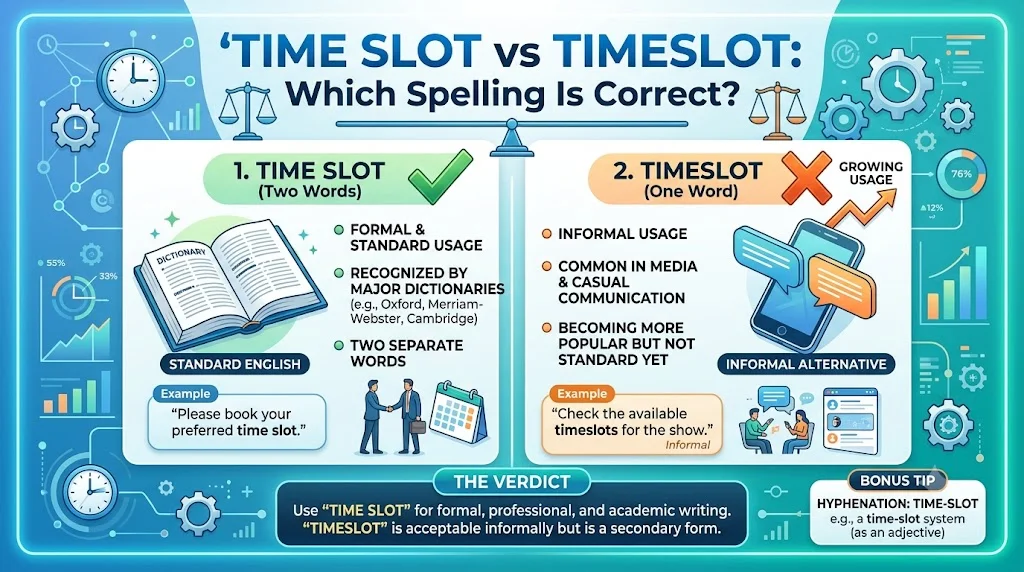
The short version: “time slot” (two words) is the standard, dictionary-preferred form in American English. “Timeslot” is a one-word variant that shows up often in casual and tech writing, but it is not yet considered fully standard. “Time-slot” (hyphenated) is rare and usually unnecessary.
But the short version only gets you so far. In this guide, I will walk you through the grammar, the history, the pronunciation, the common mistakes, and the exact situations where each form works best — the same way I would explain it to a student sitting across from me.
Time Slot vs Timeslot: The Quick Answer
Let’s settle the main question first, then unpack it.
| Form | Status | Best Use |
| Time slot | Correct, standard, dictionary-recognized | Formal writing, business documents, resumes, publications |
| Timeslot | Informal, increasingly common, not fully standardized | Casual writing, UI text, tech products, internal notes |
| Time-slot | Rare, mostly unnecessary | Almost never required; avoid unless following a specific style guide |
Meaning: All three forms refer to the same thing — a specific, defined period of time set aside for an activity, appointment, or event.
Definition: A time slot is a fixed block of time in a schedule, calendar, or timetable during which something is planned to happen.
Grammar explanation: “Time slot” is an open compound noun, meaning it is written as two separate words that function together as a single noun. English has three ways compound nouns can be written — open (two words), hyphenated (with a dash), and closed (one word) — and “time slot” currently sits in the “open” category according to major dictionaries.
Pronunciation: Both forms are pronounced the same way: /taɪm slɒt/ (US: /taɪm slɑːt/). Say “time” as in “clock time,” then “slot” as in “a slot machine.” There is no change in pronunciation whether you write it as one word or two.
Quick Tip: If you’re ever unsure which to use in professional writing, default to “time slot.” It is the safe, correct, dictionary-backed choice.
What Does “Time Slot” Mean?
Meaning: A “time slot” is a designated, limited period during which an event, task, meeting, or broadcast is scheduled.
Definition: Merriam-Webster and other major dictionaries define a time slot as a period of time set aside for a particular purpose, often as part of a larger schedule.
Word origin: The word “slot” originally referred to a narrow opening or groove — think of a slot in a mailbox or a coin slot. Over time, “slot” took on a figurative meaning: a fixed position within a sequence or schedule. Pairing it with “time” in the early-to-mid 20th century gave English a clear way to describe a scheduled block, first popularized in radio and television programming (“prime-time slot”) before spreading to general use.
Grammar explanation: “Time slot” functions as a noun phrase. “Time” acts as a modifier (an attributive noun) describing what kind of slot it is, and “slot” is the head noun. This is the same pattern as “parking space,” “lunch break,” or “coffee cup” — two nouns working together where the first describes the second.
Common mistakes:
- Writing “timeslot” in formal documents where dictionaries expect “time slot.”
- Forgetting the plural is “time slots,” not “timeslots” in formal writing (though “timeslots” is common informally).
- Using “time-slot” with a hyphen when no hyphen is needed.
Correct usage:
- “Please choose a time slot for your appointment.”
- “The 9 p.m. time slot is reserved for the news.”
Real-life examples:
- “I booked the 2 p.m. time slot for my dentist appointment.”
- “The show moved to a new time slot on Thursdays.”
- “Each speaker gets a 15-minute time slot.”
Formal vs informal usage: “Time slot” works in both formal and informal contexts. It is the safer, more universally accepted form for reports, emails to clients, academic writing, and published content.
Similar words: appointment slot, booking window, scheduled period, time block, calendar slot.
Opposite words: There is no direct single-word opposite, but contrasting concepts include “open time,” “free time,” or “unscheduled period” — moments with no fixed slot assigned.
Related phrases: “available time slot,” “book a time slot,” “assign a time slot,” “select a time slot,” “prime-time slot.”
Common collocations: choose a time slot, reserve a time slot, open time slot, limited time slot, 30-minute time slot, morning time slot.
Synonyms: slot, window, period, block, interval, session.
Is “Timeslot” a Correct Word?
Meaning: “Timeslot” carries the exact same meaning as “time slot” — a scheduled block of time.
Definition: “Timeslot” is a closed compound, meaning the two words have been fused into one with no space or hyphen.
Grammar explanation: Here is the nuance many writers miss: “timeslot” is not incorrect in the sense of being nonsense — it is understandable and widely used. But it is not yet the primary, dictionary-recommended spelling in most major American and British dictionaries. Some dictionaries list it as a variant; others do not list it as a headword at all. This puts it in a gray zone: acceptable in casual writing, but risky in formal or edited writing.
Word origin: “Timeslot” emerged naturally as English speakers began compressing frequently used two-word phrases into single words — the same process that turned “e mail” into “email” and “web site” into “website.” This happens when a phrase is used so often that writers instinctively want to treat it as one unit.
Common mistakes:
- Assuming “timeslot” is 100% standard because it “looks fused” like “email” or “website” — those words completed their transition; “time slot” has not (yet).
- Using “timeslot” in academic papers, legal documents, or formal business writing where style guides expect the two-word form.
- Mixing both forms inconsistently within the same document.
Correct usage: “Timeslot” is acceptable in:
- App interfaces and UI copy
- Casual blog posts
- Internal team messages
- Marketing copy aiming for a modern, tech-forward tone
Real-life examples:
- “Pick your timeslot from the dropdown menu.” (UI text)
- “We have three timeslots left today.” (casual)
Formal vs informal usage: Avoid “timeslot” in resumes, contracts, academic essays, and print publications. It is best reserved for informal, digital, or app-based writing.
Tips to remember: Think of “timeslot” as the “jeans and t-shirt” version — comfortable, common, and perfectly fine in casual settings, but not what you’d wear to a formal interview (or a formal document).
Time Slot vs Timeslot: What’s the Difference?
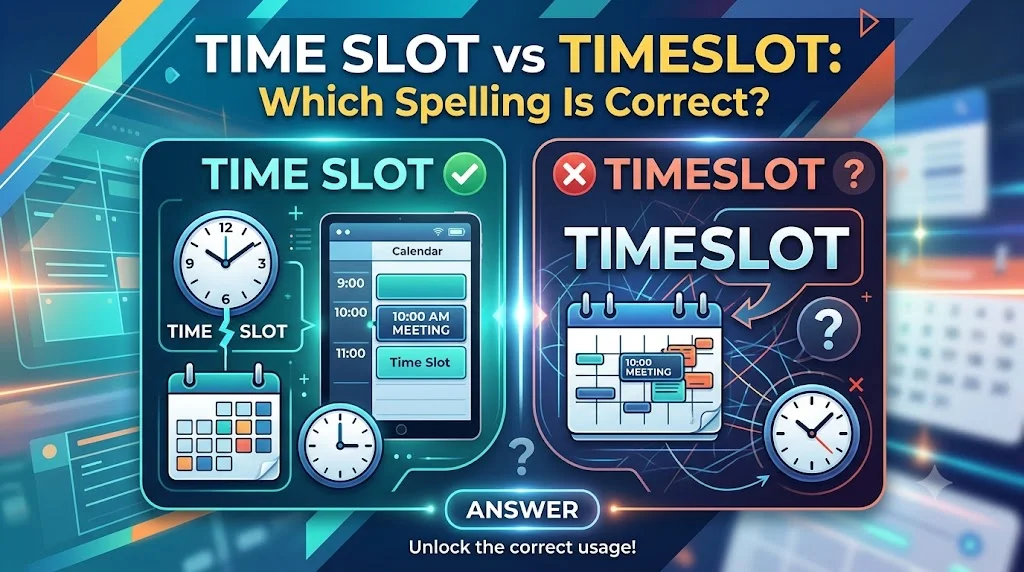
The real difference isn’t in meaning — it’s in register (how formal or casual the writing is) and standardization (how widely dictionaries and style guides accept the form).
| Feature | Time Slot | Timeslot |
| Word type | Open compound noun | Closed compound noun |
| Dictionary status | Standard, widely listed | Variant, inconsistently listed |
| Formality | Formal and informal | Mostly informal |
| Common in | Print, business, academic writing | Apps, websites, casual text |
| Plural form | time slots | timeslots |
| Recommended for SEO/content writing | Yes, primary | Secondary, use sparingly |
Grammar explanation: English compound nouns evolve along a predictable path: open → hyphenated → closed. “Time slot” is still in the open stage for most dictionaries, though it is showing early signs of moving toward the closed form, much like “email” and “database” did decades ago.
Tips to remember: If a word has fully “closed up” in respected dictionaries (like “email,” “website,” “notebook”), it is safe. If it is still listed as two words (like “time slot”), stick with two words in formal writing — even if you see the closed version everywhere online.
Why “Timeslot” Looks Correct but Isn’t Usually Preferred
This section addresses the psychological trap writers fall into.
Meaning: “Timeslot” feels correct because we constantly see closed compounds in modern English — “email,” “website,” “login,” “checkout.” Our brains pattern-match “timeslot” to that trend.
Common mistakes: Assuming frequency of use equals correctness. Popularity on the internet does not automatically change dictionary standards — it can take years or decades for a compound to officially close.
Why it happens:
- App and software interfaces favor shorter, single-word labels to save space (this is a design choice, not a grammar rule).
- Fast typing and texting habits favor fewer words.
- Non-native English content sometimes spreads the closed form through translation and localization work.
Tips to remember: When in doubt, check a dictionary, not a search engine. Search engines show you popularity; dictionaries show you standardization.
When to Use “Time Slot”
Use the two-word form “time slot” in these situations:
- Formal writing: reports, proposals, contracts, official emails
- Academic writing: essays, research papers, theses
- Published content: articles, books, newspapers, magazines
- Resumes and cover letters
- Client-facing business communication
Real-life examples:
- “Please confirm your preferred time slot by Friday.” (business email)
- “The study analyzed viewer behavior across different time slots.” (academic)
- “Interview time slots are available between 9 a.m. and 4 p.m.” (HR communication)
Quick Tip: If you’re writing something that will be printed, published, graded, or reviewed by an editor, always choose “time slot.”
When Is “Time-Slot” (Hyphenated) Correct?
Meaning: The hyphenated form “time-slot” is grammatically rare and generally unnecessary in modern usage.
Grammar explanation: Hyphens are typically used in compound modifiers that come before a noun, to prevent misreading. For example: “a well-known author” or “a three-hour meeting.” Applying this rule, “time-slot” could theoretically appear as a compound adjective before a noun, such as:
- “a time-slot booking system”
Even here, however, most style guides (including AP and Chicago) now prefer “time slot booking system” without the hyphen, because “time slot” is well-established enough not to cause confusion.
Common mistakes: Adding a hyphen out of habit, especially when following older or inconsistent web content that hyphenates compound nouns unnecessarily.
Correct usage: Avoid “time-slot” unless a specific in-house style guide requires it. Prefer “time slot” or, in casual contexts, “timeslot.”
Tips to remember: Ask yourself, “Does removing the hyphen cause confusion?” If not, don’t use it. “Time slot booking system” is perfectly clear without a hyphen.
Time Slot vs Timeslot in Formal and Informal Writing
| Context | Recommended Form | Example |
| Academic paper | Time slot | “Participants selected a time slot for testing.” |
| Business proposal | Time slot | “We propose a 30-minute time slot per client.” |
| Text message to a friend | Timeslot | “What timeslot works for you?” |
| App or website UI | Timeslot (accepted) | “Select a timeslot” |
| Legal document | Time slot | “The time slot specified in Section 4…” |
| Marketing email (casual brand voice) | Either, but be consistent | “Grab your favorite timeslot before it’s gone!” |
Grammar explanation: Register — the level of formality in your writing — determines word choice far more than “grammar rules” do here. This is similar to choosing between “kids” and “children,” or “okay” and “acceptable.” Neither is wrong; the context decides which fits.
Tips to remember: Match your compound-word style to your audience. Formal audience → two words. Casual, digital-first audience → one word is tolerated.
Why Some Apps and Websites Use “Timeslot”
Meaning: Many booking platforms, calendar tools, and scheduling apps display “timeslot” as a single word in their interfaces.
Why it happens:
- Space constraints: UI buttons and labels are small; shorter words fit better.
- Brand voice: Tech companies often favor a modern, streamlined tone, and closed compounds feel sleeker.
- International development teams: Many apps are built by global teams where English is a second language, and the closed form spreads through code, documentation, and copy templates.
- Consistency with similar tech terms: Words like “timestamp,” “timeline,” and “timeout” are already closed compounds, so “timeslot” feels like it belongs in that family.
Related phrases: “book a timeslot,” “available timeslots,” “select your timeslot,” “timeslot picker.”
Tips to remember: UI writing follows different rules than editorial writing. A scheduling app can say “timeslot” for brevity, but the same company’s official blog post or press release should still say “time slot.”
How English Compound Words Evolve
Understanding this process will help you make confident decisions about any compound word, not just “time slot.”
The three stages of a compound word:
- Open compound: Two separate words (e.g., “ice cream,” “time slot”)
- Hyphenated compound: Words joined by a hyphen (e.g., “well-being,” “check-in”)
- Closed compound: Words fused into one (e.g., “email,” “website,” “notebook”)
Word origin insight: Words don’t jump straight from open to closed. They usually pass through a hyphenated stage first, sometimes for decades, before dictionaries agree the closed form is standard. “E-mail” became “email.” “Web site” became “website.” “Time slot” is still sitting comfortably in the open-compound stage, with only light movement toward being written as one word in casual contexts.
Common mistakes: Assuming all compound words will eventually close. Some open compounds stay open indefinitely (e.g., “high school,” “post office,” “ice cream”) because closing them would create awkward or hard-to-read spellings.
Tips to remember: Predicting the “future spelling” of a word is not your job as a writer — following current dictionary standards is. Use “time slot” today; if dictionaries officially update the standard, style guides will follow.
Examples of Correct Usage in Sentences
Here are real-world style examples across contexts, organized by tone.
Formal:
- “The committee has allocated a 20-minute time slot for each presenter.”
- “Please indicate your preferred time slot on the enclosed form.”
- “Our records show no available time slots for next Tuesday.”
Business/Professional:
- “I’ve booked us a time slot at 3 p.m. for the client call.”
- “The vendor requested an earlier time slot for delivery.”
Casual/Conversational:
- “What timeslot did you pick for the gym class?”
- “There’s only one timeslot left before lunch.”
Media/Broadcasting:
- “The drama was given a Sunday-night time slot.”
- “Ratings dropped after the show’s time slot changed.”
Technology/UI:
- “Tap to select a timeslot.”
- “Your timeslot has been confirmed.”
Common Mistakes Writers Make
Mistake 1: Using “timeslot” in formal documents. ✅ Fix: Use “time slot” in resumes, contracts, and academic writing.
Mistake 2: Randomly switching between “time slot” and “timeslot” in the same piece. ✅ Fix: Pick one form per document and stay consistent.
Mistake 3: Adding an unnecessary hyphen (“time-slot”). ✅ Fix: Drop the hyphen unless it’s used as a compound modifier and clarity truly requires it.
Mistake 4: Assuming “timeslot” is wrong. ✅ Fix: It’s not wrong — it’s informal. Context decides whether it’s appropriate.
Mistake 5: Mispluralizing as “time-slots” or “timeslot’s” (using an apostrophe for a plural). ✅ Fix: The correct plural forms are “time slots” and “timeslots” — never use an apostrophe to make a noun plural.
Quick Tips to Remember the Correct Form
- Formal writing → “time slot” (two words).
- Casual or app-based writing → “timeslot” is acceptable.
- Avoid the hyphen unless your specific style guide requires it.
- Stay consistent — don’t mix forms in one document.
- When unsure, check a dictionary, not just what you see online.
- Think of “time slot” like “ice cream” — two words that work together, not yet fused.
Frequently Asked Questions
Is “Timeslot” Ever Correct?
Yes. “Timeslot” is understandable, widely used, and appropriate in informal writing, app interfaces, and casual communication. It is not, however, the primary form recognized by most major dictionaries, so it’s best avoided in formal, academic, or professionally edited writing where “time slot” is expected.
Should “Time Slot” Be Hyphenated?
Generally, no. “Time slot” does not need a hyphen in standard use. A hyphen is only occasionally justified when the phrase functions as a compound adjective directly before a noun, and even then, most modern style guides now prefer leaving it open for readability.
Can “Time Slot” and “Time-Slot” Be Used Interchangeably?
Not quite. “Time slot” is the standard, dictionary-preferred form, while “time-slot” is a rare hyphenated variant with no real grammatical advantage in most sentences. It’s safest to simply use “time slot” and skip the hyphen altogether unless a specific style guide instructs otherwise.
Why Do Some Apps Prefer “Timeslot”?
Apps and websites often use “timeslot” because it’s shorter, fits better in small UI elements like buttons and dropdowns, and matches the tone of similar closed compounds like “timestamp” or “timeline.” This is a design and branding choice, not necessarily a grammar recommendation for formal writing.
Will “Timeslot” Become Standard English?
Possibly, over time. Many English compound words move from two words to hyphenated to fully closed as usage becomes more frequent, the way “web site” became “website.” “Timeslot” shows early signs of this shift, but as of now, “time slot” remains the standard, dictionary-backed spelling.
Is “Time Slot” One Word or Two?
“Time slot” is officially two words in standard American and British English dictionaries. While “timeslot” appears frequently online, especially in tech and app contexts, the two-word form remains the recommended choice for formal and professional writing.
What Is the Plural of “Time Slot”?
The plural is “time slots” (two words) or “timeslots” (one word), depending on which form you’re using. Never write “time slot’s” or “timeslot’s” with an apostrophe to indicate plural — apostrophes are for possession, not plurals.
Does “Time Slot” Need Capitalization?
Only capitalize “time slot” if it begins a sentence, appears in a title using title case, or is part of a proper noun or heading. In regular sentences, it should stay lowercase: “Please choose a time slot,” not “Please choose a Time Slot.”
Is “Slot” a Formal Word?
Yes, “slot” is a standard, neutral English word appropriate in both formal and informal contexts. It simply means a fixed position or space, whether in a schedule, a machine, or a sequence, and carries no slang or casual connotation on its own.
What’s a Simple Synonym for “Time Slot”?
Common synonyms include “time block,” “period,” “window,” “session,” and “appointment slot.” The best synonym depends on context — “window” works well for flexible scheduling, while “session” fits structured events like classes or meetings.
Final Thoughts
“Time slot” and “timeslot” mean exactly the same thing, so this was never really a battle over meaning — it’s a question of formality and standardization. For nearly all professional, academic, and published writing, “time slot” is the correct, dictionary-backed choice. “Timeslot” isn’t wrong; it’s simply informal, common in apps and casual writing, and still working its way toward full acceptance.
The hyphenated “time-slot” is rarely needed at all. The simplest rule to carry forward: write “time slot” when accuracy and professionalism matter, and relax into “timeslot” only when the tone is casual. Consistency, more than anything, is what makes your writing look polished and confident.