
If you have ever paused mid-sentence wondering whether to write “as evidenced by” or “as evident by,” you are not alone. This little phrase trips up students, professionals, and even seasoned writers. It shows up constantly in academic papers, business reports, legal documents, and news articles, yet many people use it incorrectly without realizing it.
In this guide, I will walk you through everything you need to know about “as evidenced by” — its meaning, grammar, pronunciation, origin, common mistakes, and real-world usage — the way I would explain it to a student in my English class. By the end, you will never second-guess this phrase again.
Why “As Evidenced By” Matters in Writing
Good writing depends on precision. When you make a claim, your reader wants proof. The phrase “as evidenced by” is one of the cleanest ways to connect a claim to its supporting proof in a single sentence.
Think about the difference between these two sentences:
- Sales improved this quarter.
- Sales improved this quarter, as evidenced by a 12% increase in revenue.
The second sentence is stronger because it shows the evidence right away. This is exactly why the phrase appears so often in academic writing, business reports, journalism, and legal arguments. It signals credibility. It tells the reader, “I am not just stating an opinion — here is proof.”
This connects directly to Google’s E-E-A-T principles (Experience, Expertise, Authoritativeness, Trustworthiness). Content that clearly supports its claims with evidence — and uses the language of evidence correctly — reads as more trustworthy to both readers and search engines.
Quick Tip: Whenever you want to sound credible and back up a claim in one smooth sentence, “as evidenced by” is your friend.
What Does “As Evidenced By” Mean?
Meaning: “As evidenced by” means “as shown by,” “as proven by,” or “as demonstrated by.” It introduces proof, data, or an example that supports a statement you just made.
Definition: It is a formal transitional phrase used to connect a claim or conclusion to the specific evidence that supports it.
Part of speech: It functions as a subordinating conjunction phrase (technically, “as” is the conjunction, “evidenced” is a past participle acting as a verb, and “by” is a preposition introducing the evidence).
Example sentence: “The medicine is effective, as evidenced by the clinical trial results.”
Here, “the clinical trial results” is the proof. The phrase “as evidenced by” is simply the bridge connecting the claim (“the medicine is effective”) to that proof.
Breaking Down “As Evidenced By” Word by Word
| Word | Role | Meaning |
| As | Conjunction | Introduces a comparison or explanation |
| Evidenced | Past participle verb (from “to evidence”) | Shown, proven, demonstrated |
| By | Preposition | Introduces the source or method of proof |
When you put these three words together, you get a compact way of saying “which is proven by” or “and here is the proof.”
Real-life example: “The team worked hard, as evidenced by their record-breaking sales numbers.”
“Evidenced” vs “Evident”: The Core Difference
This is where most confusion happens. Let’s break it down clearly, like we would in a grammar class.
“Evidenced”
- Meaning: Shown or proven by something.
- Grammar: Past tense/past participle of the verb “to evidence.”
- Pronunciation: EV-uh-denst (three syllables: /ˈɛv.ɪ.dənst/)
- Function: Works as a verb form, always followed by “by” when used in this phrase.
- Example: “Her dedication was evidenced by her perfect attendance record.”
“Evident”
- Meaning: Clear, obvious, or easy to see.
- Grammar: An adjective.
- Pronunciation: EV-uh-dent (three syllables: /ˈɛv.ɪ.dənt/)
- Function: Describes a noun directly; often paired with “from” rather than “by.”
- Example: “It was evident from her smile that she was happy.”
Comparison Table: “Evidenced” vs “Evident”
| Feature | Evidenced | Evident |
| Word type | Verb (past participle) | Adjective |
| Common preposition | by | from, that |
| Correct phrase | as evidenced by | as is evident from |
| Meaning | proven/shown by | clear/obvious |
| Example | “as evidenced by the data” | “it is evident that she is right” |
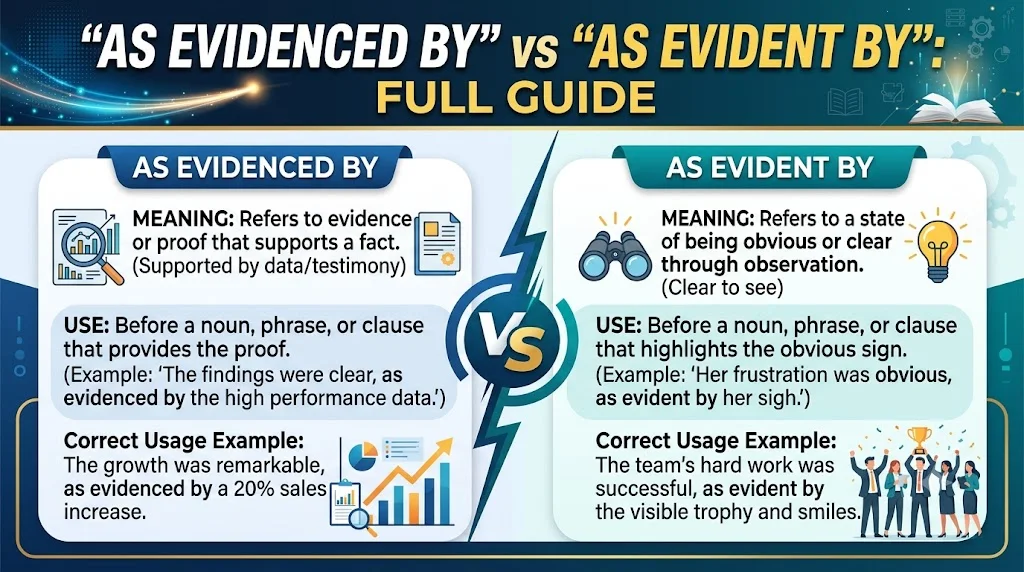
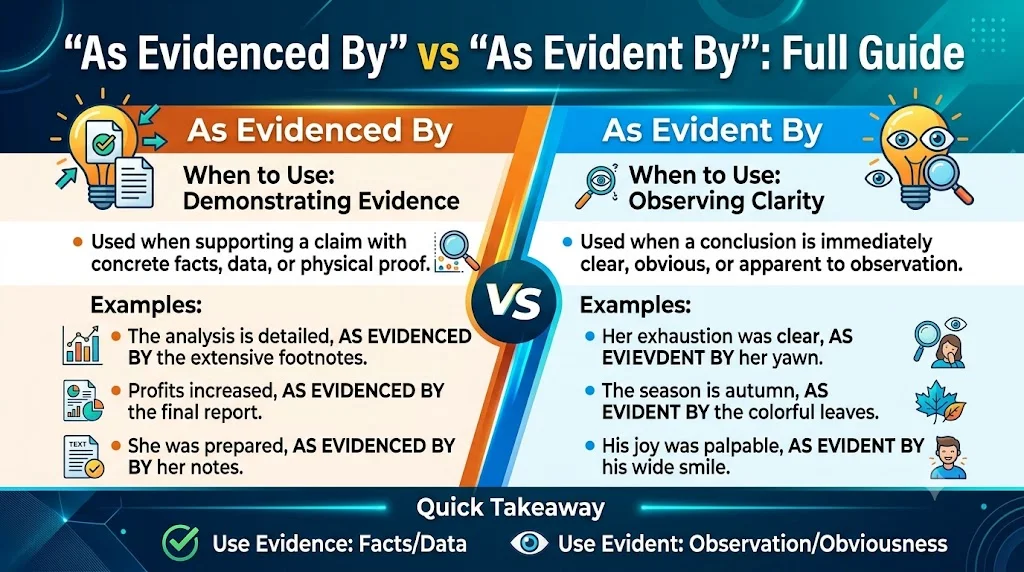
The rule to remember: “As evidenced BY” is correct. “As evident BY” is grammatically incorrect. If you want to use “evident,” pair it with “from” or “that” instead — “as is evident from” or “it is evident that.”
Common Mistake: Writing “as evident by the results” — this mixes an adjective with the wrong preposition pattern. The correct forms are “as evidenced by the results” or “as is evident from the results.”
The Grammar Behind the Phrase
Let’s slow down and look at the grammar in more detail, the way I would with my students.
“As evidenced by” is technically a reduced clause. The full version would be something like:
- “The project succeeded, as it was evidenced by the client’s positive feedback.”
In modern usage, we drop “it was” and simply say:
- “The project succeeded, as evidenced by the client’s positive feedback.”
This is called an elliptical clause — a shortened clause where understood words are omitted for smoothness. This is completely standard and accepted in formal English.
Sentence Structure Pattern
[Claim/Statement] + as evidenced by + [Proof/Evidence/Example]
Example: “The company is growing rapidly, as evidenced by its expanding workforce.”
Can You Start a Sentence With “As Evidenced By”?
Yes, though it is less common. When you do, the evidence comes first, followed by the claim.
Example: “As evidenced by the survey results, customer satisfaction has improved significantly.”
Both structures are grammatically correct. Choose the one that flows better with your sentence.
Quick Tip: If your evidence is the more important or dramatic part of the sentence, put it first. Otherwise, keep it at the end for a natural, conversational flow.
Pronunciation Guide
Pronunciation matters, especially for non-native English speakers and for spoken presentations.
| Phrase | Phonetic Spelling | Syllable Break |
| As evidenced by | /æz ˈɛv.ɪ.dənst baɪ/ | az EV-i-denst bai |
| Evidenced | /ˈɛv.ɪ.dənst/ | EV-i-denst |
| Evident | /ˈɛv.ɪ.dənt/ | EV-i-dent |
Tip: The “d” sound at the end of “evidenced” is often softened in fast speech, but it should not disappear entirely in formal speaking, like presentations or interviews.
Word Origin and History
Understanding where a word comes from often makes it easier to remember how to use it correctly.
“Evidence” comes from the Latin word evidentia, meaning “clearness” or “obviousness,” which itself comes from evidens — a combination of ex- (“out of”) and videre (“to see”). Literally, it means “that which can be clearly seen.”
The verb form “to evidence” (meaning “to show clearly” or “to prove”) developed later in English, giving us “evidenced” as its past participle. This is why “evidenced” always relates to something being demonstrated or proven — it carries that original sense of something being made visible or clear.
Knowing this root helps explain why both “evident” (clear to see) and “evidenced” (shown/proven) share the same DNA, even though they function differently in a sentence.
Real-World Usage Examples
Seeing the phrase in different contexts helps cement how it works. Here are examples across various fields.
Academic Writing
- “The hypothesis was supported, as evidenced by the statistical significance of the results (p < 0.05).”
- “Climate change is accelerating, as evidenced by rising global temperatures over the past decade.”
Business and Corporate Writing
- “Our marketing strategy is working, as evidenced by a 30% increase in website traffic.”
- “Employee morale has improved, as evidenced by higher retention rates.”
Legal Writing
- “The defendant was present at the scene, as evidenced by security camera footage.”
- “The contract was breached, as evidenced by the missed payment deadlines.”
Journalism
- “Public opinion is shifting, as evidenced by the latest polling data.”
- “The city’s economy is recovering, as evidenced by falling unemployment numbers.”
Everyday Conversation (Less Common, But Possible)
- “He’s clearly stressed, as evidenced by all those coffee cups on his desk.”
Formal vs Informal Usage
“As evidenced by” is a formal phrase. It belongs in academic papers, professional reports, legal writing, and journalism. In casual conversation, native speakers usually choose simpler alternatives.
| Context | Preferred Phrase |
| Academic paper | as evidenced by |
| Business report | as evidenced by / as shown by |
| Casual conversation | you can tell by / it’s obvious because |
| Text message to a friend | I mean, just look at… |
| Job interview | as demonstrated by / as shown by |
Tip for Writers: If you are writing a casual blog post or a friendly email, “as evidenced by” might sound stiff. Save it for formal or professional contexts where credibility and precision matter most.
Synonyms and Alternatives
Variety keeps your writing engaging. Here are natural alternatives to “as evidenced by,” along with subtle differences in tone.
| Synonym Phrase | Tone | Example |
| As shown by | Neutral/formal | “Prices rose, as shown by the latest report.” |
| As demonstrated by | Formal | “Her skill was demonstrated by the flawless performance.” |
| As proven by | Strong/confident | “The theory was correct, as proven by repeated experiments.” |
| As indicated by | Neutral | “Demand is growing, as indicated by sales figures.” |
| As illustrated by | Formal, often visual | “The trend is clear, as illustrated by the graph below.” |
| As reflected in | Formal | “Customer satisfaction improved, as reflected in the survey scores.” |
| Given the evidence of | Formal | “Given the evidence of increased traffic, the campaign succeeded.” |
| Judging by | Informal | “Judging by his smile, he got the job.” |
| Based on | Neutral | “Based on the data, sales are improving.” |
Related Phrases: “in light of,” “according to,” “supported by,” “backed by,” “confirmed by.”
Common Collocations: “evidenced by data,” “evidenced by results,” “evidenced by research,” “evidenced by statistics,” “evidenced by feedback,” “evidenced by figures.”
Opposite Expressions
Since “as evidenced by” introduces proof, its rough opposites introduce doubt, absence of proof, or contradiction.
- “Despite the lack of evidence…”
- “Contrary to what the data suggests…”
- “There is no proof that…”
- “Unsupported by evidence…”
Example: “Contrary to what the data suggests, the campaign actually underperformed.”
Common Errors to Avoid
Let’s go through the mistakes I see most often, so you can avoid them in your own writing.
Mistake 1: “As Evident By”
Incorrect: “The results were positive, as evident by the survey.” Correct: “The results were positive, as evidenced by the survey.”
Remember: “evident” is an adjective and does not pair with “by.” Use “evidenced” (verb) with “by,” or use “evident” with “from” or “that.”
Mistake 2: Missing the “By”
Incorrect: “The growth was evidenced the sales report.” Correct: “The growth was evidenced by the sales report.”
The preposition “by” is not optional. It introduces the source of the proof.
Mistake 3: Confusing “Evidence” (Noun) with “Evidenced” (Verb)
Incorrect: “This is evidence by the report.” Correct: “This is evidenced by the report.” OR “This is evidence from the report.”
“Evidence” is usually a noun (proof itself). “Evidenced” is the verb form (to show/prove). Don’t mix the two.
Mistake 4: Overusing the Phrase
Using “as evidenced by” in every single paragraph makes writing feel repetitive and robotic. Rotate with synonyms like “as shown by” or “as demonstrated by” to keep the writing natural.
Mistake 5: Using It in Casual Writing
Using “as evidenced by” in a text message or casual blog post can sound overly formal or even pretentious. Match your phrase to your audience.
Quick Tips Recap:
- Use “evidenced” with “by.”
- Use “evident” with “from” or “that.”
- Never drop the “by” in this phrase.
- Don’t overuse it — vary your language.
- Reserve it for formal writing.
Prepositions Matter: Why “By” Is Essential
In English grammar, prepositions are small words that carry big responsibility. They tell us the relationship between words in a sentence. “By” in “as evidenced by” tells the reader the source or means of the proof.
Compare:
- “Evidenced by the report” (the report is the source of proof) ✅
- “Evidenced from the report” ❌ (incorrect pairing)
- “Evidenced in the report” ❌ (also incorrect in this fixed phrase)
This is what linguists call a fixed collocation — certain words are simply expected to appear together in English, even if another preposition might seem logical. “Evidenced” almost always pairs with “by,” just as “interested” pairs with “in” and “afraid” pairs with “of.”
Tip to Remember: Think of “by” as pointing to the source: “evidenced BY the data” means the data is doing the proving.
Tips for Writers: Using “As Evidenced By” Naturally
Here are practical, teacher-approved tips for weaving this phrase smoothly into your writing.
- Use it to support claims, not to replace them. The phrase should follow a clear statement, not stand alone.
- Keep the evidence specific. Vague evidence weakens the sentence. Compare “as evidenced by results” (vague) to “as evidenced by a 15% drop in complaints” (specific and strong).
- Don’t overuse it. Once or twice per document is usually enough. Overuse dilutes its impact.
- Match your tone. Save it for reports, essays, and professional writing, not casual chats.
- Read it aloud. If the sentence sounds clunky, consider a simpler synonym like “shown by” or “based on.”
- Place it near the evidence. Don’t separate the phrase too far from the proof it introduces, or the sentence becomes confusing.
Practice Example:
- Weak: “Sales grew this year. This is evidenced by data.”
- Strong: “Sales grew 18% this year, as evidenced by internal revenue reports.”
Case Study: Academic Paper Usage
Academic writing is where “as evidenced by” truly shines, since research papers depend heavily on connecting claims to data.
Example from a research context:
“The intervention group showed measurable improvement in cognitive performance, as evidenced by a 22% increase in average test scores compared to the control group.”
Notice how the phrase does three jobs at once:
- It states the claim (improvement occurred).
- It signals that proof is coming.
- It introduces specific, quantifiable evidence (22% increase).
This structure is exactly what professors, journal reviewers, and academic style guides (like APA and MLA) expect from strong analytical writing. It shows the writer is not just asserting an opinion but grounding it in data — a core principle of academic credibility and, by extension, of E-E-A-T-aligned content online.
Another example:
“Student engagement increased significantly after the curriculum redesign, as evidenced by attendance records and end-of-term surveys.”
Here, two forms of evidence (attendance records and surveys) are combined after a single “as evidenced by,” showing that the phrase can introduce multiple pieces of proof at once.
Tip for Students: In academic writing, always follow “as evidenced by” with a specific, citable source — data, a study, a quote, or a statistic. Vague evidence weakens your argument and can lower the credibility of your paper.
Similar Words and Phrases Worth Knowing
To round out your vocabulary, here are related terms that often appear alongside or instead of “as evidenced by.”
| Word/Phrase | Type | Meaning |
| Evidence | Noun | Proof or facts supporting a claim |
| Evidently | Adverb | Clearly, apparently |
| Evidential | Adjective | Relating to or providing evidence |
| Substantiate | Verb | To provide evidence to support a claim |
| Corroborate | Verb | To confirm or support with additional evidence |
| Validate | Verb | To confirm the accuracy or truth of something |
Example with “evidently”: “Evidently, the plan worked better than expected.”
Example with “substantiate”: “The report failed to substantiate its claims with real data.”
Practice Exercises
Try these on your own before checking the answers below. This is exactly how I would test my students.
- Fill in the blank: “The company’s growth is clearly visible, ___ evidenced by its rising stock price.” (as / is)
- Correct the error: “Her talent was evident by her award-winning portfolio.”
- Rewrite using “as evidenced by”: “The results proved the theory. The results came from three independent studies.”
- True or False: “Evident” can be directly followed by “by” in standard formal English.
- Choose the correct word: “It was ___ (evident/evidenced) that she had studied hard.”
Answers:
- as
- Her talent was evidenced by her award-winning portfolio. (or: evident from her portfolio)
- The theory was proven, as evidenced by three independent studies.
- False
- evident
Final Thoughts
“As evidenced by” is a powerful, formal phrase that connects claims to proof in a single clean sentence. The key rule to remember is simple: “evidenced” pairs with “by,” while “evident” pairs with “from” or “that.” Mixing these up is the most common mistake writers make.
Use this phrase when you want to sound credible, precise, and professional — in academic papers, business reports, and formal writing. Avoid it in casual conversation, where simpler alternatives feel more natural. With the grammar rules, examples, and practice exercises in this guide, you now have everything you need to use “as evidenced by” correctly and confidently, every single time.
FAQs
1. Is “as evidenced by” grammatically correct? Yes, it is completely correct and widely used in formal writing. “Evidenced” is the past participle of the verb “to evidence,” and it naturally pairs with the preposition “by” to introduce proof or supporting data in a sentence.
2. What is the difference between “evidenced” and “evident”? “Evidenced” is a verb form meaning “shown or proven,” typically followed by “by.” “Evident” is an adjective meaning “clear or obvious,” typically followed by “from” or “that.” They are related but grammatically different.
3. Can I start a sentence with “as evidenced by”? Yes. Starting a sentence with “as evidenced by” is grammatically correct and places the evidence first, followed by the claim. Example: “As evidenced by the report, sales have increased significantly this quarter.”
4. Is “as evident by” ever correct? No, “as evident by” is grammatically incorrect. “Evident” should not be paired with “by.” Use “as evidenced by” (verb form) or “as is evident from” (adjective form) instead, depending on your sentence structure.
5. Is “as evidenced by” formal or informal? It is a formal phrase, best suited for academic writing, business reports, legal documents, and journalism. In everyday conversation, simpler alternatives like “you can tell by” or “based on” sound more natural.