
The Quick Answer (Featured Snippet)
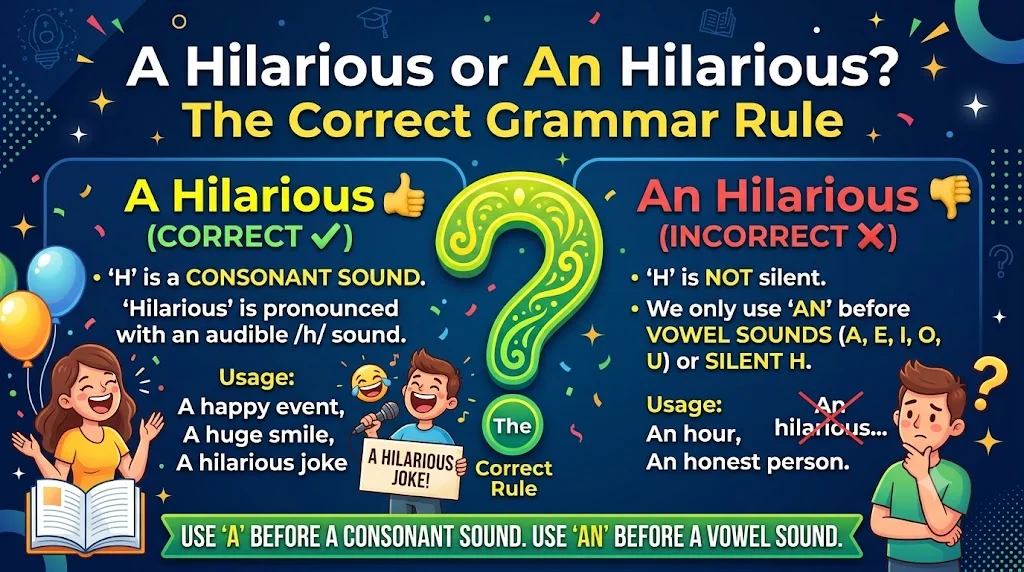
“A hilarious” is correct in modern English. The rule for choosing “a” or “an” depends on the sound that follows, not the spelling. Since “hilarious” starts with a clearly pronounced H sound (/hɪˈleriəs/), it takes “a,” not “an.” Say “a hilarious joke,” not “an hilarious joke.” The phrase “an hilarious” is an old-fashioned form that most modern style guides no longer recommend.
Why “A Hilarious” Is Correct
Let’s start with the basics, the way I would explain it to any student in my classroom.
Meaning and definition: “Hilarious” is an adjective meaning extremely funny, causing loud laughter. When we place an article in front of a noun phrase like “a hilarious story” or “a hilarious video,” the article’s job is simply to introduce that noun phrase.
Grammar explanation: English has two indefinite articles: “a” and “an.” They mean the same thing (roughly “one, unspecified”), but they are chosen based on pronunciation:
- Use “a” before words that begin with a consonant sound.
- Use “an” before words that begin with a vowel sound.
“Hilarious” begins with a strongly pronounced H consonant sound, so it follows the first rule.
Correct usage examples:
- She told a hilarious joke at dinner.
- That was a hilarious movie.
- He has a hilarious sense of humor.
Common mistake: Writing “an hilarious” because the word starts with the letter H, and mistakenly assuming all H-words behave like “hour” or “honest.” We’ll unpack exactly why that assumption fails later in this guide.
The Sound Rule: Why Pronunciation Matters More Than Spelling
This is the single most important concept in this entire article, so let’s slow down here.
Consonant Sounds vs Vowel Sounds
The a/an rule is a phonetic rule, not a spelling rule. That means your ear decides the article, not your eyes.
| Rule | Applies When | Example |
| Use “a” | Word starts with a consonant sound | a dog, a university, a hilarious story |
| Use “an” | Word starts with a vowel sound | an apple, an hour, an honest man |
Notice “university” starts with the letter U (a vowel), but it’s pronounced /juː/ — a “y” consonant sound. That’s why we say “a university,” not “an university.” The same logic, in reverse, applies to “hilarious.”
Tip to remember: Say the word out loud. If your lips, teeth, or throat block the airflow at the start (a consonant sound), use “a.” If air flows freely from the very first sound (a vowel sound), use “an.”
Why the Letter “H” Can Be Confusing
English inherited a small, inconsistent group of words from French and Latin where the “h” is silent (like “honest,” “hour,” “heir”). Because these silent-H words are common and memorable, some learners overgeneralize the rule and apply it to every H-word, including “hilarious,” “historic,” and “hotel.” That overgeneralization is exactly where “an hilarious” comes from.
How to Pronounce “Hilarious” Correctly
Getting the pronunciation right makes the a/an choice obvious.
IPA pronunciation: /hɪˈleriəs/ (US) or /hɪˈleəriəs/ (UK)
Syllable breakdown: hi-LAIR-ee-us (stress falls on the second syllable)
Audio tip: If you want to hear it, type “hilarious pronunciation” into Google or a dictionary site like Merriam-Webster or Cambridge Dictionary and click the speaker icon. You’ll clearly hear a breathy “h” sound at the start.
Why it begins with an H sound: Unlike French-origin words such as “honest” or “hour,” where the initial H was dropped historically, “hilarious” comes from the Latin word hilaris (cheerful), and English speakers have always pronounced its initial H. There was never a period where the H went silent, so there is no phonetic justification for “an.”
Word origin: “Hilarious” traces back to Latin hilaris → Greek hilaros (cheerful, merry). It entered English in the 1800s and has always kept its aspirated (clearly voiced) H sound.
Why “An Hilarious” Is Incorrect in Modern English
“An hilarious” isn’t a made-up error — it has a real history. In the 18th and 19th centuries, some British speakers pronounced the H softly or dropped it in certain words influenced by French, and writers of that era used “an” before many H-words as a matter of style (an historic, an hotel, an hilarious).
In modern English, almost nobody drops the H sound in “hilarious.” Since we clearly say the H, grammar rule requires “a,” not “an.”
Grammar explanation: Style has changed, but the underlying rule (match the article to the sound) never did. What changed is pronunciation habits, not the rule itself.
Common mistake: Assuming “an hilarious” is more formal or more “correct” because it looks old-fashioned or British. In reality, it now reads as a grammar error to most native speakers and editors.
Formal vs. informal usage: In both formal writing (essays, journalism, business writing) and informal speech, “a hilarious” is standard. There’s no context in contemporary English where “an hilarious” is preferred.
When Do You Use “An” Before H-Words?
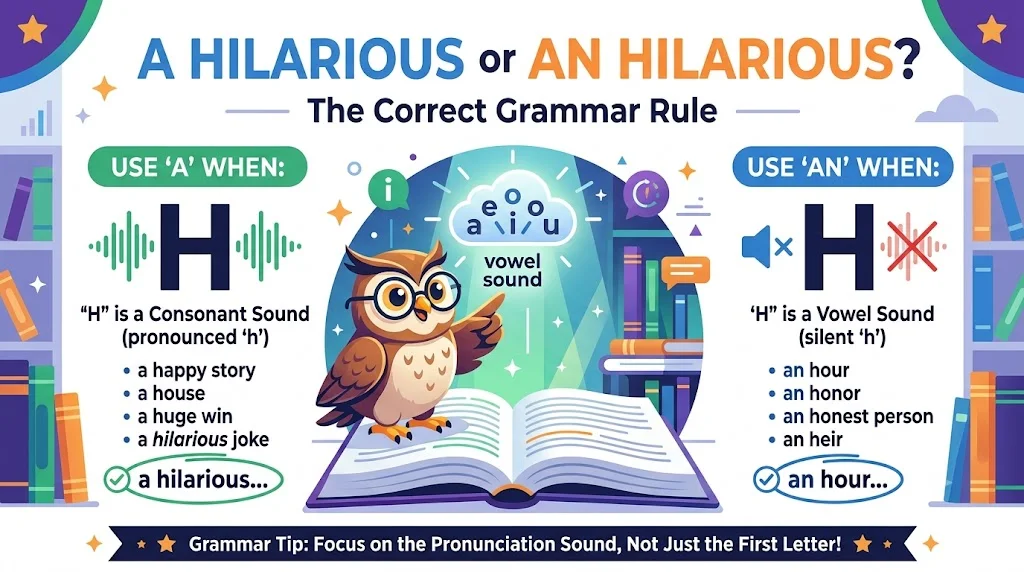
You use “an” only when the H is silent, meaning the word actually begins with a vowel sound.
Silent H Words
These words drop the H sound entirely when spoken:
- Hour → /aʊər/ → “an hour”
- Honest → /ˈɒnɪst/ → “an honest answer”
- Honor (US) / Honour (UK) → /ˈɒnər/ → “an honor”
- Heir → /eər/ → “an heir”
- Herb (American English) → /ɜːrb/ → “an herb” (in US English only — see the British English section below)
Common Silent H Examples
| Word | Pronunciation | Correct Article | Example Sentence |
| Hour | /aʊər/ | an | I’ll be there in an hour. |
| Honest | /ˈɒnɪst/ | an | She gave an honest opinion. |
| Honor | /ˈɒnər/ | an | It was an honor to meet you. |
| Heir | /eər/ | an | He is an heir to the throne. |
| Herb (US) | /ɜːrb/ | an | Add an herb garnish. |
Quick Tip: These silent-H words are a short, closed list. If a word isn’t on this list (or similar to it), assume the H is pronounced and use “a.”
A vs An Rules for Other Confusing H Words
Here’s a reference table for the H-words people mix up most often.
| Word | Correct Article | Reason |
| Hilarious | a | H is pronounced |
| Historic | a | H is pronounced in modern usage |
| Historical | a | H is pronounced |
| Hotel | a | H is pronounced |
| Heroic | a | H is pronounced |
| Horrible | a | H is pronounced |
| Honest | an | H is silent |
| Hour | an | H is silent |
| Honor | an | H is silent |
| Heir | an | H is silent |
| Herb (US English) | an | H is silent in American English |
| Herb (UK English) | a | H is pronounced in British English |
| Humble | a | H is pronounced (in most modern accents) |
| Humorous | a | H is pronounced |
A Hilarious vs An Hilarious – Examples
Seeing correct and incorrect sentences side by side helps the rule stick.
Correct Sentences
- We watched a hilarious sitcom last night.
- That’s a hilarious way to describe your morning.
- My grandfather tells a hilarious story about his first car.
- The comedian gave a hilarious performance.
- It was a hilarious mistake, but no one got hurt.
Incorrect Sentences
- ~~We watched an hilarious sitcom last night.~~
- ~~That’s an hilarious way to describe your morning.~~
- ~~My grandfather tells an hilarious story about his first car.~~
- ~~The comedian gave an hilarious performance.~~
- ~~It was an hilarious mistake, but no one got hurt.~~
Tip to remember: If you wouldn’t say “an” before “historic” or “horrible,” don’t say it before “hilarious” either — they follow the exact same sound pattern.
Common Mistakes English Learners Make
Let’s go word by word, since these six H-words trip up learners constantly.
Hilarious — Correct: a hilarious. Mistake: an hilarious. The H is fully pronounced, so it takes “a.”
Historic — Correct: a historic event. Mistake: an historic event. This one is genuinely debated (see below), but modern style guides mostly recommend “a historic.”
Hotel — Correct: a hotel. Mistake: an hotel. This was common in older British English but is now outdated.
Heroic — Correct: a heroic act. Mistake: an heroic act. The H is pronounced, so “a” is correct.
Horrible — Correct: a horrible smell. Mistake: an horrible smell. Same rule — pronounced H, use “a.”
Honest — Correct: an honest mistake. This is genuinely an exception because the H is silent.
Quick Tip: Out of this list, only “honest” (and words like it: hour, honor, heir) truly take “an.” The rest take “a.”
British English vs American English
This is where things get a little more nuanced, so let’s compare directly.
| Word | American English | British English | Note |
| Historic | a historic | a historic (an historic still appears in formal/older British writing) | “An historic” survives mainly in journalism and formal British prose |
| Hotel | a hotel | a hotel | “An hotel” is now considered outdated in both varieties |
| Herb | an herb (silent H) | a herb (pronounced H) | A genuine transatlantic pronunciation difference |
| Hilarious | a hilarious | a hilarious | No difference — both varieties pronounce the H |
Grammar explanation: “Herb” is the clearest example of regional variation, because Americans drop the H sound entirely, while British speakers pronounce it. “Hilarious,” by contrast, is pronounced the same way on both sides of the Atlantic, which is exactly why “a hilarious” is universally correct.
What Major Grammar Authorities Say
Cambridge Dictionary
Cambridge Dictionary’s usage notes explain that “a” is used before consonant sounds and “an” before vowel sounds, treating pronunciation, not spelling, as the deciding factor for words like “hilarious,” “historic,” and “hotel.”
Merriam-Webster
Merriam-Webster’s usage guidance similarly ties article choice to the initial sound of the following word, confirming that words beginning with a pronounced /h/ take “a.”
Oxford Dictionary
Oxford’s style guidance notes that “an” before words like “historic” and “hotel” is now old-fashioned, and recommends “a” in current standard English, since the H is pronounced.
AP Stylebook
The Associated Press Stylebook instructs writers to use “a” before consonant sounds, including a pronounced “h,” which is why AP-style publications write “a historic,” “a hotel,” and “a hilarious.”
Teacher’s takeaway: Every major authority agrees on the underlying rule — sound decides the article. The only disagreement across style guides is about a small handful of borderline words like “historic,” not about “hilarious,” where there’s no real debate at all.
Google Ngram Usage Comparison
If you search “a hilarious” vs. “an hilarious” in Google’s Ngram Viewer (which tracks word frequency across millions of published books), you’ll see a clear, consistent trend: “a hilarious” has been the dominant form for over a century, and “an hilarious” has remained a small minority usage that has continued to shrink over time.
This lines up with what we’d expect. “An hilarious” was never as common as “an historic” or “an hotel,” because “hilarious” doesn’t belong to the small class of French-influenced, historically H-dropping words. Modern English usage data confirms what pronunciation already tells us: “a hilarious” is, and has long been, the standard choice.
Memory Trick to Never Forget the Rule
Here’s a simple formula I give my students:
Hear an H? Use “A.” Silent H? Use “An.”
Or, if you prefer a short checklist:
- Say the word out loud.
- Listen for the first sound — not the first letter.
- Hear a consonant sound (like the H in “hilarious”)? → Use a.
- Hear a vowel sound (like the silent H in “hour”)? → Use an.
Bonus trick: Silent-H words are rare and can basically be memorized as a short list: hour, honest, honor, heir, herb (US). If your word isn’t on that list, default to “a.”
Practice Quiz (A or An?)
10 Practice Questions
Fill in the blank with “a” or “an.”
- That was ___ hilarious commercial.
- She’s ___ honest person.
- We arrived ___ hour late.
- It’s ___ historic building downtown.
- He booked ___ hotel near the airport.
- It was ___ heroic rescue.
- My uncle is ___ heir to a small farm.
- That’s ___ horrible excuse.
- Add ___ herb like basil to the sauce. (American English)
- It was ___ humorous speech.
Answer Key
- a hilarious commercial
- an honest person
- an hour late
- a historic building
- a hotel near the airport
- a heroic rescue
- an heir to a small farm
- a horrible excuse
- an herb (US English)
- a humorous speech
Quick Cheat Sheet
| Question | Answer |
| Is “hilarious” pronounced with an H sound? | Yes |
| Correct article | a |
| “A hilarious” or “An hilarious”? | A hilarious |
| Is “an hilarious” ever correct today? | No, it’s outdated |
| Rule to remember | Sound decides the article, not spelling |
Frequently Confused Words That Follow the Same Rule
The a/an sound rule doesn’t just apply to H-words — it applies to any word where spelling and pronunciation don’t match.
| Word | Correct Article | Why |
| Honest | an | Silent H |
| Hour | an | Silent H |
| Honor | an | Silent H |
| Historic | a | Pronounced H (modern usage) |
| Hotel | a | Pronounced H |
| Herb (US) | an | Silent H |
| Hilarious | a | Pronounced H |
| Human | a | Pronounced H |
| University | a | Starts with a “y” consonant sound |
| Unicorn | a | Starts with a “y” consonant sound |
Similar words: “Historic,” “heroic,” “horrendous,” and “humorous” all behave exactly like “hilarious” — pronounced H, so they take “a.”
Opposite pattern words: “Honest,” “hour,” and “heir” behave the opposite way — silent H, so they take “an.”
Related phrases and collocations: a hilarious moment, a hilarious mix-up, a hilarious meme, a truly hilarious scene, an absolutely hilarious clip.
Synonyms for “hilarious”: funny, comical, side-splitting, uproarious, riotous, amusing.
Common collocations with “hilarious”: hilarious joke, hilarious story, hilarious video, hilarious moment, hilarious mistake, hilarious meme, hilarious prank.
Final Verdict
“A hilarious” is the grammatically correct, modern, standard choice, and “an hilarious” should be avoided in everyday writing and speech. The rule is simple once you strip away the confusion: articles follow sound, not spelling.
Because “hilarious” begins with a clearly pronounced H, it needs “a.” Save “an” for the small set of silent-H words like “hour,” “honest,” and “heir.” Once you internalize that one distinction, you’ll never second-guess “a” versus “an” again — not just for “hilarious,” but for any tricky word in English.
FAQs
1. Is “a hilarious” or “an hilarious” grammatically correct? “A hilarious” is grammatically correct in modern English. The article “a” is used because “hilarious” begins with a clearly pronounced H consonant sound, following the standard a/an sound rule.
2. Why do some old books use “an hilarious”? Older writers, especially in 18th and 19th century British English, sometimes softened or dropped H sounds in certain words influenced by French. That habit produced “an hilarious,” but it has since fallen out of standard usage.
3. Is “an hilarious” a British English form? It appears occasionally in older or very formal British writing, but most modern British style guides, including Oxford, now recommend “a hilarious” as standard.
4. Does the a/an rule depend on spelling or pronunciation? It depends entirely on pronunciation. Use “a” before consonant sounds and “an” before vowel sounds, regardless of which letter the word starts with.
5. Which other H-words use “a” like “hilarious”? Words like “historic,” “hotel,” “heroic,” “horrible,” and “humorous” all use “a” because their H sound is pronounced, just like in “hilarious.”