
If you’ve ever paused mid-sentence wondering whether to say “I’m at the house” or “I’m in the house,” you’re not alone. These two phrases look almost identical, but they carry different meanings — and using the wrong one can confuse your listener more than you’d think.
As an English teacher, I hear this question constantly from learners and even native speakers who want to sharpen their grammar. In this guide, we’ll break down the meaning, grammar rules, real-life examples, and common mistakes tied to “at the house” and “in the house,” so you’ll never second-guess yourself again.
Quick Answer: At the House vs In the House
Here’s the short version before we go deeper:
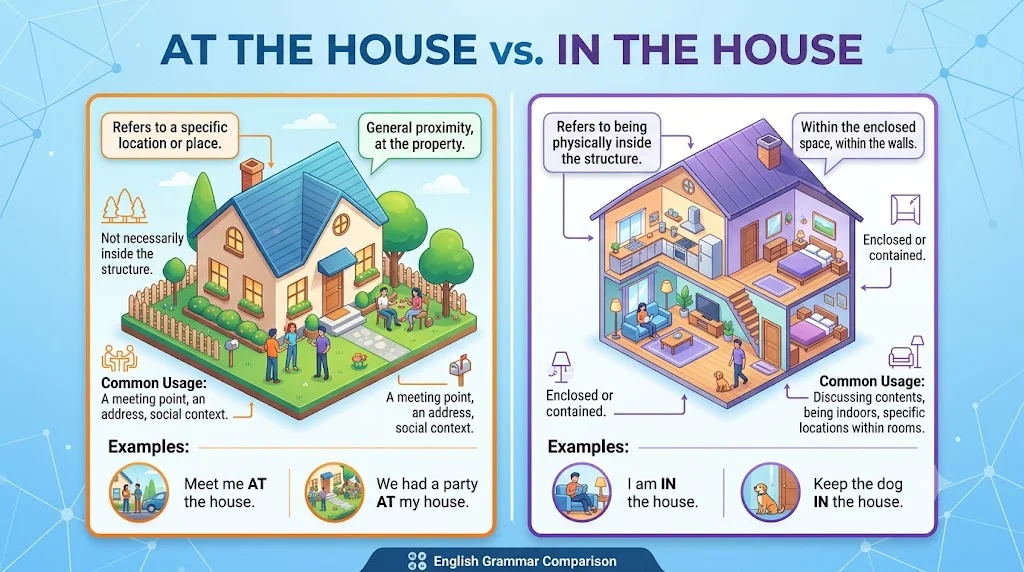
- “At the house” refers to a general location or place. It tells you where something is happening, without focusing on whether you’re inside or outside.
- “In the house” refers to being physically inside the building, within its walls.
Think of it this way: “at the house” points to the address or property as a whole, while “in the house” points to the interior space. If you’re standing on the porch, you’re “at the house” but not yet “in the house.”
Why People Get Confused Between “At the House” and “In the House”
The confusion happens because English prepositions don’t always follow logical, one-size-fits-all rules. Prepositions like “at,” “in,” and “on” often depend on context, perspective, and even regional habits rather than strict grammar formulas.
Many learners translate directly from their native language, where a single preposition might cover both meanings. In English, though, “at” and “in” express different relationships between a person (or object) and a place.
Another reason for the mix-up: native speakers sometimes use these phrases loosely in casual conversation, which makes the “rule” seem inconsistent. Once you understand the underlying grammar logic, though, the difference becomes much clearer.
The Grammar Rule Behind “At” and “In”
Before we dive into each phrase individually, let’s look at the grammar foundation. Understanding this rule will help you apply it not just to “house,” but to dozens of other location-based sentences.
Place vs Location
In English grammar, prepositions of place work on a kind of zoom scale:
- “At” is used for a specific point or place, almost like pinpointing a location on a map. It treats the place as an address or a general spot, not as a three-dimensional space.
- “In” is used for an enclosed or bounded space. It treats the place as a container — something with an inside and an outside.
So when we say “at the house,” we’re treating the house as a point of reference — a location you can travel to, meet someone at, or be near. When we say “in the house,” we’re treating the house as a physical structure with walls, a roof, and an interior.
Quick Tip: If you can replace the phrase with “inside,” and the sentence still makes sense, “in” is correct. If you can replace it with “at that location” or “at that address,” “at” is correct.
Easy Rule to Remember
Here’s a simple trick I give my students:
“At” = near or present at a place. “In” = inside the physical structure.
Example test:
- “I’m at the house” = I’m near it, on the property, or generally present there.
- “I’m in the house” = I’m literally indoors, past the front door.
What Does “At the House” Mean?
Definition
“At the house” is a prepositional phrase used to describe someone’s presence at a specific location — the house as a whole, including the property, yard, porch, or general vicinity. It doesn’t necessarily mean the person is inside.
Pronunciation: /æt ðə haʊs/ — the “at” is pronounced with a short, quick vowel sound, almost blending into the next word in fast speech.
Common Situations
You’ll hear “at the house” used when:
- Talking about meeting someone at a residence
- Describing an event happening at a property (a party, a repair, a delivery)
- Giving directions or describing someone’s whereabouts in general terms
- Referring to work being done on or around the property
Real-Life Examples
- “We’re having the party at the house this Saturday.”
- “The plumber is at the house right now, fixing the sink.”
- “I’ll meet you at the house around 6 p.m.”
- “She spent the whole weekend at the house, cleaning the garage.”
Notice that none of these sentences confirm whether the person is indoors. “At the house” simply places them at that location.
Formal vs Informal Usage: “At the house” is neutral and works in both formal and informal contexts. You might hear it in casual conversation (“I’ll be at the house”) or in more formal settings (“The inspection will take place at the house on Tuesday”).
What Does “In the House” Mean?
Definition
“In the house” describes being physically inside the building — within the walls, past the front door, in an interior room or space.
Pronunciation: /ɪn ðə haʊs/ — the “in” is short and crisp, often stressed slightly more than “at” in casual speech.
Common Situations
“In the house” is used when:
- Describing someone’s location as indoors, not outside
- Talking about activities that happen inside (cooking, watching TV, sleeping)
- Referring to objects or people located within the building
- Emphasizing shelter, safety, or enclosure
Real-Life Examples
- “It’s raining, so let’s stay in the house.”
- “The kids are in the house, playing video games.”
- “There’s a strange smell in the house — can you check it?”
- “He left his phone in the house before we drove off.”
Formal vs Informal Usage: “In the house” is also neutral and common in everyday speech. In more formal or written English, you might see “inside the house” or “within the residence” as slightly more polished alternatives.
At the House vs In the House: Key Differences
Let’s compare the two directly, since seeing them side by side often makes the distinction click.
- Focus: “At the house” focuses on location/presence. “In the house” focuses on interior space.
- Indoors or not: “At the house” doesn’t confirm indoor presence. “In the house” confirms the person or object is indoors.
- Typical use: “At the house” is used for meetings, events, and general whereabouts. “In the house” is used for indoor activities and interior details.
- Grammar category: “At” is a preposition of point/place. “In” is a preposition of enclosed space.
Comparison Table: At the House vs In the House
| Feature | At the House | In the House |
| Meaning | Present at the location/property | Physically inside the building |
| Confirms indoors? | No | Yes |
| Typical context | Meetings, events, deliveries, work | Indoor activities, objects, people inside |
| Example | “I’ll be at the house by noon.” | “I’m in the house, come on in.” |
| Grammar type | Preposition of place/point | Preposition of enclosed space |
| Formality | Neutral | Neutral |
Word Origin: Where “At,” “In,” and “House” Come From
Understanding where these words come from can help you appreciate why they behave the way they do in modern English.
- “At” comes from Old English æt, related to Old Norse at, originally meaning “near” or “toward.” This root explains why “at” still carries a sense of nearness or a fixed point rather than enclosure.
- “In” comes from Old English in, closely tied to Proto-Germanic in and Latin in, both carrying the meaning “inside” or “within.” This is why “in” almost always signals enclosure across Germanic and Romance-influenced English vocabulary.
- “House” comes from Old English hus, meaning “dwelling” or “shelter.” It’s one of the oldest words in the English language, shared across nearly all Germanic languages (German Haus, Dutch huis).
Knowing this history isn’t just trivia — it reinforces the grammar rule. “At” has always pointed toward proximity, and “in” has always pointed toward enclosure, even a thousand years ago.
Similar Words and Expressions Worth Knowing
Beyond “at the house” and “in the house,” English has several related expressions that describe location and presence. Learning these will round out your understanding of prepositions of place.
- “By the house” — near the house, close to it, but not necessarily on the property. Example: “There’s a mailbox by the house.”
- “Near the house” — similar to “by,” emphasizing proximity without specifying exact position. Example: “Park near the house, not in the driveway.”
- “Outside the house” — the opposite of “in the house,” meaning not indoors. Example: “The dog has to stay outside the house.”
- “Around the house” — refers to general chores or tasks done on the property, indoors or outdoors. Example: “I have a few things to do around the house today.”
- “Throughout the house” — describes something spread across every room. Example: “The smell of coffee spread throughout the house.”
These expressions often appear alongside “at the house” and “in the house” in everyday English, so recognizing their subtle differences will make your speech and writing more precise.
House vs Home: What’s the Difference?
Since we’re talking about “house,” it’s worth clarifying “house” vs “home,” because learners often mix these up too.
- House refers to the physical building — the structure made of walls, a roof, and rooms.
- Home refers to the emotional or personal concept of where you live — it can be a house, apartment, or even a city you feel connected to.
Example:
- “That’s a beautiful house.” (describing the building)
- “There’s no place like home.” (describing a feeling of belonging)
You can say “at home” or “in my home,” but “at the house” and “in the house” specifically refer to the physical structure, often someone else’s or a specific one being discussed.
When to Use “At the House”
Visiting Someone
Use “at the house” when talking about visiting or being present at someone’s residence, regardless of whether you’ve stepped inside yet.
Example: “I’m at the house, but no one’s answering the door.”
Waiting Outside
This phrase works perfectly when someone hasn’t entered the building yet.
Example: “The delivery driver is at the house, waiting on the porch.”
Talking About a Location
Use it when referring to the property as a general destination or meeting point.
Example: “Let’s all meet at the house before the trip.”
When to Use “In the House”
Being Inside a Building
Use “in the house” whenever you want to confirm someone or something is indoors.
Example: “It’s freezing outside, so we stayed in the house all day.”
Talking About Activities Indoors
This phrase fits naturally with indoor actions.
Example: “We watched movies in the house since it was raining.”
Referring to People Inside
Use it to specify who or what is located within the building.
Example: “Is anyone in the house right now?”
Real-Life Examples of “At the House” vs “In the House”
Friends Visiting
- “Come over — we’re all at the house.” (general invitation to the property)
- “Come on in, we’re in the house.” (confirming you’re indoors, inviting them past the door)
Delivery Driver
- “The delivery driver said he’s at the house.” (arrived at the property)
- “He left the package in the house.” (placed it indoors, perhaps through an open door)
Emergency Situations
- “Everyone needs to get at the house immediately.” (this sounds awkward — “get to the house” is correct here)
- “Stay in the house until the storm passes.” (clear instruction to remain indoors)
Common Mistake: Notice that “at” doesn’t pair naturally with verbs like “get” or “go” in the same way “to” does. You’d say “go to the house,” not “go at the house.”
Phone Conversations
- “Where are you?” — “I’m at the house, just got here.”
- “Where are you?” — “I’m in the house, in the kitchen.”
Common Collocations With “At the House”
Collocations are word combinations that native speakers use naturally together. Here are common ones with “at the house”:
- Meet at the house
- Party at the house
- Work at the house
- Wait at the house
- Arrive at the house
- Stay at the house (this one can overlap with staying indoors, depending on context)
Common Collocations With “In the House”
- Stay in the house
- Stuck in the house
- Someone in the house
- Smell in the house
- Noise in the house
- Rules in the house
Synonyms and Related Phrases
For “at the house,” similar expressions include:
- At the property
- At the residence
- At that address
- On-site
For “in the house,” similar expressions include:
- Inside the house
- Indoors
- Within the residence
- Inside the building
Opposite phrases:
- “Out of the house” or “outside the house” is the opposite of “in the house.”
- “Away from the house” is the opposite of “at the house.”
American English vs British English Usage
Both “at the house” and “in the house” are used in American and British English with the same core meaning. However, American English speakers tend to use “at the house” more casually in everyday conversation (“I’ll be at the house”), while British English speakers might lean slightly more toward “at home” or “round at the house” in informal speech.
Neither version is incorrect — this is more of a stylistic tendency than a strict grammar rule. If you’re writing for a US audience, “at the house” and “in the house” as covered in this article will sound completely natural.
Common Mistakes and How to Avoid Them
Here are mistakes learners commonly make with these phrases:
- Mistake: “I go at the house every weekend.” Correct: “I go to the house every weekend.” (“Go” pairs with “to,” not “at.”)
- Mistake: “She is inside at the house.” Correct: “She is in the house.” (Avoid combining “inside” and “at” redundantly.)
- Mistake: Using “in the house” when the person is actually outside on the property. Correct: Use “at the house” if you’re unsure whether they’re indoors or outside.
- Mistake: Overusing “in the house” for formal writing. Correct: In formal contexts, “inside the residence” or “within the home” sounds more polished.
Quick Tip: When in doubt, ask yourself: “Am I confirming this is indoors?” If yes, use “in.” If you’re just stating a general location, use “at.”
Easy Memory Trick to Remember the Difference
Here’s a simple visual trick: imagine a house with a fence around the yard.
- If you’re anywhere inside that fence — the yard, the porch, or the building — you can say you’re at the house.
- If you’ve walked through the front door and you’re standing in the living room, you’re in the house.
“At” covers the whole property. “In” only covers the inside.
Another trick: “At” is for Address. “In” is for Interior. Both start with the same first letter as their meaning, which makes them easy to recall under pressure.
Practice Sentences and Quiz
Try filling in the blanks with “at” or “in” before checking the answers below.
- We’re meeting ___ the house at noon.
- It’s cold outside, so let’s stay ___ the house.
- The mechanic is ___ the house, working on the car in the driveway.
- Is your sister ___ the house right now?
- I left my keys ___ the house.
- They had a barbecue ___ the house last weekend.
- Please wait ___ the house until I get back.
- The cat is sleeping ___ the house, on the couch.
Answers:
- at
- in
- at
- in
- in
- at
- in (or “at,” depending on whether you mean the property or specifically indoors)
- in
Frequently Asked Questions
Is it correct to say “I’m at the house”?
Yes, it’s completely correct. “I’m at the house” means you’re present at the location or property, whether you’re inside or just arriving. It’s commonly used in casual conversation to describe your general whereabouts without specifying indoor or outdoor status.
Is “I’m in the house” grammatically correct?
Yes, this is grammatically correct and very common. It confirms that you’re physically inside the building, past the front door. Native speakers use this phrase naturally in daily conversation, especially to reassure someone or specify your exact location.
What’s the difference between house and home?
“House” refers to the physical structure or building, while “home” refers to the emotional or personal sense of belonging tied to where you live. You can renovate a house, but you feel connected to a home. Both words can describe the same place, but their meaning depends on context.
Which expression is more common in American English?
Both phrases are common, but “at the house” tends to appear more often in casual American speech when referring to meetings, events, or general presence. “In the house” is equally common but used specifically when confirming someone is indoors.
Can both expressions be correct in the same sentence?
Yes. For example: “I’m at the house, but I’m not in the house yet — still on the porch.” This shows how “at” refers to the property while “in” refers to the interior, and both can appear together to add clarity.
Why do native speakers sometimes use these phrases interchangeably?
In casual conversation, some speakers use “at the house” loosely to mean indoors, especially when context makes the meaning obvious. This doesn’t mean the phrases are truly interchangeable — it just reflects natural, relaxed speech patterns.
Is “on the house” related to these phrases?
No, “on the house” is an idiom meaning something is given for free, usually at a restaurant or bar (“Your drink is on the house”). It has no connection to physical location and shouldn’t be confused with “at” or “in the house.”
Does “at the house” ever mean inside the house?
It can imply it in context, but it doesn’t confirm it. “At the house” is intentionally general. If indoor location matters to your sentence, “in the house” is the clearer and more precise choice.
How do I know which preposition to use with other buildings, like “school” or “office”?
The same at/in rule applies. “At school” means present at that location generally, while “in the school” (less common) would emphasize being inside the building. Most native speakers say “at school” by default, similar to “at the house.”
Is it wrong to say “inside of the house”?
“Inside of the house” is technically redundant since “inside” already implies enclosure, but it’s widely used in casual American English. “Inside the house” (without “of”) is considered more grammatically precise and preferred in formal writing.
Final Thoughts
Choosing between “at the house” and “in the house” comes down to one simple question: are you talking about a general location, or specifically about being indoors? “At the house” points to the property as a whole, while “in the house” confirms you’re physically inside. Once this distinction clicks, you’ll use both phrases naturally and correctly, whether you’re texting a friend, writing a story, or speaking in a formal setting. Keep the memory tricks in mind — “at” for address, “in” for interior — and you’ll never mix them up again.