
Every Easter, millions of people say “He is risen.” Some say “He has risen.” Both sound similar, but only one follows modern English grammar rules. As an English teacher, I get this question every spring — and it’s a genuinely interesting one, because it sits right at the crossroads of grammar history, Bible translation, and church tradition.
This guide breaks down both phrases in plain, simple English. By the end, you’ll know exactly which one is grammatically correct, why the Bible uses the phrase it does, and which version to use depending on where you’re speaking or writing.
Quick Answer: Is It “He Is Risen” or “He Has Risen”?
“He has risen” is the grammatically correct form in modern English, using the present perfect tense (has + past participle). “He is risen” is an older grammatical structure from Early Modern English, still preserved in the King James Bible and Easter liturgy. Both are understood today, but only “he has risen” follows current grammar rules. “He is risen” survives purely as a traditional, religious expression.
Why Do People Confuse “He Is Risen” and “He Has Risen”?
The confusion isn’t really the reader’s fault. English grammar changed significantly between the 1600s and today, but religious language often freezes in time.
Here’s the core issue: modern English builds the present perfect tense with “have/has” + past participle (he has risen, she has gone, they have arrived). Older English sometimes built the same idea with “be” + past participle (he is risen, she is come, they are arrived) — especially for verbs describing movement or change of state.
So when people hear “He is risen,” their modern grammar instincts say something feels off, even though it was completely standard centuries ago. That mismatch between old grammar and modern ears is exactly why the phrase keeps sparking questions every Easter.
Quick Tip: If a phrase from the Bible sounds grammatically “wrong” to you, it’s often not wrong — it’s just old. English rules were different when the King James Version was translated in 1611.
What Does “He Is Risen” Mean?
Literal Meaning
“He is risen” literally means “he has risen” or “he has gotten up.” In the Christian context, it specifically refers to Jesus Christ rising from the dead after his crucifixion — the resurrection.
- Definition: A declaration that someone (specifically, in this phrase, Christ) has completed the act of rising, and is now in the resulting state of being risen.
- Pronunciation: /hi ɪz ˈrɪz.ən/ — “he” + “is” + “RIZ-uhn” (two syllables, stress on the first).
- Word origin: “Risen” comes from the Old English verb risan, meaning “to rise” or “to get up.” It’s the past participle of “rise.”
Historical English Usage
In Early Modern English (the English of Shakespeare and the King James Bible, roughly 1500–1700), verbs of motion or change of state — such as come, go, rise, fall, arrive — often paired with “be” instead of “have” to form the perfect tense.
That’s why you’ll find phrases like:
- “He is come” (he has come)
- “She is gone” (she has gone)
- “Christ is risen” (Christ has risen)
This wasn’t broken grammar. It was the standard rule at the time, closely related to a similar pattern still used today in French (il est allé) and German (er ist gekommen).
Why Christians Still Say It Today
“He is risen” survives today for one main reason: tradition, not grammar. It’s the phrase used in the King James Version, in classic Easter hymns, in liturgical call-and-response (“He is risen! He is risen indeed!”), and in centuries of church teaching.
Changing it to “He has risen” would be more grammatically modern, but it would also break a phrase that carries deep emotional, spiritual, and historical weight. Religious language often preserves older forms on purpose — think of “hallowed be thy name” in the Lord’s Prayer, which no one tries to “correct” either.
What Does “He Has Risen” Mean?
Modern English Meaning
“He has risen” means exactly the same thing as “he is risen” — someone has completed the act of rising and remains in that risen state. The difference is entirely grammatical, not a difference in meaning.
- Definition: A present perfect tense statement showing a completed action with present relevance.
- Pronunciation: /hi hæz ˈrɪz.ən/ — “he” + “haz” + “RIZ-uhn.”
Present Perfect Grammar Explained
Modern English forms the present perfect tense like this:
Subject + has/have + past participle
- He has risen.
- They have arrived.
- She has finished.
This tense connects a past action to the present moment. “He has risen” tells us the rising happened in the past, but its effect (he is now alive and risen) matters right now — which is exactly the theological point Christians want to make at Easter.
Common Usage in Everyday English
Outside of religious contexts, “has risen” is extremely common:
- “Prices have risen sharply this year.”
- “The sun has risen over the mountains.”
- “Bread dough has risen nicely.”
This is one reason “he has risen” sounds more natural to modern readers — it matches a grammar pattern we use constantly in daily speech.
“He Is Risen” vs “He Has Risen” — What’s the Difference?
Grammar Differences
| Aspect | He Is Risen | He Has Risen |
| Verb structure | be + past participle | have + past participle |
| Grammar era | Early Modern English (archaic) | Modern English (current standard) |
| Tense name | Old-style perfect construction | Present perfect tense |
Meaning Differences
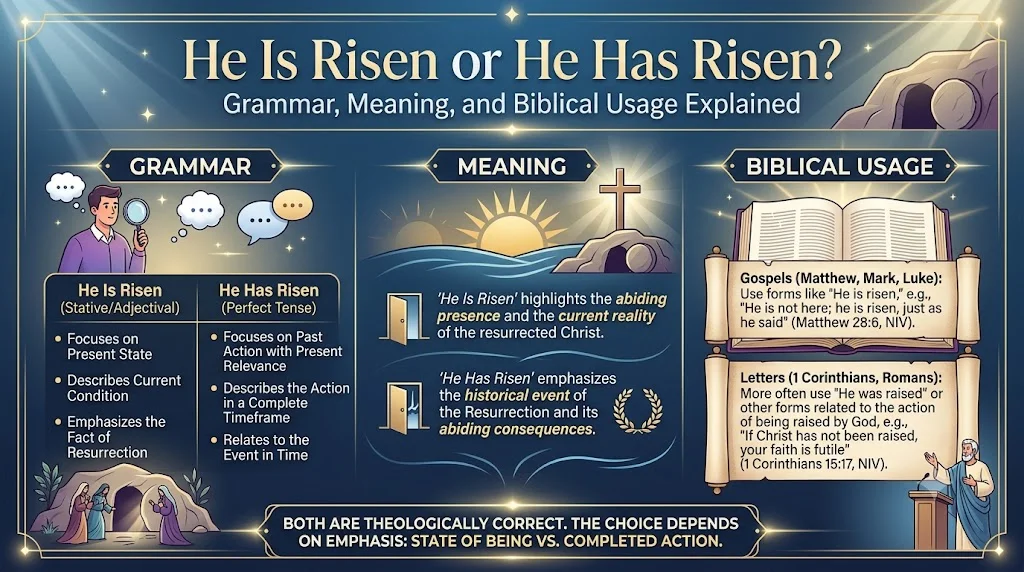
There is no real difference in meaning. Both describe a completed action (rising) with continuing relevance in the present. The resurrection happened once, in the past, and its truth continues today — both phrases capture that idea equally well.
Tone and Style
- “He is risen” feels solemn, poetic, and traditional — it belongs in hymns, liturgy, and formal Easter greetings.
- “He has risen” feels plain, modern, and conversational — it fits everyday speech, casual writing, and modern Bible translations.
Tradition vs Modern English
Think of it like the difference between “thee/thou” and “you.” Both refer to the same thing, but one belongs to a specific historical and religious register, while the other is what we actually speak today.
Is “He Is Risen” Grammatically Correct?
Why It Sounds Unusual Today
Modern English learners are taught that the present perfect always uses “have/has,” never “is/are.” So “he is risen” can look like an error — mixing up “be” with “have.”
Why It Was Correct in Older English
It wasn’t an error at all in its time. English used to select between “be” and “have” depending on the type of verb:
- Verbs of motion/change (come, go, rise, fall, become) → often used “be”
- Most other verbs (eat, write, see, do) → used “have”
By the 1600s, this rule was already starting to fade, but it hadn’t disappeared — which is exactly why it appears in the King James Bible (1611).
Is It Still Acceptable?
Yes — as a fixed traditional phrase, “he is risen” is completely acceptable, especially in religious, liturgical, or quoted contexts. It is not acceptable as a general grammar rule to apply to other sentences today (you wouldn’t say “I am finished my homework” using this old pattern in modern writing).
Quick Tip: Treat “He is risen” like an idiom or a fixed quotation — correct in its traditional context, not a model for new sentences.
Is “He Has Risen” Grammatically Correct?
Why Modern English Prefers It
“He has risen” is the standard, textbook-correct present perfect construction in contemporary English. It’s the form taught in grammar books, used in modern journalism, and found in nearly all recent Bible translations.
Grammar Rule Behind the Phrase
The rule is simple: all present perfect verbs use “have” or “has,” regardless of the type of verb.
- He has risen. ✅
- He is risen. ❌ (only correct as an archaic/traditional form)
This single rule replaced the old “be vs. have” split by around the 18th century, and it’s the rule every modern English learner should follow.
Which Phrase Is Biblically Correct?
What the Original Greek Says
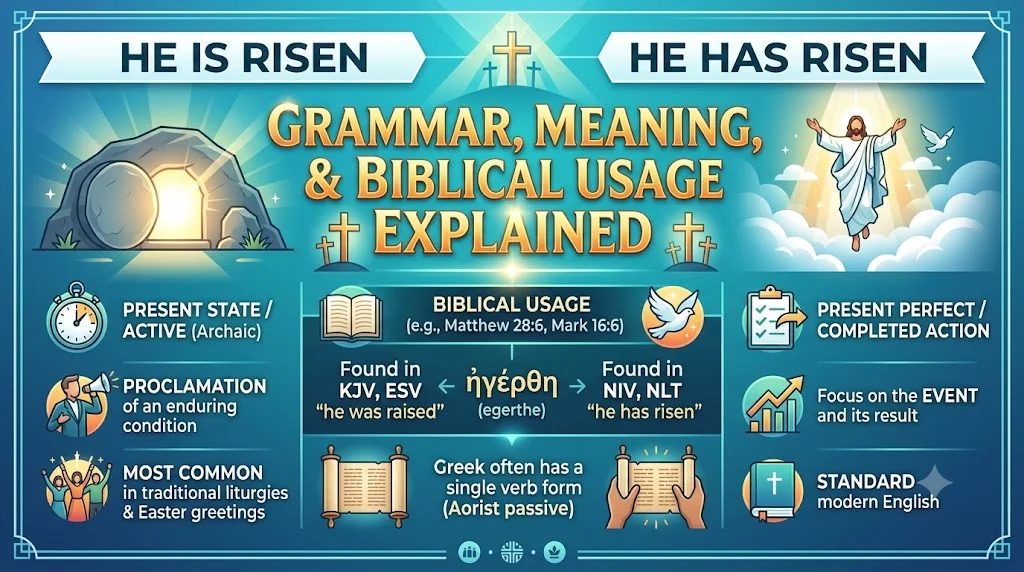
The New Testament was written in Koine Greek. In passages describing the resurrection (for example, Matthew 28:6 and Luke 24:6), the Greek verb used is a form of egeiro (“to raise” or “to rise”), typically in the perfect tense — a tense that, like English’s present perfect, shows a completed action with ongoing present significance.
So the original Greek grammar supports the meaning behind both English phrases: a past event (the resurrection) with continuing present truth (Christ is alive now). Neither English phrase is more “biblically accurate” than the other — the difference is purely about English translation style, not Greek grammar.
King James Version (KJV)
The KJV (1611) uses “He is risen” — for example, in Matthew 28:6: “He is not here: for he is risen, as he said.” This reflects the English grammar conventions of the early 17th century.
NIV, ESV, NASB & Other Modern Bible Translations
Most modern translations — including the NIV, ESV, NASB, and NLT — use “He has risen”, matching current English grammar. This makes the text easier for modern readers to understand without changing the theological meaning at all.
Why Does the Bible Say “He Is Risen”?
Archaic English Grammar
As explained above, “is risen” was standard grammar for verbs of motion and change of state in 1611, when the KJV was translated. Translators weren’t making an error — they were using correct, contemporary English for their time.
Historical Language Changes
English grammar has shifted dramatically over 400 years. The “be + past participle” perfect construction gradually disappeared from general use, replaced entirely by “have + past participle.” The KJV is essentially a linguistic time capsule, preserving grammar patterns that no longer exist in everyday speech.
Religious and Liturgical Tradition
Beyond grammar, “He is risen” has become a fixed liturgical phrase — like “Amen” or “Hallelujah.” Congregations recite it as a ritual declaration, and changing the wording would feel like altering a sacred formula, even though grammatically “He has risen” would be just as accurate.
Can Both Phrases Be Correct?
Grammar Perspective
Yes, with a caveat: “He has risen” is correct by current grammar rules. “He is risen” is correct only as a historical/traditional form, not as a pattern you should apply to new sentences.
Biblical Perspective
Yes. Both phrases faithfully represent the meaning of the original Greek text. Translation choice depends on which English era the translators were writing in, not on theological accuracy.
Christian Tradition
Yes. Many churches use “He is risen” in liturgy and Easter greetings, while using “He has risen” in modern Bible readings and sermons. Both are fully accepted within Christian practice.
Which Phrase Should Christians Use Today?
Church Services
Either phrase works well. “He is risen” fits traditional liturgy, hymns, and call-and-response greetings. “He has risen” fits sermons based on modern translations like the NIV or ESV.
Easter Greetings
“He is risen! He is risen indeed!” remains the standard traditional greeting exchanged between Christians on Easter morning. This phrasing is so established that switching to “He has risen indeed” would sound unusual, even though it’s grammatically “more correct.”
Daily Conversations
In casual, everyday conversation, “He has risen” is more natural and grammatically expected, especially when talking to people unfamiliar with traditional religious phrasing.
Academic or Formal Writing
For essays, theology papers, or formal writing, use “He has risen” unless you are specifically quoting the King James Version or discussing historical grammar (in which case, quote “He is risen” accurately, in context).
Why Do Christians Say “He Is Risen Indeed”?
Meaning of the Easter Greeting
“He is risen indeed” is the traditional response to the greeting “He is risen.” The word “indeed” means “truly” or “certainly,” emphasizing agreement and affirmation of the resurrection as a real, historical fact — not just a story.
Historical Origin
This call-and-response greeting, sometimes called the Paschal greeting, dates back to the early Christian church and is especially prominent in Eastern Orthodox tradition, where it’s exchanged in many languages during the Easter season.
Proper Response
- Greeting: “He is risen!”
- Response: “He is risen indeed!”
This exchange is meant to be spoken aloud, often between strangers, as a shared declaration of faith during the Easter season.
“He Is Risen” vs “He Has Risen” Comparison Table
| Feature | He Is Risen | He Has Risen |
| Grammar | Archaic “be” + past participle | Modern present perfect (“have/has”) |
| Meaning | Completed resurrection, present relevance | Same meaning, modern phrasing |
| Usage | Liturgy, hymns, Easter greetings | Everyday speech, modern Bible translations |
| Tone | Solemn, traditional, poetic | Neutral, modern, conversational |
| Bible | King James Version (KJV) | NIV, ESV, NASB, NLT |
| Modern English | Not standard grammar today | Fully standard grammar today |
Correct Examples of “He Is Risen” and “He Has Risen”
Correct Sentences
- “He is risen, just as the Scriptures foretold.” (traditional/liturgical)
- “He has risen from his chair to greet the guests.” (modern, everyday)
- “The bread dough has risen and is ready to bake.” (modern, everyday)
- “Christ is risen! He is risen indeed!” (Easter greeting)
Incorrect Sentences
- “He is risen his salary this year.” ❌ (mixing archaic grammar with a non-motion verb; should be “He has raised his salary” or “His salary has risen”)
- “He have risen early today.” ❌ (subject-verb agreement error; should be “He has risen”)
Formal Examples
- “The theological significance of the phrase ‘he has risen’ is discussed extensively in modern biblical commentary.”
- “In the King James Version, the resurrection is announced with the words, ‘He is risen.'”
Informal Examples
- “Good morning, he’s finally risen from bed!” (informal contraction of “has risen”)
- “He’s risen to the challenge and finished the project early.”
Common Mistakes to Avoid
- Mistake: Using “is risen” in general modern sentences outside religious/traditional contexts. Fix: Use “has risen” for everyday, non-liturgical writing.
- Mistake: Writing “he have risen” instead of “he has risen.” Fix: Match “has” with third-person singular subjects (he, she, it).
- Mistake: Assuming one phrase is “more biblically accurate” than the other. Fix: Remember both are valid English translations of the same Greek perfect tense.
- Mistake: Capitalizing “risen” unnecessarily mid-sentence. Fix: Only capitalize at the start of a sentence or in titles.
Similar Grammar Examples
Understanding related “be vs. have” pairs makes this grammar pattern much easier to remember.
He Is Gone vs He Has Gone
- He is gone: Archaic/poetic; also survives today as an adjective phrase meaning “he is absent” (e.g., “He is gone for the day”).
- He has gone: Standard modern present perfect (e.g., “He has gone to the store”).
Christ Is Born vs Christ Has Been Born
- Christ is born: Traditional Christmas phrasing, similar archaic pattern (e.g., in Christmas carols and liturgy).
- Christ has been born: Modern grammatical phrasing, less common in everyday speech but grammatically standard.
He Is Come vs He Has Come
- He is come: Archaic, found in older hymns and translations (e.g., “Joy to the world, the Lord is come”).
- He has come: Standard modern usage (e.g., “He has come a long way”).
She Is Arrived vs She Has Arrived
- She is arrived: Fully archaic; essentially unused today except in historical texts.
- She has arrived: The only correct modern form (e.g., “She has arrived at the airport”).
Quick Tip: In every pair above, the “is/are” version is old-fashioned or poetic, while the “has/have” version is the modern grammatical standard. If you’re writing anything today outside of a quote or hymn, choose “has/have.”
Which Bible Versions Use “He Is Risen”?
The phrase “He is risen” appears in:
- King James Version (KJV)
- New King James Version (NKJV) — in some passages
- Douay-Rheims Bible
- Other older or more traditional/formal translations
Which Bible Versions Use “He Has Risen”?
The phrase “He has risen” appears in:
- New International Version (NIV)
- English Standard Version (ESV)
- New American Standard Bible (NASB)
- New Living Translation (NLT)
- Christian Standard Bible (CSB)
Most translations published after the mid-20th century favor “He has risen” because they aim for clear, natural modern English.
Synonyms, Related Phrases, and Collocations
- Synonyms for “risen”: raised, resurrected, arisen, awakened (in a figurative sense)
- Opposite concept: “he has died,” “he is fallen,” “he remains in the tomb”
- Related phrases: “Christ is risen,” “the Lord has risen,” “risen from the dead,” “risen indeed”
- Common collocations with “risen”: has risen sharply, has risen again, risen from the ashes, newly risen sun, risen to the occasion
- Common collocations with “is risen”: He is risen indeed, Christ is risen today
SEO Quick Summary (Key Takeaways)
- “He has risen” is the grammatically correct, modern English form.
- “He is risen” is an older, archaic form preserved in the King James Bible and Easter tradition.
- Both phrases carry the same meaning — a completed resurrection with present significance.
- Use “he is risen” for liturgy, hymns, and traditional Easter greetings.
- Use “he has risen” for everyday speech, modern writing, and contemporary Bible translations.
- The traditional Easter response is “He is risen indeed!“
Frequently Asked Questions
Is “He Is Risen” grammatically correct?
It’s correct as a traditional, archaic English form from the 1600s, still used in the King James Bible and Easter liturgy. By today’s grammar rules, though, “he has risen” is the standard, modern correct form.
Is “He Has Risen” correct?
Yes, completely. “He has risen” follows the standard present perfect tense rule (has + past participle) used in modern English, and it’s the form found in most contemporary Bible translations.
Which phrase appears in the Bible?
Both do, depending on the translation. The King James Version says “He is risen” (Matthew 28:6), while modern translations like the NIV and ESV say “He has risen.”
Why do Christians say “He Is Risen Indeed”?
It’s the traditional response to the Easter greeting “He is risen!” The word “indeed” means “truly,” affirming belief in the resurrection as a real, historical event, not just a story.
Which phrase should I use in modern English?
Use “he has risen” for everyday writing, conversation, and formal contexts. Reserve “he is risen” for quoting Scripture, singing traditional hymns, or exchanging the classic Easter greeting.
Final Verdict
Both “He is risen” and “He has risen” describe the same powerful truth — the resurrection is complete, and its meaning carries into the present. Grammatically, “He has risen” is the correct choice for modern English, following the standard present perfect tense rule. “He is risen” remains grammatically valid only as a preserved traditional phrase from the King James Bible and Easter liturgy.
Neither phrase is “wrong” — they simply belong to different eras of English and different contexts of use. Use “He has risen” when you want clear, modern, grammatically standard English. Use “He is risen” when you want to honor centuries of religious tradition, hymnody, and the timeless Easter greeting exchanged by Christians around the world: “He is risen! He is risen indeed!”