
If you have ever paused mid-sentence wondering whether to write heard, herd, or hurd, you are not alone. These three words sound almost identical when spoken aloud, yet they mean completely different things and belong to completely different grammar categories.
In this guide, we will break down each word in plain, simple English — the way a patient English teacher would explain it in a classroom. By the end, you will know exactly which word to use, when to use it, and how to avoid the mistakes that trip up even confident writers.
Heard vs Herd vs Hurd at a Glance
Before we go deep into grammar and examples, here is the short answer:
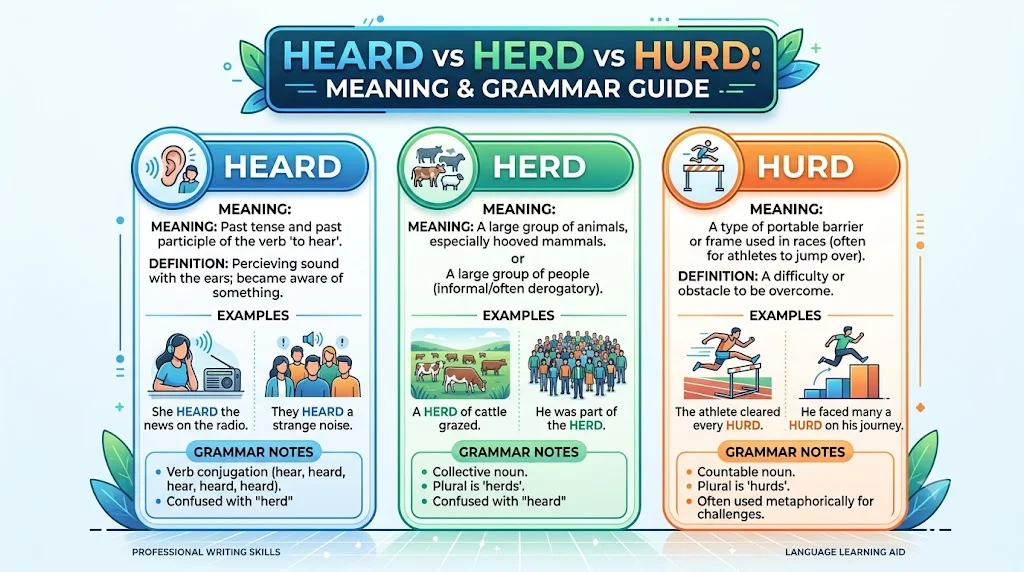
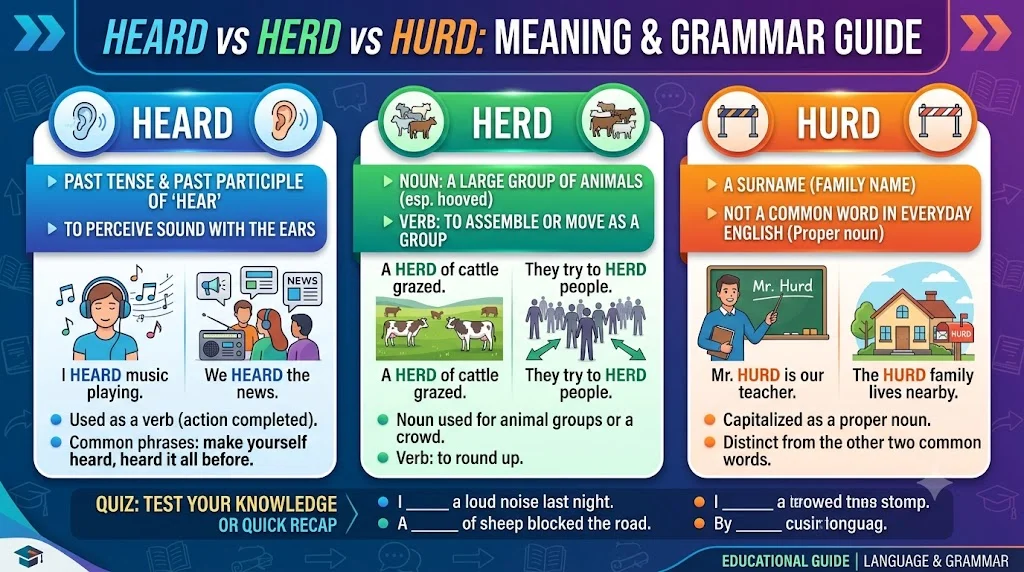
- Heard is the past tense and past participle of the verb hear. It means you received sound through your ears. Example: I heard the phone ring.
- Herd is usually a noun that means a large group of animals, such as cows or elephants. It can also be a verb meaning to gather or move animals (or people) together. Example: A herd of goats crossed the road.
- Hurd is a rare word. It is mostly used as a surname (a person’s last name) and, in older or technical English, as a term for the coarse fibers of flax or hemp. Example: Mr. Hurd runs the local bakery.
These three words are called homophones — words that sound the same but have different spellings and meanings. That is exactly why they cause so much confusion, even among native English speakers.
Quick Comparison Table
| Word | Part of Speech | Meaning | Pronunciation | Example Sentence |
| Heard | Verb (past tense/past participle) | Received sound through the ears | /hɜːrd/ (like “bird”) | She heard the alarm go off. |
| Herd | Noun / Verb | A group of animals; to gather animals or people | /hɜːrd/ (like “bird”) | The herd moved across the field. |
| Hurd | Noun (rare) / Surname | Coarse plant fiber; a person’s last name | /hɜːrd/ (like “bird”) | The Hurd family owns the farm. |
Notice something interesting? All three words are pronounced the same way in most English accents. This is the root of the confusion, and we will explain the pronunciation in more detail later in this guide.
Why Do People Confuse Heard, Herd, and Hurd?
The main reason is simple: homophones share a sound but not a spelling. English has hundreds of these tricky word pairs and trios — think of there, their, they’re or to, too, two. Because heard, herd, and hurd sound identical, your ears cannot tell them apart. Only context and spelling can.
A second reason is that herd and heard are both extremely common in everyday English, so writers often type one when they mean the other, especially when typing quickly or relying on autocorrect. Hurd, on the other hand, is rare, so many people are not even sure it is a real word at all.
Quick Tip: If you can replace the word with “listened to” or “was told,” you need heard. If you can replace it with “group of animals,” you need herd.
What Does “Heard” Mean?
Definition and Meaning
Heard means to have perceived a sound with your ears, or to have been told or informed about something. It is always a verb — never a noun.
- Meaning 1 (literal): to receive sound through the ears. Example: I heard music coming from the next room.
- Meaning 2 (figurative): to be told, informed, or made aware of something. Example: I heard that the meeting was cancelled.
Heard as the Past Tense and Past Participle of Hear
Heard is an irregular verb form. The base verb is hear, and its three main forms are:
| Base Form | Past Tense | Past Participle |
| hear | heard | heard |
Unlike regular verbs that add “-ed” (like walked or talked), hear does not become “heared.” Instead, it changes completely to heard. This is why many English learners misspell it — the irregular pattern feels unnatural at first.
- Simple past: I heard a strange noise last night.
- Present perfect: I have heard this song before.
- Past perfect: She had already heard the news before I called.
Pronunciation of Heard
Heard is pronounced /hɜːrd/ in US English — it rhymes with bird, word, and nerd. The “ea” spelling is misleading here because it does not sound like the “ea” in head or heat. This unusual spelling-to-sound relationship is one more reason learners get confused.
Word Origin of Heard
Heard comes from Old English hīeran or hȳran, meaning “to hear, listen, obey.” Over centuries, English spelling shifted, but the irregular past tense form survived, giving us the modern word heard.
Examples of Heard in Sentences
- I heard a knock at the door.
- Have you heard the new album yet?
- We heard that the flight was delayed.
- She heard her name being called from across the room.
- They heard thunder in the distance before the storm hit.
Common Phrases and Collocations with Heard
- “I heard through the grapevine” — I found out from an informal, unofficial source.
- “Never heard of it” — completely unfamiliar with something.
- “Heard it straight from the source” — got information directly and reliably.
- “Make your voice heard” — express your opinion so others notice it.
- “Heard loud and clear” — understood something completely.
Common Mistakes with Heard
- ❌ I heared the news. → ✅ I heard the news. (heard is already past tense; do not add “-ed”)
- ❌ I have hear that before. → ✅ I have heard that before.
- ❌ I herd you the first time. → ✅ I heard you the first time. (confusing herd with heard)
What Does “Herd” Mean?
Herd as a Noun
As a noun, herd means a large group of animals that live, feed, or move together, such as cattle, deer, elephants, or buffalo. It can also refer informally to a large crowd of people, sometimes with a slightly negative tone (implying people who follow others without thinking independently).
- Example: A herd of elephants walked across the savanna.
- Example: The herd mentality made people buy the stock without research.
Herd as a Verb
As a verb, herd means to gather, guide, or move animals (or people) together as a group.
- Example: The dog helped herd the sheep into the barn.
- Example: Security guards herded the crowd toward the exit.
The verb forms are: herd (base), herded (past tense/past participle), herding (present participle). Unlike hear/heard, this verb is completely regular.
Pronunciation of Herd
Herd is also pronounced /hɜːrd/ — identical to heard. This is exactly why the two words are so often mixed up in writing, even though a listener cannot actually hear a difference.
Word Origin of Herd
Herd comes from Old English heord, related to Old High German and Old Norse words for a flock or group of livestock. It has referred to grouped animals for well over a thousand years.
Examples of Herd in Sentences
- The herd of cows grazed peacefully in the meadow.
- Cowboys herded the cattle toward the ranch.
- A herd of wild horses ran across the plain.
- The shepherd worked hard to keep the herd together.
- Investors sometimes follow the herd instead of thinking independently.
Common Idioms and Collocations with Herd
- “Herd mentality” — the tendency to follow what everyone else is doing.
- “Herd immunity” — a medical term describing when enough people are immune to a disease that it stops spreading easily.
- “Part of the herd” — blending in with the majority instead of standing out.
- “Herd instinct” — a natural pull to copy the behavior of a group.
- “Lead like a shepherd, not follow like the herd” — a popular saying about leadership.
Common Mistakes with Herd
- ❌ I herd that you got a promotion! → ✅ I heard that you got a promotion!
- ❌ A large heard of buffalo → ✅ A large herd of buffalo
- ❌ The farmer herd the sheep (missing -ed) → ✅ The farmer herded the sheep
Is “Hurd” a Real Word?
Yes, hurd is a real word, but it is rare in everyday conversation. Most people encounter it only as a surname.
Meaning and Origin of Hurd
In older and technical English, hurd (sometimes spelled hurds) refers to the coarse, woody fibers separated from flax or hemp during processing, before the finer fibers are spun into linen thread. This meaning is mostly found in historical texts, textile industry writing, or dictionaries — not in casual speech.
The word comes from Old English heordan, related to fiber and cloth-making traditions.
Hurd as a Surname
Today, Hurd is most commonly seen as a family or last name. You have likely seen it in names like Douglas Hurd (a British politician) or Mark Hurd (a former technology company executive). In this case, “Hurd” is a proper noun, so it is always capitalized.
When Should You Use Hurd?
- Use Hurd only when referring to someone’s surname.
- Use hurd (lowercase) only in specialized, technical, or historical writing about textile fibers.
- Do not use hurd as a substitute for heard or herd — this is a common spelling mistake, not an alternate word choice.
Examples of Hurd in Context
- Mr. Hurd will present the quarterly report on Monday.
- The Hurd family has lived in this town for four generations.
- Workers separated the hurd from the flax fibers by hand.
Quick Tip: If you are not writing a person’s name or discussing flax processing, you almost certainly need heard or herd, not hurd.
Heard vs Herd vs Hurd: Side-by-Side Differences
| Feature | Heard | Herd | Hurd |
| Word type | Verb only | Noun or Verb | Noun (rare) / Proper noun (surname) |
| Common usage | Very common | Common | Rare |
| Related to | Hear (sound, listening) | Animals, groups | Flax fiber, surname |
| Example | I heard the news. | A herd of cattle. | The Hurd family. |
| Grammar role | Past tense/participle of hear | Countable noun / regular verb | Countable noun / proper noun |
Heard vs Herd: Which One Should You Use?
This is the comparison people search for most, so let’s make it simple.
Ask yourself: Is the sentence about sound, information, or animals?
- If it is about your ears, sound, or being told something → use heard. I heard a loud crash outside.
- If it is about a group of animals or gathering people/animals together → use herd. A herd of sheep blocked the road.
Grammar shortcut: Heard always functions as a verb. Herd is usually a noun, but can also be a verb (to herd animals). If the word follows “have,” “has,” or “had,” it is almost certainly heard (e.g., have heard, has heard, had heard).
Heard vs Listened: What’s the Difference?
Both words relate to sound, but they are not interchangeable.
- Heard means sound entered your ears, often without effort or intention. It can be passive. I heard footsteps behind me. (I noticed the sound, maybe without trying.)
- Listened means you paid active, intentional attention to a sound. I listened to the footsteps carefully to figure out where they came from.
Tip: You can hear something accidentally, but you listen on purpose. Compare: I heard the song on the radio (it happened to play) vs. I listened to the song carefully (I focused on it).
Formal vs Informal Usage
| Word | Formal Usage | Informal Usage |
| Heard | The witness heard the argument from the hallway. | Dude, did you hear that?! |
| Herd | A herd of cattle grazed on the property. | The whole herd of us went to the concert. (casual, joking use for people) |
| Hurd | The Hurd family established the company in 1974. | Rarely used informally except as a name |
In formal writing — academic papers, business reports, news articles — stick to the standard meanings above. In casual conversation, herd is sometimes used jokingly to describe a big group of friends or family, but this is informal slang, not standard grammar.
Synonyms and Opposites of Heard and Herd
Synonyms for heard:
- Listened to
- Perceived
- Caught (as in “I caught what you said”)
- Was told
- Learned (of)
- Picked up on
Opposites (antonyms) of heard:
- Missed
- Ignored
- Overlooked
- Unheard
Synonyms for herd (noun):
- Flock (usually birds or sheep)
- Pack (usually wolves or dogs)
- Drove (a moving group of cattle)
- Group
- Crowd (for people)
Synonyms for herd (verb):
- Gather
- Round up
- Corral
- Drive
- Guide
Opposites of herd (verb):
- Scatter
- Disperse
- Release
Pronunciation Guide (US & UK English)
In both US English and UK English, heard, herd, and hurd are pronounced the same way: /hɜːrd/. The vowel sound is close to the “ur” in fur or the “ir” in bird.
- US English: /hɜːrd/ — a smooth, slightly rounded “er” sound.
- UK English: /hɜːd/ — in non-rhotic British accents, the “r” is softer and less pronounced, but the word still rhymes with bird and word.
Because pronunciation gives zero clues about spelling, always rely on the meaning of the sentence to choose the correct word, not the sound.
Common Mistakes and How to Avoid Them
| Mistake | Correction | Why |
| I herd you calling my name. | I heard you calling my name. | This is about sound, not animals. |
| A large amount of buffalo heard. | A large herd of buffalo. | Herd is the noun for a group of animals. |
| I have never herd of that band. | I have never heard of that band. | “Have/has/had + heard” is a fixed grammar pattern. |
| The dog hurd the sheep. | The dog herded the sheep. | Herd needs “-ed” for past tense; hurd is unrelated. |
| Hurd you the first time. | Heard you the first time. | Hurd is not a substitute spelling for heard. |
Quick Tip: When proofreading, do a “find and replace” mental check — read the sentence aloud and ask, “Is this about sound/information, or about animals?” That one question solves 90% of the confusion.
Easy Tricks to Remember the Difference
Memory Trick for Heard
Think: “Heard” has “ear” hidden inside it — H-EAR-D. Your ears are what let you hear, so whenever the sentence is about sound or information, look for that hidden “ear.”
Memory Trick for Herd
Think: “Herd” rhymes with “word” and starts like “herbivore” — many animals in a herd, like cows and sheep, are herbivores (plant-eaters). Both words also share the letter pattern that suggests grouping.
Memory Trick for Hurd
Think: “Hurd” looks unfinished — it is missing the “ea” that “heard” and “herd” don’t need at all. Since hurd is mostly a surname, picture it capitalized, like a nameplate on a desk: Hurd.
Real-Life Examples from Everyday English
- News headline: “Residents heard a loud explosion near the factory last night.”
- Wildlife documentary: “The herd of wildebeest crossed the river during the great migration.”
- Business news: “Mark Hurd previously served as CEO of a major technology company.”
- Casual text message: “Have you heard back from the interview yet?”
- Farming report: “Farmers are herding cattle indoors before the storm arrives.”
Practice Quiz: Can You Choose the Correct Word?
Try filling in the blanks with heard, herd, or hurd before checking the answers below.
- I ______ a strange sound coming from the basement.
- The ______ of elephants moved slowly across the plain.
- Mr. ______ will be joining our meeting today.
- Have you ______ the latest company announcement?
- The shepherd worked to ______ the sheep into the pen.
Answers: 1. heard, 2. herd, 3. Hurd, 4. heard, 5. herd
Frequently Asked Questions
Is heard a correct spelling? Yes, heard is the correct spelling of the past tense and past participle of the verb hear. It means you perceived a sound or were told something. Common errors like “heared” or “herd” (when meaning sound) are incorrect. Always use heard after words like have, has, had, or when describing something in the past.
What is heard herd? “Heard herd” is not a standard phrase — it likely comes from confusing two separate words. Heard relates to sound or information (“I heard the news”), while herd relates to a group of animals (“a herd of cows”). If you saw this phrase somewhere, it was probably a spelling mix-up between the two homophones.
What does hurd mean? Hurd has two rare meanings: it can refer to the coarse fibers left over from processing flax or hemp, used mainly in historical or technical writing, or it can be a person’s surname, like Mark Hurd. It is not an alternate spelling of heard or herd and should not be used that way.
Is it heard or herd? It depends on meaning. Use heard for anything related to sound, listening, or being informed (“I heard a noise”). Use herd for a group of animals or the act of gathering them (“a herd of goats,” “herd the cattle”). Checking whether the sentence involves sound or animals instantly tells you which word fits.
What does heard mean? Heard means to have perceived sound through the ears, or to have been told or informed about something. It is the past tense and past participle of hear. For example, “I heard the doorbell ring” means sound reached your ears, while “I heard you got the job” means you were informed of news.
Are heard, herd, and hurd pronounced the same way? Yes. In both US and UK English, all three words are pronounced almost identically, close to /hɜːrd/, rhyming with bird and word. This is exactly why they are called homophones and why spelling — not sound — is the only reliable way to tell them apart in writing.
Final Thoughts
Heard, herd, and hurd are classic examples of English homophones that sound identical but serve very different purposes. Heard is a verb tied to sound and information. Herd is mainly a noun (or verb) tied to groups of animals. Hurd is a rare word, mostly reserved for surnames or specialized textile writing.
Once you connect each word to a clear mental picture — ears for heard, animals for herd, and a name tag for hurd — the confusion disappears. With a little practice and the memory tricks in this guide, you will never second-guess these three words again.