
Are you talking about something happening right now or describing a temporary situation? The present continuous tense helps you express actions that are happening at the moment of speaking, ongoing activities, temporary situations, and planned future events. Also known as the present progressive tense, it is formed using am, is, or are + the verb ending in -ing. Learning its rules, sentence structures, and uses will help you communicate more naturally and accurately in English.
What Is the Present Continuous Tense?
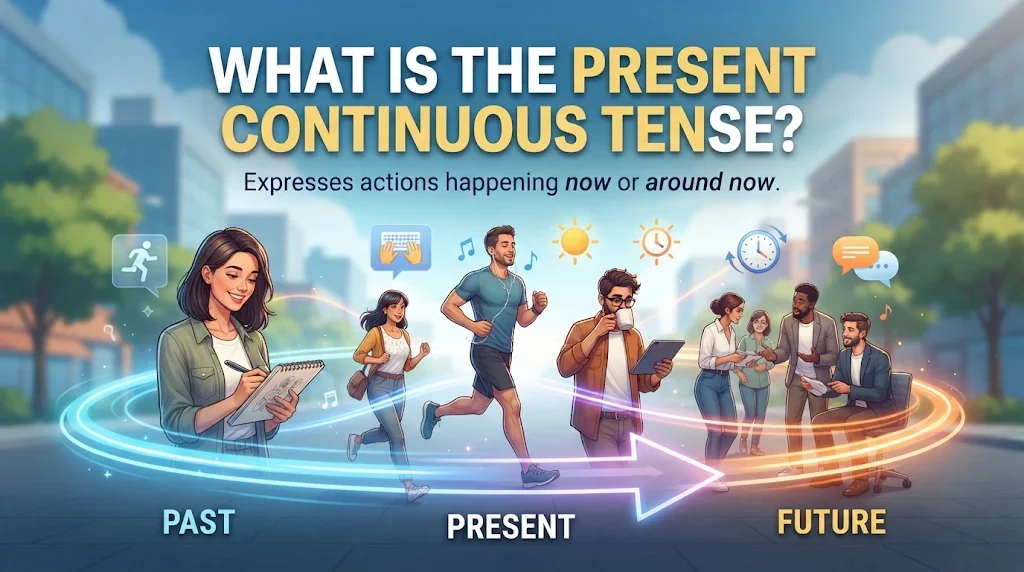
The present continuous tense is a grammatical tense used to describe actions and situations that are happening now or continuing around the present time. It can also express temporary activities, changing situations, and future arrangements.
It is formed by combining the appropriate form of the helping verb be (am, is, or are) with the main verb ending in -ing.
Examples:
- She is reading a book.
- They are playing football.
- I am learning English.
- He is working on a new project.
In these examples, the actions are happening now or are in progress.
Present Continuous Tense Structure
The present continuous tense has three main sentence structures:
- Affirmative sentences
- Negative sentences
- Interrogative sentences
Understanding these structures will help you form grammatically correct sentences.
1. Affirmative Sentences
Affirmative sentences express actions that are happening or continuing in the present.
Structure:
Subject + am/is/are + Verb-ing + Object.
| Subject | Helping Verb | Example |
| I | am | I am writing a letter. |
| He | is | He is watching television. |
| She | is | She is cooking dinner. |
| It | is | It is raining outside. |
| You | are | You are learning English. |
| We | are | We are studying together. |
| They | are | They are playing cricket. |
More examples:
- My mother is preparing breakfast.
- The children are playing in the garden.
- We are watching an interesting movie.
- The teacher is explaining the lesson.
- I am improving my writing skills.
2. Negative Sentences
Negative sentences describe actions that are not happening or are not in progress.
Structure:
Subject + am/is/are + not + Verb-ing + Object.
Examples:
- I am not watching television.
- She is not cooking dinner.
- He is not playing football.
- They are not studying English.
- We are not going to school today.
- You are not listening to me.
Negative contractions:
| Full Form | Short Form |
| Is not | Isn’t |
| Are not | Aren’t |
| Am not | Usually written as am not |
3. Interrogative Sentences
Interrogative sentences are used to ask questions about ongoing actions or situations.
Structure:
Am/Is/Are + Subject + Verb-ing + Object +?
Examples:
- Am I speaking correctly?
- Is she reading a book?
- Is he watching television?
- Are they playing cricket?
- Are you learning English?
- Are we going to the market?
WH-Question Structure:
WH-word + am/is/are + Subject + Verb-ing +?
Examples:
- What are you doing?
- Where is she going?
- Why are they laughing?
- When are you leaving?
- Who is talking outside?
Uses of the Present Continuous Tense
The present continuous tense has several important uses in everyday English. Let’s understand when and why we use it.
1. Actions Happening Right Now
Use the present continuous tense for actions happening at the exact moment of speaking.
Examples:
- She is talking on the phone.
- I am writing an article.
- The baby is sleeping.
- He is drinking a glass of water.
- They are watching a football match.
2. Temporary Actions and Situations
Use this tense to describe temporary activities or situations that are happening around the present time but may not be happening at this exact moment.
Examples:
- I am staying with my uncle this week.
- She is working at a different office this month.
- They are learning Spanish these days.
- He is preparing for his final examination.
- We are living in London temporarily.
3. Changing or Developing Situations
Use the present continuous tense to describe situations that are gradually changing or developing.
Examples:
- The weather is getting colder.
- Technology is changing rapidly.
- The population is increasing.
- Your English is improving.
- The world is becoming more digital.
4. Future Arrangements and Plans
The present continuous tense can express definite future arrangements, especially when the time or place has already been decided.
Examples:
- I am meeting my friend tomorrow.
- She is visiting her grandparents next weekend.
- We are traveling to London next Monday.
- They are attending a business meeting tonight.
- He is starting his new job next week.
5. Repeated Actions That Cause Annoyance
Use the present continuous tense with words such as always, constantly, and continually to express repeated behavior, often with irritation or criticism.
Examples:
- He is always interrupting me.
- She is constantly complaining about her work.
- You are always losing your keys.
- They are continually making noise.
- My brother is always borrowing my clothes.
Present Continuous Tense Spelling Rules
When adding -ing to a verb, some spelling changes are necessary. Understanding these rules will help you avoid common mistakes.
1. Add -ing to Most Verbs
For most verbs, simply add -ing to the base form.
| Verb | Verb + ing |
| Read | Reading |
| Play | Playing |
| Eat | Eating |
| Watch | Watching |
| Work | Working |
| Talk | Talking |
2. Remove the Final Silent E
When a verb ends in a silent -e, usually remove the -e before adding -ing.
| Verb | Verb + ing |
| Make | Making |
| Write | Writing |
| Dance | Dancing |
| Come | Coming |
| Take | Taking |
| Drive | Driving |
Examples:
- She is making a cake.
- I am writing an email.
Exception: Keep the final e in verbs such as seeing and agreeing.
3. Double the Final Consonant
For many short verbs ending in consonant-vowel-consonant (CVC), double the final consonant before adding -ing.
| Verb | Verb + ing |
| Run | Running |
| Sit | Sitting |
| Swim | Swimming |
| Stop | Stopping |
| Get | Getting |
| Begin | Beginning |
Examples:
- The boy is running fast.
- She is sitting on the chair.
4. Verbs Ending in -ie
Change -ie to -y before adding -ing.
| Verb | Verb + ing |
| Lie | Lying |
| Die | Dying |
| Tie | Tying |
Examples:
- The cat is lying on the sofa.
- The plant is dying.
5. Verbs Ending in -y
Keep the final y and simply add -ing.
| Verb | Verb + ing |
| Study | Studying |
| Cry | Crying |
| Enjoy | Enjoying |
| Carry | Carrying |
Verbs Not Normally Used in the Present Continuous Tense
Some English verbs describe states rather than actions. These are called stative verbs. They are not normally used in continuous tenses when they express their usual state-related meanings.
Common examples include:
| Category | Stative Verbs |
| Feelings | Love, hate, prefer, dislike |
| Thinking | Know, believe, understand, remember |
| Possession | Own, belong, possess |
| Senses | Hear, smell, taste, see |
| Other states | Seem, need, want, contain |
Incorrect: I am knowing the answer.
Correct: I know the answer.
Incorrect: She is owning a car.
Correct: She owns a car.
Incorrect: He is wanting some water.
Correct: He wants some water.
Important Exceptions
Some verbs can be used in both simple and continuous forms, depending on their meanings.
Examples:
- I think you are right. (Opinion)
- I am thinking about my future. (Mental activity)
- This soup tastes delicious. (Quality)
- The chef is tasting the soup. (Action)
- I have a new laptop. (Possession)
- I am having lunch. (Activity)
- She looks beautiful. (Appearance)
- She is looking at the picture. (Action)
Present Continuous Tense vs. Simple Present Tense
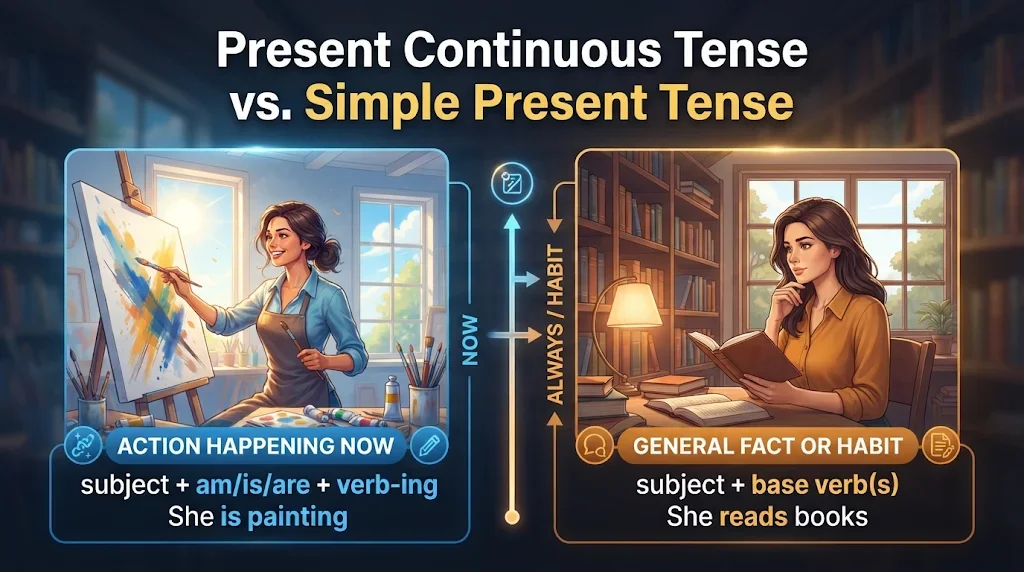
The present continuous and simple present tenses both describe present-time situations, but they serve different purposes.
| Simple Present Tense | Present Continuous Tense |
| Describes habits and routines | Describes ongoing actions |
| Expresses general truths | Expresses temporary situations |
| Uses the base verb or -s/-es | Uses am/is/are + verb-ing |
| She reads every day. | She is reading now. |
| They play cricket every Sunday. | They are playing cricket now. |
| He works in a bank. | He is working from home this week. |
Common Grammar Mistakes in the Present Continuous Tense
English learners often make mistakes when using helping verbs and adding -ing to main verbs. Here are 10 common mistakes and their corrections.
1. Missing the Helping Verb
❌ She reading a book.
✅ She is reading a book.
Explanation: Always use am, is, or are before the main verb ending in -ing.
2. Using the Wrong Helping Verb
❌ They is playing football.
✅ They are playing football.
Explanation: Use are with plural subjects such as they and we.
3. Incorrect Verb Form
❌ He is play cricket.
✅ He is playing cricket.
Explanation: The main verb must end in -ing.
4. Incorrect Negative Structure
❌ I am no studying.
✅ I am not studying.
Explanation: Use not after the helping verb to form a negative sentence.
5. Incorrect Question Structure
❌ You are watching television?
✅ Are you watching television?
Explanation: In standard yes/no questions, place the helping verb before the subject.
6. Using Continuous Forms With Stative Verbs
❌ I am understanding the lesson.
✅ I understand the lesson.
Explanation: Understand is normally a stative verb.
7. Incorrect Spelling of the -ing Form
❌ She is runing fast.
✅ She is running fast.
Explanation: Double the final consonant in run before adding -ing.
8. Using the Wrong Form of Be
❌ I is writing an email.
✅ I am writing an email.
Explanation: Always use am with the subject I.
9. Adding -ing After the Helping Verb Twice
❌ He is is working today.
✅ He is working today.
Explanation: Use only one appropriate helping verb before the main verb.
10. Using the Present Continuous for Regular Habits
❌ I am going to school every day.
✅ I go to school every day.
Explanation: Use the simple present tense for regular habits and routines. The first sentence can be correct in a different context, but it is not the normal choice for a regular routine.
20 Examples of Present Continuous Tense in Everyday Life
Here are 20 practical examples to help you understand how the present continuous tense works in different situations.
- I am learning a new language.
- She is preparing dinner for her family.
- They are playing basketball in the park.
- He is reading an interesting novel.
- We are planning our summer vacation.
- The students are completing their assignments.
- My father is driving to his office.
- The children are drawing beautiful pictures.
- It is raining heavily outside.
- I am waiting for my friend.
- She is talking to her manager.
- The company is launching a new product.
- We are discussing an important topic.
- He is repairing his bicycle.
- The teacher is checking the students’ homework.
- They are building a new house.
- My sister is learning how to cook.
- The dog is sleeping under the table.
- I am improving my English grammar.
- The employees are attending an online meeting.
Quick Rules of the Present Continuous Tense
Remember these essential rules when forming present continuous sentences:
- Use am with the subject I.
- Use is with he, she, it, and singular nouns.
- Use are with you, we, they, and plural nouns.
- Always add -ing to the main verb.
- Use not after am, is, or are to form negative sentences.
- Place am, is, or are before the subject when asking yes/no questions.
- Use this tense for ongoing actions and temporary situations.
- Use it for changing situations and definite future arrangements.
- Avoid continuous forms with stative verbs when they describe states.
- Follow the correct spelling rules when adding -ing.
Conclusion:
The present continuous tense is an essential part of English grammar because it helps describe ongoing actions, temporary situations, changing circumstances, and future arrangements. By understanding its affirmative, negative, and interrogative structures, you can form sentences more accurately. Remember to use am, is, or are with the verb ending in -ing and follow the correct spelling rules. Regular practice with everyday examples will help you master the present continuous tense and improve your overall English communication skills.
FAQs:
1. What is the present continuous tense?
The present continuous tense describes actions happening now, temporary situations, changing circumstances, and future arrangements. It is formed using am, is, or are + verb-ing.
Example: She is reading a book.
2. What is the formula of the present continuous tense?
The basic formula is:
Subject + am/is/are + Verb-ing + Object.
Example: They are playing football.
3. What are the three forms of the present continuous tense?
The three main forms are:
- Affirmative: She is writing a letter.
- Negative: She is not writing a letter.
- Interrogative: Is she writing a letter?
4. When do we use the present continuous tense?
We use it for actions happening right now, temporary situations, changing circumstances, future arrangements, and repeated actions that may express annoyance.
Example: I am studying for my examination.
5. What is the difference between the present continuous and simple present tense?
The simple present tense describes habits, routines, and general truths, whereas the present continuous tense describes ongoing actions and temporary situations.
Example:
- Simple present: He works every day.
- Present continuous: He is working right now.
6. Can we use the present continuous tense for the future?
Yes. We can use it for definite future arrangements, especially when plans have already been made.
Example: We are meeting our teacher tomorrow.
7. Which verbs cannot be used in the present continuous tense?
Stative verbs such as know, believe, understand, own, and prefer are not normally used in continuous forms when they describe states.
Example:
Incorrect: I am knowing him.
Correct: I know him.
