
If you have ever paused mid-sentence wondering whether to write “as evidenced by” or “as evident by,” you are not alone. This is one of the most common grammar mix-ups in academic writing, business reports, and formal emails. The good news is that the rule is simple once you understand the grammar behind it.
In this guide, I will break down the meaning, grammar, and correct usage of both phrases like a language teacher explaining it in class. By the end, you will never confuse them again.
Quick Answer: Which Is Correct?
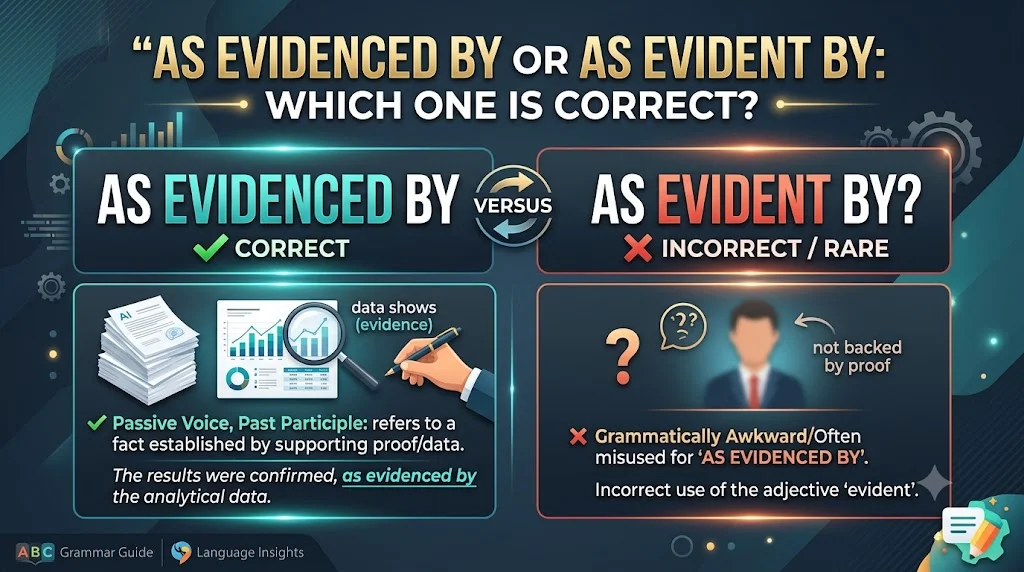
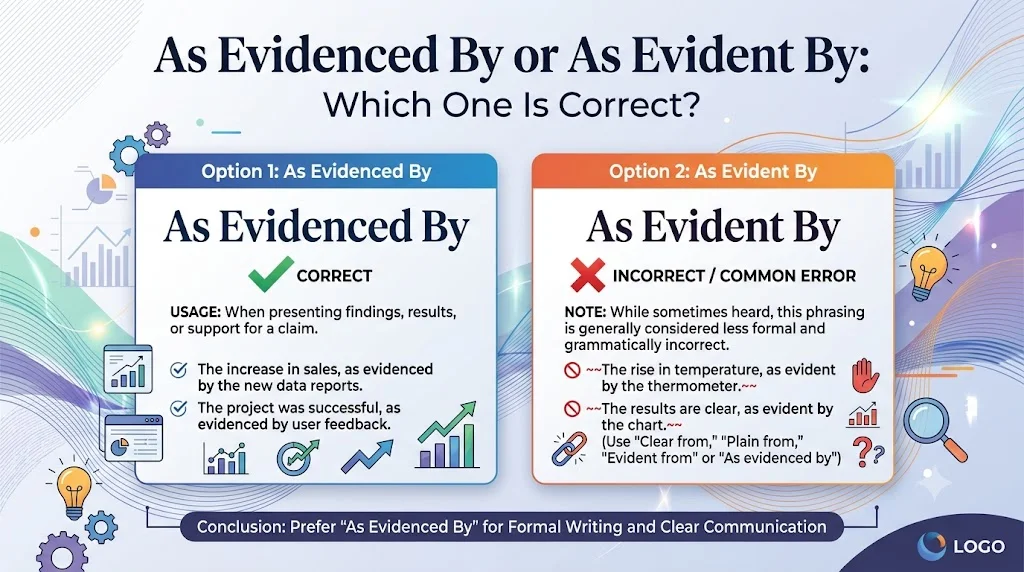
“As evidenced by” is the grammatically correct phrase. “As evident by” is a common but incorrect variation that many writers use by mistake.
The confusion happens because “evident” (an adjective) and “evidenced” (a verb form) sound similar and relate to the same idea — proof. However, the grammar structure of the sentence only works with “evidenced.” If you want to use “evident,” the correct preposition is “in,” not “by,” as in “as is evident in the data.”
So remember this short rule: use “evidenced by,” never “evident by.”
What Does “As Evidenced By” Mean?
“As evidenced by” means “as proven by” or “as shown by.” It introduces proof, data, or an example that supports a claim you just made.
Definition: A phrase used to show that a statement is supported by specific evidence, facts, or examples.
Word origin: The word “evidence” comes from the Latin word evidentia, meaning “clearness” or “obviousness.” Over time, English speakers turned the noun “evidence” into the verb “to evidence,” meaning “to show or prove something.” Adding “-ed” creates the past participle “evidenced,” which functions as an adjective describing something that has been proven.
Grammar breakdown:
- “As” = conjunction, meaning “in the way that”
- “Evidenced” = past participle of the verb “to evidence”
- “By” = preposition introducing the source of proof
Together, the phrase functions like a reduced passive clause. Think of it as a shorter way of saying “as it is evidenced by.”
Example:
The company’s growth is strong, as evidenced by its record-breaking sales this quarter.
Here, “as evidenced by” connects the claim (“the company’s growth is strong”) to the proof (“record-breaking sales”).
What Does “As Evident By” Mean?
“As evident by” is a phrase that many people use but that breaks a basic grammar rule. It tries to combine the adjective “evident” with the preposition “by,” but adjectives in English do not pair with “by” in this way.
Definition (intended meaning): Speakers who use this phrase usually mean “as is clear from” or “as shown by.”
Why it’s incorrect: “Evident” is an adjective, and adjectives that describe proof or clarity are followed by “in” or “from,” not “by.”
- ❌ As evident by the report
- ✅ As is evident in the report
- ✅ As evidenced by the report
Pronunciation note: “Evident” is pronounced EV-uh-duhnt, while “evidenced” is pronounced EV-uh-duhnst. The difference is subtle, which is part of why people confuse them in writing.
As Evidenced By vs As Evident By: The Key Difference
Let’s compare both phrases side by side so the difference becomes crystal clear.
| Feature | As Evidenced By | As Evident By |
| Grammatical correctness | ✅ Correct | ❌ Incorrect |
| Part of speech used | Verb (past participle) | Adjective |
| Correct preposition pairing | “by” | “in” or “from” (not “by”) |
| Common usage | Academic, business, formal writing | Informal speech, common mistake in writing |
| Recommended in Standard English | Yes | No |
Meaning
Both phrases attempt to say the same thing: something is proven or made clear by a piece of evidence. Only “as evidenced by” expresses this correctly.
Grammar
“Evidenced” is a verb form, so it naturally takes “by” to show who or what performed the action (similar to “caused by,” “written by,” or “supported by”). “Evident” is an adjective and does not take “by” in standard grammar.
Correct Usage
Use “as evidenced by” whenever you are introducing proof after a claim.
Customer satisfaction has improved, as evidenced by the latest survey results.
Common Confusion
Writers often confuse the two because both relate to “evidence” and both appear in formal writing. But mixing them up is one of the fastest ways to lose credibility in academic or professional writing.
Why Is “As Evidenced By” Grammatically Correct?
English allows past participles like “evidenced,” “supported,” “shown,” and “proven” to pair with “by” because this structure mirrors the passive voice.
Compare:
- The theory is supported by data.
- The theory, as supported by data, is widely accepted.
- The theory, as evidenced by data, is widely accepted.
Since “evidenced” behaves the same way “supported” does, it logically and grammatically pairs with “by.” This is called a reduced passive construction, and it is extremely common in formal English writing.
Why Do People Say “As Evident By”?
There are three main reasons this mistake happens so often:
- Sound similarity — “Evident” and “evidenced” look and sound alike.
- Overgeneralization — Many adjectives pair with “by” in English (like “surprised by” or “confused by”), so writers assume “evident by” follows the same pattern.
- Autocorrect and habit — Once people see or hear the phrase used incorrectly, they repeat it without checking the grammar rule.
This is a natural language mistake, not a sign of poor writing skills. Even experienced writers make it before learning the rule.
Is “As Evident By” Ever Correct?
Rare Cases
Strictly speaking, “as evident by” is not considered standard or grammatically correct in formal English. You may see it used informally in speech or casual writing, but it will not pass a grammar check or academic review.
Better Alternatives
If you want to use the adjective “evident,” change the preposition instead of the word:
- ✅ As is evident in the report
- ✅ As is evident from the results
- ✅ As evidenced by the report (best formal choice)
Quick Tip: If your sentence uses “evident,” pair it with “in” or “from.” If it uses “evidenced,” pair it with “by.”
Correct Examples of “As Evidenced By”
Academic Writing
The hypothesis was confirmed, as evidenced by the statistical analysis in Chapter 4.
Business Writing
Our marketing strategy is working, as evidenced by a 30% increase in engagement.
Everyday English
She’s clearly exhausted, as evidenced by the three cups of coffee she’s had this morning.
Formal Emails
Please note that the issue has been resolved, as evidenced by the successful test results attached.
Incorrect Examples and How to Fix Them
| Incorrect Sentence | Corrected Sentence |
| The project succeeded, as evident by the results. | The project succeeded, as evidenced by the results. |
| His skills improved, as evident by his portfolio. | His skills improved, as evidenced by his portfolio. |
| The city’s growth is clear, as evident by construction. | The city’s growth is clear, as evidenced by construction. |
Quick Tip: If you can replace the phrase with “as proven by” or “as shown by” and the sentence still makes sense, use “evidenced,” not “evident.”
Common Mistakes to Avoid
- ❌ Using “as evident by” in formal writing
- ❌ Mixing “evident” with “by” instead of “in” or “from”
- ❌ Forgetting the “-d” in “evidenced” (writing “as evidence by”)
- ❌ Overusing the phrase repeatedly in the same paragraph
- ❌ Using it at the start of a sentence without a supporting clause before it
Alternative Phrases You Can Use Instead
Variety keeps your writing engaging. Here are strong alternatives to “as evidenced by.”
As Demonstrated By
Used when showing proof through actions or experiments.
The theory holds true, as demonstrated by the experiment.
As Shown By
A more casual, versatile option for both spoken and written English.
Sales are rising, as shown by this month’s report.
As Indicated By
Best for statistics, surveys, or measurable data.
Customer trust is growing, as indicated by the survey data.
As Proven By
Used for strong, undeniable evidence.
The medicine is effective, as proven by clinical trials.
As Revealed By
Ideal for new or surprising findings.
The truth came out, as revealed by the investigation.
Synonyms list: as shown by, as demonstrated by, as proven by, as indicated by, as revealed by, as confirmed by, as supported by, as illustrated by.
As Evidenced By in American vs British English
The good news is that “as evidenced by” is standard in both American and British English. There is no regional difference in correctness.
| Region | Accepted Form | Notes |
| American English | As evidenced by | Common in academic and business writing |
| British English | As evidenced by | Equally accepted, same grammar rule applies |
The confusion between “evidenced” and “evident by” is a grammar issue, not a regional dialect issue.
Memory Trick to Remember the Correct Form
Here’s a simple trick I teach my students:
“Evidenced” ends in “-ed,” just like other action words that pair with “by”: caused by, written by, supported by, evidenced by.
If the word ends in “-ed” and describes an action that was done, it almost always pairs naturally with “by.”
Another trick: say the sentence out loud. “As evident by the report” sounds incomplete because your ear is missing the action. “As evidenced by the report” sounds complete because “evidenced” acts like a verb showing what happened.
Frequently Asked Questions
Is “as evidenced by” formal or informal?
“As evidenced by” is a formal phrase most commonly used in academic papers, business reports, legal writing, and professional emails. While it can appear in everyday speech, it carries a more polished and precise tone than casual alternatives like “you can tell by” or “it’s obvious from.”
Can I use “as evident by” in casual writing?
It’s best to avoid “as evident by” even in casual writing since it is grammatically incorrect. Instead, use “as evidenced by” for accuracy, or simplify with “you can see this from” or “this is clear from” in relaxed, conversational contexts.
What’s the difference between “evidenced” and “evident”?
“Evidenced” is a verb form meaning “proven or shown,” and it pairs with “by.” “Evident” is an adjective meaning “clear or obvious,” and it pairs with “in” or “from.” They share a root word but function differently in a sentence.
Is “as evidenced by” correct in academic writing?
Yes, “as evidenced by” is widely used and fully accepted in academic writing. It is especially common in research papers, theses, and reports where writers need to connect a claim directly to supporting data or findings in a formal tone.
Is “as evidenced by” used in American and British English?
Yes, “as evidenced by” is standard in both American and British English. There is no regional variation in its correctness, and it appears frequently in academic, legal, and business writing across English-speaking countries.
Final Thoughts
The rule is simple once you see it clearly: “as evidenced by” is correct, and “as evident by” is not. The mistake happens because “evident” and “evidenced” look alike, but they play different grammatical roles — one is an adjective, the other a verb form.
Whenever you want to introduce proof after a claim, reach for “as evidenced by,” or try alternatives like “as shown by” or “as demonstrated by” for variety. If you truly want to use “evident,” pair it with “in” or “from” instead of “by.”
Master this small rule, and your academic, business, and professional writing will instantly sound more precise and credible.