

If you have ever paused mid-sentence and wondered, “Wait, did I just say the opposite of what I meant?” — you are not alone. This exact confusion happens all the time with the phrase “I didn’t do nothing” versus “I didn’t do anything.”
As an English teacher, I hear this question constantly from students, professionals, and even native speakers who grew up hearing both forms. The short answer is that “I didn’t do anything” is the grammatically correct form in Standard English, while “I didn’t do nothing” is a double negative that is common in casual speech but avoided in writing, school, and professional settings.
But there is a lot more nuance here than a simple right-or-wrong answer. Let’s break it down the way I would in a real classroom — with clear explanations, real examples, and practical tips you can actually remember.
What Is the Difference Between “I Didn’t Do Nothing” and “I Didn’t Do Anything”?
Meaning: Both sentences are usually intended to communicate the same idea: “I am innocent. I performed no action.” But grammatically, they don’t say the same thing.
Definition:
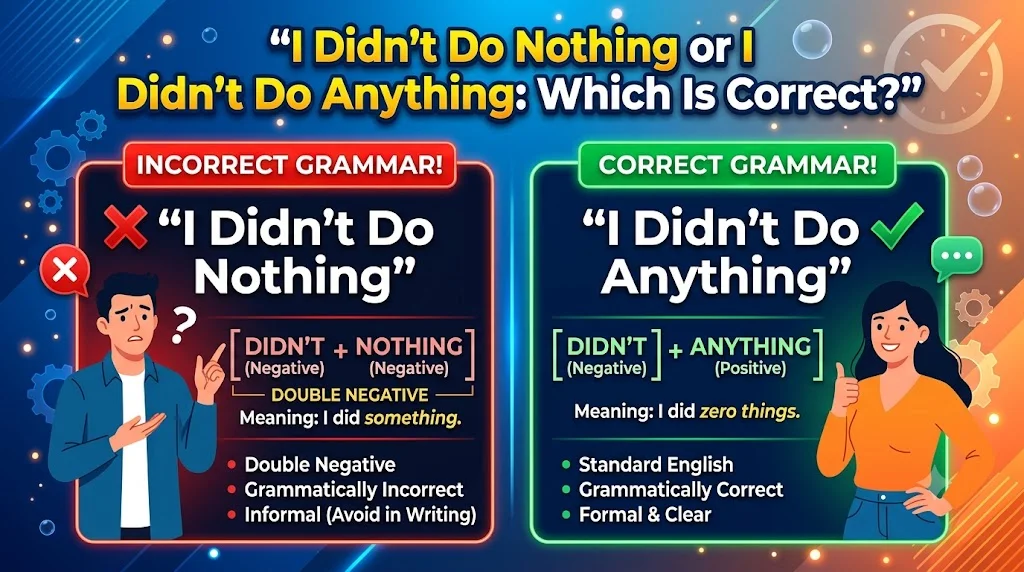
- “I didn’t do anything” = a single negative sentence. It correctly states that no action was taken.
- “I didn’t do nothing” = a double negative sentence. Grammatically, two negatives (didn’t + nothing) cancel each other out, which technically means “I did something.”
Grammar explanation: In Standard English, negation should appear only once per clause. “Didn’t” already carries the negative meaning, so pairing it with another negative word like “nothing” creates a logical contradiction, even though everyone understands the intended meaning in casual conversation.
Real-life example:
- Formal/written: “I didn’t do anything wrong during the meeting.”
- Casual/spoken: “I didn’t do nothing wrong, I swear!”
Quick Tip: If you already used a negative word like didn’t, isn’t, can’t, or won’t, pair it with a positive word like anything, anyone, or anywhere — not another negative word.
Why Is “I Didn’t Do Anything” Grammatically Correct?
Meaning: This sentence follows the standard rule of single negation in English.
Definition: A single negative sentence contains exactly one negation word, which clearly and logically expresses the negative meaning without contradiction.
Grammar explanation: The structure is:
Subject + didn’t (auxiliary + not) + verb + anything (indefinite pronoun)
“Anything” is a positive indefinite pronoun. It becomes negative in meaning only when paired with a negative auxiliary verb like “didn’t,” “isn’t,” or “can’t.” This is why “anything” works perfectly with “didn’t” — together they form one clear negative statement.
Pronunciation: /aɪ ˈdɪdənt duː ˈɛniːθɪŋ/ — said as one smooth phrase, with stress on “didn’t” and “any.”
Word origin: “Anything” comes from Old English ænig (any) + þing (thing), meaning “any object or matter.” It has functioned as an indefinite pronoun in English for over a thousand years.
Common mistakes: Learners sometimes say “I didn’t do something,” which is also incorrect in negative sentences. “Something” is used in affirmative sentences or offers, not negatives.
- ❌ I didn’t do something.
- ✅ I didn’t do anything.
Correct usage table:
| Sentence Type | Correct Word | Example |
| Negative | anything | I didn’t see anything. |
| Affirmative | something | I saw something. |
| Question | anything | Did you see anything? |
Formal vs. informal: “I didn’t do anything” is appropriate in both formal and informal English. It is the only version accepted in academic writing, business communication, and standardized tests like TOEFL, IELTS, and SAT.
Similar words: nothing, none, no one, nobody (all negative pronouns — but they should not be doubled up with “didn’t”).
Synonyms for “anything” in this context: a single thing, one thing, whatsoever.
Related phrases: “not at all,” “not in the slightest,” “nothing at all.”
Tips to remember: Think of it like math. One negative + one positive = negative result (correct). Two negatives = positive result (usually wrong, unless you intend it).
What Is a Double Negative?
Meaning: A double negative is a sentence that contains two negative words or negative forms within the same clause.
Definition: In formal grammar, a double negative technically cancels itself out, turning the sentence positive — even though the speaker usually means it negatively.
Grammar explanation: English, unlike some other languages (such as Spanish or Russian, where double negatives are required for emphasis), generally treats double negation as incorrect in Standard English because it creates logical ambiguity.
Word origin: The “rule” against double negatives in English was popularized in the 18th century by grammarians who modeled English grammar on Latin logic, where two negatives do create a positive.
How Double Negatives Change the Meaning of a Sentence
Let’s look at this logically, the way a grammar teacher would explain math to a student.
- “I didn’t do nothing” literally breaks down to: “I did NOT do NOTHING” → “I did do something.”
This is why, strictly speaking, “I didn’t do nothing” can be interpreted as an admission of guilt — the opposite of what most speakers intend.
Real-life example of confusion:
- Speaker’s intention: “I am innocent.”
- Literal grammatical meaning: “I am guilty (I did something).”
This mismatch is exactly why teachers, editors, and employers discourage double negatives in professional and academic English.
Common Double Negative Examples
| Double Negative (Incorrect) | Correct Version |
| I don’t know nothing. | I don’t know anything. |
| She didn’t go nowhere. | She didn’t go anywhere. |
| He doesn’t have no money. | He doesn’t have any money. |
| We didn’t see nobody. | We didn’t see anybody. |
| They didn’t want none. | They didn’t want any. |
Common mistakes: Even confident English speakers slip into double negatives because they hear them so often in music, movies, and casual conversation. That doesn’t make them correct in writing.
Quick Tip: Read your sentence aloud and count your negative words. If you count two, rewrite the sentence.
Breaking Down the Grammar: Didn’t, Do, Anything, and Nothing
Let’s examine each word individually, the way I would walk a student through a sentence diagram.
“Didn’t”
- Meaning: Contraction of “did not,” used to form the negative past tense.
- Grammar: Auxiliary verb “did” + “not,” contracted.
- Pronunciation: /ˈdɪdənt/
- Common mistake: Writing “did’nt” instead of “didn’t” — the apostrophe replaces the “o” in “not,” so it goes before the “t.”
“Do”
- Meaning: A base-form verb meaning to perform an action.
- Grammar: Here it functions as the main verb, following the auxiliary “didn’t.”
- Common mistake: Adding “-ed” — “didn’t did” is incorrect. After “didn’t,” the verb returns to its base form: “didn’t do,” not “didn’t did.”
“Anything”
- Meaning: An indefinite pronoun referring to any object, event, or action, with no specific one in mind.
- Grammar: Used in negative sentences, questions, and conditionals.
- Opposite word: “everything” (in affirmative context).
“Nothing”
- Meaning: A negative indefinite pronoun meaning “not anything” or “no thing.”
- Grammar: Already negative in meaning, so it should not be combined with another negative verb form like “didn’t.”
- Correct standalone usage: “I did nothing.” (This is correct because there is only ONE negative word — “nothing” — and no “didn’t.”)
Important distinction:
| Sentence | Correct? | Why |
| I did nothing. | ✅ Correct | Single negative (“nothing”) |
| I didn’t do anything. | ✅ Correct | Single negative (“didn’t”) |
| I didn’t do nothing. | ❌ Incorrect (Standard English) | Double negative |
This is one of the most useful grammar tricks in this entire article: “nothing” and “didn’t” are both negative words, so they should never be used together in Standard English.
Does “I Didn’t Do Nothing” Mean You Did Something?
Meaning: Technically, yes — under strict formal logic, “I didn’t do nothing” means “I did something.”
Grammar explanation: This is the classic double-negative paradox. Two negatives mathematically produce a positive, similar to how “-(-5) = 5” in math.
However, in real spoken English — especially in African American Vernacular English (AAVE), Southern American English, and various British dialects — double negatives function as negative concord, meaning they intensify the negative rather than cancel it. In these dialects, “I didn’t do nothing” clearly and unambiguously means “I did not do anything at all.”
Real-life example:
- A child says to a parent: “I didn’t do nothing!” — Everyone understands this means “I’m innocent,” not “I confess.”
Common mistake: Assuming double negatives are simply “bad English.” Linguists recognize negative concord as a consistent, rule-governed feature of certain dialects — not a random error. Still, it is not accepted in Standard English writing, academic papers, or formal speech.
Tip to remember: In casual conversation among people who share the same dialect, meaning is rarely lost. In writing and formal English, always default to the single-negative form to avoid ambiguity.
Standard English vs. Informal English
Definition: Standard English is the version of English taught in schools, used in publishing, business, and official communication. Informal English includes slang, regional dialects, and casual speech patterns.
| Feature | Standard English | Informal English |
| Negation | Single negative only | Double negatives allowed for emphasis |
| Example | I didn’t do anything. | I didn’t do nothing. |
| Where used | Essays, resumes, emails, exams | Conversations, song lyrics, texting |
| Perception | Neutral, professional | Casual, regional, emotional |
When “I Didn’t Do Anything” Should Be Used
- Job interviews and workplace emails
- Academic essays and research papers
- Standardized tests (TOEFL, IELTS, SAT, ACT)
- News writing and journalism
- Legal statements and official documents
- Formal conversations with teachers, employers, or officials
Example: “I didn’t do anything to cause the system failure,” the engineer explained to the review board.
Where “I Didn’t Do Nothing” Is Commonly Used
- Casual conversations among friends or family
- Song lyrics and poetry (for rhythm and emphasis)
- Regional and cultural dialects
- Emotional or dramatic speech, where the double negative adds intensity
- Movie and TV dialogue to reflect authentic character voice
Example: “I told you, I didn’t do nothing to that car!” (spoken with frustration, for emphasis)
Quick Tip: Match your grammar to your setting. Use “anything” in writing and professional speech; “nothing” (as a double negative) is a stylistic, dialectal choice in casual speech — not an error to be “corrected” in every context, but one to avoid if you’re being graded, evaluated, or judged on formal English skills.
Regional Dialects and Cultural Use of Double Negatives
Double negatives are not unique to English, and within English, they are far from random. Several dialects use them systematically:
- African American Vernacular English (AAVE): Uses negative concord as a grammatical rule — “I ain’t done nothing” is fully consistent within this dialect’s grammar system.
- Southern American English: Frequently uses double negatives for emphasis, such as “I don’t want none of that.”
- British regional dialects: Cockney and various working-class British dialects also use double negatives, as seen in older literature and film.
- Historical English: Interestingly, Old and Middle English (including Chaucer’s writing) regularly used multiple negatives for emphasis. The “one negative only” rule is a relatively modern convention, formalized in the 1700s.
Why this matters: Understanding this history helps explain why double negatives feel so natural to so many speakers — they are not “broken English,” but a different, historically rooted grammatical system. Still, for exams, job applications, and professional writing, Standard English rules apply.
Professional, Academic, and Everyday Usage
| Context | Recommended Form | Reason |
| Resume/Cover Letter | I didn’t do anything to violate policy. | Formal tone required |
| Classroom Essay | I didn’t do anything wrong in the experiment. | Graded on Standard English |
| Text to a Friend | I didn’t do nothing, chill out. | Casual tone, dialect-appropriate |
| Courtroom Testimony | I didn’t do anything illegal. | Legal precision matters |
| Song Lyrics | I didn’t do nothing to you. | Stylistic and rhythmic choice |
| Business Email | I didn’t do anything to change the settings. | Clarity and professionalism |
Common mistake: Using casual double negatives in professional emails or essays, which can make writing appear careless or unpolished to teachers, editors, and employers.
Tip to remember: When in doubt, write for your strictest reader — a teacher, editor, or hiring manager. If it would pass their review, it works everywhere.
Examples of Correct and Incorrect Usage
Correct Sentence Examples
- I didn’t do anything to upset her.
- He didn’t say anything during the meeting.
- We didn’t find anything unusual in the report.
- She didn’t eat anything before the exam.
- They didn’t do anything to fix the printer.
Incorrect Sentence Examples
- I didn’t do nothing wrong. (double negative — avoid in formal English)
- She didn’t say nothing about the plan. (double negative)
- We didn’t find nothing in the box. (double negative)
- He doesn’t want no help. (double negative)
- I didn’t see nobody at the door. (double negative)
Real-Life Conversation Examples
Formal workplace conversation:
Manager: “Did you make any changes to the file?” Employee: “No, I didn’t do anything to it. It’s exactly how you left it.”
Casual conversation between friends:
Friend 1: “Why is the room a mess?” Friend 2: “Don’t look at me, I didn’t do nothing!”
Both conversations are understandable, but only the first follows Standard English grammar rules.
Common Grammar Mistakes with Negative Sentences
Beyond “nothing” vs. “anything,” here are related mistakes I see often as a teacher:
- Mixing “no” and “not any”: “I have no money” is correct. “I don’t have no money” is a double negative.
- Using “barely,” “hardly,” or “scarcely” with another negative: “I didn’t hardly do anything” is incorrect — these words are already negative in function. Correct: “I hardly did anything.”
- Confusing “any” and “some” in negatives: “I don’t want some” should be “I don’t want any.”
- Double negatives with “neither/nor”: “I don’t like neither one” should be “I like neither one” or “I don’t like either one.”
- Overcorrecting into unnatural formality: Some learners swing too far and avoid all contractions, producing stiff sentences like “I did not do anything whatsoever at all,” which is grammatically fine but unnecessarily wordy.
Quick Tip: Words like hardly, barely, scarcely, never, no, none, nobody, nothing, nowhere, and neither all carry negative meaning. Never combine two of them in the same clause unless you intend a special emphatic, dialectal meaning.
Tips to Avoid Double Negative Mistakes
- Count your negatives: Before finalizing a sentence, count negative words. If there are two, revise.
- Read aloud: Double negatives often sound “off” when spoken slowly and clearly.
- Swap “no” words for “any” words: Replace nothing → anything, nobody → anybody, nowhere → anywhere, none → any.
- Practice with flashcards: Pair negative auxiliary verbs (didn’t, isn’t, can’t) with positive indefinite pronouns (anything, anyone, anywhere).
- Proofread formal writing twice: Once for content, once purely for grammar patterns like this one.
Easy Trick to Remember the Correct Form
Here’s the simplest memory trick I give my students:
“Didn’t” already means NO. Don’t say NO twice.”
Think of “didn’t” as a red stop sign. Once you’ve placed that stop sign in your sentence, you don’t need a second one. Just continue driving forward with a positive word like “anything,” “anyone,” or “anywhere.”
Memory sentence: “One negative gets the job done.”
Practice drill: Try converting these on your own before checking the answers below.
- She didn’t tell nobody about the surprise.
- I don’t have no time for this.
- We didn’t go nowhere last weekend.
Answers:
- She didn’t tell anybody about the surprise.
- I don’t have any time for this.
- We didn’t go anywhere last weekend.
Quick Comparison Table
| Feature | “I Didn’t Do Anything” | “I Didn’t Do Nothing” |
| Grammar type | Single negative | Double negative |
| Standard English | ✅ Correct | ❌ Incorrect (in formal use) |
| Formal writing | ✅ Recommended | ❌ Avoid |
| Casual speech | ✅ Acceptable | ✅ Common, dialect-based |
| Meaning (literal) | I performed no action | Technically “I did something” |
| Meaning (intended, spoken) | I performed no action | I performed no action (emphatic) |
| Used in exams/resumes | ✅ Yes | ❌ No |
| Common in song lyrics/AAVE | Less common | ✅ Very common |
Final Verdict: Which One Should You Use?
For writing, exams, job applications, professional emails, and any situation where you’re being evaluated on your English skills, always use “I didn’t do anything.” It is grammatically correct, universally understood, and appropriate in every register of English.
“I didn’t do nothing” is not “bad” English — it’s a feature of certain dialects and casual speech used for emphasis. But because it technically creates a double negative, it’s best reserved for informal conversation, creative writing, or dialogue that reflects a specific voice or character.
Simple rule to walk away with: When it counts, choose “anything.” When you’re just talking with friends, either one will get your point across.
Frequently Asked Questions
Is “I Didn’t Do Nothing” Ever Correct?
It’s not correct in Standard English grammar because it forms a double negative. However, it is considered grammatically valid within certain dialects, such as African American Vernacular English and various regional dialects, where it functions as negative concord for emphasis rather than contradiction.
Why Do Native English Speakers Say “I Didn’t Do Nothing”?
Many native speakers grow up in communities or regions where double negatives are a natural, rule-governed part of everyday speech. It’s a dialectal and cultural pattern, not a sign of poor education. Historically, English even used multiple negatives for emphasis before 18th-century grammarians standardized the single-negative rule.
Can Double Negatives Be Correct in English?
Yes, in specific dialects and for stylistic effect (like song lyrics or emphatic speech), double negatives are used intentionally and consistently. In Standard English grammar, though, they are generally considered incorrect because they can create logical confusion about the sentence’s true meaning.
Is “I Didn’t Do Anything” Formal English?
Yes, “I didn’t do anything” is fully appropriate in both formal and informal English. It’s the standard, grammatically correct form used in academic writing, business communication, exams, and professional speech, making it the safest choice in any context.
What Is the Difference Between Nothing and Anything?
“Nothing” is a negative indefinite pronoun meaning “not anything,” so it already carries negative meaning on its own. “Anything” is a neutral indefinite pronoun that becomes negative only when paired with a negative verb like “didn’t.” Never use both together in one clause.
Final Thoughts
“I didn’t do anything” is the grammatically correct choice for Standard English, and it’s the safe, professional option for writing, exams, and formal speech. “I didn’t do nothing” is a double negative — technically contradictory, but widely used and understood in casual conversation and certain dialects, where it adds emphasis rather than confusion.
The real skill isn’t memorizing a rule; it’s knowing which form fits your audience and setting. Use “anything” when clarity and professionalism matter, and don’t feel embarrassed if you slip into “nothing” with friends — just recognize the difference, and you’ll always communicate exactly what you intend.